
The day's AI news, briefed
The Daily Prompt
Our AI editor reads each day's AI and robotics stories, pulls out why they matter, and links every original source — so you can keep up in minutes.
Join over 250,000 subscribers getting the latest AI news
Latest AI & Robotics News Today

OpenAI Releases LifeSciBench, a 750-Task Benchmark Grading AI Models on Real Life-Science Research With Expert-Written Rubric
LifeSciBench aims to enhance the evaluation of AI models in the life sciences, improving their effectiveness in real-life research applications.
- OpenAI has released LifeSciBench, a benchmark consisting of 750 tasks for assessing AI models.
- The benchmark uses an expert-written rubric to grade AI performance in real-life scientific research.
OpenAI is a research organization focusing on advancing artificial intelligence. LifeSciBench builds on existing benchmarks to provide a more specialized assessment tool for life science applications. The introduction of this benchmark reflects ongoing efforts in the AI community to ensure models are effective in practical scenarios.
Based on the headline only — the full article could not be fetched.
Read the original ↗
How to turn off AI in your Google Docs
Understanding how to manage AI features in productivity tools like Google Docs is essential for enhancing user experience and reducing distractions during work.
- Users can disable AI pop-ups in Google Docs by selecting 'Gemini' on the menu and changing 'bottom bar preferences' to turn off the feature.
- Google Workspace users can also turn off all smart features through Gmail settings by navigating to 'Manage Workspace smart feature settings.'
- Disabling AI features helps users maintain focus and improve their writing process without interruptions from AI suggestions.
Google Docs is a widely used word processing application that integrates AI features to assist users while they work. Recent updates introduced functions like 'Gemini,' prompting some users to seek options to minimize unwanted interruptions. Users should monitor ongoing developments in AI integration within productivity tools to optimize their use.
Read the original ↗
NVIDIA SkillSpector Guide: Scanning AI Skills for Security Risks with Static Analysis and SARIF Reports
This story highlights NVIDIA's efforts to enhance security in AI skills, which is crucial as AI applications continue to proliferate, raising potential security concerns.
- NVIDIA has introduced a guide for SkillSpector, which scans AI skills for security risks.
- The scanning process employs static analysis and generates SARIF reports, a standard format for sharing analysis information.
NVIDIA is a leading technology company known for its contributions to AI and graphics processing. The SkillSpector tool is part of the broader initiative to ensure safe and secure deployments of AI technologies. Observers will look at how this tool impacts AI skill development and security practices.
Based on the headline only — the full article could not be fetched.
Read the original ↗
The Korean Telecom Giant at the Center of Anthropic’s Mythos Controversy
The US government's decision to revoke SK Telecom's access to Anthropic's AI technology raises significant national security concerns and highlights the complexities of international tech collaborations amid geopolitical tensions.
- The White House ordered Anthropic to revoke SK Telecom's access to its Claude Mythos AI model, citing alleged ties to China.
- Concerns arose following Amazon's identification of vulnerabilities in a version of Mythos, prompting questions about Anthropic's ability to safeguard technology.
- SK Telecom had previously become one of 150 companies permitted to access Mythos through a program called Project Glasswing, which involved collaboration with US experts and the government.
Anthropic is an AI research company known for developing advanced models like Claude Mythos. The Trump administration's export control measures aim to mitigate potential security risks associated with foreign access to US AI technologies. Observers are watching developments regarding the reinstatement of access and ongoing negotiations with the US government.
Read the original ↗
Epic Games details how it's embracing generative AI in Unreal Engine
The integration of generative AI into Unreal Engine signals a major shift in game development practices, potentially reshaping workflows and creative processes in the gaming industry.
- Epic Games detailed its plans to incorporate generative AI into Unreal Engine 6 and new features in Unreal Engine 5.8 during a keynote at Unreal Fest.
- The new Model Context Protocol (MCP) plugin allows developers to connect generative AI models such as Claude and Gemini to Unreal Engine.
- Generative AI is expected to reduce tedious content creation tasks, allowing teams to focus on creative development and increase iteration efficiency.
- Unreal Engine 6 is set to merge Unreal Engine 5 and Unreal Engine for Fortnite into a single platform, aiming for early access in late 2027.
- Some game developers express concerns about generative AI's impact on the industry, with more than half perceiving it negatively according to a recent report.
Unreal Engine is a popular game development platform used for creating video games, and Epic Games is evolving its capabilities with the inclusion of generative AI. Previous reports indicated a growing use and apprehension around generative AI among game developers, highlighting a divide in opinion. The upcoming Unreal Engine 6 aims to integrate AI technologies more deeply into game development workflows.
Read the original ↗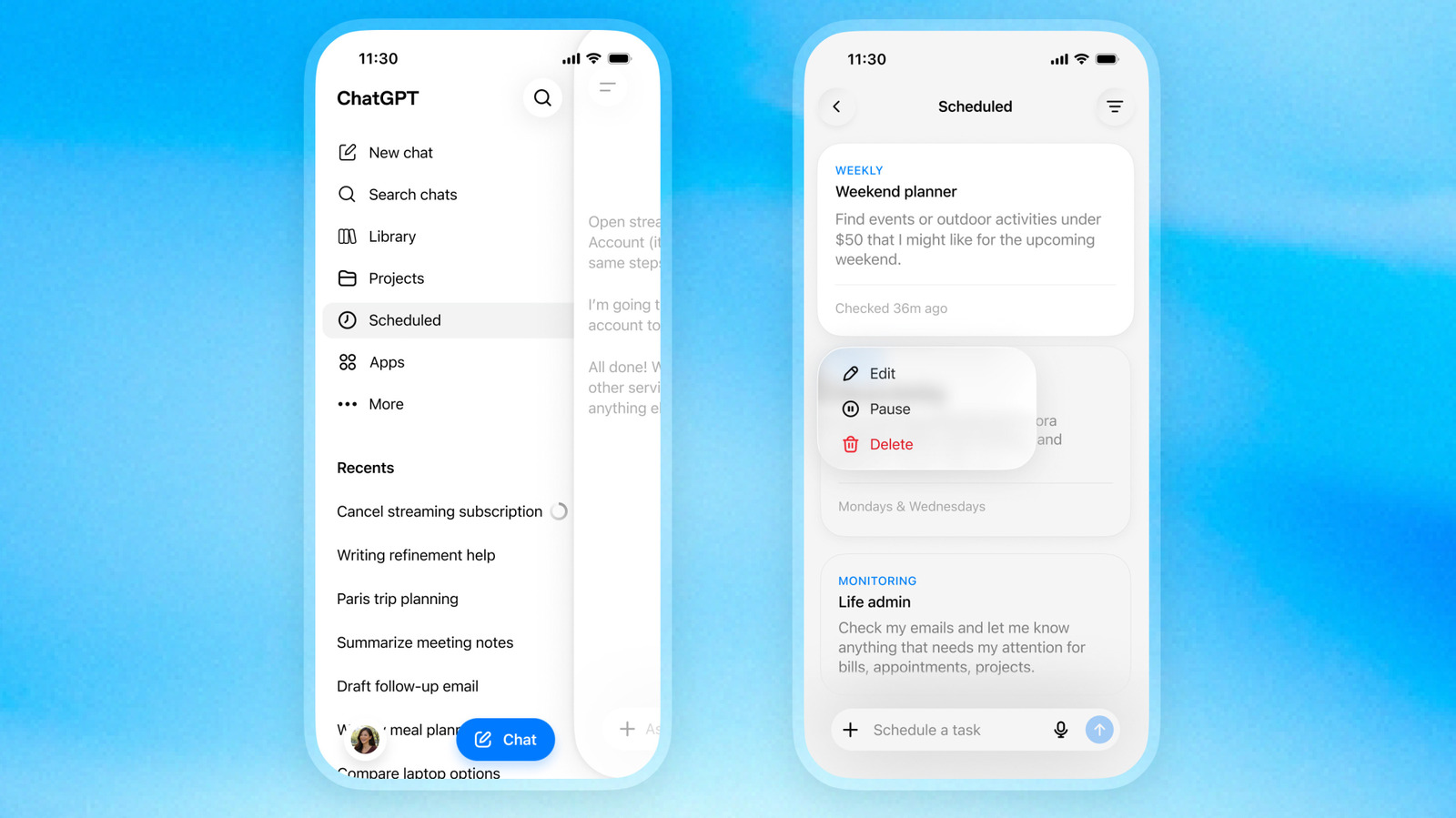
ChatGPT now has a hub for scheduled tasks
This update enhances ChatGPT's functionality, allowing users to efficiently automate tasks and manage their schedules, which can significantly improve productivity and user experience.
- OpenAI has rolled out a new update for ChatGPT that allows users to schedule tasks.
- Users can access a new Scheduled page in the ChatGPT sidebar to manage active tasks, including editing and deleting them.
- Scheduled tasks in ChatGPT are now more robust, and users can set tasks for specific times or broader timeframes.
- The update is available to Plus, Pro, Business, and Enterprise users on both web and mobile platforms.
- OpenAI is discontinuing the Pulse feature, which provided personalized daily summaries for users.
ChatGPT is an AI chatbot developed by OpenAI that can perform various tasks based on user prompts. Previously, it did not prominently feature scheduling capabilities, which are now being highlighted with this update. Users can expect increased reliability with scheduled prompts and the discontinuation of the Pulse feature in favor of the new scheduling hub.
Read the original ↗
No, I Don’t Want to Watch Your Straight Hockey Show
The streaming industry is increasingly favoring straight-themed hockey romances, overlooking the success of queer narratives, which reflect a significant audience demand for diverse storytelling.
- Streaming shows Off Campus and Icebreaker feature heterosexual hockey romances, diverging from the successful LGBTQ series Heated Rivalry.
- Heated Rivalry was recognized for its LGBTQ representation and gained a large following, including straight female viewers.
- Despite criticism, Off Campus has reportedly drawn 36 million viewers in its first 12 days on Prime Video.
Heated Rivalry is a popular series centered on a secret gay relationship in a hockey setting. The trend of adapting sports romances continues with the release of straight-themed series which may overlook audience preferences for diverse narratives. The success of LGBTQ stories suggests a demand for more inclusive representation in entertainment.
Read the original ↗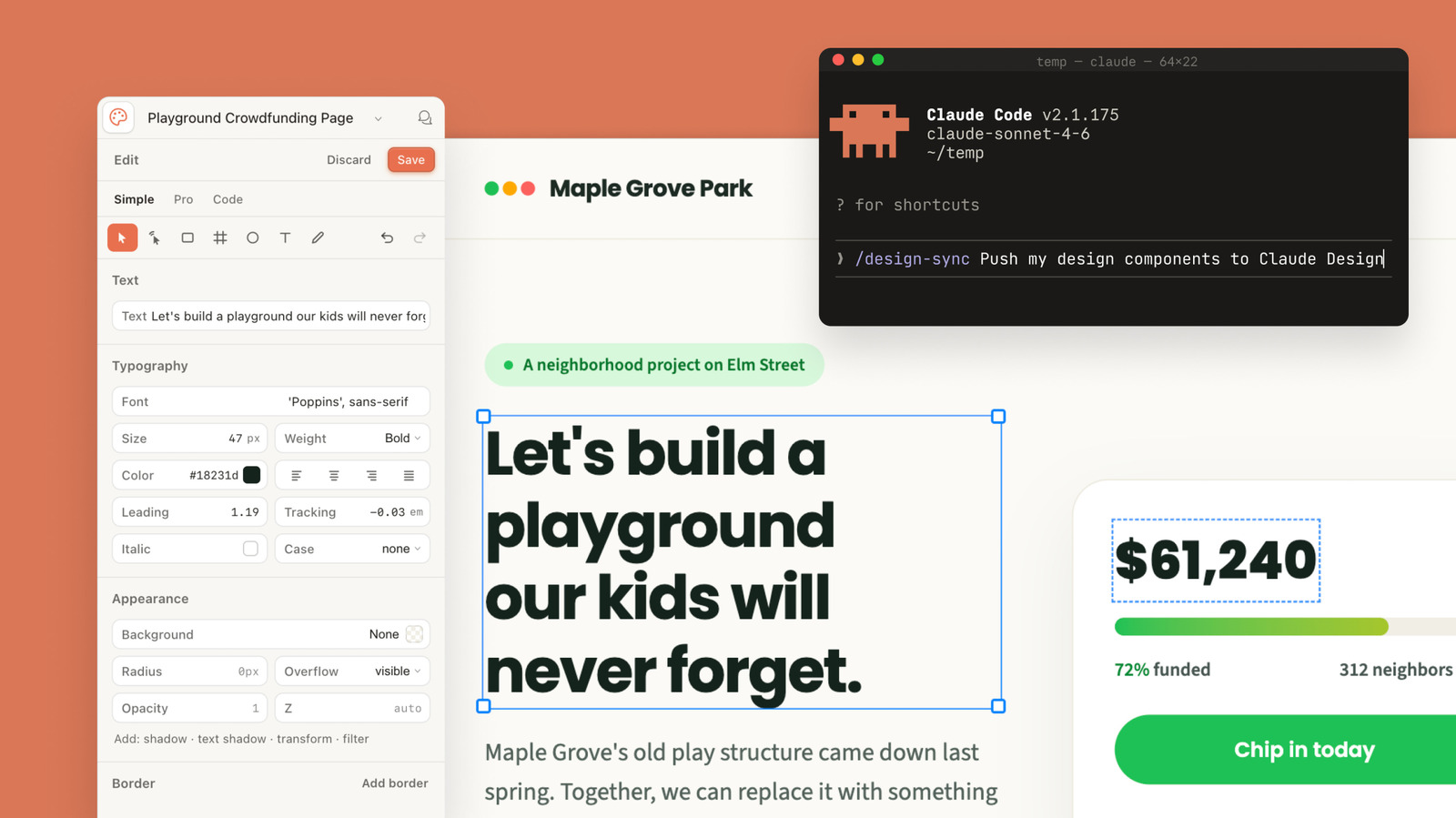
Anthropic's design assistant now works better with its coding agent
The update enhances the functionality of Anthropic's AI tools, streamlining workflows for users and potentially increasing productivity in design and coding tasks.
- Anthropic has released a major update for its design assistant, Claude Design, improving integration with its coding agent, Claude Code.
- Claude Design can now work from a local codebase, allowing the use of existing assets in generated designs.
- Users can create and edit designs directly from Claude Code by typing /design in their terminal.
- The update also includes a more flexible import tool and refined image editor for better design control.
- Anthropic has reported that over a million users engaged with Claude Design in its first week of availability.
Anthropic is an AI research company known for developing advanced AI applications. Previously, it launched Claude Design to assist with design tasks. The company is enhancing its tools' interoperability, which is something to monitor for future improvements and user engagement.
Read the original ↗
Anthropic becomes first AI startup to join the Frontier carbon removal coalition
Anthropic's entry into the Frontier coalition highlights the emerging commitment of AI companies to address climate change through significant funding for carbon removal projects.
- Anthropic has joined the Frontier carbon removal coalition as the first AI startup, contributing to a new $915 million funding round.
- This new round nearly doubles Frontier's total pledges to $1.8 billion, allowing it to contract nearly $700 million across more than 50 carbon removal projects.
- Frontier aims to enhance its position in the carbon removal industry by focusing on larger, more impactful projects, requiring companies to show paths to government support for new contracts.
Frontier is a coalition founded by tech companies to support carbon removal efforts, addressing challenges in reducing carbon emissions. Anthropic's involvement marks a shift towards greater sustainability commitments among AI firms, reflecting broader industry trends towards clean energy and environmental responsibility.
Read the original ↗
World leaders want American AI. They just don’t want America to be able to turn it off.
Concerns over access to American AI raise questions about economic security and reliance on U.S. technology, prompting discussions on alternative partnerships among G7 nations.
- World leaders, including French President Emmanuel Macron and Indian Prime Minister Narendra Modi, expressed concerns at the G7 Summit about potential U.S. restrictions on access to American AI models.
- Macron warned that if the U.S. could block access to AI overnight, it would harm European customers and damage AI firms.
- The Trump administration recently blocked Anthropic from exporting its AI models over national security issues, raising alarms internationally about digital sovereignty.
- G7 leaders discussed creating a 'trusted partners' scheme for non-U.S. nations to maintain access to advanced AI models and strengthen defenses against rivals like China.
- The ongoing situation highlights the growing push for AI sovereignty in Europe and other non-U.S. countries, as they seek alternatives to American AI dominance.
The article reflects growing unease among global leaders about the U.S. control over advanced AI technologies, particularly following a recent export ban on Anthropic's models. As nations navigate their dependence on U.S. AI, the conversation around creating cooperative frameworks continues, signaling a potential shift in international AI dynamics.
Read the original ↗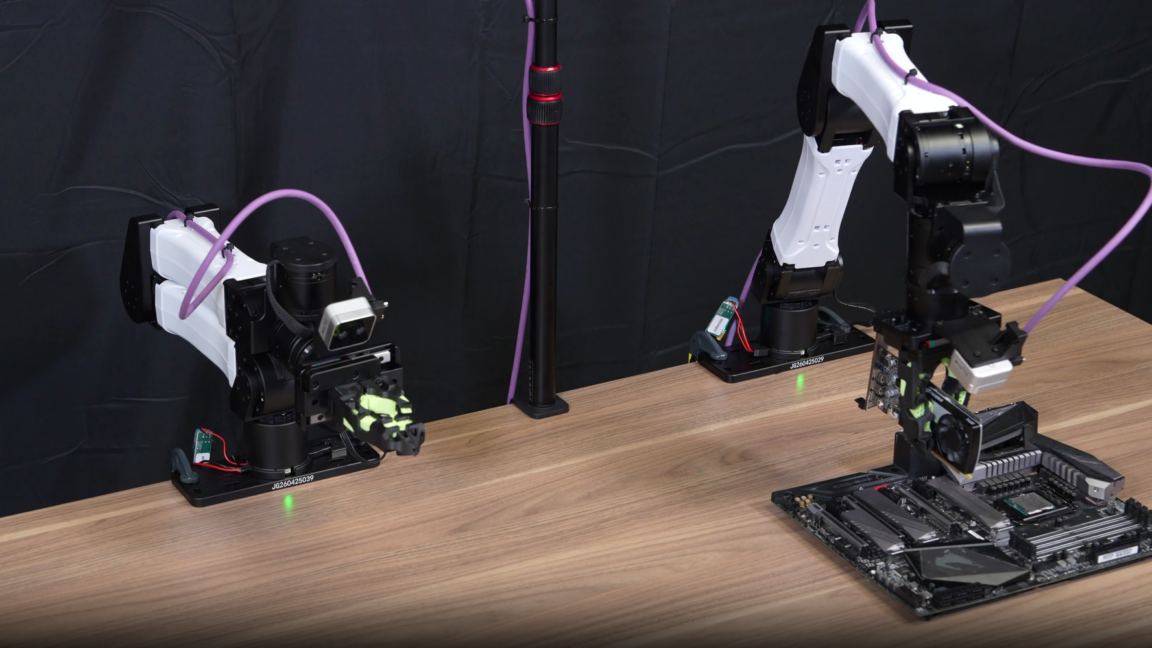
AI coding agents taught robots how to install GPUs and cut zip-ties
This development highlights the potential for AI to streamline and enhance robotics training, which could significantly improve efficiency and capabilities in automation tasks.
- AI coding agents can autonomously train robots to perform tasks such as cutting zip ties and installing GPUs using a new software framework called ENPIRE.
- The ENPIRE framework integrates modules for task verification, policy refinement, and failure analysis, allowing robots to achieve up to a 99 percent success rate in specific tasks.
- Larger teams of AI coding agents showed faster training success, but also faced challenges such as inefficient resource usage and increased operational costs.
- The framework was tested with various AI coding agents, including OpenAI's Codex and Anthropic's Claude Code, each developing unique training approaches.
Nvidia's robotics initiatives include the development of autonomous training methods for robots using AI coding agents. This follows a trend in robotics where AI is increasingly used to optimize and automate processes. Future advancements could simplify robot training for broader applications across industries.
Read the original ↗
Vercel Releases Eve: An Open-Source AI Agent Framework Where Each Agent is a Directory of Files Mapped to Capabilities
The launch of Vercel's Eve framework introduces a new approach to building AI agents, emphasizing open-source accessibility and modularity in AI capabilities.
- Vercel has released Eve, an open-source AI agent framework.
- Each AI agent in Eve is represented as a directory of files mapped to specific capabilities.
Vercel is known for its development platform that simplifies web development. The release of Eve marks a significant advancement in how developers can create and customize AI agents. As open-source technologies continue to grow, projects like Eve allow for greater collaboration in AI development.
Based on the headline only — the full article could not be fetched.
Read the original ↗
NASA Just Tested a Secretive Experimental Aircraft in a “Major Milestone” for Supersonic Flight
This achievement in supersonic flight technology could pave the way for commercial air travel that significantly reduces noise pollution associated with conventional sonic booms.
- NASA's X-59 aircraft achieved speeds of 1.4 Mach, approximately 924 miles per hour, during recent test flights.
- The aircraft reached an altitude of 55,000 feet, meeting critical conditions for future quiet supersonic flight.
- NASA plans to conduct community overflights to assess public perception of the X-59's quieter sonic thump at supersonic speeds.
The X-59 is part of NASA's Quesst mission, aiming to develop supersonic flight capabilities without traditional sonic booms. Previous tests had only reached speeds of Mach 1.1, representing significant progress. The upcoming tests focus on measuring the aircraft's acoustic signatures and expanding its operational parameters.
Read the original ↗
The White House Wants Anthropic to Block All Jailbreaks. That May Not Be Possible
The government's insistence that Anthropic block all jailbreaking of its AI could shape future regulations on AI safety and pose challenges for the company’s technology development.
- The Trump administration is demanding that Anthropic ensure its AI model, Claude Fable 5, is free from vulnerabilities that allow jailbreaks—methods to bypass safeguards.
- While the administration insists on fixes, Anthropic argues that concerns about jailbreaks are overstated and suggested that potential impacts remain minimal.
- Independent experts claim that guardrails on AI models serve only as temporary solutions and assert that jailbreaking will continue to be feasible for skilled users.
Anthropic is a prominent AI company known for developing advanced models like Claude. The current focus on jailbreaking follows recent government interventions and highlights ongoing challenges in AI safety and security. Continued scrutiny in this area may lead to stricter AI regulations and compliance requirements.
Read the original ↗
Only 16 percent of Americans think AI will have a positive impact on society, a new study shows
The significant skepticism among Americans regarding AI's societal impact reflects broader concerns that could influence future regulations and the development of technology in the U.S.
- Only 16% of Americans believe AI will positively impact society in the next 20 years, according to Pew Research.
- Approximately 40% of respondents anticipate a negative impact from AI, while 67% do not expect meaningful government regulation.
- Nearly two-thirds of Americans feel that the development of AI is occurring too quickly, indicating a demand for cautious advancement.
- About 25% of Americans use AI chatbots daily, with ChatGPT being the most popular at 44%.
- Younger individuals under 30 have the most pessimistic views on AI, with only 14% anticipating beneficial effects.
AI technology is becoming increasingly integrated into daily life and economic activities. Previous studies have shown mixed views on AI’s benefits and governance, with rising calls for regulation. Monitoring public sentiment will be crucial for shaping future AI policy.
Read the original ↗
Ten months later, the $100 Google Home Speaker is finally available for preorder
The release of the Google Home Speaker highlights the competition in the smart home market as companies innovate to enhance user interaction and sound quality.
- Google's new Home Speaker is available for preorder at $100 and officially launches on June 25.
- This is Google's first new smart home speaker in almost six years; the last was the Nest Audio in September 2020.
- The speaker features 360-degree sound, a light ring for audio cues, and three far-field microphones for improved voice recognition.
- It has a quad-core processor and uses local AI for enhanced noise filtering, but audio quality is reportedly lower than the Nest Audio.
- Purchasing the speaker includes six months of Google Home Premium, enhancing features and enabling interaction with Google's AI, Gemini.
The Google Home Speaker is part of the smart home audio device market, where companies are increasingly integrating AI capabilities. Prior to this model, Google launched the Nest Audio, and competition remains strong with ongoing innovations in sound technology and interaction methods. Observers will be watching how this speaker performs against rivals as its launch approaches.
Read the original ↗
How Musicians Can Get Paid for Training AI
Establishing fair compensation for musicians in the age of AI is crucial to sustaining creativity and ensuring that artists benefit from their work amid growing technological challenges.
- Musicians traditionally receive payments for various usage of their works, but generative AI complicates this by blurring the lines of how creative input is used.
- Startups like Sureel and SoundVerse are developing systems to ensure artists are compensated when their music is used to train AI tools.
- Sureel's software tracks how media is used in AI training and sets licensing fees to compensate music creators appropriately.
- SoundVerse advocates for ongoing artist royalties that reflect the differential influence of training data on AI outputs.
- Current industry momentum includes private agreements between major music companies and AI firms, gradually shifting from lawsuits to negotiated deals.
The growing use of generative AI in music raises concerns about copyright and compensation for artists. Companies like Sureel are exploring ways to ensure creators are paid for their contributions. As the industry evolves, discussions around effective attribution and fair compensation are increasingly important.
Read the original ↗
Pramaana Labs raises $27M seed round from Khosla Ventures to bring formal verification to AI
Pramaana Labs' funding is significant as it targets the crucial sectors of law, drug discovery, and tax preparation where accuracy is vital and mistakes can have severe consequences.
- Pramaana Labs has raised $27 million in seed funding, led by Khosla Ventures with participation from other investors.
- The startup aims to use formal verification techniques to enhance AI reliability in sensitive fields such as law and drug discovery.
- Pramaana's approach combines a conventional language model with a deterministic verification layer to address AI errors and hallucinations.
Pramaana Labs focuses on formalizing rules within critical sectors using advanced verification methods to ensure AI reliability. Previously, businesses struggled with integrating AI into core operations due to reliability concerns, highlighting the need for such solutions.
Read the original ↗
Collecting robot training data is dirty, unglamorous work. Some AI labs are already paying XDOF to do it.
The development of advanced robotics hinges on the availability of high-quality training data, highlighting XDOF's emergence as a key player in addressing this industry gap.
- XDOF is a startup focused on creating training data pipelines for robotics, a crucial need as the AI industry aims to enhance physical interaction capabilities.
- The company has raised $70 million and is already working with 20 clients, including several top AI labs.
- XDOF aims to release a substantial dataset, the ABC collection, which includes 130,000 robot manipulation trajectories and 400 hours of evaluation data.
- The startup's founders identified a critical gap in the availability of large-scale robot training data during their time at UC Berkeley.
- XDOF plans to employ teleoperators globally to gather high-quality data necessary for training advanced robotic systems.
XDOF was founded in October 2024 to provide solutions for collecting and annotating training data for robotics. Unlike language models that utilize text data, effective robotic performance requires specific physical interaction data. The startup's initial collaboration with UC Berkeley aims to release a vast dataset necessary for advancing robotic capabilities.
Read the original ↗
#504 America blocked its best AI. China just raised $7.4 billion.
The U.S. export controls on Anthropic's AI models are inadvertently benefiting competitors, particularly in China, by driving investments and causing significant price reductions in AI technologies.
- The U.S. government restricted foreign access to Anthropic's AI models, which has led to increased interest in alternative AI solutions, especially from companies outside the U.S. and China.
- DeepSeek raised $7.4 billion in funding at a valuation exceeding $50 billion, marking a significant increase since its last valuation in April.
- Chinese labs, including ByteDance and Tencent, have slashed token prices by up to 99% in response to U.S. export restrictions, making their models more attractive to buyers.
- Anthropic's U.S. enterprise AI spending share has risen to 41%, surpassing OpenAI's 39.5% as it becomes less competitive internationally.
- Cohere reports an influx of inquiries from clients outside the U.S. and China for AI solutions that aren't subject to U.S. control.
Anthropic is a leading AI company that developed advanced models now restricted for foreign use by the U.S. government. The initial export controls aimed to maintain U.S. dominance in AI but are leading to increased investment and competition from Chinese firms. Future developments to watch include potential shifts in global AI market dynamics and responses from U.S. allies.
Read the original ↗