
The day's AI news, briefed
The Daily Prompt
Our AI editor reads each day's AI and robotics stories, pulls out why they matter, and links every original source — so you can keep up in minutes.
Join over 250,000 subscribers getting the latest AI news
Latest AI & Robotics News Today

Inside a Martian Meteorite, These Grains of an Unexpected Gemstone Hold Clues to a Hidden Past
The discovery of garnet in a Martian meteorite offers new insights into Mars' geological history and processes, potentially reshaping our understanding of the planet's ancient conditions.
- A Martian meteorite fragment contains grains of garnet, a mineral never before observed in Martian rock samples.
- Discovering garnet could illuminate Mars' geological history, including its extreme past conditions over 4.5 billion years.
- The garnet was discovered in a rare meteorite sample known as NWA 8171, held at the Royal Ontario Museum.
This finding is significant, as garnet is commonly found on Earth and its presence on Mars may indicate past geological processes, such as meteorite impacts or magma activities. The research team includes international scientists analyzing the garnet's chemistry and mineralogy to understand its origins and implications for Martian history.
Read the original ↗
The CEO of Allbirds’ new AI biz has a plan, but no employees
The pivot from footwear to AI infrastructure by Allbirds' new CEO highlights the rapidly shifting priorities in tech and the potential for new business models in AI.
- Allbirds has transitioned to an AI-focused company named Smartbird after selling its shoe business for $43 million and raising $100 million from the stock market.
- Nadia Carlsten, a former AWS executive, is the CEO of Smartbird and plans to build a new team and establish an office.
- Smartbird aims to provide managed AI infrastructure, focusing on customers that value data sovereignty and control over their servers.
Allbirds, known for its sustainable footwear, has recently shifted its focus to AI infrastructure in response to market demand. The company previously operated as a public benefit corporation, advocating sustainability, but has since abandoned that status to pursue this new direction.
Read the original ↗
ImageWAM: Do World Action Models Really Need Video Generation, or Just Image Editing?
This research suggests that using image editing models instead of video generation in robot control can improve efficiency and performance while lowering computational costs.
- ImageWAM replaces video generation in world action models by using pretrained image editing models for robot control.
- The new framework shows better performance and less computation, reducing FLOPs to one-sixth and latency to one-fourth compared to video-based models.
- Video-based world action models face limitations such as high inference costs and potential errors in predicting long-term actions.
World Action Models (WAMs) connect visual world modeling to robot control, traditionally relying on video generation. This study proposes that image editing can enhance efficiency and outcome for robot action prediction.
Read the original ↗
The AI Enablement Journey and The Era Ahead
Understanding the phases of AI enablement is crucial for businesses to effectively adapt their workforce and embrace technological advancements ahead.
- The article discusses the AI enablement journey and its phases.
- It highlights the impact of AI on workforce transformation in the coming era.
AI enablement refers to the process of integrating artificial intelligence into business operations and workforce practices. As AI technology evolves, organizations are increasingly focusing on how to leverage it for enhanced productivity and efficiency. Observers should consider how these transformations will affect employment and skills development.
Based on the headline only — the full article could not be fetched.
Read the original ↗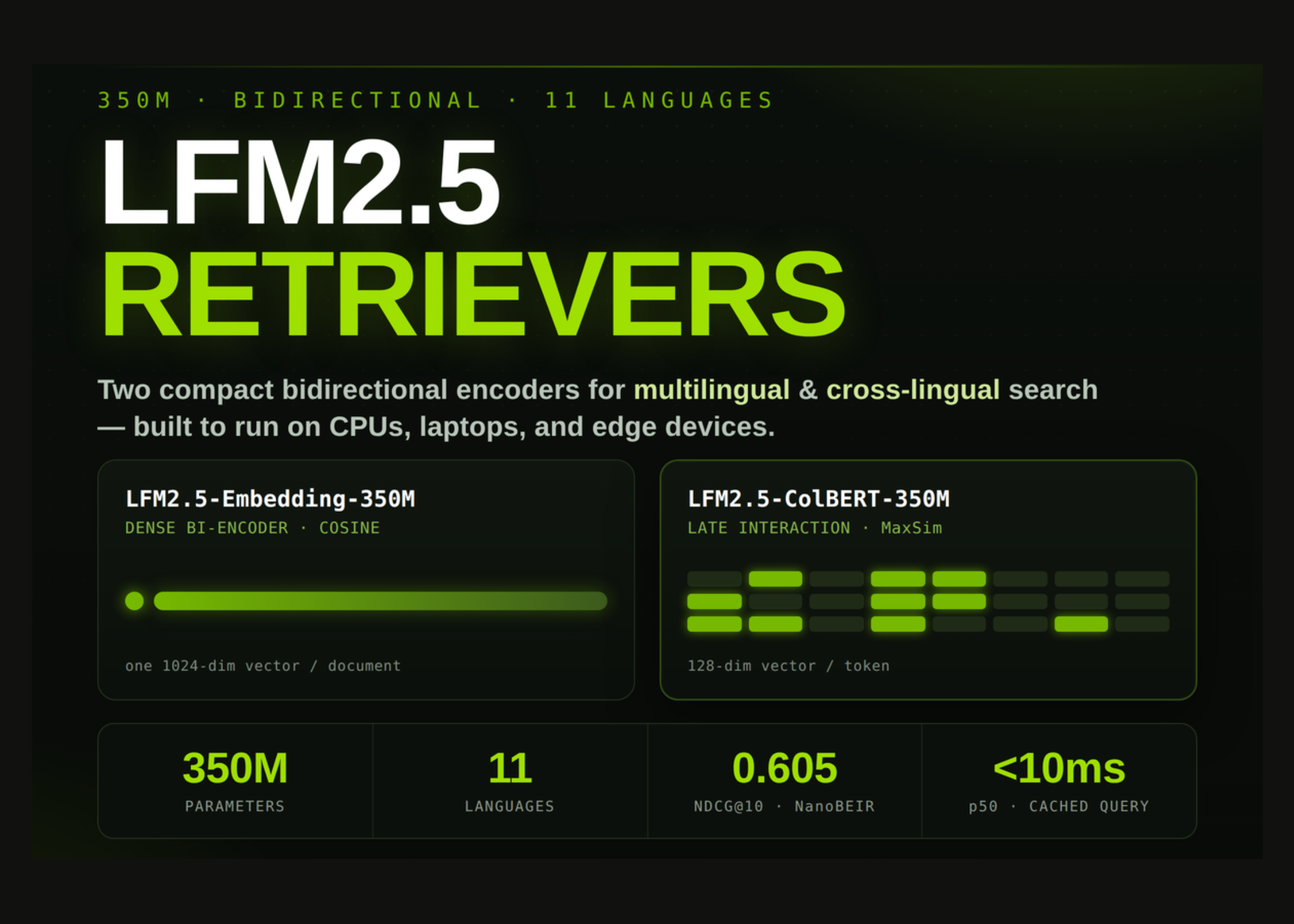
Liquid AI Introduces LFM2.5-Embedding-350M and LFM2.5-ColBERT-350M: Dense Bi-Encoder and Late-Interaction Models for Fast Multilingual Search Across 11 Languages
The introduction of these AI models could enhance the efficiency and accuracy of multilingual search capabilities, impacting businesses and users who operate across diverse languages.
- Liquid AI has launched two new models: LFM2.5-Embedding-350M and LFM2.5-ColBERT-350M.
- These models are designed for fast multilingual search across 11 different languages.
Liquid AI specializes in artificial intelligence solutions aimed at improving search and information retrieval. The launch of these models represents a step forward in developing efficient multilingual search technology, which is increasingly important in a globalized world. Future advancements may focus on improving these models' capabilities and performance in real-world applications.
Based on the headline only — the full article could not be fetched.
Read the original ↗
AI Personal Assistant: How to Build One from Scratch (No Coding)
Building an AI personal assistant can enhance productivity by automating repetitive tasks, allowing users to focus on activities that require human judgment.
- AI personal assistants perform automated tasks like managing calendars, drafting emails, and answering questions, increasing efficiency in daily activities.
- Users do not need programming skills to create an AI assistant but should define their goals and select appropriate tools and platforms.
- Key AI models for personal assistants include OpenAI’s GPT-4o, Google Gemini, Anthropic’s Claude, and Microsoft Copilot, each optimized for different user ecosystems.
AI personal assistants are software programs that automate routine tasks through artificial intelligence. This article outlines a step-by-step guide to building one, aiming to help users maximize their productivity without needing coding experience.
Read the original ↗
An Open Strait of Hormuz Won’t Fix Gas Prices Overnight
The prolonged instability in the Strait of Hormuz could lead to sustained high gas prices and increased costs for consumer goods dependent on oil, impacting financial markets and consumers alike.
- A ceasefire agreement between the US and Iran has reopened the Strait of Hormuz, a key oil shipping route.
- Despite the reopening, experts warn that gas prices are unlikely to return to pre-war levels soon due to ongoing supply disruptions.
- Shipping risks remain high as experts highlight threats from underwater mines in the strait and continued US military tensions with Iran.
The Strait of Hormuz is a strategic waterway for global oil transport, with 20 million barrels moving through daily. The ongoing US-Iran conflict has severely impacted oil supply chains and pricing, raising concerns about potential new tolls for passing ships. Monitoring the developments in international shipping routes and oil production will be critical in the coming months.
Read the original ↗
How to Use an AI App for Music Video Creation in 2026
The rise of AI tools like Freebeat reflects a significant shift in how independent musicians can create and distribute music videos, crucial for modern music promotion.
- In 2026, global recorded music revenues reached $31.7 billion, with streaming constituting about 70% of this income.
- Freebeat allows musicians to create complete, publishable music videos on mobile, focusing on the song's audio and visual coherence.
- The app supports various creation modes tailored for different video production goals, enhancing flexibility for artists.
- Lip sync accuracy in Freebeat's videos was around 90%, effectively connecting characters with the music performance.
- Freebeat provides social media-friendly formats, facilitating the creation of multiple content types from one song.
Freebeat is an AI-powered app designed for musicians to create music videos by analyzing songs and generating visuals that align with and enhance the audio. As music consumption continues to emphasize visual content through platforms like TikTok and Instagram, tools like Freebeat are essential for independent artists seeking to promote their work effectively.
Read the original ↗
Source: Elastic agrees to buy CRV-backed DeductiveAI for up to $85M
This acquisition highlights the growing trend of established companies integrating AI technologies into their services to enhance operational efficiency and offer advanced solutions.
- Elastic has agreed to acquire Deductive AI for up to $85 million.
- Deductive AI specializes in AI-driven tools for identifying and fixing software bugs and was co-founded in 2023.
- The acquisition enhances Elastic's observability platform, allowing for real-time performance monitoring and resolution of system issues.
- Deductive AI previously raised a $7.5 million seed round, valuing the startup at $33 million at that time.
- The deal emerges as established tech companies seek to enhance their offerings by integrating AI-native startups.
Deductive AI, founded in 2023, operates in the field of AI site reliability engineering, aiming to automate the debugging process in software development. The startup's acquisition by Elastic, known for its powerful data analytics and search tools, signals a growing interest in AI solutions to optimize software reliability. This transaction underscores a dynamic market trend where tech companies are acquiring AI startups to bolster their product capabilities.
Read the original ↗
The Cheap Era of Always-On Claude Agents Is Quietly Ending
The potential end of the subsidized usage for Claude Agents may significantly impact users who rely on affordable automated services for their operations, prompting a need for rapid adjustments.
- Anthropic recently paused changes to its Claude Agent SDK billing, originally set to take effect on June 15, 2026.
- The planned billing shift would have separated automated use from subscription limits, enforcing new charges at standard API rates.
- This change aimed to address unsustainable usage patterns as Anthropic prepares for an initial public offering (IPO).
- The pause in changes signals that while the pricing model is evolving, it is not reversed, affecting long-term user strategies.
- Users relying on Claude agents are encouraged to reassess their operational costs based on potential API pricing.
Anthropic is the company behind Claude, an AI agent platform. The previous billing model was perceived as heavily subsidized, allowing users to operate automated tasks affordably. Users should expect a shift towards metered billing and adapt their strategies accordingly.
Read the original ↗
Amazon Wants to Sell Its Own AI Chips
Amazon's potential entry into the AI chip market could significantly alter industry dynamics, offering companies an alternative to Nvidia's dominance and impacting future chip supply chains.
- Amazon Web Services is exploring the sale of its Trainium AI chips to external companies, according to AI chief Peter DeSantis.
- Amazon's AI chip business could generate about $50 billion annually, similar to Intel's revenue, if it operated as a standalone company.
- The company must balance selling chips externally with maintaining support for its cloud customers due to limited supply capacity.
- Amazon's Trainium chips have sold out quickly, and the next generation, Trainium4, won’t be available for over a year.
Amazon Web Services (AWS) provides cloud computing services and is now venturing into chip sales. This strategy could disrupt the AI chip market, currently dominated by Nvidia. Future developments will depend on Amazon's ability to scale chip production and manage existing cloud service commitments.
Read the original ↗
The White House Is Making Up Its Rules for AI in Real Time
This dispute highlights the challenges in developing regulatory frameworks for advanced AI technologies, which may affect the future of innovation and collaboration in the sector.
- The Trump administration issued an export control directive to Anthropic, requiring the company to pull its AI models Claude Mythos and Fable 5 offline.
- Anthropic argues it did not violate any known rules, while the White House claims the company acted recklessly with advanced technology.
- The White House's demand barred foreign nationals from using Anthropic's models, impacting the company's research and restricting customer access.
- Concerns arose from Anthropic sharing models with SK Telecom, which US officials allege has ties to China, raising security issues.
- Other AI companies are now considering giving the government early access to their models to avoid similar disputes with regulators.
Anthropic is a prominent AI research lab known for its advanced AI models. The current regulatory landscape is complicated, as the Trump administration shifts towards real-time decision-making on AI oversight without clear policies. This incident illustrates the uncertainty in AI regulation that companies must navigate moving forward.
Read the original ↗
Snap spins off AI video team into new company, Dotmo, due to costs
Snap's spin-off of its AI video team into Dotmo highlights its strategy to manage costs while still fostering innovation in interactive gaming experiences.
- Snap is spinning off its internal generative AI video team into a new company called Dotmo.
- Dotmo will focus on developing AI models for interactive gaming experiences, with close ties to Snap.
- Snap will retain a significant equity stake in Dotmo in exchange for providing technology licensing and talent.
Snap is a social media company known for Snapchat and has previously spun off its Specs division to focus on smart glasses. The creation of Dotmo indicates a shift in Snap's strategy to reduce operational costs while exploring emerging technologies in gaming.
Read the original ↗
AI inference startup Baseten reportedly raising $1.5B months after its last mega round
Rapidly increasing valuations in AI inference startups indicate significant investor confidence in this sector, potentially reshaping funding landscapes and market dynamics.
- AI inference startup Baseten is reportedly closing a $1.5 billion funding round at a $13 billion valuation.
- This follows a $300 million Series E funding round announced five months ago at a $5 billion valuation.
- The current funding round features a split-price structure, with some investors valuing the company at $13 billion and others at $11 billion.
Founded in 2019, Baseten specializes in AI inference, which refers to the process occurring after a user submits a prompt to an AI model. The company has attracted significant funding amid a trend of substantial investments in the inference layer of AI technology. Upcoming developments in its funding strategy may impact the larger competitive landscape of AI startups.
Read the original ↗
As China looms, Taiwan makes more drones for defense and the US military
Taiwan's increased drone production for defense could enhance its military readiness amid rising tensions with China and create new export opportunities, impacting regional security dynamics.
- Taiwan's government proposed a $6.6 billion budget to enhance domestic drone production, aiming to buy over 208,000 coastal attack drones by 2031.
- Taiwanese drone manufacturers, like Thunder Tiger, have established international partnerships to market their products to the US military and European buyers.
- In 2026, Taiwan's drone exports reached $115 million within the first three months, surpassing total exports for 2025.
Taiwan is bolstering its defense capabilities due to threats from China, focusing on drone technology for military use. The country aims to compete against China’s dominant drone market by expanding its production capacity and improving technology through international collaborations.
Read the original ↗
Perplexity Launches Brain, a Self-Improving Memory System That Builds a Context...
The launch of Perplexity's Brain memory system is significant as it aims to enhance AI's contextual understanding and learning capabilities.
- Perplexity has launched a new self-improving memory system called Brain.
- The Brain system focuses on building context for better user interaction and memory retention.
Perplexity is an AI company focused on improving artificial intelligence's conversational abilities. Self-improving systems like Brain represent advancements in AI's capability to retain and utilize context for enhanced learning experiences. This development could influence how AI systems enhance their responses in user interactions.
Based on the headline only — the full article could not be fetched.
Read the original ↗
Meta’s AI Workers Are Revolting, Peter Thiel’s Secret Society, and SBF’s Plea to Trump
The struggles within Meta's AI unit reflect broader challenges in tech as companies grapple with employee morale during significant reorganization and investment in AI technologies.
- Meta's new AI unit, Meta Superintelligence Labs, is reportedly causing significant employee dissatisfaction and low morale due to recent restructuring efforts.
- About 7,000 employees were reassigned to AI-focused teams despite widespread frustration regarding the menial nature of their new tasks.
- A leaked document revealed a group co-founded by Peter Thiel, listing over 200 high-profile members, which has drawn attention for its secrecy and influence.
- In other news, Sam Bankman-Fried is reportedly seeking a pardon from the Trump administration amid ongoing legal troubles.
Meta, a leading social media company, is heavily investing in AI technology amid operational changes that include significant layoffs and staff reassignment to new teams. Ongoing issues have led to employee discontent and management's struggle to maintain morale as the company shifts focus.
Read the original ↗
Amazon hopes to challenge Nvidia more directly by selling its AI chips
Amazon's potential entry into the AI chip market could significantly impact Nvidia's dominance, highlighting increased competition in the sector and the evolving landscape of AI technology.
- AWS plans to sell its AI chip Trainium to other data centers, aiming to challenge Nvidia's chip market share.
- Amazon CEO Andy Jassy indicated that the chips business could generate a $50 billion annual run rate.
- Current AWS chip capacity has sold out quickly, complicating the prospect of selling to third parties.
Amazon Web Services (AWS) is expanding its offerings by potentially selling its artificial intelligence chips, previously reserved for internal use. Nvidia currently dominates the AI chip market, thus any competition from AWS could reshuffle industry dynamics. Stakeholders will be monitoring AWS's manufacturing capabilities and market response as developments progress.
Read the original ↗
Almost half of U.S. singles feel negatively about AI in dating, Match says
The mixed feelings of U.S. singles about AI in dating reflect broader societal concerns regarding technology’s role in personal relationships and authenticity in human interactions.
- Match Group's survey reveals that 47% of U.S. singles view AI negatively in dating contexts.
- 40% of singles would not date someone who uses an AI companion app, rising to 51% among women aged 18 to 24.
- Despite reservations, 64% of respondents acknowledge AI could assist with dating-related tasks like profile enhancement and conversation starters.
Match Group owns popular dating apps like Tinder and Hinge and conducted a survey to assess singles' attitudes towards AI in dating. Previous efforts have introduced AI features in dating apps, suggesting a push towards integrating technology without replacing genuine human interactions.
Read the original ↗
OpenAI is bringing on some big guns in the lead-up to its IPO
The addition of top talent before OpenAI's IPO indicates strategic investments in technology and governance, highlighting the competitive landscape in the artificial intelligence sector.
- OpenAI has recruited Noam Shazeer from Google DeepMind and Dean Ball, a former Trump administration AI policy official, ahead of its IPO.
- Shazeer is a co-author of the influential paper "Attention Is All You Need" and has been a key figure in generative AI development.
- Ball will lead a new team called Strategic Futures at OpenAI, focusing on AI policy and governance issues.
- The Strategic Futures team aims to address AI risks, labor market impacts, and relationships with government and society.
- This recruitment comes at a time when rival firm Anthropic is facing government export control challenges.
OpenAI is a leading artificial intelligence research organization, known for its advancements in generative AI technologies. The company is preparing for its public debut amid a shifting landscape where AI policy and governance are increasingly critical. Recruitment of experienced figures like Shazeer and Ball may shape its strategic direction and regulatory approach.
Read the original ↗