
The day's AI news, briefed
The Daily Prompt
Our AI editor reads each day's AI and robotics stories, pulls out why they matter, and links every original source — so you can keep up in minutes.
Join over 250,000 subscribers getting the latest AI news
Latest AI & Robotics News Today

AI Isn’t Costing You Customers. Bad Experiences Are
Customer experiences significantly affect retention rates, indicating the need for businesses to focus on service quality rather than blaming AI for customer loss.
- AI technology is not the primary factor causing customer loss for businesses.
- Negative customer experiences are responsible for losing customers, not the implementation of AI solutions.
Businesses increasingly implement AI technologies to enhance operations and customer service. Prior discussions often blame AI for customer dissatisfaction, but they may overlook service quality issues. Improving customer experiences will be essential for retaining clientele as AI usage grows.
Based on the headline only — the full article could not be fetched.
Read the original ↗
Tryll Engine Raises $600K Pre-Seed at $6M Valuation to Bring On-Device AI Characters and Conversations to Games
If successful, Tryll's technology could revolutionize game development by allowing for dynamic, on-device AI characters without high operating costs or privacy concerns, enhancing player experience significantly.
- Tryll raised $600,000 in a pre-seed funding round, valuing the company at $6 million.
- The company’s Tryll Engine enables AI to run directly on players’ hardware, eliminating reliance on cloud-hosted models.
- Tryll's platform is currently in closed alpha testing with six entertainment companies, focusing on AI-powered game interactions.
- The engine allows developers to create conversational non-player characters (NPCs) that adapt to player behavior without additional AI engineering resources.
- Applications for Tryll's beta program are now being accepted, with a public release planned for later in the year.
Tryll aims to become a foundational technology for AI-native gameplay, allowing developers to run language models locally. This shift comes as gaming hardware has improved, making it feasible to run sophisticated AI without cloud dependency. The company's approach targets a growing demand for immersive and interactive game experiences using AI characters.
Read the original ↗
Odyssey Raises $310 Million Series B at $1.45 Billion Valuation to Advance AI World Models
Odyssey's substantial funding round highlights a significant shift in AI development toward world models, which may revolutionize various industries by enabling systems to understand and interact with the physical environment.
- Odyssey has raised $310 million in Series B funding, achieving a valuation of $1.45 billion.
- The funding round was led by Natural Capital and included participation from major players like Amazon and AMD Ventures.
- Odyssey focuses on developing AI world models that can simulate physical environments and learn causality, rather than solely generating language.
- The company has formed a partnership with Amazon Web Services to utilize AWS Trainium chips for training AI models.
- Odyssey's advancements in world models could transform industries such as robotics, healthcare, and gaming by providing more realistic simulations.
Odyssey, a Palo Alto-based AI research lab, is pioneering AI systems known as world models, which predict interactions in the physical world. The company aims to expand beyond traditional language models to support a wide range of applications. With ongoing investment in this area, future AI systems may achieve unprecedented levels of understanding of their environments.
Read the original ↗
Kick Back and Watch the Robot Mower Do Your Yard Work
As robot lawn mowers improve in quality and become more affordable, they are increasingly capable of transforming yard maintenance, offering increased convenience for homeowners.
- Robot lawn mowers are becoming more effective and cheaper, making them a feasible option for more homeowners.
- The TerraMow V1000 utilizes AI camera systems and GPS for efficient lawn mapping and mowing without physical boundary wires.
- The Mammotion Luba 3 AWD is designed for rough terrain and combines GPS, lidar, and AI vision for superior navigation and mowing performance.
Robot lawn mowers automate lawn care tasks that traditionally required manual effort. The market has progressed from niche products to robust models suitable for various terrains. Future developments may focus on further enhancements in navigation and machine learning.
Read the original ↗
Artificial Intelligence (460)
Understanding the development of AI assistants is crucial as they influence efficiency in various tasks across industries and personal use.
- An article discusses the creation and purpose of an AI assistant.
- It explores both the motivations and the methodologies behind building such technology.
AI assistants are software systems designed to perform tasks and provide services to users through voice or text. They are becoming more prevalent in both personal and professional settings. Monitoring advancements in AI assistant technology can offer insights into future capabilities and applications.
Based on the headline only — the full article could not be fetched.
Read the original ↗
Canadian pension giant joins race to fund India’s AI-fueled data center boom
This investment signifies a growing trend among global investors seeking to capitalize on India's rapidly expanding data center and AI infrastructure market.
- Canada Pension Plan Investment Board will invest up to ₹70 billion (approximately $741 million) in Indian data center operator CtrlS.
- CPP Investments will acquire an 8.2% stake in CtrlS and also invest in a joint venture to develop data centers across India.
- The partnership is intended to help CtrlS expand capacity specifically designed for AI workloads.
CtrlS, founded in 2007, operates over 15 data centers in India and aims to meet increasing demand from cloud providers and AI workloads. The investment reflects a broader commitment from CPP Investments, which has been active in India since 2009, to build its digital infrastructure portfolio. India is positioning itself as a major hub for digital and AI infrastructure with various investor-backed projects underway.
Read the original ↗
Why the Future of AI in Business Isn’t Just Automation, It’s Intelligent Conversation
Understanding the transition from automation to intelligent conversation in AI can significantly impact business operations and customer relationships.
- AI in business is evolving from automation to enabling more intelligent and adaptive interactions with customers.
- Current AI systems often use scripted responses, which limits their ability to understand and engage in complex conversations.
- Trust becomes crucial as businesses scale AI interactions, requiring designed systems that represent the brand accurately without making assumptions.
AI has traditionally focused on automating tasks to improve efficiency in business processes. The next evolution involves AI systems that engage in more nuanced conversations, adapting to user needs in real time. Companies are encouraged to rethink how they leverage AI to enhance customer interactions and trust in automated systems.
Read the original ↗
Top 7 AI Chip and Companies Winning the Hardware Race and What Separates Them
Understanding the competitive landscape of AI chip manufacturers is crucial as the market rapidly expands and influences technology decisions across industries.
- NVIDIA commands approximately 82.4% of the AI chip market, with fiscal year 2026 revenue reaching $215.9 billion.
- AMD's Instinct MI300X GPU matches NVIDIA's performance specifications but struggles with software adoption due to its still-maturing ROCm software stack.
- Google's Ironwood TPU is optimized for inference and boasts the ability to scale significantly, outperforming El Capitan, the fastest supercomputer.
- Cerebras is known for its wafer-scale processors, recently launching AI inference data centers that can handle 40 million Llama 70B tokens per second.
- Qualcomm is pivoting towards AI PCs and automotive systems amid a 13.4% revenue contraction in early 2026 as cell phone sales stagnate.
The AI chip market is projected to be worth $85 to $95 billion by 2026, growing at 25-30% annually. Major players include NVIDIA, AMD, and Google, each employing distinct approaches to dominate the market. Future developments to watch include advancements in software integration and performance efficiencies from competitors like AMD and Google.
Read the original ↗
Pinterest launches an experimental AI shopping app called ‘Ask Pinterest’
The launch of 'Ask Pinterest' could reshape how users discover products online, moving from traditional search methods to a more conversational and personalized shopping experience.
- Pinterest has introduced an experimental shopping app called 'Ask Pinterest' that uses AI to provide personalized recommendations through a conversational interface.
- The app leverages Pinterest's 'Taste Graph,' which maps user interests to enhance product discovery beyond the main Pinterest app.
- Ask Pinterest is initially available in limited access on both mobile and desktop platforms, allowing for testing of multistep queries around shopping needs.
Pinterest is a visual discovery platform that enables users to find and save inspirations for various projects. This launch follows a trend where AI is increasingly being integrated into shopping experiences, competing with traditional search engines. Future developments may enhance AI capabilities within the primary Pinterest app based on insights from 'Ask Pinterest.'
Read the original ↗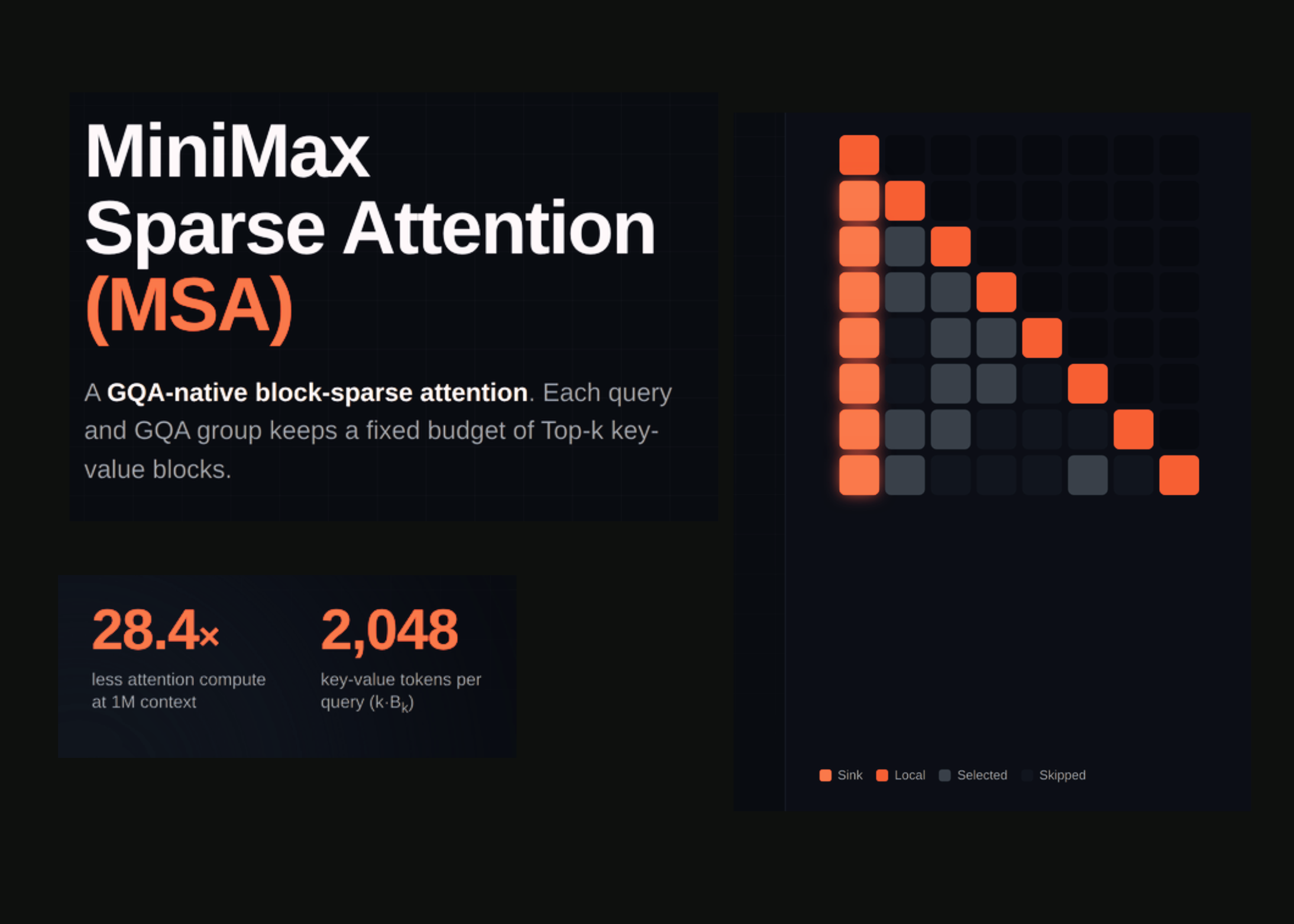
MiniMax Sparse Attention (MSA): a Two-Branch Block-Sparse Attention Trained on a 109B-Parameter MoE With a 3T-Token Budget
The development of MiniMax Sparse Attention (MSA) may enhance the efficiency of processing large language models by optimizing attention mechanisms, which is critical for AI advancements.
- MiniMax Sparse Attention is a new technique that utilizes a two-branch block-sparse attention framework.
- The method is trained on a 109 billion-parameter mixture of experts model.
MiniMax Sparse Attention (MSA) aims to improve the performance and efficiency of neural networks in AI applications. Previous systems relied on denser attention mechanisms, which can be resource-intensive. Future work will likely focus on practical implementations and their scalability in real-world applications.
Based on the headline only — the full article could not be fetched.
Read the original ↗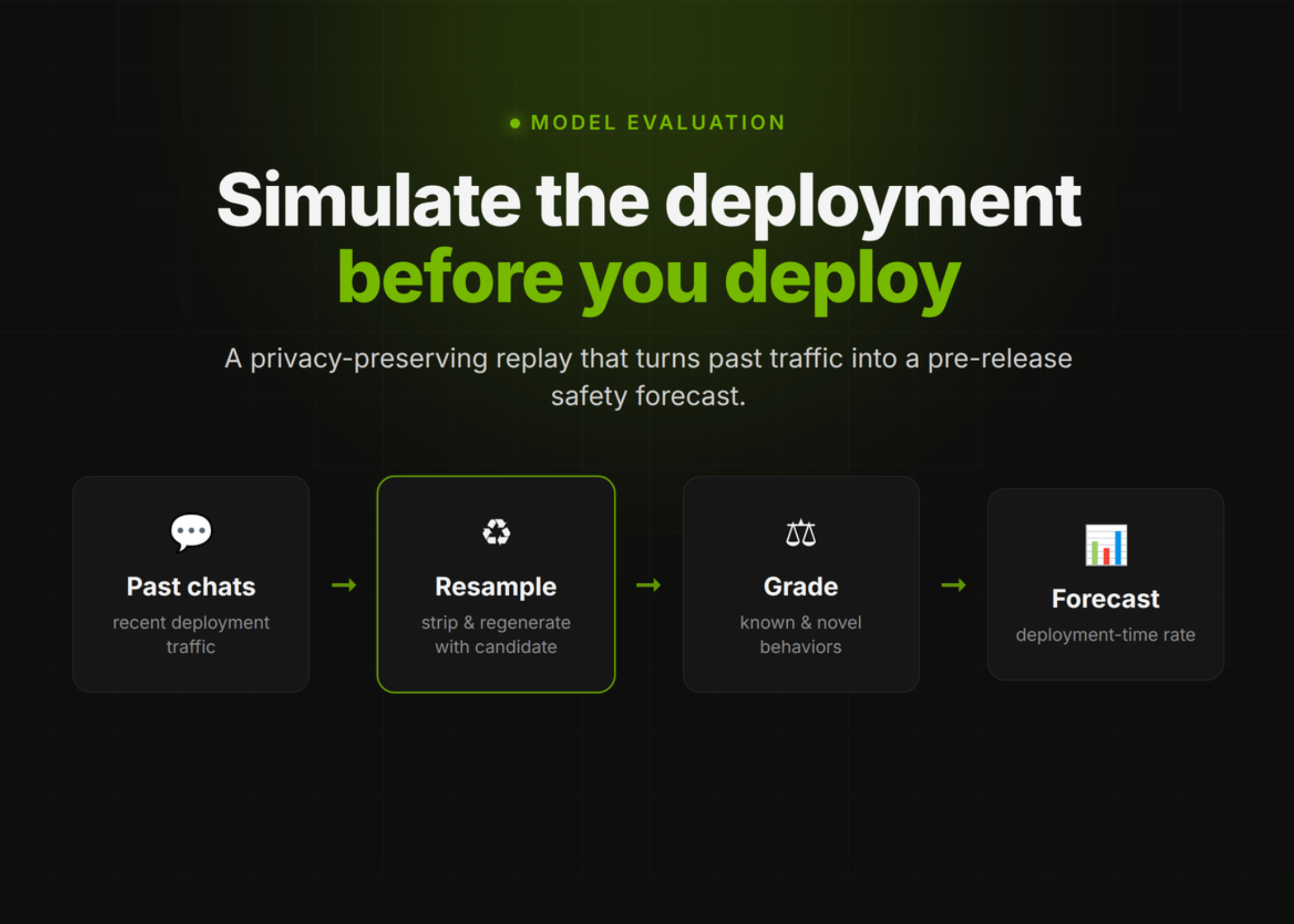
OpenAI’s Deployment Simulation Extends Pre-Deployment Risk Assessment to Agentic Coding Through Simulated Tool Calls
This development highlights the importance of risk assessment in AI, particularly as agents use increasingly complex coding techniques.
- OpenAI has introduced a deployment simulation to assess risks associated with agentic coding.
- The simulation extends pre-deployment risk assessment through simulated tool calls.
OpenAI focuses on developing advanced artificial intelligence technologies and ensuring their safe deployment. Pre-deployment risk assessments have become crucial in identifying potential issues before technology goes live. Monitoring how AI agents interact with tools is a key area for future advancements.
Based on the headline only — the full article could not be fetched.
Read the original ↗
Genpact and HFS Research Report Finds $18 Trillion in Enterprise Value Trapped by AI Readiness Gaps
Addressing enterprise debt could unlock nearly $18 trillion in value for organizations, significantly enhancing revenue, reducing costs, and improving the effectiveness of AI deployments across industries.
- A report by Genpact and HFS Research estimates that $17.9 trillion in enterprise value is trapped due to four categories of enterprise debt: process, data, technology, and talent debt.
- 92% of Global 2000 executives believe agentic AI will change work execution, yet only 13% have integrated such AI into operations.
- Resolving enterprise debt could lead to an 8% increase in annual revenue growth and a 16% reduction in costs for large enterprises.
- Manufacturing and healthcare sectors represent the largest opportunities for debt resolution, estimated at $4.8 trillion and $3.3 trillion respectively.
Genpact is a global professional services firm that focuses on business transformation and technology solutions. The report highlights a critical gap between AI aspirations and actual enterprise readiness, with many organizations still reliant on outdated systems and processes. Future developments will likely focus on how companies address these gaps to realize the full potential of AI investments.
Read the original ↗
Anthropic’s latest feud with the Trump admin may actually help it, sales data suggests
This story highlights how regulatory disputes can unexpectedly influence business performance, reflecting broader trends in the AI industry amid governmental scrutiny.
- Anthropic surpassed OpenAI in market share for business spending, capturing 41% of AI subscriptions in May.
- The company is reportedly preparing for an IPO following its first profitable quarter.
- The Trump administration demanded a ban on non-Americans from accessing Anthropic's new models, leading to the withdrawal of Mythos and Fable 5 from the market.
- Despite the controversy, business adoption of Anthropic's models has been increasing, with strong usage of its Opus models.
- Ramp's data indicates that business spending on Anthropic's AI tools is at an all-time high post-controversy.
Anthropic is an AI research company specializing in advanced machine learning models. It has faced scrutiny from the U.S. government over its technology, particularly regarding export controls and its refusal to assist in surveillance. Observers are watching how these issues affect its upcoming IPO plans and overall market position.
Read the original ↗
Trump admin tries to block Clean Air Act lawsuit over xAI’s gas turbines
The outcome of this lawsuit could set a precedent affecting the enforcement of environmental regulations and citizen rights to challenge potential violations.
- The Trump administration is supporting xAI Corp. against a Clean Air Act lawsuit filed by the NAACP, which alleges unpermitted operation of gas turbines in Mississippi.
- The NAACP claims xAI has increased the number of unpermitted gas turbines from 27 to 57 and plans to add more.
- The lawsuit argues these turbines pose health risks to local communities, particularly among vulnerable populations.
- The US Department of Justice is requesting a federal judge to dismiss the lawsuit, siding with xAI's claim that the turbines do not require permits.
- The NAACP is seeking a permanent injunction against the gas turbines and civil penalties for violations of the Clean Air Act.
xAI Corp. is a technology company founded by Elon Musk, utilizing gas turbines to power its data centers. The Clean Air Act imposes limits on emissions to protect air quality and public health. Future developments will likely center on the court's response to the government's argument against citizen enforcement of environmental laws.
Read the original ↗
Anthropic “pauses” token-based billing for its Claude Agent SDK
This pause in billing changes helps avoid a significant increase in costs for users of Anthropic's Claude Agent SDK, impacting their financial planning and usage of AI in applications.
- Anthropic suspended its planned billing change for the Claude Agent SDK just before it was set to take effect.
- The original plan would have raised costs significantly for heavy users by altering how SDK usage is billed.
- Power users currently benefit from more generous usage limits under their existing subscriptions, avoiding higher API costs.
- The pause allows users to continue their current usage patterns without increased expenses for the time being.
- Anthropic indicated it will work on a revised plan to better accommodate user needs in the future.
Anthropic, an AI company, offers the Claude Agent SDK for automation in various applications. A proposed billing change was largely criticized for increasing costs for heavy users of the service. Future changes in pricing may still affect users as Anthropic refines its billing approach.
Read the original ↗
Unlocking UK house-building with AI-accelerated planning
The development of an AI-powered planning tool could significantly expedite the UK's house-building efforts, addressing a critical housing shortage while improving planning efficiency.
- The UK government and Google DeepMind aim to create an AI planning prototype to cut application processing times by 50%.
- This initiative targets the local planning authorities that are hindered by paperwork and administrative backlogs as Britain seeks to build 1.5 million homes by 2029.
- Testing of the prototype is taking place in Barnet, Camden, and Dorset, with a nationwide rollout planned for 2027.
Google DeepMind is collaborating with the UK government to leverage AI technology in public service sectors, specifically to optimize the planning process for housing applications. The project builds on previous work with the tool Extract, which converts legacy planning documents into accessible data. Continued progress is expected in response to growing housing needs in the UK.
Read the original ↗
Holo AI Review: I Didn’t Expect This Ad Tool to Work So Well
Holo AI automates marketing content creation, significantly reducing the time businesses spend on ad development while optimizing for brand consistency across multiple platforms.
- Holo AI generates ads, posts, emails, and videos based on a website URL, learning a brand's tone and style within minutes.
- The platform supports over 99 languages, enabling global content creation for high-volume marketing needs.
- Holo AI is designed for various users, including e-commerce brands and marketing agencies, assisting in the production of large quantities of marketing material.
Holo AI is an AI marketing platform that streamlines content creation by leveraging a brand's website. It builds on OpenAI's technology to provide quick and cohesive marketing solutions. As it evolves, users should monitor how it addresses output consistency and editing needs.
Read the original ↗
‘Dangerous’ AI Models Are Coming No Matter What
This story highlights the emerging risks associated with advanced AI models, underlining the urgent need for effective regulatory frameworks to manage their potential misuse in cybersecurity and beyond.
- Anthropic's Claude Fable 5 and Mythos 5 AI models were taken offline following a U.S. government export-control directive preventing foreign nationals from using them.
- The Trump administration moved to restrict these models due to concerns that their security measures could allow access to dangerous capabilities.
- Experts warn that other companies may soon develop AI models with similar or superior capabilities, presenting ongoing national security risks.
Anthropic, a company focused on AI, has launched models with dual-use capabilities, which can be beneficial or harmful depending on who controls them. As concerns over AI capabilities grow, experts are calling for more robust regulatory frameworks to address future risks.
Read the original ↗
Pentagon boasts of using AI to write reports mandated by Congress
The Pentagon's use of AI to draft reports highlights the growing reliance on technology to improve efficiency in government operations, raising questions about accuracy and oversight.
- The US Department of Defense is utilizing generative AI tools to draft congressionally mandated reports more efficiently.
- Pentagon Chief Technology Officer Emil Michael noted that AI can reduce report preparation time from 200 hours to five hours.
- The number of personnel using AI tools within the Department of Defense has risen sharply from 80,000 in December 2025 to 1.5 million by June 2026.
- There are concerns regarding the accuracy of AI-generated reports and the potential for errors without sufficient human oversight.
The Department of Defense has faced challenges in efficiently meeting the growing number of reports required by Congress. The introduction of generative AI tools, such as Google Cloud's Gemini, aims to streamline report generation. The implications of AI in critical reporting duties raise questions about accountability and oversight.
Read the original ↗
Meet Qwen-RobotSuite: Three Embodied AI Models for VLA Manipulation, Video World Modeling, and Navigation
The introduction of Qwen-RobotSuite's three AI models could significantly enhance the capabilities of robotics in areas like manipulation and navigation, impacting various industries.
- Qwen-RobotSuite includes three embodied AI models that focus on VLA manipulation, video world modeling, and navigation.
- These models aim to advance robotic efficiency and versatility in practical applications.
Qwen-RobotSuite represents the latest development in AI-driven robotics, combining multiple capabilities to improve interaction with physical environments. The models cater to specific tasks critical for advancing robotics applications, which promise increased autonomy and effectiveness.
Based on the headline only — the full article could not be fetched.
Read the original ↗