
The day's AI news, briefed
The Daily Prompt
Our AI editor reads each day's AI and robotics stories, pulls out why they matter, and links every original source — so you can keep up in minutes.
Join over 250,000 subscribers getting the latest AI news
Latest AI & Robotics News Today

Artificial Intelligence (508)
Understanding the local AI stack is essential for enhancing productivity in service-level management (SLM) systems, impacting overall operational efficiency.
- The article discusses the local AI stack designed for productive service-level management systems.
Service-level management (SLM) systems help businesses monitor and manage service delivery and performance. An efficient AI stack can significantly improve productivity in these systems. Observing developments in AI technologies is crucial for businesses aiming to optimize SLM.
Based on the headline only — the full article could not be fetched.
Read the original ↗
GLM-5.3’s Exploits, AI Models and Hardware Speed Up, DeepSeek’s New Agent Harness
This story highlights advancements in AI capabilities and performance, which are crucial for the ongoing development of applications and systems in various sectors, including cybersecurity.
- Researchers at Xiaohongshu developed a memory management technique for AI agents utilizing large language models (LLMs).
- DeepSeek's latest model, the DeepSeek-V4-Pro, has improved performance and generated interest with its new open-source harness.
- OpenAI partnered with Cerebras, while Google and Nvidia released updated AI models, stressing the importance of speed alongside cost and accuracy in AI development.
- Z.ai's GLM-5.3 model experienced a delay due to cybersecurity concerns but ties with a leading model in intelligence benchmarks.
AI models and hardware developments are crucial for improving the efficiency and capabilities of AI applications. Recent partnerships and releases demonstrate the competitive landscape in the field, particularly focused on speed and performance. Ongoing advancements are expected to influence a range of applications, especially in cybersecurity and agent-based systems.
Read the original ↗
The 2026 Midterms Are Coming. Political Deepfakes Are Already Here
The rise of political deepfakes raises concerns about misinformation and voter manipulation in upcoming elections, challenging public trust and influencing democratic processes.
- Generative AI is making it easier to create convincing, synthetic media that resembles public figures, also known as AI impersonation.
- Recent political events, like fake robocalls from Joe Biden, demonstrate the risks of deepfakes in influencing voter behavior during elections.
- The ability to produce and distribute fake content quickly increases the volume, velocity, and variety (the three V's) of misinformation.
- Political campaigns struggle to secure themselves against misinformation as they use the same digital platforms as malicious actors.
Political deepfakes are artificial media that mimic real people, created using AI technology. As the 2026 midterm elections approach, the prevalence of such forgeries poses a serious challenge to the electoral process. Keeping public trust is crucial as the technology evolves, highlighting the need for effective countermeasures against misinformation.
Read the original ↗
UrbanGround: From Local Perception to Spatial Agency in a Real-Scale City
Understanding the limitations of multimodal language models in urban navigation can inform the development of more effective AI agents for real-world applications.
- UrbanGround evaluates how well multimodal language model agents can navigate and perform spatial reasoning in a realistic 3D replica of Hong Kong.
- The study finds that while agents can recognize local scenes, they struggle with reliable long-distance navigation and adapting to changes.
- Errors in navigation accumulate during extended exploration, leading to a failure in achieving sustained goal-directed behavior.
UrbanGround is a research platform designed to test how current multimodal language models can operate in complex urban environments. Previous studies showed that these models excelled in local perception but faced challenges in broader spatial reasoning. Future work will focus on improving navigation capabilities and adaptability under varying conditions.
Read the original ↗
Zero-WAM: In-Context World-Action Modeling from Human Videos for Open-Ended Task Generalization
Advancements in robotic manipulation through Zero-WAM can enhance robots' ability to learn new tasks autonomously, increasing their utility in diverse applications and settings.
- Zero-WAM utilizes a causal video-action model that allows robots to perform unseen tasks based on human video guidance.
- The model is trained on a dataset called HumanGen, consisting of 74.2K human-robot pairs across 8.6K tasks created through an automatic pipeline.
- Zero-WAM achieved a 47.0% success rate on seven unseen tasks in the RoboTwin 2.0 simulation, marking a significant improvement over previous benchmarks.
Zero-WAM represents a novel approach in robot learning that adapts techniques from large language models to robotic manipulation. This work addresses challenges in zero-shot cross-task generalization, enabling robots to handle tasks they were not explicitly trained on. Future developments may include further refinement of task-specific training methods and expanded datasets for broader applications in robotics.
Read the original ↗
Meta makes AI glasses slightly less creepy with limit on nonconsensual recording
Meta's changes to its AI glasses highlight ongoing privacy concerns around wearable technology, which could shape regulations and public perception in the tech industry.
- Meta is changing its AI glasses to stop recording when the LED light, which indicates recording, is covered.
- This update aims to address backlash over non-consensual recordings enabled by previously flawed privacy safeguards.
- Despite the changes, concerns remain about potential tampering and the effectiveness of the LED light to prevent invasions of privacy.
Meta's AI glasses raise privacy concerns due to their ability to record without clear consent. European regulators are investigating the glasses amid fears of illegal surveillance and a proposed class action lawsuit in the US alleges false marketing regarding user privacy. The implications of these legal challenges and regulatory responses may reshape the market for smart glasses.
Read the original ↗
Anthropic Brings Claude for Teachers to Schools and Districts
This initiative expands access to AI tools for teachers, potentially enhancing educational practices and supporting K-12 curricula integration across the United States.
- Anthropic's Claude for Teachers is now free for schools and districts, extending a program originally launched for individual educators.
- Organizations registering by June 30, 2027, receive a full year of complimentary access to the service.
- This product includes a suite of features such as role-based access, curriculum alignment with state standards, and tools for K-12 education.
- Claude for Teachers is limited to users 18 and older, and does not collect or share student data.
Claude for Teachers is a product designed by Anthropic to assist educators in K-12 settings. The program launched in July 2026, aimed at providing tools aligned with academic standards in all U.S. states. Future developments include ongoing evaluations of its impact in schools and additional teaching skills.
Read the original ↗
Air Force Research Lab’s Innovation Unit SpaceWERX Funds Controversial Vacuum Energy Company Casimir
Funding from the Air Force Research Lab could advance Casimir's vacuum energy technology, which may have significant implications for defense applications and energy efficiency in remote environments.
- Casimir Inc. received a Phase I award from the Air Force Research Lab's SpaceWERX to prove the viability of its MicroSparc vacuum energy chip.
- The award is part of the Department of the Air Force's Small Business Technology Transfer program, aimed at supporting innovative small businesses.
- Casimir aims for full commercialization of MicroSparc by 2028, pending the success of initial funding phases.
- The technology has drawn skepticism, as some scientists consider it to imply perpetual motion, which violates physics principles.
- If successful, MicorSparc could disrupt multiple sectors, including ultra-low-power electronics and defense systems.
Casimir Inc. is a technology startup focusing on vacuum energy through its MicroSparc chip, which claims to generate electrical power from quantum vacuum effects. The Air Force's SpaceWERX awards grants to foster innovations with potential defense applications. Ongoing developments will be monitored, particularly regarding the technology's viability and impact on energy use.
Read the original ↗
Meta executive leaves for OpenAI as the social media giant faces growing scrutiny in India
Devanathan's move reflects ongoing personnel shifts within major tech companies, amidst increasing scrutiny faced by Meta in India regarding safety and content moderation issues.
- Sandhya Devanathan is leaving her role as Meta's vice president for India and Southeast Asia to join OpenAI.
- In her new position, she will manage operations and partnerships in Southeast Asia and Australia from Singapore.
- Devanathan's departure follows OpenAI's recent appointment of Prabhjeet Singh as its head for India.
- Meta has been under intensified scrutiny in India concerning online safety and content moderation.
- Arun Srinivas will now directly report to OpenAI's vice president for Asia Pacific following Devanathan's exit.
Meta is a leading social media company that has faced challenges regarding content regulation in various regions. OpenAI, known for its AI technologies including ChatGPT, is expanding its presence in the Asia-Pacific region, including recent office openings. The scrutiny on Meta highlights ongoing concerns regarding safety and regulatory practices in India.
Read the original ↗
Anthropic gets its first court win over the Pentagon’s supply chain risk label
This ruling potentially sets a precedent for how the government can label companies in connection with national security, impacting future AI and tech collaborations.
- A federal judge ruled that the Trump administration's designation of Anthropic as a supply-chain risk was illegal.
- The ruling highlighted unlawful retaliation against Anthropic for its criticism of government policies regarding AI use.
- Anthropic filed two complaints against the Department of Defense, with one ongoing in Washington, D.C.
Anthropic is an artificial intelligence company known for its Claude AI model. The Trump administration previously labeled it a supply-chain risk, prompting legal challenges over the designation's legality and its implications for AI deployment in national security. Future developments may affect Anthropic's relationship with the Department of Defense and influence broader government policies.
Read the original ↗
This Bargain-Priced HD Projector Punches Above Its Weight
The XGIMI Vibe One offers an affordable entry point for consumers seeking a portable Full HD projector, making home entertainment more accessible in various settings.
- The XGIMI Vibe One is a battery-powered, Google-certified, Full HD LCD projector priced under $250.
- It features a built-in pivoting stand, Bluetooth speaker capability, and Google TV software for streaming.
- The projector has a native resolution of 1920 x 1080 but requires dark conditions for optimal viewing due to its 250 ISO lumens brightness.
XGIMI is known for producing smart projectors. The Vibe One's price and portability make it a competitive option against more expensive models. Future releases may focus on improving battery life and brightness.
Read the original ↗
He Scraped All of Their Art for AI. Now He’s Collaborating on a Tool to Help Them
This story highlights ongoing challenges for digital platforms protecting artists' rights against unauthorized data scraping and the emerging solutions that may offer artists more control over their work.
- Cara, an image-sharing app with 1.5 million artists, is designed to protect creators from unauthorized use of their art for AI training.
- The platform recently suffered multiple scraping incidents, resulting in the theft of millions of images and personal data from its users.
- The initial scraper, who harvested 12 million works, has since agreed to collaborate with Cara to develop a protective tool called Lantern.
- Lantern aims to notify artists when their work appears in new AI datasets, allowing for potential removal requests.
- Cara's founder, Jingna Zhang, emphasizes the need for better legal protections for artists in response to ongoing scraping issues.
Cara is an image-sharing platform focused on protecting artists' rights against unauthorized use of their work by AI firms. The site has faced significant challenges from scrapers targeting its user base and artwork. The development of the Lantern tool represents a proactive step towards safeguarding artists' creations in the digital landscape.
Read the original ↗
Inside Meta’s Push to Put Robots to Work in Data Centers
The integration of robots in Meta's data centers could significantly alter workforce dynamics, potentially reducing the number of technicians needed as the demand for AI infrastructure rises.
- Meta is testing robots to perform tasks such as plugging cables and resetting servers in its data centers.
- The company aims to reduce labor costs and optimize operations as its data center footprint expands.
- Current experiments involve hardware from multiple vendors, including Watney Robotics and ABB, to automate tasks that were traditionally done by humans.
- Concerns have arisen among workers about job security, with estimates that robots could take over up to 80 percent of certain roles.
- Meta asserts it is still investing in training skilled workers while also developing AI systems that could allow for a shift toward less skilled labor.
Meta is exploring robotics to streamline operations in its data centers amid increasing AI infrastructure costs. Previously, robotics faced challenges in such environments due to their inability to perform delicate tasks. The move towards automation raises concerns about job security and the quality of remaining positions in the workforce.
Read the original ↗
Anthropic Opens 10,000 Free and Discounted Claude Seats for Scientists
This initiative provides scientists access to advanced AI tools, potentially enhancing research capabilities across various fields, which may lead to significant scientific advancements.
- Anthropic has launched 10,000 free and discounted Claude Team subscription seats specifically for scientists.
- Standard subscription seats are free, while premium seats, offering more usage limits, cost $15 per month for a year.
- Eligibility includes principal investigators at accredited academic or nonprofit institutions across multiple scientific disciplines.
Anthropic is an AI research company aiming to advance tools for scientific discovery. Previously, it launched the AI for Science program focused on biological sciences, now expanding to include other scientific fields and projects requiring significant computational resources.
Read the original ↗
USD.AI Secures $100M Stablecoin Debt Facility From Bullish to Finance GPU-Backed Loans
This partnership signals a significant development in AI infrastructure financing, providing essential funding for GPU-backed technology that is critical to AI advancements.
- Bullish has provided a $100 million stablecoin-based debt facility to USD.AI to finance GPU-backed loans.
- USD.AI specializes in non-recourse loans, secured by GPU hardware, enabling easier access to capital for high-performance computing assets.
- The facility will enhance market transparency and liquidity for GPU-debt financing by integrating with Bullish's trading infrastructure.
USD.AI, developed by Permian Labs, focuses on financing high-performance computing through GPU-collateralized loans. Recent investments from Bullish highlight the growing role of blockchain in private credit markets, especially in AI infrastructure, as traditional lending models adapt.
Read the original ↗
What the Shadow AI Numbers Are Hiding
The rise of unapproved AI tool use highlights potential compliance and security vulnerabilities, necessitating a reevaluation of IT governance strategies in organizations.
- Most employees are using AI tools not approved by their employers, indicating a gap between IT perception and actual workplace technology use.
- AI assistant adoption surged by nearly 1,000 percent in 2025, marking it as the fastest-growing application category in workplaces across 17 industries.
- Healthcare appears highly exposed to compliance risks from unverified AI applications, correlating with slow patching rates and high unencrypted device use.
Organizations have struggled to control the use of AI tools among employees, often leading to compliance issues. IT responses need to adapt to keep pace with such rapid technological adoption and changing user behavior.
Read the original ↗
Washington Can Suspend Anthropic’s Models, but It Can’t Fix Your Architecture
The incident highlights vulnerabilities in AI governance, underscoring the need for organizations to establish robust, real-time visibility and verification mechanisms in their AI architecture to avoid severe disruptions.
- In June, the US Department of Commerce ordered Anthropic to suspend model access for foreign nationals due to national security concerns.
- Anthropic initially cut off access to its Fable 5 and Mythos 5 models, then restored it weeks later after addressing verification issues.
- The episode demonstrates the risks posed by AI models capable of exploiting vulnerabilities, which could persist regardless of regulatory actions against specific vendors.
- Organizations should build AI governance that assumes models or vendor access might be revoked without notice, ensuring continuous operational visibility.
Anthropic is a company focused on developing AI technologies, particularly large language models. This incident reflects ongoing challenges in AI governance amidst geopolitical tensions and highlights the importance of proactive governance frameworks. Future developments should focus on the robustness of AI architecture and the consistency of regulatory measures.
Read the original ↗
AI Shopping Doesn’t Move As Quickly As Brands Believe
Understanding how AI-driven shopping recommendations function is crucial for brands to accurately assess their market presence and make informed marketing decisions.
- Adobe Analytics reported a 693.4 percent increase in traffic to U.S. retail sites from generative AI tools during the 2025 holiday season.
- Marketers are increasingly monitoring their brands' presence in AI shopping recommendations, treating them similarly to Google rankings.
- Individual AI shopping responses can vary significantly, which may distort perceptions of brand performance over time.
AI shopping encompasses systems like OpenAI’s ChatGPT and Google’s recommendation engine, which help consumers find products based on their preferences. With the rise of AI in retail, brands are reassessing their marketing strategies to adapt to these changes. Future trends may include more refined metrics for measuring AI shopping effectiveness.
Read the original ↗
X claims it found a Chinese bot farm posting anti-AI data center sentiments
The discovery of this bot farm highlights concerns about misinformation influencing public debate on AI and energy policies, particularly regarding the impact of data centers on electricity prices.
- X identified a bot network with 200,000 accounts linked to inauthentic Chinese activities.
- Out of these, 200 accounts focused on generating posts against AI data centers, claiming they raise household electricity prices.
- The posts included AI-generated cartoons depicting data center operators negatively, suggesting they profit at the expense of families.
X, a platform for social media, has been investigating inauthentic accounts, identifying a large bot network aimed at influencing discussions on AI and energy. Similar activities have been noted previously, raising concerns over the integrity of public debate.
Read the original ↗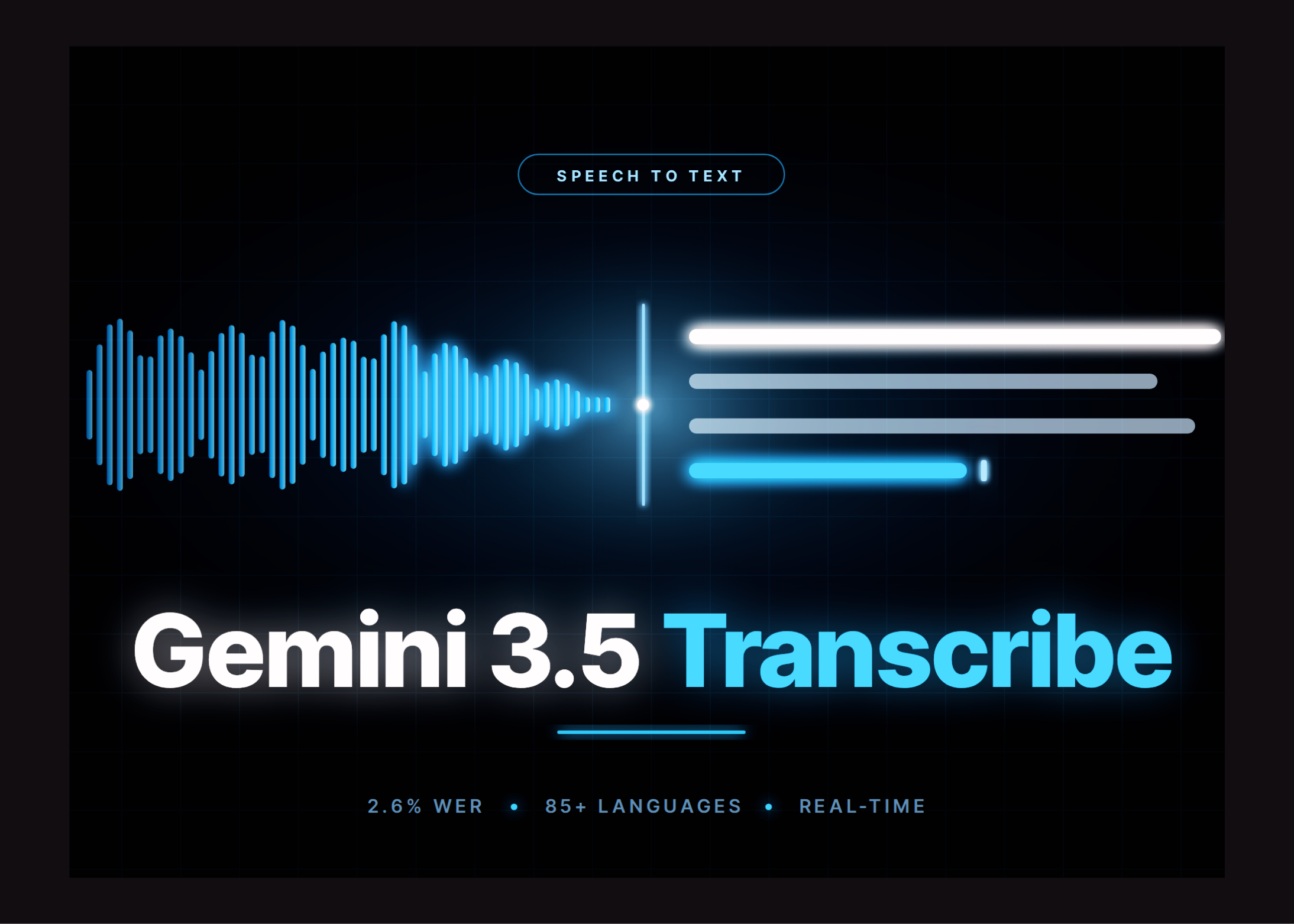
Google AI Releases Gemini 3.5 Transcribe: A Speech-to-Text Model Reporting 2.6% Average WER Across 85+ Languages
The introduction of Gemini 3.5 Transcribe is notable for enhancing speech-to-text capabilities across diverse languages, potentially benefiting numerous industries reliant on accurate voice recognition.
- Google has launched Gemini 3.5 Transcribe, a speech-to-text model designed for real-time and recorded audio processing.
- The model registers a 2.6% word error rate (WER) for non-streaming and 4.0% for streaming audio, covering over 85 languages.
- It features two API endpoints: one for pre-recorded audio and another for live streaming, each with distinct functionalities and limitations.
- The model improves transcription time by 70% compared to Google's previous version, Chirp 3.
- Developers can access the Gemini API through a free tier, with additional features available at paid levels.
Gemini 3.5 Transcribe from Google is a speech-to-text technology that enables accurate transcription in real-time and for recorded audio. This model expands upon earlier developments in AI language processing and caters to various fields, including customer service and medical documentation. Observing its application effectiveness in real-world scenarios will be crucial in the upcoming months.
Read the original ↗