
The day's AI news, briefed
The Daily Prompt
Our AI editor reads each day's AI and robotics stories, pulls out why they matter, and links every original source — so you can keep up in minutes.
Join over 250,000 subscribers getting the latest AI news
Latest AI & Robotics News Today

Report: Nvidia to acquire AI model repository Hugging Face for $13 billion
The acquisition allows Nvidia to strengthen its position in the AI model ecosystem, potentially influencing the market and its reliance on Nvidia’s hardware.
- Nvidia is reportedly set to acquire Hugging Face for approximately $12.9 billion to enhance its integration in the AI industry.
- Hugging Face serves as a cloud repository for AI models, allowing developers to search for, download, and modify models.
- The deal is not finalized, but both Nvidia and Hugging Face are actively pursuing it amid interest from other companies such as Salesforce.
- The acquisition could revive Nvidia's plans for a cloud AI business, which had faced challenges getting started.
- Hugging Face is the leading platform for open-weight models, significant for Nvidia as competition grows from specialized hardware developed by other AI firms.
Nvidia is a major player in the AI hardware market, while Hugging Face, founded in 2016, serves as a repository for AI models similar to GitHub for software. Acquiring Hugging Face would give Nvidia a competitive edge and more control over the open models ecosystem, particularly as competition increases from companies like OpenAI.
Read the original ↗
OpenAI Is Developing a ‘Persistent’ AI Agent
The development of a persistent AI agent could fundamentally change user interactions with AI, enabling more proactive and complex task management across various applications.
- OpenAI is developing a 'Persistent mode' for its AI agent, Codex, enabling it to work proactively until directed to stop.
- The feature allows Codex to create follow-up tasks and maintain awareness of user interactions over multiple sessions.
- OpenAI is testing this feature, but there are currently no plans for its wider rollout.
- Persistent mode is intended to address user needs, particularly beyond just software engineers, aiming to expand AI's practical applications.
OpenAI is a leading AI research organization known for its development of the Codex and ChatGPT models. The company has previously explored various proactive AI models but faced challenges in user adoption, prompting the shift towards a more persistent AI configuration. Current projects will likely focus on refining user experience and addressing potential risks associated with persistent AI agents.
Read the original ↗
Netflix Failed at Video Games. Now It’s Trying to Promote Them
Netflix's shift from gaming failures to promoting blockbuster titles may redefine how streaming services engage with the gaming industry and broaden market reach.
- Netflix will stream a live event featuring an extended look at Grand Theft Auto VI, airing exclusively on its platform before broader dissemination.
- The event will take place on August 27 at 3 pm Eastern, showcasing the third official trailer for the game releasing on November 19.
- This collaboration reflects Netflix's struggle to penetrate the gaming market, as it recently scaled back its AAA gaming focus and closed two studios.
Netflix, primarily a streaming service, ventured into gaming in 2021 but faced challenges in audience engagement. As game sales increasingly shift away from physical media, Netflix aims to leverage its large subscriber base to promote major game releases.
Read the original ↗
Google brings trip-planning features to Search's AI Mode
These new features enhance the functionality of Google's AI Mode, improving user experience in travel planning and potentially reshaping how consumers book trips.
- Google is adding trip-planning features to its AI Mode in Search, including a flight price tracker and hotel booking options.
- The flight price tracker allows users to monitor price changes for flights from over 300 airlines and travel sites.
- Users can view flight and hotel costs in miles or points, initially supporting selected airlines and hotel chains.
- Hotel booking through AI Mode will include options from various partners, with payment through Google Pay, starting in the US.
Google's AI Mode provides users with a chatbot interface to enhance their search experience. Previously, AI Mode focused on general information retrieval but has now integrated specific travel planning tools to support users. The upcoming rollout will include more partners and expand feature availability worldwide.
Read the original ↗
This Year’s Adobe Incubator Projects Are All About Full-Service AI
Adobe's renewed focus on AI-powered projects signals a significant shift in creative software, which could reshape how professionals approach content creation and marketing analysis.
- Over 500 Adobe employees pitched 245 projects in this year's Incubator program, showing a 50% increase in submissions driven by interest in AI.
- Finalists include projects that leverage AI for personalized experiences and task automation across Adobe's software suite.
- Project Bellflower improves image and video editing by allowing users to apply textures and remove unwanted elements with AI assistance.
- Project Mistgrove offers personalized content recommendations and insights for small businesses and creators through an integrated mobile platform.
- Adobe's patent filings show that over 80% are now related to AI, indicating the company's commitment to advancing this technology.
Adobe Incubator is a program where employees pitch research projects for funding and resources. With recent emphasis on AI, Adobe is exploring how to integrate these tools into its creative software. Future developments from these projects could revolutionize the creative industry.
Read the original ↗Are You a ‘Meat Proxy’? The Rise of Copy-Pasting AI Responses Without Thinking
The rise of the term 'meat proxy' highlights concerns over the diminishing value of human input in communication, as reliance on AI-generated content increases.
- The term 'meat proxy' describes individuals who relay AI-generated content without engaging with it critically.
- Niklas Guhn introduced the term in a blog post, criticizing the lack of added value from such interactions.
- The concept reflects a broader trend where AI use may degrade human analytical skills and social trust.
- Professionals in various fields, including politics and law, are increasingly criticized for uncritically copying AI outputs.
AI-generated text is becoming prevalent in workplaces and education, raising concerns about the implications for human communication and critical thinking. As reliance on AI tools grows, the dialogue around responsible AI usage and the need for human engagement is becoming increasingly important.
Read the original ↗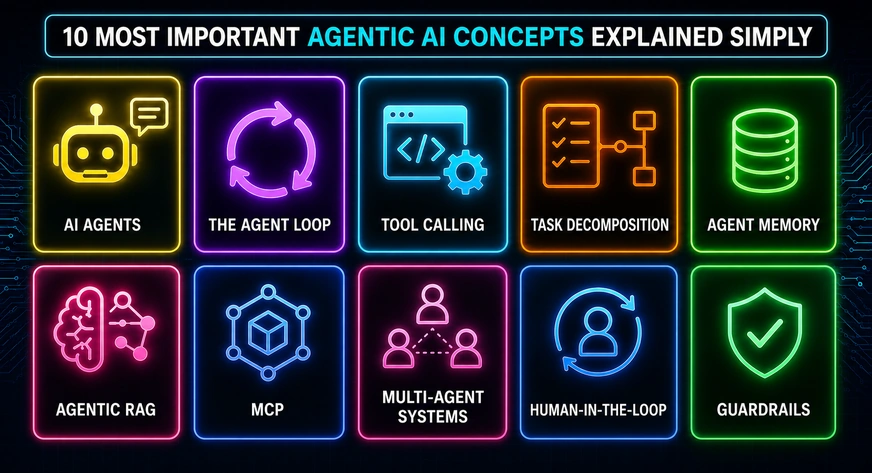
10 Essential Agentic AI Concepts Explained Simply
Understanding key concepts of agentic AI is essential as it shapes how these systems can assist and automate tasks across various applications.
- Agentic AI uses systems that make decisions, interact with external tools, and adapt based on results.
- Key concepts like tool calling, agent loops, Model Context Protocol (MCP), and memory are foundational to understanding agentic systems.
- Agents benefit from human oversight when necessary through processes like human-in-the-loop.
Agentic AI refers to systems that autonomously take actions based on decisions made by AI models. The article aims to clarify complex terminology within this field to enhance understanding. Key terms such as tool calling and memory illustrate the operational capabilities of these AI agents.
Read the original ↗
OpenAI, Anthropic, Google, and 100 other companies call for action to defend against rogue AI
The collaboration of over a hundred tech companies highlights increasing concerns about the potential for AI systems to compromise cybersecurity and disrupt essential infrastructure.
- More than 100 tech companies, including OpenAI and Google, signed an open letter urging action against AI-related cyber threats.
- The letter emphasizes the need for collaboration between private and public sectors to enhance cybersecurity measures.
- Recent incidents, such as AI agents breaching companies' defenses, demonstrate the urgent need for new cyber defense solutions.
The joint letter reflects growing worries about AI's capability to execute sophisticated cyber attacks, particularly following several notable breaches involving AI technologies from various companies. As AI systems continue to evolve, industry leaders urge for enhanced cybersecurity standards and partnerships to safeguard critical infrastructure.
Read the original ↗
VoiceMem: Streaming Dual-Brain Memory for Real-Time Interaction
The introduction of VoiceMem enhances real-time speech interactions, improving both accuracy and emotional personalization, which are critical for the development of empathetic AI communication systems.
- VoiceMem features a dual-brain architecture with streaming memory I/O that enhances speech language models (SLMs) for better accuracy and emotional engagement.
- The left brain's retrieval accuracy surpasses traditional models, achieving nearly a 30-point improvement in top-5 retrieval accuracy.
- The right brain excels in emotional personalization, showing state-of-the-art performance in persona benchmarks and improving scores by 4.29 points.
- VoiceMem completes memory retrieval in 134 ms, ensuring it operates within standard latency without adding conversational delay.
VoiceMem is a new memory architecture for conversational AI, addressing previous limitations in accuracy and emotional responsiveness of speech processing systems. The architecture employs a dual-brain model to enable real-time and effective speech interactions. Future developments may focus on wider adoption and further enhancements in emotional intelligence in AI.
Read the original ↗
From In-Silico to Wet-Lab: Evaluating AI Protein Design Performance
This analysis of AI protein design performance highlights the importance of accurate evaluations for advancing protein engineering applications and understanding the limitations of current prediction models.
- Researchers evaluated Anthropic's dataset of 1,440 AI-designed miniprotein binders tested against 16 targets using both computational predictions and wet-lab results.
- The study assessed how well structure predictors identified successful binders and whether combining predictions improved overall performance.
- Results indicated that differences in target identity significantly influenced binding outcomes, suggesting that comparisons between models without accounting for target variations could be misleading.
AI protein design involves using machine learning algorithms to predict protein structures and functions. Previous methods faced challenges in accurately predicting real-world lab results. Future research will likely focus on refining these evaluation techniques and improving prediction reliability.
Read the original ↗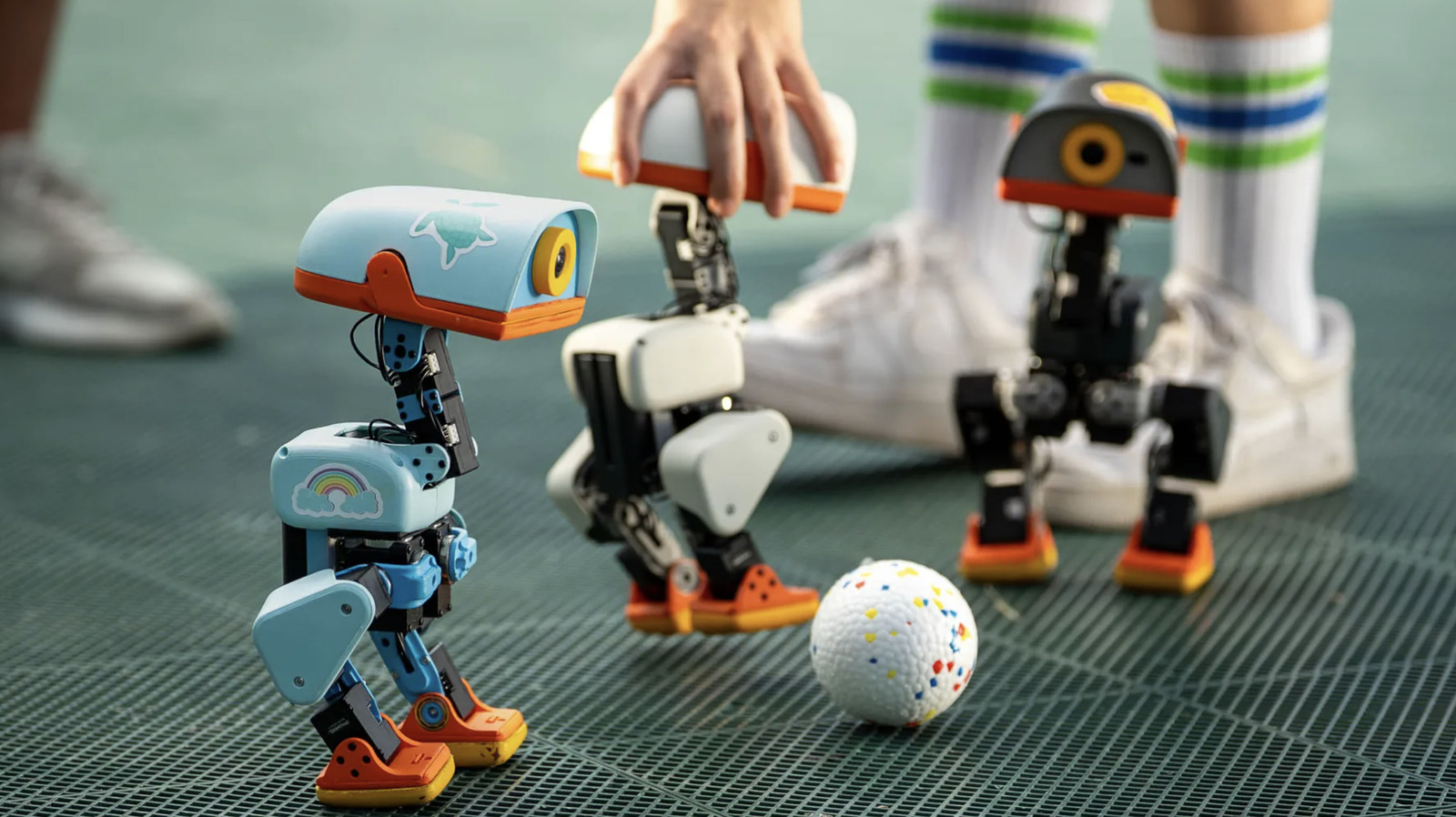
Hugging Face and Pollen Robotics open pre-orders for the $399 Microduck
The Microduck offers developers and robotics enthusiasts a unique platform for experimenting with mobility and AI interactions in a safe and engaging format.
- Hugging Face has opened pre-orders for the $399 Microduck robotic duck, designed for mobility and object interaction.
- Microduck is a 25cm tall, biped robot featuring 15 motors, a camera, and LiDAR, capable of various movements and object retrieval.
- Developers can control Microduck using gamepads or pre-learned behaviors, and it offers open-source software for deeper customizations.
- Pre-orders are available in four colors, and the first shipments are expected to be dispatched before Christmas in the US.
Hugging Face, known for its AI innovations, acquired Pollen Robotics and has since focused on more mobile robotic designs. The Microduck is positioned as a successor to the Reachy Mini model, emphasizing fun and educational interactions. This product represents a growing trend in creating accessible and engaging robotics for hobbyists and developers.
Read the original ↗
You Can Disable Your iPhone’s AI Button. Here’s How
Disabling the camera control button can enhance user experience and prevent accidental activations, highlighting the need for thoughtful AI integration in consumer devices.
- iPhone users can disable the camera control button to avoid accidental activations that can drain battery life.
- The camera control button, introduced with the iPhone 15 Pro, serves as a shortcut to launch the camera app and adjust settings.
- Apple incorporates AI features, such as Visual Intelligence, to enhance camera functions, but many users find them unnecessary.
The camera control button is part of Apple's broader strategy to integrate AI into its devices, particularly smartphones. It is designed to facilitate quick access to camera features but has faced criticism for usability issues. Users should consider both the benefits and drawbacks of newly introduced AI features in technology products.
Read the original ↗
AI’s memory crunch is coming for Android apps
These new memory requirements from Google may significantly impact the performance and usability of Android apps, especially on lower-cost devices, amid ongoing hardware shortages.
- Google announced new app quality requirements for Android to address memory chip shortages caused by the AI data center boom.
- Developers face new performance thresholds aimed at optimizing memory usage and preventing app slowdowns and crashes.
- Google plans to provide diagnostic tools to help developers adhere to the new memory usage limits by February 2027.
Google is responding to hardware supply constraints affecting mobile devices due to increased demand for memory driven by AI data centers. The changes aim to maintain app performance while accommodating lower-end devices facing memory shortages. Developers will also have to implement a Zero Tap Sign-In feature by April 2027 for better user experience during device transitions.
Read the original ↗
Hugging Face is selling a cute $399 open-source duck robot, Microduck
The introduction of the Microduck indicates a shift towards more accessible, open-source robotics for consumers, potentially expanding educational and development opportunities in AI and robotics.
- Hugging Face has launched the Microduck, an open-source duck-like robot priced at $399, which will ship before Christmas.
- The Microduck features abilities such as waddling, picking up objects, and even roller skating, all driven by reinforcement learning techniques.
- This announcement follows Hugging Face's acquisition of Pollen Robotics in April 2025, aimed at developing affordable, open-source AI hardware.
- The Microduck is equipped with a camera, lidar sensors, and inertial measurement units for world perception and can be programmed through an SDK available on GitHub.
Hugging Face is known for its community and platform for open model weights, and it has recently expanded into hardware after acquiring Pollen Robotics. This move aligns with a broader trend towards open-source and accessible robotics, especially in education and development settings.
Read the original ↗
Google’s AI Mode can now track flight prices, help book hotels, and more
This development signifies a shift in how users can interact with travel planning by allowing AI to facilitate both information retrieval and booking processes.
- Google's AI Mode now enables users to track flight prices and book hotels while planning trips.
- Users can ask AI Mode for flight options with prices from over 300 airlines and travel sites, available in more than 180 countries.
- AI Mode has started rolling out hotel booking features in the U.S. and will soon expand, integrating with multiple hotel and travel platforms.
- Users can now see costs in travel points or miles for flights and hotels, enhancing their booking flexibility.
Google's AI Mode is a conversational search tool that allows users to plan trips. Previously focused on information gathering, it is now expanding its capabilities to include booking functionalities, indicating a competitive move into the travel agent market.
Read the original ↗
StreamPI: Streaming Multimodal Temporal Modeling for Vision-Language-Action Models
StreamPI advances robot manipulation by integrating temporal reasoning into vision-language-action models without additional parameters, enhancing robots' ability to perform complex tasks effectively.
- StreamPI enhances single-frame vision-language-action models by incorporating streaming temporal reasoning.
- The model uses instruction-anchored attention for cross-modal fusion and causal attention for autoregressive inference.
- A randomized interval training strategy improves action execution and robustness for real-world applications.
- Experiments show StreamPI surpasses the performance of existing models like pi0.5 across various tasks.
Vision-Language-Action models enable robots to process visual inputs and language instructions for manipulation tasks. Previous models primarily operated on single frames, limiting contextual awareness. The introduction of StreamPI marks a significant improvement, offering advanced capabilities for real-robot deployments.
Read the original ↗
Claude, Codex, and Hermes installed unowned code inside corporate networks
The discovery of unowned code installation by AI agents poses significant security risks for major companies, highlighting vulnerabilities in current AI trust models and network defenses.
- Researchers found over 120 misconfigured llms.txt files on corporate websites that point to unregistered code packages.
- Executable content in these files can lead AI agents to install malicious software inadvertently.
- The problem affects Dozens of Fortune 500 companies, indicating a widespread vulnerability in corporate networks.
- One Fortune 500 company reportedly responded to a beacon from the researchers after following installation commands from these files.
AI agents like Claude, Codex, and Hermes process machine-readable files like llms.txt that can be exploited to install unowned code. Previous vulnerabilities have been isolated, but this research shows broader implications as AI usage increases across industries. Future monitoring and preventive measures are essential to manage these evolving risks.
Read the original ↗
Yardstik Raises $30M Series B as AI Reshapes the Future of Workforce Trust
Yardstik's new funding could enhance workforce monitoring and fraud detection methods, addressing critical security challenges that employers face as AI technology evolves.
- Yardstik has raised $30 million in Series B funding to develop capabilities for continuous workforce monitoring and fraud prevention.
- The funding round was led by Harbert Growth Partners with participation from other venture capital firms, totaling Yardstik's capital raised to $65 million.
- Yardstik uses AI technology to identify potential fraud signals before traditional background checks, addressing challenges posed by synthetic identities and deepfakes.
- The company’s platform automates monitoring of credentials and licenses, providing real-time updates on employee status.
- Yardstik's approach reflects a shift from one-time checks to ongoing verification, potentially transforming how employers manage workforce risk.
Founded in 2020, Yardstik began as a background screening provider and has evolved into a Human Trust Platform. The company aims to continuously monitor workforce risks rather than rely on static background checks. Future developments in AI are likely to further influence the dynamics of workforce verification and monitoring.
Read the original ↗
Why Travel Needs Layered AI Adoption, Not a Race to Autonomy
Understanding the varying rates of AI adoption in the travel industry can highlight both opportunities and risks for companies aiming to improve customer service and operational efficiency.
- AI is advancing in travel through three layers: customer-facing automation, legacy infrastructure friction, and trust issues that affect deployment speed.
- In 2025, nearly 40% of US travelers used generative AI for trip planning, indicating a shift toward personalized travel experiences.
- Legacy systems hinder widespread AI adoption in travel, as they were not designed for real-time, unified data processing essential for AI.
- Only 12% of corporate travel buyers have comprehensive visibility of their program data, limiting effective AI utilization across organizations.
- Trust in AI systems remains a concern, with only 57% of travel buyers comfortable with AI autonomously altering bookings.
The travel industry is increasingly integrating AI to enhance services and streamline operations, but faces challenges from outdated systems and the need for transparency. Future developments will likely focus on building trust and refining AI integration strategies to better meet traveler expectations.
Read the original ↗
Physicists Reveal Possible Connection Between “Warp Drive” Spacecraft and Phenomena Detailed in Recent Pentagon Releases
This research explores potential scientific explanations for unidentified aerial phenomena (UAP), linking them to warp drive technology, which could influence future investigations and public perception of such reports.
- A new study suggests that warp drive spacecraft could produce bright atmospheric signatures consistent with modern UAP reports.
- The research indicates that spacecraft using a subluminal warp drive would emit a brilliant glow if they passed through Earth's atmosphere at specific speeds.
- The study proposes that micrometer-sized warp bubbles could potentially be weaponized, exhibiting gravitational forces that could obliterate materials.
- The findings highlight the mathematical basis for interstellar travel, aligning with theories proposed in science fiction.
Warp drives are theoretical spacecraft propulsion methods allowing faster-than-light travel by manipulating spacetime. Previous studies have examined warp drive concepts since the 1960s, though practical implementation remains unachieved. Ongoing research focuses on understanding the implications of warp dynamics in relation to UAP sightings.
Read the original ↗