
The day's AI news, briefed
The Daily Prompt
Our AI editor reads each day's AI and robotics stories, pulls out why they matter, and links every original source — so you can keep up in minutes.
Join over 250,000 subscribers getting the latest AI news
Latest AI & Robotics News Today

How to Keep AI Characters Consistent Across 10+ Microdrama Episodes
This guidance on maintaining character consistency in AI-generated microdramas is crucial for preserving viewer trust and enhancing engagement in episodic storytelling.
- Consistent character portrayal across episodes is vital, as even minor changes can disrupt viewer trust in a microdrama series.
- AI generation models typically lack memory, making it challenging to keep characters visually consistent without proper context provided.
- Effective character reference sheets should include multiple images from various angles to prevent discrepancies across different episodes.
Creating realistic AI-generated characters in microdramas requires careful tracking of visual details and story changes. Inconsistent character depiction can lead to viewer confusion and a decline in engagement. Future developments may introduce enhanced tools for automating character continuity management.
Read the original ↗
UK Launches £100M Sovereign AI Procurement Competitions for Public Services
This initiative aims to enhance the capabilities of British AI startups, fostering innovation in public services while addressing barriers that limit smaller firms from government contracts.
- The UK government has launched a £100 million Sovereign AI R&D Procurement Scheme to support British AI startups.
- Four procurement competitions will focus on developing AI systems for the NHS, defence, computing efficiency, and AI security.
- Successful firms will retain intellectual property rights, allowing for further development of their technologies in the commercial market.
- The competition aims to support the NHS's 10 Year Health Plan and improve public AI computing infrastructure, among other goals.
The Sovereign AI initiative, launched in April 2026, aims to assist UK AI companies in competing globally by removing public procurement barriers. This scheme is part of the government's broader strategy to leverage AI for public services and drive economic growth.
Read the original ↗
FSB Chair Warns G20 That Frontier AI Could Amplify Cyber Risk
The warning from the FSB Chair highlights the potential for frontier AI to exacerbate cyber risks, which could undermine financial stability globally.
- Bank of England Governor Andrew Bailey warned G20 finance ministers that frontier AI could significantly change cyber risk dynamics in the financial sector.
- Bailey highlighted that the interconnected global financial system is vulnerable to cyber disruptions that could spread across borders.
- Firms must enhance their vulnerability management and recovery processes due to the fast pace of potential cyber threats associated with frontier AI.
The Financial Stability Board (FSB) coordinates financial regulation among countries. In light of emerging frontier AI models, the FSB emphasizes the need for global frameworks to manage associated cyber risks.
Read the original ↗
What Is Grok? Everything to Know About Elon Musk’s AI Tool
The development of Grok highlights ongoing innovations and challenges in AI, particularly regarding how chatbots can influence information dissemination on social platforms like X.
- Grok is an AI chatbot launched by Elon Musk's startup xAI in November 2023, designed to compete with similar tools like ChatGPT and Claude.
- Initially exclusive to paying X subscribers, Grok is now accessible via grok.com, Android, iOS apps, and in Tesla vehicles.
- The latest model, Grok 4.6, released in August 2026, specializes in coding, complex tasks, and agentic behavior, expanding its utility beyond conventional chat.
- Grok integrates real-time data from X, enhancing its responsiveness but raising concerns over misinformation and safety due to its unmoderated environment.
- SpaceX acquired xAI in February 2024, placing Grok under the SpaceXAI umbrella, which links it closely to Musk’s other ventures.
Grok is an AI chatbot developed by xAI, the company founded by Elon Musk in July 2023. It originally aimed to leverage humor and sarcasm similar to Musk's style while offering advanced AI functionalities. Following a corporate acquisition, Grok has continued to evolve with updates that enhance its capabilities.
Read the original ↗
DiDi Starts Driverless Trials With R2 Robotaxi in Beijing and Guangzhou
The trials of DiDi's R2 Robotaxi are significant as they contribute to the advancement of fully autonomous transportation, potentially transforming urban mobility.
- DiDi Autonomous Driving launched fully driverless passenger service trials with its R2 Robotaxi on August 31, 2026, in select areas of Beijing and Guangzhou.
- The R2 features enhanced safety and performance, meeting five-star standards in Chinese and European safety assessments and utilizes 33 sensors for improved navigation.
- Developed in partnership with GAC Aion, the R2 is equipped with advanced technology including a central computing platform with over 2,000 TOPS of GPU power for better processing capabilities.
DiDi Autonomous Driving specializes in developing autonomous vehicle technology and began public trial operations with Robotaxis in China, reflecting a growing trend towards driverless transport services. The R2 has previously undergone public road testing and is part of a continued rollout of intelligent connected vehicle initiatives, including future plans for international expansion.
Read the original ↗
The 10 Best AI Meeting Assistants in 2026 (Ranked and Compared)
The growing reliance on AI meeting assistants shows the shift in how teams are maximizing efficiency, particularly through improved transcription and integration features.
- Fathom ranked first among AI meeting assistants for its transcription accuracy and generous free features, including unlimited recordings across popular platforms like Zoom and Google Meet.
- Fireflies.ai serves over 1 million users, including many Fortune 500 companies, with an emphasis on CRM automation and user-friendly structuring of meeting data.
- Other notable tools include Avoma, which bundles multiple features for revenue teams at competitive prices, and Krisp, which enhances audio quality by removing background noise.
AI meeting assistants are specialized tools designed to record and transcribe meetings and integrate with customer relationship management (CRM) systems. The current landscape features various options, each focused on improving meeting efficiency through different capabilities and pricing models. Future developments may include enhancements in AI features and user interfaces as demand grows.
Read the original ↗
Sonara AI: Can AI Job Search Really Help You Find a Job?
Understanding the strengths and weaknesses of Sonara AI helps job seekers make informed decisions about using AI-driven auto-apply tools in their job search process.
- Sonara AI is an auto-apply platform that submits job applications based on user-uploaded resumes and job preferences.
- The platform was relaunched after a previous shutdown in February 2024 due to funding issues, now owned by BOLD.
- User reviews reflect polarized experiences, with 65% giving five stars and 17% giving one star, highlighting issues with application reliability and job matching accuracy.
- Sonara's application failure rate is reported between 25% and 40%, affecting how many applications actually reach employers.
- The pricing model includes a $2.95 trial for 14 days, renewing into a $23.95 subscription, which can lead to unexpected charges if canceled late.
Sonara AI is part of a category of job search tools that automate the application process, allowing users to apply to multiple jobs quickly. The platform's previous iteration experienced a shutdown that affected user trust, and its current ownership aims to improve reliability. Auto-apply tools like Sonara may save time, but they often struggle with job relevance and application quality.
Read the original ↗
The U.S. is building barriers around drones and robots, but China has scale to get around them
The U.S. restrictions on foreign-made drones and robots may hinder American competitiveness, while Chinese manufacturers could capitalize on these barriers to expand their global presence.
- The U.S. has imposed stricter tariffs on foreign-made drones and advanced robotics, citing national security concerns.
- Chinese manufacturers dominate global humanoid robot production, accounting for 86% of shipments in early 2026.
- Restrictions may lead to a fragmented global robotics market, with Chinese firms expanding into developing regions where automation is needed.
The U.S. is tightening its regulations on foreign technology, particularly in robotics and drones, while China maintains a strong manufacturing base. The competition in the robotics industry may increasingly shift to regional markets as companies adapt to different demands and security needs.
Read the original ↗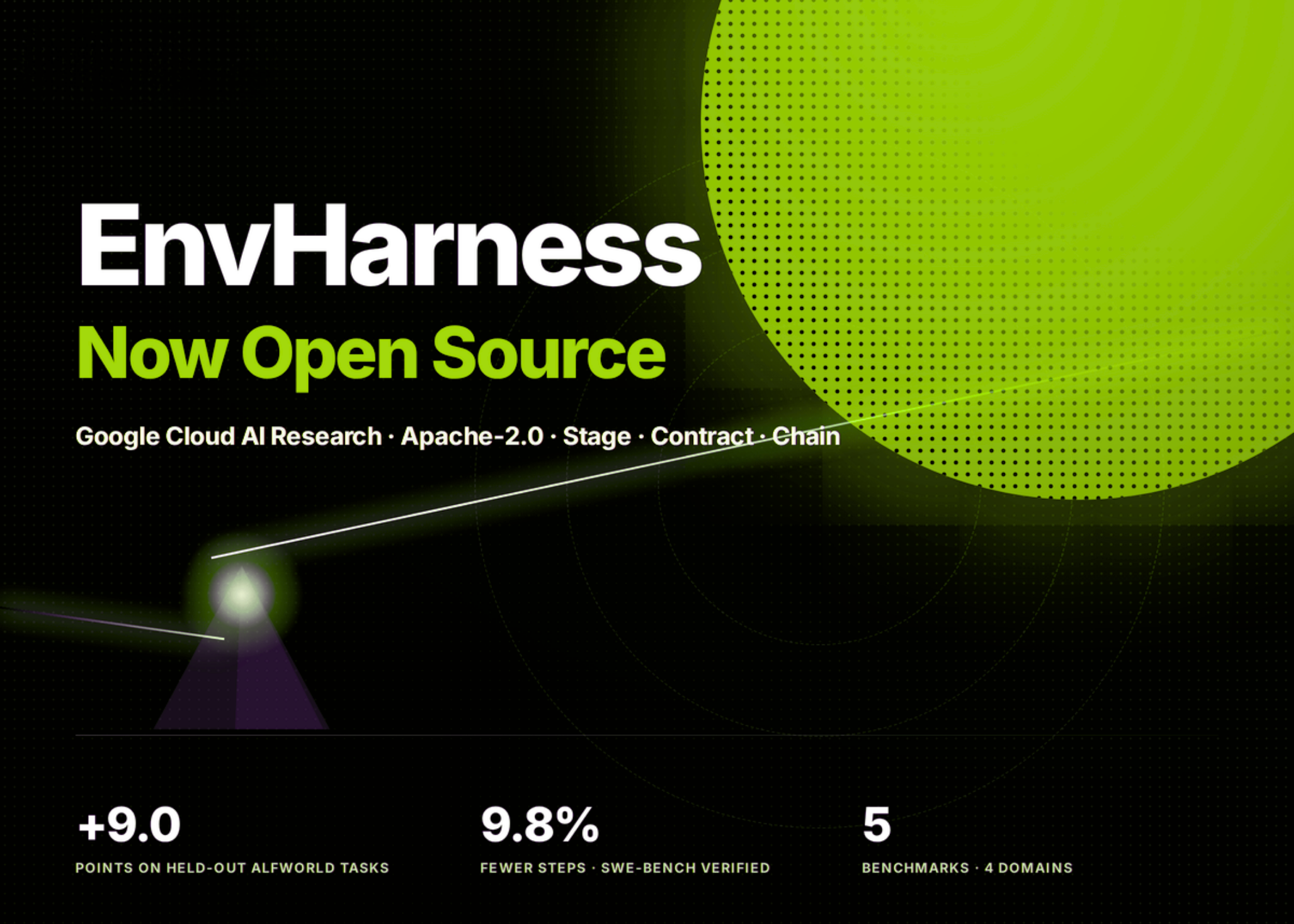
Google AI Introduces EnvHarness: A Programmable Layer That Turns Static Agent Environments Into Adaptive Training Worlds
EnvHarness enhances the adaptability and efficiency of training environments for large language model (LLM) agents, potentially improving their effectiveness in real-world applications.
- Google AI has introduced EnvHarness, a programmable layer that adapts static agent environments without modifying their underlying code.
- EnvHarness wraps existing environments with plug-in components, enabling LLM agents to learn from interactive scenarios rather than fixed ones.
- The new tool has demonstrated improvements across five benchmarks, increasing performance by up to 9.0 points while reducing execution steps by 9.8%.
- Three core components—Stage, Contract, and Chain—modify episode start points and interaction rules without altering the original tasks or verifiers.
- EnvHarness ships with Apache-2.0 Python code and requires resettable environments for implementation.
EnvHarness is developed by researchers from Google Cloud AI Research and universities to enhance how LLM agents learn through adaptable environments. Traditional methods required creating new environments, but EnvHarness allows for dynamic adjustments to existing static environments. The tool aims to replace the need for domain-specific training setups and maximize learning efficiency for AI agents.
Read the original ↗
Caterpillar is bringing to AI deployment what it learned from automating mining
Caterpillar's experience in automating mining operations provides insights into overcoming deployment challenges of AI technology in dynamic work environments, impacting industries reliant on automation.
- Caterpillar has leveraged decades of experience in automating mining to enhance AI deployment in various industries such as construction and quarries.
- The company is developing tools like the Cat AI Assistant for technicians, allowing voice commands to access repair information on-site.
- Caterpillar plans to invest $100 million over the next five years to train its 118,000 employees on AI and autonomy technologies.
- The company reported record quarterly revenue of $20.5 billion, driven by demand for power-generation equipment supporting AI infrastructure.
- Caterpillar currently manages about 1.6 million connected assets globally, generating over 16 petabytes of structured data.
Caterpillar has historically been an industrial leader in automation, particularly within the mining sector. The company's shift towards integrating AI into diverse operational workflows comes as industries increasingly seek efficiency in automation. Future developments will likely focus on enhancing AI applications and workforce training to adapt to newly developed technologies.
Read the original ↗
#527 Schools are choosing opposite futures for AI
The contrasting AI policies at educational institutions highlight a significant division in how education is adapting to technological advancements, affecting future learning models and student assessment methods.
- The University of Chicago's curriculum will prohibit AI-assisted writing and limit technology use in classrooms for the upcoming academic year.
- Alpha School is expanding its model to approximately 50 US campuses, focusing on adaptive software as a core teaching tool.
- Both institutions represent differing philosophies on AI in education, with UChicago emphasizing traditional learning processes and Alpha advocating for technology integration into the curriculum.
The University of Chicago and Alpha School are redefining educational approaches to AI, showcasing a split between traditional methods and technology-driven models. Observers are watching for broader implications for educational policies as these models influence future practices.
Read the original ↗
Sony and Warner Chappell Sue Anthropic Over Claude Lyric Training
This lawsuit could significantly impact AI model training practices and copyright enforcement in the music industry, setting a potential legal precedent for content usage without licenses.
- Sony Music Publishing and Warner Chappell Music filed a lawsuit against Anthropic and its co-founders on August 28, 2026, alleging illegal copyright infringement.
- The complaint accuses Anthropic of using tens of thousands of copyrighted musical compositions to train its Claude AI models without authorization.
- Plaintiffs allege that Anthropic engaged in activities like torrenting, scraping lyrics from licensed websites, and altering copyright management information during model development.
- The lawsuit seeks up to $150,000 in statutory damages per allegedly infringed work and requests the destruction of all infringing copies under court supervision.
Sony Music Publishing and Warner Chappell Music are prominent entities in music publishing, representing various artists and songwriters. This lawsuit follows previous litigation against Anthropic for similar copyright violations involving pirated books, indicating ongoing scrutiny of intellectual property usage in AI development. The outcome may influence future AI training methods and copyright law enforcement.
Read the original ↗
What Is Platform Engineering? Platforms, Developer Experience, and Guardrails
Understanding platform engineering is crucial as organizations increasingly adopt these practices to enhance developer experience and streamline software delivery through self-service workflows.
- Platform engineering builds shared internal capabilities to aid software teams in application delivery using self-service workflows.
- It focuses on reducing cognitive load and lead time while improving reliability and security for developers.
- Essential elements include user feedback, measurable outcomes, and maintaining clear responsibilities between application and platform teams.
Platform engineering organizes operational capabilities into user-friendly formats for developers, facilitating easier access to resources such as APIs and CI/CD pipelines. As teams strive for more efficient software deployment, establishing robust internal platforms is becoming increasingly important for maintaining reliability and improving user experiences.
Read the original ↗
What Is Agentic AI? How Systems Plan, Use Tools, and Complete Tasks
Understanding agentic AI is essential as it represents a significant shift in how artificial intelligence systems can autonomously achieve complex goals, impacting various industries and applications.
- Agentic AI systems enable autonomous task completion through a feedback loop of planning, execution, observation, and adaptation.
- These systems operate beyond traditional responses, allowing them to manage tasks across multiple domains, like data analysis and software engineering.
- Agency in AI exists on a spectrum, with varying degrees of autonomy in how tasks are approached and executed.
Agentic AI refers to AI systems that pursue goals through a structured process rather than providing a single response. This builds on previous AI developments that emphasized straightforward task completion and sets the stage for future advancements in self-directed AI applications.
Read the original ↗
Faster Video Diffusion with Trainable Sparse Attention
The introduction of trainable sparse attention could significantly enhance the efficiency of video diffusion models, enabling more powerful and faster AI-generated video content.
- Trainable sparse attention (VSA) reduces the computational cost of video diffusion transformers while maintaining performance.
- VSA enables scaling of video diffusion transformers by replacing full attention with a more efficient, trainable sparse method.
- The method achieved a reduction in training FLOPS by 2.53 times without increasing diffusion loss.
- Retrofitting the Wan-2.1 model with VSA decreased end-to-end generation time from 31 seconds to 18 seconds, retaining quality.
Video diffusion transformers (DiTs) face scaling challenges due to their quadratic 3D attention mechanism. The introduction of VSA, a more efficient attention method, could facilitate further advancements in the generation speed and quality of video content. Future developments will likely focus on optimizing VSA for broader applications in AI-generated video.
Read the original ↗
SPEED-Bench: A Unified and Diverse Benchmark for Speculative Decoding
The introduction of SPEED-Bench standardizes the evaluation of speculative decoding, which is vital for improving the performance of large language models in real-world applications.
- SPEED-Bench provides a comprehensive evaluation suite for speculative decoding (SD) across diverse semantic domains and realistic serving environments.
- Current benchmarks are limited in task diversity and do not accurately reflect performance in production systems, necessitating SPEED-Bench's development.
- The benchmark includes a Qualitative data split for measuring speculation quality and a Throughput data split for assessing speed under various load conditions.
Speculative decoding (SD) is a technique used to accelerate inference in large language models (LLMs). Existing benchmarks have not provided adequate diversity or realism for performance evaluation. SPEED-Bench aims to fill this gap by integrating standardized methodologies suited for practical applications.
Read the original ↗
Anthropic Opens a Research Preview of the Model Hardware Standard (MHS):...
The Model Hardware Standard (MHS) aims to significantly reduce the setup time for AI agents operating physical devices, potentially transforming workflows in laboratories and production environments.
- Anthropic has launched a research preview of the Model Hardware Standard (MHS), which standardizes how AI agents discover and operate physical devices.
- MHS reduces integration setup times from weeks to hours by allowing devices to communicate without bespoke translators.
- The standard includes a small set of commands and safety tags to enhance user interaction and automate operations across incompatible devices.
The Model Hardware Standard (MHS) is intended to streamline the interaction between AI agents and various lab instruments, addressing interoperability issues in complex setups. Previous methods required extensive custom programming and coordination among devices. Moving forward, monitoring how well MHS performs in diverse laboratory settings will be crucial.
Read the original ↗
India’s Airbound bags $37M to take on trucks with rocket-like drones
The funding allows Airbound to advance its drone technology in quest of replacing traditional trucking for deliveries, potentially transforming logistics in India.
- Indian startup Airbound has raised $37 million in a Series A funding round led by Greenoaks.
- The company is developing lightweight autonomous drones designed to reduce transportation costs compared to road trucking.
- Airbound aims to create a drone delivery network in Andhra Pradesh with a target of 10,000 daily flights across three cities.
- The startup has completed over 13,000 flights, including transporting diagnostic samples for a hospital network in India.
- Airbound is working on regulatory approvals for beyond visual line of sight flight operations, essential for expanding its delivery services.
Airbound, founded in 2023, focuses on creating ultra-lightweight drones for logistics. The startup builds its aircraft in Bengaluru and has plans for significant growth amid evolving drone regulations in India. Similar companies are emerging, highlighting a competitive landscape in drone delivery.
Read the original ↗
JIT-Agent: Scaling Harness Intelligence via Just-in-Time Harness Evolution
JIT-Agent introduces a method for adaptable agent harnesses that could significantly enhance the performance of existing language models in various tasks and contexts.
- JIT-Agent is a model that synthesizes adaptive agent harnesses for pre-existing large language models (LLMs).
- The agent harness encompasses components like memory management and action protocol, playing a crucial role in overall performance.
- JIT-Agent can customize and repair harnesses in real-time, evolving based on performance data from previous configurations.
- DeepSeek-V4-Flash, equipped with JIT-Agent, outperforms GPT-5.6 on specific benchmarks by significant margins.
- JIT-Agent-generated harnesses compete with established runtimes, enhancing various model families.
Just-in-time harness generation represents a new frontier in agent capabilities, allowing for scalable and adaptive solutions in LLM applications. Prior approaches to harness design were often manual and limited in scalability. The emergence of JIT-Agent marks a significant shift towards more autonomous and efficient harness development in AI.
Read the original ↗
Sony and Warner sue Anthropic for 'blatant violation' of copyright law
This lawsuit could significantly impact the legality of using copyrighted materials for training AI, potentially leading to substantial financial consequences for Anthropic and similar tech companies.
- Sony Music Publishing and Warner Chappell Music have sued Anthropic, alleging thousands of copyright infringements.
- The lawsuit claims Anthropic engaged in illegal activities like torrenting and scraping copyrighted music to train its Claude AI models.
- Damages sought include $150,000 for each infringing work and $25,000 for each instance of removed copyright management information.
Anthropic develops AI models, including Claude, and has faced multiple copyright lawsuits over its data usage. Earlier this year, two major music publishers sued Anthropic for similar allegations, seeking over $3 billion in damages. This ongoing legal scrutiny highlights the contentious relationship between AI development and intellectual property rights.
Read the original ↗