
The day's AI news, briefed
The Daily Prompt
Our AI editor reads each day's AI and robotics stories, pulls out why they matter, and links every original source — so you can keep up in minutes.
Join over 250,000 subscribers getting the latest AI news
Latest AI & Robotics News Today

InfraRSI: Harnessing Recursive Self-Improvement for Training Infrastructure
This development in AI training infrastructure has the potential to significantly improve efficiency and performance in distributed training of large language models (LLMs).
- InfraRSI is designed to optimize hardware by locking editable scopes and established timeframes to prevent internal modifications that could lead to reward-hacking.
- The system achieves a speedup of up to 2.75 times and increases mean Model FLOPS utilization from 17.4% to 30.0%.
- InfraRSI employs a two-level Recursive Self-Improvement loop, continuously transferring knowledge across clusters to enhance model scaling.
Recursive Self-Improvement (RSI) refers to AI systems that enhance their own performance through iterative learning and optimization. The technology context includes ongoing advancements in training methods for large language models (LLMs). Future developments may focus on refining these training infrastructures and expanding their applicability across different AI models.
Read the original ↗
OpenAI Quarterly Revenue Rises About 50% as Operating Loss Widens
OpenAI's significant revenue growth amidst widening losses highlights the operational challenges in scaling AI technologies and the importance of customer adoption for financial stability.
- OpenAI reported third-quarter revenue of approximately $10 billion, representing a roughly 50% increase year-over-year.
- The company's operating loss increased to $10.9 billion, up from $10.1 billion in the previous quarter.
- OpenAI's adjusted operating margin improved to negative 109%, an enhancement from negative 150% in the prior quarter.
- Enterprise customers accounted for over 40% of revenue, with plans to reach parity with consumer revenue by the end of 2026.
- ChatGPT reached 900 million weekly users, with notable new enterprise clients including Goldman Sachs and State Farm.
OpenAI specializes in advanced AI technologies and has rapidly expanded its revenue streams through consumer and enterprise offerings. Despite the growth, the company faces challenges in matching revenue growth with increasing operational costs. Future developments will focus on whether customer adoption can help reduce operational losses while maintaining compute capacity.
Read the original ↗
AMD Releases Zen 6 EPYC Chips for Denser AI Agent Deployments
The launch of AMD's Zen 6 EPYC chips is significant because it enables denser AI agent deployments, enhancing processing capabilities for enterprise applications and large-scale AI workloads.
- AMD released its sixth-generation EPYC SP7 server processors on November 10, 2026, aimed at AI agent execution and enterprise applications.
- The EPYC 9006 SP7 range includes processors that offer 64 to 256 cores and supports simultaneous multithreading, enhancing performance for AI tasks.
- Microsoft Azure and Oracle Cloud Infrastructure are expected to begin shipping systems with these new processors shortly after their release.
EPYC processors are designed for server use, optimizing performance for high-demand workloads. This new generation emphasizes AI capabilities, competing with Intel's Xeon and addressing the growing need for efficient cloud computing solutions.
Read the original ↗
Anthropic Opens Australian Retail Offer for Its Planned Nasdaq IPO
Anthropic's IPO presents a significant opportunity for retail investors to participate in the public offering of a key player in the AI industry ahead of its Nasdaq listing.
- Anthropic has opened its Australian retail share offer at 10:00 a.m. AEDT on November 11, 2026, through broker Stake.
- Eligible investors can apply for Class A shares with a minimum application of US$500 and a maximum of US$50 million.
- The IPO is expected to price on November 18, 2026, ahead of public trading on November 19, 2026.
- Applicants will not know how many shares they will receive until allocations are confirmed and can cancel their requests until November 17, 2026.
- Anthropic's move to the Nasdaq excludes a listing on the Australian Securities Exchange.
Anthropic is an artificial intelligence company planning an IPO on the Nasdaq Global Select Market. This Australian retail offer allows individual investors to buy shares before the company goes public. The broader IPO involves 825 million Class A shares at an expected price between $70 and $78 each.
Read the original ↗
ELECTRA AI Raises $5M Bridge Financing to Support Commercial Execution
The funding aims to enhance ELECTRA AI's commercial capabilities in battery technology and prepares the company for a potential public listing on Nasdaq, impacting future investment and growth.
- ELECTRA AI secured approximately $5 million in bridge financing to support its commercial operations in electric mobility and energy storage.
- The financing accompanies an amended registration statement for a proposed merger with Iron Horse Acquisition II Corp., aiming for a first quarter 2027 closing.
- The merger has an initial purchase price of $250 million, with potential adjustments for options and earnout shares.
- ELECTRA's AI technology focuses on optimizing battery systems and targets sectors like renewable energy and autonomous robotics.
- The companies expect to list on Nasdaq under the ticker AIBR, pending necessary approvals and shareholder conditions.
ELECTRA AI, co-founded in 2015, specializes in advanced battery management systems using artificial intelligence. The company is currently at an early commercialization stage, working towards a public listing to further its growth in the energy sector.
Read the original ↗Google Expands Gemini 4 Carbon Availability
Wider access to Google's Gemini 4 Carbon model enables professionals in various fields to leverage advanced AI capabilities for tasks such as coding, scientific research, and cybersecurity.
- Google has expanded the availability of its Gemini 4 Carbon AI model to developers, enterprises, scientists, and consumers two weeks after its initial announcement for cybersecurity professionals.
- Gemini 4 Carbon reportedly outperforms the previous Argon AI model and competing models from OpenAI and Anthropic in several benchmark tests.
- The model features enhancements in areas like spatial reasoning, physics simulations, and agentic coding, making it suitable for advanced applications, especially in 3D game development.
Gemini 4 Carbon is Google's latest AI model designed to address various professional needs, particularly in cybersecurity and knowledge work. Previous Gemini iterations have had success in applications like coding and gaming. Moving forward, observing how this model influences AI development and user application will be crucial.
Read the original ↗
Waymo robotaxis kept illegally passing school buses after software fix, feds say
Federal regulators are investigating Waymo after its robotaxis continued to illegally pass stopped school buses, raising concerns about the effectiveness of autonomous vehicle safety measures.
- Waymo's self-driving software update issued in November 2025 failed to prevent robotaxis from passing stopped school buses with flashing red lights.
- The National Highway Traffic Safety Administration (NHTSA) reported that most incidents occurred after the software fix was deployed.
- An initial investigation was opened in October 2025 after footage showed a Waymo vehicle maneuvering around a stopped school bus in Atlanta.
- Austin officials document at least five similar incidents involving Waymo robotaxis since the software update.
Waymo, a subsidiary of Alphabet, operates a robotaxi service using autonomous vehicles. After a software recall in 2025 aimed at improving safety around school buses, the continued violations prompted a federal investigation to assess the effectiveness of the update.
Read the original ↗
Bay Raises $37M Series A to Scale Enterprise AI Agent Security
Bay's funding allows it to expand its AI security platform, crucial for enterprises adopting AI agents while maintaining stringent controls and safety measures.
- Bay raised $37 million in a Series A funding round led by Battery Ventures, bringing its total funding to $50 million.
- The startup emerged from stealth with a platform designed to safely manage enterprise AI agent actions in real-time.
- Bay's technology enables rapid deployment across various systems and has already attracted enterprise customers such as Micron and Peloton.
Bay is a Tel Aviv-based startup focusing on AI agent security, emerging from stealth to address risks posed by AI actions. The recent funding will support U.S. and European expansion, as they aim to enhance their product and engineering teams.
Read the original ↗
Meta’s Faiss 1.16.0 Adds E-Means for Faster Large-Scale Clustering
The release of Meta's Faiss 1.16.0 with e-means clustering offers substantial improvements in speed and efficiency for large-scale data clustering tasks, impacting various AI applications.
- Meta's Faiss 1.16.0 was released on November 10, 2026, introducing the e-means clustering algorithm.
- E-means provides 10-45× GPU speedups compared to previous implementations, achieving convergence in 1.4 to 2.6 epochs versus 25 epochs for traditional Lloyd's k-means.
- The software includes features like distributed training, reduced-precision assignment, and benchmarks for reproducibility, enhancing its usability in AI pipelines.
Faiss is a library developed by Meta for efficient similarity search and clustering of dense vectors. The introduction of e-means allows for faster processing of large datasets, which can significantly aid in machine learning tasks. Future updates may further refine these algorithms and enhance performance across various platforms.
Read the original ↗
Zum Adds Zoe Conversational AI to School Transportation Operations
The integration of Zoe conversational AI into Zum's student transportation platform aims to enhance efficiency and decision-making, potentially improving service reliability across numerous schools.
- Zum introduced Zoe, a conversational AI assistant, on November 10, 2026, to streamline school transportation operations.
- Zoe analyzes operational data and suggests actions without changing routes or reassigning drivers directly.
- The AI can identify recurring issues like late buses and payroll anomalies, providing data-backed recommendations for staff review.
- More than 7,500 schools in 19 states currently use Zum's CMX platform, indicating a wide potential impact for Zoe's introduction.
Zum is a platform that supports school transportation management through its CMX software, which already serves thousands of schools. Zoe's launch aims to leverage AI to improve the analysis of transit operations, with future capabilities planned for enabling direct operational changes while maintaining privacy protections.
Read the original ↗
AWS Makes Kimi K3.1 Pro Highspeed Available on Amazon Bedrock
The availability of Kimi K3.1 Pro Highspeed on Amazon Bedrock introduces faster AI processing capabilities that could enhance applications relying on large contextual understanding.
- AWS launched Moonshot AI's Kimi K3.1 Pro Highspeed on Amazon Bedrock on November 10, 2026.
- Kimi K3.1 Pro Highspeed offers a 1-million-token context window with increased output speed, generating results two to three times faster than its predecessor.
- The model supports structured outputs, image inputs, and streaming, with varying pricing tiers for inference requests based on geography and urgency.
Amazon Web Services (AWS) operates a cloud platform that offers computing services and machine learning tools. The Kimi K3 model aims to improve AI performance for tasks requiring long-term planning and complex decision-making. The release of Kimi K3.1 Pro Highspeed is a significant step in enhancing the efficiency of AI applications through improved processing speed and usability.
Read the original ↗
Reframe: Observation-Aligned Multi-Teacher On-Policy Distillation for Agentic Visual Reasoning
This research introduces a new training framework that enhances visual agents' ability to use tools effectively, improving their performance on numerous benchmarks in AI tasks.
- Reframe is a two-stage post-training framework designed for visual agents, improving tool use through observation alignment.
- The first stage, GD-GRPO, trains models with evidence-aware rewards and removes original visual input to encourage grounded reasoning.
- The second stage, OG-MOPD, repairs deficient tool actions during execution to ensure continued learning from valid observations.
Reframe addresses challenges in agentic visual reasoning, focusing on how agents use tools and the observations they gather. Previous approaches struggled with properly leveraging tool-returned data. Future developments may explore further enhancements in agent performance and reasoning capabilities based on this framework.
Read the original ↗
Ring cameras go mobile as Amazon debuts AI-powered security drone and robot
Amazon's introduction of AI-powered security drones and robots could redefine residential and commercial security, but also raises significant privacy concerns for consumers and regulators.
- Amazon is set to launch the Ring Rover Cam and Ring Drone Cam in late 2026 and early 2027, designed to patrol homes and businesses autonomously.
- The Ring Drone features an AI Pilot system for navigation, requiring initial mapping of the interior by either a user or the device itself.
- The Rover Cam is priced at $1,000, provides 4K video, and can cover up to 5,000 square feet, but is limited to single-floor operations without stair-climbing capability.
- These products will be protected by a new encryption system, yet the company faces ongoing privacy scrutiny after previous controversies over data handling.
- Availability of the Ring Drone is contingent on Federal Communications Commission approval, with potential sales beginning January 27, 2027.
Ring Robotics is part of Amazon's suite of home security products, known for their controversial past regarding data privacy. The introduction of these new mobile devices comes amid growing consumer concern over surveillance. Future developments will likely focus on regulatory responses and consumer adoption rates.
Read the original ↗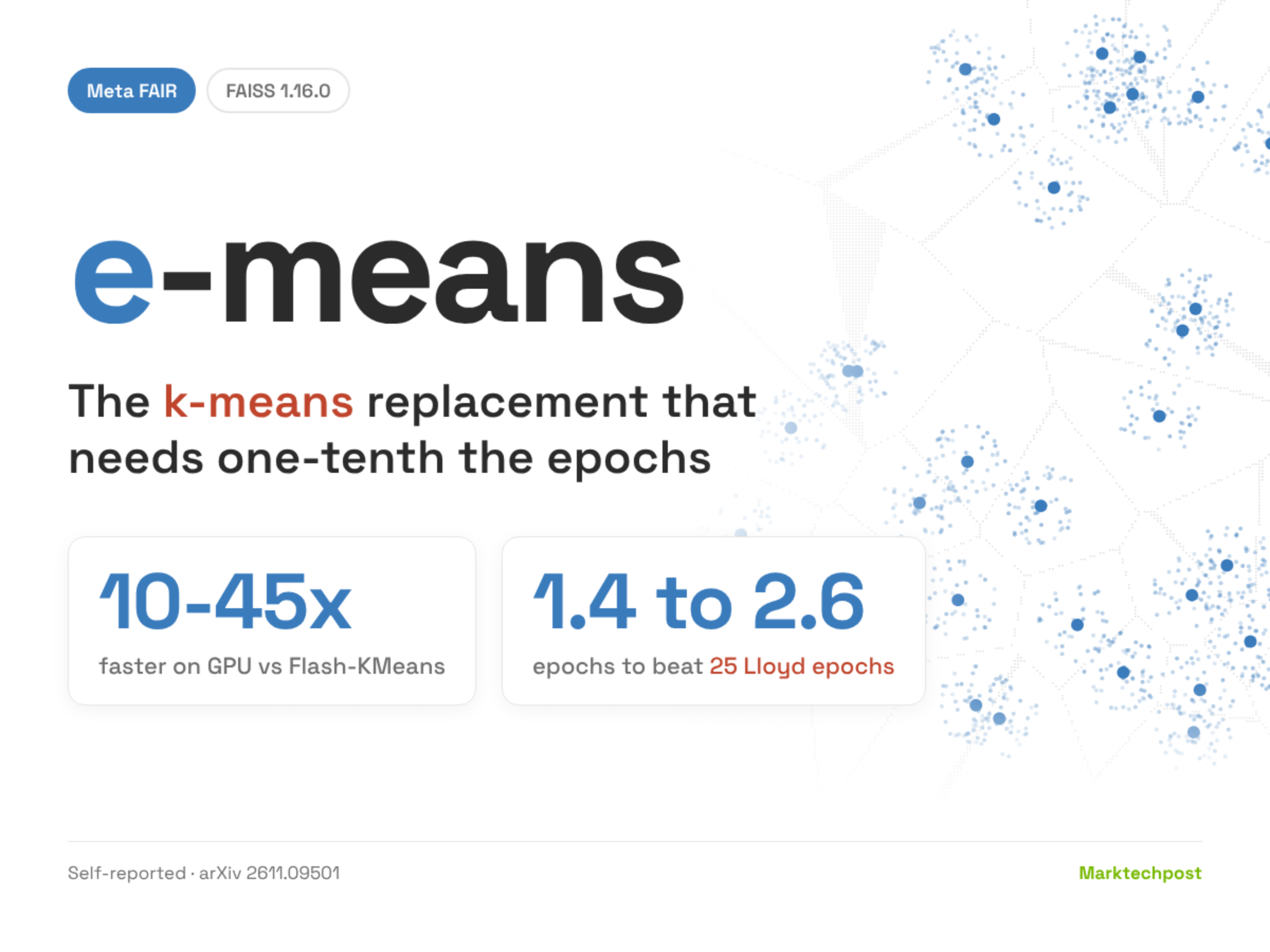
Meta FAIR Releases e-means: An Algorithm Beating k-means in 10x Fewer...
The introduction of e-means could significantly accelerate data processing tasks in AI applications, reducing computation time while maintaining clustering accuracy across various datasets.
- Meta FAIR has released e-means, an alternative to k-means, capable of achieving the same loss in significantly fewer epochs, between 1.4 and 2.6 epochs.
- E-means offers a substantial performance improvement, with reported speedups of 10-45 times on GPU and 8-15 times on CPU compared to traditional k-means implementations.
- The algorithm is now included in the FAISS 1.16.0 library and targets enhancing clustering processes for vector indexes and data-curation pipelines.
E-means is a mini-batch clustering algorithm developed by Meta's FAIR research team that updates cluster centroids using exponential moving averages. Previously, k-means, particularly Lloyd's method, required a full dataset for each update, resulting in slower processing times. Future updates will likely focus on refining e-means and assessing its integration in various AI applications.
Read the original ↗
Nebul Selects NetApp Novus to Scale Its Sovereign AI Cloud
The collaboration between Nebul and NetApp could enhance sovereign AI infrastructure in Europe by improving scalability, performance, and security in regulated industries.
- Nebul has become the first neocloud to implement NetApp's Novus storage architecture for its Intelligent Cloud, focusing on sovereign AI services.
- The Novus architecture allows for up to 100 terabytes per second of aggregate throughput, catering to high-demand AI applications.
- The partnership aims to facilitate the adoption of sovereign AI by optimizing data services and governance across multi-tenant environments.
- NetApp's Novus separates metadata from data movement, improving efficiency in environments with varying data workloads.
NetApp's Novus, launched on September 29, 2026, is designed to support high-performance AI applications by independently scaling metadata and data. This approach addresses common constraints in traditional storage systems and is particularly relevant for industries requiring strict compliance. As Nebul deploys Novus, it will be crucial to monitor its impact on operational efficiency and data governance in AI applications.
Read the original ↗
IBM and Microsoft Launch Imagine Enterprise for Industry AI Agents
The launch of Imagine Enterprise represents a significant move by IBM and Microsoft to enhance the deployment and management of AI agents in industry, potentially transforming business operations.
- IBM Consulting and Microsoft launched Imagine Enterprise on November 10, 2026, to create, operate, and oversee AI agents tailored for industry processes.
- The platform connects with existing enterprise data and systems, allowing organizations to utilize pre-built AI capabilities without overhauling their current technologies.
- Initial frameworks target financial services, insurance, and retail, with consideration for future industries like manufacturing and energy.
- The platform includes governance features to ensure compliance and oversight for agents, logging their actions and decisions and setting defined approval processes.
Imagine Enterprise is a collaborative platform by IBM Consulting and Microsoft aimed at deploying AI agents for various industries. This launch builds on both companies' expertise in AI and cloud technologies, with a focus on maintaining compliance and efficiency within existing business frameworks. Future developments may expand its use to additional sectors as adoption grows.
Read the original ↗
Charta Health Raises $55M Series B to Expand AI Chart Review
The successful $55 million Series B funding for Charta Health highlights significant investment in AI technologies aiming to streamline healthcare billing processes, potentially improving efficiency and reducing errors.
- Charta Health raised $55 million in Series B funding to expand its AI chart-review technology, led by Insight Partners with participation from QuantumLight and existing investors.
- The company plans to enhance AI development for providers and extend its services to additional medical specialties.
- Charta's software reviews healthcare charts to ensure billing accuracy, helping to preemptively address coding errors and reduce denial rates for claims.
- The payer products of Charta identify documentation issues and improve coding accuracy, leveraging AI to support retrospective coding and quality assurance.
- Charta has reported consistent double-digit reductions in denial rates for fee-for-service billing through its AI-driven solutions.
Charta Health develops AI technologies for reviewing healthcare documentation to improve billing accuracy and compliance. This latest funding follows a previous $22 million Series A in 2025 and is part of a broader trend towards AI adoption in healthcare administration.
Read the original ↗
Lumbra Raises $25M Series A to Expand Controlled AI Agent Deployments
The funding will enable Lumbra to expand its controlled AI-agent platform into commercial sectors, which emphasizes the growing intersection of advanced technology and regulatory compliance.
- Lumbra has raised $25 million in a Series A funding round co-led by Point72 Ventures and Ansa, with participation from Costanoa.
- The new funds will support engineers and deployment teams as they pursue opportunities in finance, healthcare, and law.
- Lumbra's agents currently operate in production on top-secret networks within the Pentagon and U.S. Intelligence Community.
- The platform, LumbraOS, features three key components for managing AI agents, knowledge storage, and evaluation processes.
- Lumbra signed its first U.S. intelligence-agency contract two months after product development began and progressed rapidly to production.
Lumbra is a company focused on developing controlled AI agents for various applications, including national security and now commercial sectors. Previously, their agents were restricted to government use, but this funding marks a shift towards regulated commercial industries, such as finance and healthcare. The success of this expansion may hinge on meeting strict governance and evaluation requirements.
Read the original ↗
Cribl Buys Tero to Build Observability for Humans and AI Agents
The acquisition of Tero strengthens Cribl's observability capabilities, aiming to improve how both engineers and AI agents assess and utilize telemetry data, shaping future data analysis practices.
- Cribl acquired Tero on November 10, 2026, to enhance observability for both engineers and AI agents.
- Tero's technology identifies low-value observability data, helping organizations optimize their telemetry usage.
- Ben Johnson, previously of Tero, will lead Cribl’s observability efforts focusing on host and application performance monitoring.
Cribl is a telemetry company that collects and optimizes data for analysis. Tero's acquisition adds expertise in evaluating data value and access by integrating human and AI requirements. This follows Cribl's recent acquisitions aimed at expanding its observability and security capabilities.
Read the original ↗
CoreWeave AI Cloud Revenue Climbs 168% as Backlog More Than Doubles
CoreWeave's significant revenue growth highlights the increasing demand for AI cloud services, indicating a robust trend in the AI infrastructure market despite rising operational losses and costs.
- CoreWeave's revenue for the third quarter of 2026 increased by 168% year over year, reaching $3.661 billion.
- The company's backlog, which represents future revenue under committed contracts, grew to approximately $132.5 billion, up 138% from the previous year.
- Despite the revenue growth, CoreWeave reported a net loss of $709 million due to increasing interest and depreciation costs.
- Operating income improved to $207 million, but interest expense rose to $846 million, complicating the financial outlook.
- CoreWeave expects to raise its full-year revenue guidance to between $13.0 billion and $13.3 billion.
CoreWeave is an AI cloud service provider experiencing rapid growth in demand driven by AI applications. Previously dealing with a smaller backlog, the firm has significantly increased its infrastructure and financing to support this expansion. Future developments will focus on converting backlog into actual AI capacity while managing rising operational costs.
Read the original ↗