
The day's AI news, briefed
The Daily Prompt
Our AI editor reads each day's AI and robotics stories, pulls out why they matter, and links every original source — so you can keep up in minutes.
Join over 250,000 subscribers getting the latest AI news
Latest AI & Robotics News Today

Edelbyte Raises $70M to Build Data Infrastructure for AI Agents
Edelbyte's new funding and platform aim to streamline how AI agents access and analyze data, potentially transforming data infrastructure for AI applications.
- Edelbyte has raised $70 million in funding to develop a unified data platform for search, analytics, and AI applications.
- The startup's platform aims to consolidate various data functions, improving efficiency in handling large data sets for AI agents.
- Founded by former Microsoft experts, Edelbyte's solution allows deployment in multiple environments, including public clouds and on-premises setups.
Edelbyte is a startup focused on creating a comprehensive data infrastructure to support AI functionality. The company emerged from stealth mode and secured significant funding to target the growing demand for efficient AI data access. Future developments to watch include product performance at scale and customer adoption rates.
Read the original ↗
Rox Raises $100M Series B at $1.3B Valuation to Advance AI Research
Rox's $100 million funding boost will enhance its AI research capabilities, crucial for driving innovation in various enterprise sectors, including healthcare and technology.
- Rox has raised $100 million in a Series B round, achieving a valuation of $1.3 billion.
- The funding was co-led by General Catalyst and March Capital, with participation from existing and new investors.
- Rox plans to invest in AI research and custom-model development to expand its customer base across multiple industries.
- Its platform utilizes data from various sources to enhance sales processes, streamlining prospecting and engagement for clients.
- Rox reported annual recurring revenue growth exceeding tenfold in its first year.
Rox is a San Francisco-based startup focused on developing AI solutions for enterprise sales processes. Founded by Ishan Mukherjee and other tech veterans, it has quickly gained traction, evidenced by substantial revenue growth and a growing client base. The upcoming research spending aims to improve its AI models and systems for real-world applications.
Read the original ↗
Plurai Raises $13M Seed and Opens AI Agent Simulation Platform
Plurai's new AI-agent simulation platform has the potential to significantly improve the development and reliability of AI agents across various industries.
- Plurai raised $13 million in seed funding and launched an AI-agent simulation platform on November 11, 2026.
- The seed funding round was led by Team8, with contributions from U&I, Velocity, Mercer, and over 20 angel investors.
- The platform uses simulation to evaluate AI agents in realistic scenarios, aiming to identify errors before deployment.
- Plurai's design partners reported reductions in agent development time from months to hours and an 82% drop in failures reaching users.
Plurai, founded by former Nexar executives, specializes in AI agent development and validation using simulated environments to enhance performance and safety. The company is transitioning from limited design partnerships to a broader self-service model for users, following successful earlier deployments.
Read the original ↗
StitchStudio Raises $8M to Expand Insurance AI Products and Support
The funding will allow StitchStudio to enhance its AI-driven tools, improving efficiency for insurance companies and brokers struggling with outdated technology and complex data management processes.
- StitchStudio raised $8 million in funding led by Voyager Capital to expand its insurance AI products and customer support.
- The investment will facilitate growth in self-service tools for insurance carriers and brokers.
- StitchStudio's AI models help automate and streamline insurance processes, saving significant time and resources for clients.
StitchStudio develops AI solutions tailored for the insurance industry, aiming to optimize workflows and compliance across varied systems and regulations. Recent deployments have shown efficiency gains, positioning StitchStudio for further growth. Future developments will focus on scaling operations and improving integration across different organizational frameworks.
Read the original ↗
Valory Unveils Open-Weight Olas Predict Model With Gains in Real-World Forecasting
The release of Valory's Olas-Predict-Qwen3.8-27B model could enhance forecasting accuracy in prediction markets significantly, offering a viable alternative to larger models like GPT-5.6.
- Valory launched Olas-Predict-Qwen3.8-27B, an open-weight forecasting model that achieves 67.3% balanced accuracy on real-world prediction markets.
- The model comes within 1.2 percentage points of Valory’s GPT-5.6 comparator in a controlled evaluation across 6,824 markets.
- Olas-Predict-Qwen3.8-27B improves upon its predecessor by 22% on Brier error and 8.4 percentage points on balanced accuracy with domain training.
Valory develops AI models for forecasting markets. The Olas system connects agents that create and trade forecasts, allowing for comparisons between predictions and outcomes, which supports improvements in model accuracy. Observers should monitor how this model performs in real-world applications and future iterations from Valory.
Read the original ↗
ChatGPT Users Can Compare Home and Auto Quotes Through VIU by HUB
This launch introduces a new way for consumers to easily compare insurance quotes using AI, streamlining the insurance shopping process without the pressure of immediate purchases.
- VIU by HUB launched a Personal Insurance plugin in ChatGPT that allows consumers to compare home and auto insurance quotes in 48 states.
- The tool lets users describe their coverage needs and receive personalized quotes from multiple insurance carriers in one conversation.
- A licensed advisor follows up with users after they select a quote to finalize and bind their insurance coverage.
VIU by HUB is a digital insurance brokerage affiliated with HUB International. The Personal Insurance plugin enables users to navigate insurance options conveniently, maintaining licensed advisor support for policy finalization. This development reflects ongoing shifts in how consumers interact with insurance through digital platforms.
Read the original ↗
Supermicro Ships H15 AMD EPYC Servers for AI and HPC Workloads
The deployment of Supermicro's H15 servers is significant for advancing capabilities in AI and high-performance computing, enhancing efficiency and performance in data centers.
- Supermicro is now shipping its H15 server portfolio featuring over 20 systems powered by AMD's sixth-generation EPYC 9006 processors.
- The H15 line includes diverse systems for enterprise, HPC, and AI workloads, designed for increased CPU density and accelerated AI applications.
- Configurations can support up to 256 Zen 6 cores, 512 threads, and 16 memory channels, achieving memory bandwidth of up to 1.6 TB/s per socket.
- The product includes various models like Hyper for AI inference and virtualization, and CloudDC for cloud-scale environments, optimizing for different deployment patterns.
- Supermicro's collaboration with AMD also aims to launch new platforms, Helios and Helion, focusing on large-scale AI deployment.
Supermicro specializes in high-performance computing servers and solutions, and the H15 series represents an upgrade to its server offerings with advanced AMD technology. The integration of systems and storage nodes aims to enhance overall performance for AI workloads in modern data centers. Future developments to anticipate include the release of Helios and Helion platforms for specialized AI applications.
Read the original ↗
Adobe Previews Four AI Experiments for Creative Workflows
Adobe's exploration of AI tools could significantly transform creative workflows in filmmaking, image editing, and audio mixing, impacting how professionals interact with technology.
- Adobe previewed four experimental AI tools aimed at enhancing creative workflows for professionals in filmmaking, editing, and audio mixing.
- The tools include Project Screen Test, Sight Span, Sound Bender, and Rinse Repeat, each designed to make creative processes more interactive.
- Projects such as Screen Test allow users to develop animated characters through guided conversations, while Sound Bender generates sound effects based on text descriptions.
- Sight Span creates a 3D environment from flat images, enabling viewers to navigate and interact with the artwork in real-time.
- Project Rinse Repeat automates repetitive editing tasks in Photoshop while allowing for native control and adjustments.
Adobe is known for its Creative Cloud suite, offering software for graphic design, video editing, and more. The company earlier unveiled AI innovations aimed at enhancing creative processes. Moving forward, the effectiveness and integration of these AI tools in mainstream applications like Creative Cloud will be crucial to watch.
Read the original ↗
Databricks Turns Genie Into an Autonomous Enterprise AI Coworker
The development of an autonomous AI coworker like Genie marks a significant evolution in enterprise task management, potentially improving productivity across multiple departments.
- Databricks introduced Genie, an autonomous AI coworker designed for ongoing enterprise tasks, on November 11, 2026.
- Genie can manage assignments, run scheduled jobs, and handle event-triggered tasks, requiring user approval for certain actions.
- The updated system features Genie Ontology, which builds knowledge from existing data and includes tools for data governance and indexing.
- General Motors has implemented over 1,000 Genie agents across various operations, showcasing the assistant's multi-department capabilities.
- Genie One, the platform's interface, enables users to generate reports and interactive content, with a promotional free period ending on January 31, 2027.
Databricks is a data and analytics company known for its Unified Data Analytics Platform. The introduction of Genie highlights the increasing integration of AI in enterprise workflows, providing tools for automation and data management. Future developments to watch include the rollout of beta features and additional integrations with business intelligence sources.
Read the original ↗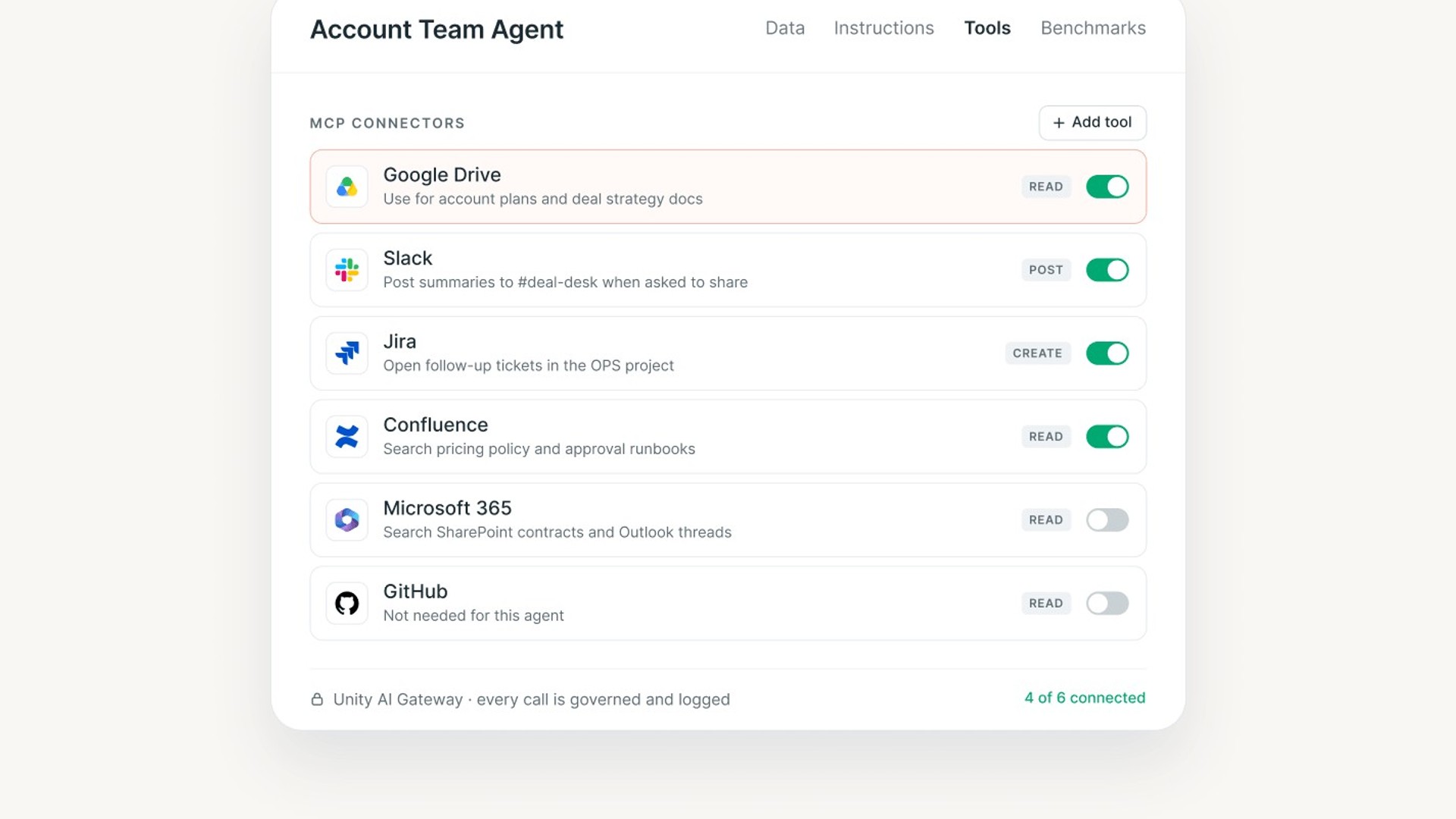
Databricks Launches Native Genie Plugins for Four AI Agents
This launch enhances AI agents' ability to access and utilize business-specific data via built-in plugins, streamlining workflows across multiple platforms and improving operational efficiency.
- Databricks launched native Genie plugins for ChatGPT, Claude, Microsoft Copilot Cowork, and Grok Bot on November 11, 2026.
- These plugins allow AI agents to access controlled business context within Databricks, enhancing their functionality and interactivity.
- The system resolves business terms, runs SQL queries, and returns results with citations to maintain data governance and accuracy.
Databricks is a data and AI company that offers a unified platform for data analytics and machine learning. The Genie system connects AI agents to enterprise data sources, which allows for governed access to specific information. Organizations can utilize these plugins to integrate AI capabilities into their existing business processes efficiently.
Read the original ↗
From Green Screen to Gray Box: AI Is Stepping Onto the Hollywood Sound Stage
The integration of AI in filming techniques can significantly enhance creative efficiency and reduce production costs in the filmmaking industry.
- Filming in gray boxes allows for more flexible shots and faster setup times compared to traditional green screen methods.
- Promise Advanced Imagination's technology enables quicker post-production processes by utilizing AI-generated backgrounds and lighting adjustments.
- Disney's collaboration with Promise aims to integrate emerging technologies while ensuring that human artistry remains central to filmmaking.
Filmmaking has traditionally relied on green screens for visual effects, but new techniques like gray boxes, combined with AI, are being explored to streamline production. This innovation seeks to balance technology and human creativity in film, addressing concerns about job impacts in the industry.
Read the original ↗
Adobe’s Cutting-Edge AI Research Projects Are All About Precision Editing
Adobe's upcoming AI tools promise to enhance creative work by enabling more precise editing, potentially transforming the efficiency and quality of digital content creation.
- Adobe is unveiling three AI research projects at its upcoming Max event focused on precision editing.
- Project Deep Brush introduces a context-aware digital brush that conforms to various surfaces and lighting.
- Project Hands-On allows users to manipulate objects directly in a scene using a dynamic user interface, saving time with batch edits.
- Project Scene Sweep offers precise multishot video edits by allowing consistent character adjustments across a timeline.
Adobe has invested in generative AI technology to improve creative processes. The new projects aim to provide tools that streamline editing workflows and enhance user creativity. Upcoming releases will be available on Adobe Labs for early access exploration.
Read the original ↗
Can an AI Agent Inherit Its Team’s Hard-Won Lessons? A Hands-On L...
The ability for AI agents to inherit lessons learned by their teams could significantly improve efficiency and reduce error rates in automated systems.
- TencentDB Agent Memory is an open-source project designed to help AI agents share team-specific knowledge.
- The project manages memory as controlled assets, allowing specific agents to access relevant information while maintaining necessary privacy levels.
- An experiment demonstrated a 28 percentage point improvement in performance when AI utilized memory compared to when it did not.
TencentDB Agent Memory addresses the limitations of standard chat context windows by allowing AI agents to retain and share team knowledge effectively. Previously, AI agents would forget specific lessons from one conversation to another, leading to repeated mistakes. Future developments may further refine memory management and retrieval processes for broader applications.
Read the original ↗
NSF’s X-Labs Program Draws Support From Charities and Investors
The NSF's X-Labs program is attracting diverse support to facilitate groundbreaking scientific research, potentially reshaping the nature and scale of research collaborations in the U.S.
- The National Science Foundation (NSF) initiated the X-Labs program in May to tackle urgent scientific challenges through high-risk, high-funded research.
- The NSF has announced October support from charities, companies, and investors to provide resources like laboratory space and expertise to X-Labs winners.
- X-Labs recipients will receive $1.5 million for a nine-month planning phase, with the goal of qualifying for larger $50 million multi-year grants.
The NSF X-Labs program focuses on supporting innovative scientific research, particularly in artificial intelligence and advanced computing. It aims to enable more agile, independent research through partnerships with various organizations, including charities and tech companies. The initiative reflects a shift towards modernizing how government and institutions fund and support research.
Read the original ↗
When Does It Actually Make Sense to Put AI Into Products?
Understanding when and how to integrate AI is crucial for companies to create effective products without unnecessary complexity, potentially enhancing user satisfaction and trust.
- The tech industry has been pushing for AI integration into products, but not all integrations improve user experience.
- Savannah Kunovsky of Ideo emphasizes the importance of assessing whether AI genuinely aids users rather than create complications.
- Some designers advocate for maintaining physical controls alongside AI capabilities to prevent diminishing usability in stressful situations.
AI is increasingly used in everyday products like smart devices, yet the effectiveness of this integration is under scrutiny. Companies are now evaluating the necessity and impact of AI, aiming to avoid complications from unnecessary automation.
Read the original ↗
Drugmakers in China Explore AI Marketing Amid Anti-Graft Scrutiny
The shift to AI marketing by drugmakers in China is significant as it coincides with tightened anti-corruption measures, altering how pharmaceutical companies interact with healthcare professionals.
- Chinese pharmaceutical companies are exploring AI marketing solutions like medical assistants and disease-specific academic platforms amid stricter anti-corruption enforcement.
- Companies such as Alibaba Health and Roche are considering AI tools for direct marketing to doctors, although many proposals remain in early stages.
- A multiyear anti-corruption campaign has led to increased scrutiny of traditional pharmaceutical marketing practices, impacting spending and compliance requirements.
Pharmaceutical companies in China are adapting to a stricter regulatory environment that limits traditional marketing methods. As AI tools become more prevalent among physicians, the drug industry is testing new avenues for marketing while maintaining compliance. This transition is part of a broader change in the pharmaceutical marketing landscape, highlighting the ongoing need for innovation within regulatory frameworks.
Read the original ↗
What Is Physical AI? How Foundation Models Are Moving Into the Real World
Understanding Physical AI is crucial as it informs the development of machines that navigate uncertainty, challenges, and safety considerations in real-world environments.
- Physical AI involves applying learned perception, reasoning, and control to machines operating in the real world, where physical constraints and safety cannot be overlooked.
- It distinguishes itself from traditional AI systems that operate in a digital environment, as it addresses real-world operational challenges and uncertainties.
- The methodology of Physical AI can be visualized through a five-stage operating map that includes sensing the environment, estimating state, planning actions, executing those actions, and monitoring outcomes.
Physical AI refers to systems that use advanced AI techniques in real-world applications, where factors like uncertainty and safety are critical. It builds on traditional AI concepts but emphasizes the need for practical implementations that can handle real-world variables. Future focus areas include the integration of these systems across various industries and their operational robustness.
Read the original ↗
Fincantieri Launches Shipyard AI Partnership with Poste Italiane and TIM
This partnership aims to digitize shipbuilding processes in Italy, potentially enhancing efficiency and safeguarding technical knowledge in an essential industrial sector.
- Fincantieri has partnered with Poste Italiane and TIM to integrate industrial AI into ship design, construction, and management.
- The collaboration seeks to establish Italy's first national Physical AI value chain for heavy manufacturing and ship management.
- Key objectives include developing 4D design models and AI-optimized work packages to improve shipyard operations and promote worker efficiency.
Fincantieri is a leading global shipbuilder with a significant order backlog and extensive manufacturing capabilities. The partnership is part of Fincantieri's broader F4 industrial plan, focusing on digitalization and automation in shipbuilding. Subsequent developments from this initiative will focus on preserving technical knowledge and enhancing workforce integration with technology.
Read the original ↗
Metalenz Buys PxE Imaging to Add Color and Depth to Edge AI
The acquisition positions Metalenz to enhance its edge AI capabilities with advanced imaging technology, potentially improving device performance across various industries.
- Metalenz has acquired PxE Imaging to broaden its sensing capabilities into visible imaging and add color and depth information from a single camera.
- PxE Imaging's Holocoder technology captures simultaneous color and depth data without the light absorption typically associated with conventional camera filters.
- This acquisition supports Metalenz's goal of improving edge AI performance by enabling efficient information processing directly in hardware.
Metalenz, founded in 2016 as a Harvard spinout, specializes in metasurface optics integrated into consumer devices. The acquisition of PxE Imaging enhances their existing imaging technology, enabling advancements in applications like consumer electronics and robotics.
Read the original ↗
Torus Raises $500M Growth Capital to Expand Modular AI Infrastructure
The $500 million funding will enhance modular AI infrastructure, potentially accelerating AI deployment timelines in various industries.
- Torus has secured $500 million in growth capital to expand its manufacturing operations in Salt Lake City.
- The funding will support the launch of Foundry, modular infrastructure for AI computing that integrates essential systems into prefabricated units.
- Foundry aims to reduce conventional deployment schedules from years to 12–16 weeks by utilizing existing electrical capacities.
- The initial customers include Hydra Host and another unnamed AI cloud provider, with a target of over 47,000 GPUs by the end of 2027.
Torus develops modular infrastructure for AI inference that utilizes existing electrical resources for faster deployment. The growth capital will help scale up their operations to meet increasing demand in the AI sector, particularly for efficient computing solutions. Foundry aims to offer rapid deployment of AI systems by integrating power, cooling, and compute using existing infrastructure.
Read the original ↗