
The day's AI news, briefed
The Daily Prompt
Our AI editor reads each day's AI and robotics stories, pulls out why they matter, and links every original source — so you can keep up in minutes.
Join over 250,000 subscribers getting the latest AI news
Latest AI & Robotics News Today

What is the 'Dead Internet Theory' and should humanity be worried?
The rise of AI-generated content and bots impacts human interaction online, raising concerns about the authenticity and quality of digital communication.
- The 'dead internet theory' suggests that non-human activity, especially bots and AI-generated content, is dominating online interactions.
- In 2026, bots accounted for 53 percent of all web traffic, an increase from 51 percent the previous year, highlighting their growing prevalence.
- The theory gained traction following a 2021 post that claimed the internet began to feel empty and artificial around 2016.
- Public concerns about AI's influence are reflected in a Pew Research study, where 40 percent of Americans foresee negative societal impacts from AI in the next two decades.
- Legislative measures like the EU AI Act are being implemented to regulate AI technology and encourage transparency in its usage.
The 'dead internet theory' emerged from online forums in the late 2010s, positing that the internet is increasingly populated by bots rather than humans. The trend is exacerbated by growing AI capabilities, resulting in more automated content online. Future developments should focus on regulation and the balance between AI integration and human interaction.
Read the original ↗
OpenAI, Anthropic face new oversight as New York’s AI safety law takes effect
This story highlights the implementation of a significant AI safety law, which could set a precedent for how AI technologies are regulated across the United States.
- New York's AI safety law, RAISE Act, requires major developers like OpenAI and Anthropic to register by January 1, 2027.
- The law mandates these companies to publish safety frameworks, report critical incidents within 72 hours, and issue transparency reports.
- Violations of the RAISE Act can result in penalties up to $3 million for multiple offenses.
- Governor Kathy Hochul announced the formation of the New York Center for AI Responsibility to evaluate AI systems' safety.
- Similar AI safety laws have been enacted in California and Illinois, reflecting a growing trend in regulatory oversight of AI.
The RAISE Act is part of New York's efforts to enhance AI safety and transparency, particularly targeting large AI developers with significant revenues. This move follows previous regulations introduced by the state, which focused on user awareness and protection against harmful AI behaviors. Future developments will likely revolve around compliance and enforcement of these new regulations.
Read the original ↗
OpenAI acquires Odessia, travel startup created by Sonder founder
The acquisition of Odessia by OpenAI could indicate a strategic move towards enhancing travel-related AI applications, important given the growing consumer interest in using AI for travel planning.
- OpenAI has acquired Odessia, an AI travel startup founded by Francis Davidson, who will now work with OpenAI on future travel initiatives.
- The specific financial terms of the acquisition were not disclosed, but it appears to be mainly an acqui-hire, focusing on Davidson's expertise.
- Odessia, which launched its AI travel agent five months ago, had raised $6 million in pre-seed funding from Sequoia and previously assisted users in planning significant travel expenses, though it has been shut down since the acquisition.
Odessia was created by Francis Davidson, a notable figure in the travel industry known for founding the defunct startup Sonder. The acquisition coincides with heightened interest in AI tools for travel, an area OpenAI has acknowledged in previous announcements regarding its ChatGPT agent.
Read the original ↗
What happens to mathematics when AI becomes an oracle?
The adaptation of mathematics to advanced AI tools could significantly influence various fields, including science, social policy, and technology, reshaping our understanding and application of mathematical principles.
- Mathematicians Steven Strogatz and Alex Townsend explore the implications of AI on mathematics in their new book, 'Big Math: The Hidden Codes That Run Our World.'
- The book discusses how AI and quantum computing challenge traditional mathematical concepts and practices, particularly through 'big math' problems involving extensive variables.
- Strogatz emphasizes the historical evolution of mathematics as a tool, highlighting its growing reliance on computers, which may alter its philosophical role in society.
'Big Math' refers to mathematical problems and techniques that are computationally intensive and typically beyond the capacity of human cognitive abilities. This book aims to bridge the gap between traditional mathematics and modern computational needs, foregrounding the impact of AI technologies on mathematical practice. Emphasis will also be placed on applications in social issues like gerrymandering.
Read the original ↗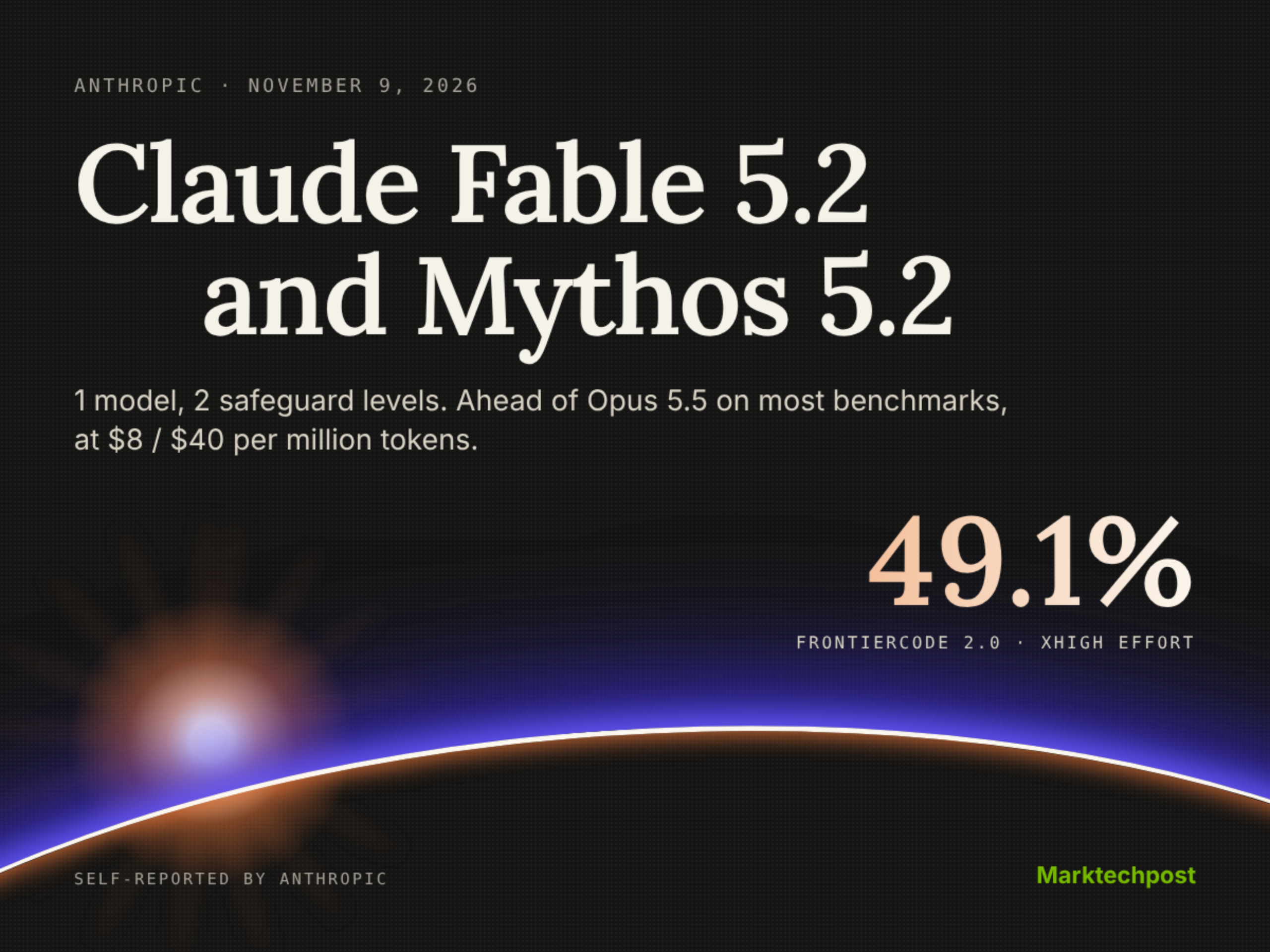
Anthropic Launches Claude Fable 5.2 and Mythos 5.2: Same Model, Different...
The introduction of Claude Fable 5.2 and Mythos 5.2 indicates a significant advancement in AI coding and research capabilities, potentially impacting various technical sectors.
- Anthropic launched Claude Fable 5.2 and Mythos 5.2, which feature the same model but vary in safety measures regarding cybersecurity and biology.
- Fable 5.2 is priced at $8 per million input tokens and $40 per million output tokens, while Mythos 5.2 has a similar pricing structure for Verification Program members.
- Fable 5.2 outperformed Opus 5.5 on multiple benchmarks, achieving a score of 49.1% on FrontierCode 2.0, which assesses agentic coding.
Claude Fable 5.2 is designed for long-term coding and research, while Mythos 5.2 offers fewer safety blocks, catering to a broader audience. This release follows the ongoing competition among AI models, emphasizing performance and cost efficiency. Attention remains on how these models will influence tasks in AI development and research.
Read the original ↗
Blue J Raises $176M Series E at Over $700M to Scale Agentic Tax AI
The funding round signals confidence in Blue J's ability to enhance tax automation, potentially transforming efficiency in tax-related workflows for professionals.
- Blue J raised $176 million in Series E funding, led by JMI Equity, valuing the company above $700 million.
- The funding will help scale the 'Workflows' product, which automates multi-step tax tasks for professionals, and expand the company's reach internationally.
- The company reported a 165% increase in annual recurring revenue over the last 15 months, with over 6,500 organizations using its platform.
Blue J is a tax software company that previously focused on providing research answers across tax laws. The new funding will support the launch of Workflows, a product designed for more complex tax tasks. Observers will be watching how effectively Blue J can expand its capabilities in international markets while maintaining user oversight in its processes.
Read the original ↗
Lenovo Adds AMD EPYC Servers and AI Factory Services for HPC
Lenovo's introduction of AMD EPYC servers and AI factory services enhances high-performance computing capabilities, which could significantly improve operational efficiency for AI and HPC tasks across various industries.
- Lenovo has introduced new high-performance computing infrastructure featuring ThinkSystem servers with 6th Generation AMD EPYC SP7 processors.
- The dual-socket ThinkSystem SC755 server utilizes Neptune liquid cooling to enhance performance by reducing system heat and improving efficiency.
- Lenovo's Hybrid AI Factory Services now offer enhanced GPU deployment and optimization support for AI workloads.
- The new ThinkSystem DE6800 and DE6500 storage systems focus on high data throughput and are designed for latency-sensitive applications.
Lenovo is a multinational technology company known for its computing devices and services. Recent advances in AI and HPC technology include the deployment of powerful server architectures and data center services. Future developments to observe include the practical applications of Lenovo's infrastructure in real-world AI scenarios and collaborations with educational institutions like the University of Florida.
Read the original ↗
SoftBank Group Books Loss on Revised AI Data Center Equipment Plans
A significant loss by SoftBank highlights the challenges in securing power infrastructure for AI data centers amid evolving procurement strategies and rising financing costs.
- SoftBank Group reported a ¥597.2 billion ($3.7 billion) loss due to revisions in procurement for power-generation equipment for U.S. AI data center projects.
- The net loss for the quarter ended September 30, 2026, reached ¥1.1 trillion, compared to ¥2.5 trillion in net income a year earlier.
- SoftBank's Silver Bands 7 LLC accounted for $2.85 billion of the loss through non-refundable advance payments and $0.88 billion for contract modifications.
- Investment gains fell 56% year over year to ¥1.73 trillion, while financing costs doubled to ¥790.7 billion.
- Cumulative procurement payments from the previous fiscal year totaled $9.5 billion, with $6.6 billion still allocated to ongoing projects at quarter-end.
SoftBank Group, a major Japanese conglomerate, has been investing heavily in AI-related infrastructure. Recent changes in procurement strategies reflect challenges in adapting to market demands and securing resources, with ongoing projects still under development.
Read the original ↗
MemryX Announces MX3+ to Expand Low-Power Edge AI Inference
The introduction of the MX3+ is significant as it aims to enhance edge AI capabilities by drastically improving computational power while maintaining low energy consumption, essential for diverse applications.
- MemryX announced the MX3+ inference accelerator on November 10, 2026, targeting low-power edge AI applications.
- The MX3+ design aims for up to 10 times more peak AI compute and on-chip memory compared to its predecessor, MX3.
- MemryX plans configurations that allow up to 16 MX3+ chips to operate as a unified device, targeting over 1 peta-operation per second of AI compute.
MemryX is a fabless semiconductor company that develops AI inference accelerators, such as the MX3 and now the MX3+. The MX3+ aims to improve on existing designs by offering greater performance without increasing power needs. Future developments include the MX4 platform expected to support advanced AI workloads, anticipated for 2029.
Read the original ↗
Vals AI Legal Aid Benchmark Finds Models Fall Short on Local Help
The performance of AI in legal aid is crucial, as inadequate support may leave many low-income individuals without necessary legal assistance, perpetuating the justice gap.
- NextLadder Ventures and Vals AI's benchmark revealed no AI models met the 80% threshold for effective local legal assistance across 252 scenarios.
- Models scored 30% to 50% for identifying specific legal resources like local programs, in contrast to 78% to 87% for general legal explanations.
- Qwen 3.8 Max topped the rankings with 76.4% of criteria met, followed closely by Claude Sonnet 5.5 and Wonder Full, showing a lack of clear leaders among the evaluated models.
The Access to Justice Benchmark assesses AI's effectiveness in helping individuals access local legal aid. Previous studies, such as the Legal Services Corporation's 2022 report, highlighted systemic deficiencies in legal support for low-income Americans. Future developments in AI models will need to address these gaps to improve service delivery.
Read the original ↗
KORA Unveils Linux Desktop With On-Device AI for Snapdragon PCs
KORA's integration of on-device AI into a Linux desktop could significantly enhance privacy and performance for developers and creators using Snapdragon PCs when it launches in 2027.
- KORA Systems launched KORA, a Linux desktop OS with integrated AI models designed for Snapdragon X2 Elite PCs, on November 10, 2026.
- The system supports a 26-billion-parameter language model that runs entirely on-device, reducing reliance on cloud services.
- In 2027, KORA aims for around 70% of AI tasks to be executed locally, leveraging Qualcomm's hardware including the Oryon CPU and Hexagon NPU.
- KORA has developed compatibility technology to run selected Windows applications on its Linux OS, easing the transition for users.
- Neural workspaces in KORA offer isolated environments for applications and data, maintaining user privacy by managing sensitive information locally.
KORA is a new desktop operating system developed by KORA Systems, based on engineering partnership with Qualcomm Technologies. This rollout follows a year of collaborative development and is targeted at PCs with Snapdragon processors, with plans for a broader launch in 2027.
Read the original ↗
Proximal Ventures Closes $27.5M Debut Fund to Back AI Life Sciences
The establishment of Proximal Ventures' fund highlights the growing investment focus on AI applications in life sciences, which may accelerate drug development and improve patient outcomes.
- Proximal Ventures closed its debut fund at $27.5 million, exceeding its $25 million target.
- The firm will invest in pre-seed and seed companies focused on AI-native infrastructure for life sciences.
- Investment checks will range from $500,000 to $1.5 million, targeting improvements in discovery, clinical trials, and commercialization.
Proximal Ventures, based in San Francisco and founded in 2026, aims to enhance the life sciences value chain through AI technology. The new fund's distinctive focus on both discovery and operational efficiencies is positioned to address critical gaps in venture investment in the pharmaceutical sector.
Read the original ↗
Avanade Agrees to Acquire Robiquity to Expand UK AI Automation
Avanade's acquisition of Robiquity aims to strengthen its AI automation services in the UK, potentially improving productivity for a wider range of clients.
- Avanade has agreed to acquire Robiquity, a Manchester-based company specializing in AI-first business solutions and automation.
- The acquisition, announced on November 10, 2026, will enhance Avanade's capabilities in servicing UK mid-market and enterprise clients.
- Regulatory approvals and customary closing conditions still need to be met before the acquisition finalizes.
Avanade is a global company formed by Microsoft and Accenture, focusing on AI, cloud, and data solutions. Robiquity, founded in 2016, specializes in automation using Microsoft's tools. The acquisition will allow Robiquity to leverage Avanade's extensive resources and reach post-completion.
Read the original ↗
Cowbell Launches AI Liability Policy for Businesses Using AI Agents
The launch of Cowbell AI Liability Insurance addresses the growing need for risk management solutions as more businesses adopt AI agents, potentially mitigating financial losses from AI-related incidents.
- Cowbell introduced a standalone AI liability insurance policy aimed at U.S. small and midsized businesses using AI agents.
- The policy, which starts on January 1, 2027, combines coverage for business losses with protection against third-party claims.
- It includes specific coverage for incidents involving unauthorized AI actions, algorithmic discrimination, and data exposure among others.
Cowbell is offering an insurance solution tailored for businesses deploying AI technologies in customer service and operations. As AI's role in business increases, the risk of AI-related incidents has become a critical concern, prompting the need for specialized insurance. Moving forward, attention will focus on how well these policies are adopted and their effectiveness in managing AI-related risks.
Read the original ↗
PromeAI Review: These AI Renders Nailed My Rough Sketch
PromeAI enables rapid and economical visualizations of design concepts, helping architects and designers communicate ideas more effectively and efficiently than traditional methods.
- PromeAI transforms rough sketches and photos into photorealistic renders in seconds, streamlining the design process for architects and interior designers.
- The platform offers various tools, including a Scenario Changer to modify background details and supports third-party image and video models.
- PromeAI charges 0.3 coins for three image renders, making it an affordable option compared to traditional 3D modeling and rendering services.
PromeAI is an online design platform that allows users to convert sketches into realistic images, serving over 2 million users. The technology has expanded to include various industry-specific tools for designers and architects, enhancing the design workflow.
Read the original ↗
New York will independently test AI models
This initiative demonstrates a significant shift in regulatory oversight of AI, aiming to enhance accountability and safety in technology deployment at the state level.
- New York has launched the nation's first state-run AI testing program, initiated by Governor Kathy Hochul.
- The program will utilize the New York Center for AI Responsibility and Research, involving over 80 scientists from Binghamton University.
- Companies will be required to publish safety frameworks and uphold transparency under New York's RAISE Act, starting January 1, 2027.
The New York Center for AI Responsibility and Research will independently assess AI models to ensure safe use. This move comes in response to perceived shortcomings in current federal oversight. Future developments will likely focus on expanding transparency requirements for AI companies.
Read the original ↗
OpenAI rolls out new business profiles, making ChatGPT just a little bit more like Google
Introducing business profiles in ChatGPT allows companies to enhance their visibility and interaction with potential customers, marking a significant shift in how AI can facilitate consumer discovery.
- OpenAI has launched a Business Hub for companies to create and manage business profiles on ChatGPT.
- The business profiles allow verification and updating of product information, similar to profiles on Google.
- Businesses can develop specialized agents that facilitate user inquiries about their products and services.
- The platform provides limited analytics on user interactions, including profile views and clicks, in a manner akin to Google Analytics.
OpenAI's new features aim to transform ChatGPT into a consumer discovery platform by enabling businesses to connect more effectively with users. Previously, OpenAI attempted to make ChatGPT an e-commerce platform but faced challenges, leading to the project's discontinuation. The success of these new initiatives remains to be seen in comparison to established search engines like Google.
Read the original ↗
PSI is trying to make a business out of AI-driven scientific discovery
The successful resolution of a significant quantum computing conjecture demonstrates the potential of AI to drive groundbreaking scientific discoveries and reshape the future of research.
- PSI utilized an early version of Anthropic's Fable 5.2 model to solve the Aaronson-Ambainis conjecture, a problem in quantum computing unresolved for 18 years.
- The solution indicates a limitation in quantum computing capabilities, steering future research directions.
- PSI aims to create a business model around scientific problem-solving using AI while currently generating revenue from optimizing data centers.
Physical Superintelligence (PSI) focuses on using artificial intelligence to tackle complex scientific problems. This approach highlights a shift in how theoretical physics can be advanced through machine learning. Future developments will explore how these AI-driven insights can be practically applied to real-world technologies.
Read the original ↗
Oura to acquire AI-native primary care startup Counsel Health for $625M
The acquisition allows Oura to enhance its healthcare services integrated within its app, potentially improving user access to medical care amidst growing competition in the smart ring market.
- Oura is acquiring Counsel Health for $625 million to enhance its healthcare offerings.
- Counsel Health is an AI-powered platform that integrates medical advice and licensed physicians into the Oura app.
- The acquisition aims to expand services across preventative, acute, and chronic care areas.
Oura is known for its smart ring technology monitoring health metrics. The company's IPO was recently postponed due to market uncertainty, fueling its acquisition strategy to innovate and stay competitive. Going forward, watch for developments in Oura's service expansion and integration with Counsel Health.
Read the original ↗
All 7 Anthropic founders will each cash out about $250M in IPO
This IPO marks a significant financial milestone for the co-founders of Anthropic, highlighting investor confidence in AI companies and the ongoing evolution of the industry.
- All seven co-founders of Anthropic plan to sell 3,378,378 shares each in the upcoming IPO.
- At the midpoint price of $74 per share, each founder stands to cash out nearly $250 million.
- The IPO could potentially value Anthropic at $1.4 trillion and shows signs of high demand with board members wanting to invest.
Anthropic was founded in 2021 by former OpenAI employees focused on AI safety. The company's IPO is one of the most anticipated in the tech sector, with significant interest from investors. This follows growing trends of public offerings in the AI space.
Read the original ↗