
The day's AI news, briefed
The Daily Prompt
Our AI editor reads each day's AI and robotics stories, pulls out why they matter, and links every original source — so you can keep up in minutes.
Join over 250,000 subscribers getting the latest AI news
Latest AI & Robotics News Today

Stanford AI100 Report Finds Scaling Limits as AI’s Impact Widens
The Stanford AI100 report reveals significant limits in current generative AI strategies, highlighting the need for smarter algorithms and addressing consequences for energy resources and economic impacts.
- Stanford HAI's third AI100 report identifies data and cost limits constraining generative AI's scaling strategies.
- The report forecasts AI-powered laboratories will become standard across various scientific fields within the next decade.
- It notes that AI is already compressing research timelines significantly, but economic impacts remain unclear.
- The panel highlights unresolved issues including public input in AI development and the implications for critical sectors like cybersecurity and democratic institutions.
- International governance around AI is fragmented, with increasing reliance on statecraft for chip access and model restrictions.
The One Hundred Year Study on Artificial Intelligence is a series of reports initiated by Stanford to assess the evolution of AI over a century. Previous reports from 2016 and 2021 have outlined both advancements and challenges in AI technology. Currently, the focus is on the sustainability of scaling strategies in AI against the backdrop of economic and societal effects.
Read the original ↗
Hochul Launches Statewide AI Safety Testing Network in New York
This initiative aims to improve AI safety and accountability in New York, potentially influencing national standards for AI regulation and development.
- New York Governor Kathy Hochul launched a statewide AI safety effort on November 10, 2026, led by the New York Center for AI Responsibility and Research (NYCAIRR).
- NYCAIRR will focus on independent testing, evaluations, and training in AI safety, supported by over 80 researchers and a $500 million public-private initiative.
- Starting January 1, 2027, large AI developers must register with the state and comply with new safety and transparency requirements.
- NYCAIRR will provide assessment and expertise, coordinating with the Office of Digital Innovation to oversee developer safety frameworks.
- This program began with a $30 million philanthropic donation and a $25 million state investment, building on an earlier research mission.
The New York Center for AI Responsibility and Research aims to enhance the safety and accountability of AI technologies. This program is part of a broader push for responsible AI use in critical sectors. Future developments will focus on the effectiveness of the independent evaluations as new regulations come into force in January 2027.
Read the original ↗
Finite State Raises $27 Million Series C to Expand AI-Powered Device Security
As manufacturers face increasing software supply-chain risks, this funding will enable Finite State to enhance its AI-driven security platform, potentially improving device protection across various industries.
- Finite State has raised $27 million in Series C funding to enhance its AI-powered product security platform and expand its international operations.
- The funding round was led by The O.H.I.O. Fund, with participation from several other financial institutions.
- Finite State aims to help manufacturers identify and address vulnerabilities in their products through advanced software analysis and compliance tools.
- The company's technology focuses on analyzing software components and their associated risks to improve overall device security.
Finite State, based in Columbus, Ohio, specializes in product security for connected devices by analyzing software vulnerabilities. As manufacturers increasingly face regulatory requirements concerning software risk management, Finite State's platform aims to provide actionable insights and compliance evidence. Future developments to watch include enhancements in automated analysis and expanded international market reach.
Read the original ↗
Mosaic Raises $47M Seed to Develop Spatial Intelligence for Surgery
Mosaic Intelligence Labs' $47 million funding aims to enhance surgical outcomes by integrating spatial intelligence in less invasive procedures, addressing key limitations in current practices.
- Mosaic has secured $47 million in seed funding to develop spatial intelligence for surgical applications, focusing on endovascular care.
- The company was founded by Ileana Pirozzi and Alison Kight Mackanic after their work during their doctoral studies at Stanford.
- Mosaic plans to enhance surgical navigation by combining sensor readings with advanced computation to create a three-dimensional representation of anatomy.
- The technology aims to improve precision in surgeries performed through vascular systems, addressing issues such as operator experience variability and radiation exposure.
Mosaic Intelligence Labs is focused on improving surgical procedures through advanced sensing technology, specifically in endovascular care where tools are navigated through blood vessels. The startup emerged from stealth mode with significant backing and aims to record and enhance surgical knowledge and outcomes by leveraging machine learning. Future developments will expand treatment capabilities using vascular routes for various therapies.
Read the original ↗
Fidelity Sets Retail Participation Terms for Anthropic’s Planned IPO
This story highlights Fidelity's specific terms for retail investors participating in Anthropic’s IPO, revealing the structure of access to this significant public offering in the AI sector.
- Fidelity Investments published terms for retail participation in Anthropic's planned common-stock IPO on November 10, 2026.
- Eligible customers must have at least $25,000 in certain Fidelity assets to participate; allocations are not guaranteed.
- The offer period closes at 4 p.m. ET on November 17, 2026, with pricing expected on the evening of November 18, 2026.
- Indications of interest can start at 25 shares, increasing in increments of 25 up to a maximum of 1,000,000 shares.
- Fidelity's allocation process ranks participants based on associated assets and revenue tied to their taxpayer identification.
Anthropic, founded in 2021, develops AI models and tools and is preparing its first public share sale. This IPO marks a shift for the company from private to public ownership, allowing retail investors to participate under Fidelity's structured guidelines. Market observers will watch how this offering unfolds amid ongoing AI advancements.
Read the original ↗
Anthropic Launches Claude Whiteboards and Sheets in Beta
The launch of Claude Whiteboards and Sheets enhances collaborative workflows, making it easier for teams to leverage AI in project management and data analysis.
- Anthropic launched Claude Whiteboards and Claude Sheets in beta on November 10, 2026, alongside the general availability of Claude Data.
- Claude Whiteboards provide a real-time collaborative space for planning, while Claude Sheets offers spreadsheet functionalities that can generate content from simple prompts.
- The new Claude Data product connects to various data platforms and CRM systems, allowing users to create real-time dashboards with governance features.
Anthropic is an AI research company known for developing advanced AI tools that support team collaboration and data analysis. The newly launched products build on previous offerings aimed at streamlining workflows and enhancing productivity through AI. Future developments may include expanded functionality and integrations with other software applications.
Read the original ↗
Zillow Rentals Rolls Out Proactive AI Agents After Sales Pilot
The rollout of proactive AI agents by Zillow Rentals could significantly improve sales efficiency and customer retention in the competitive real estate market.
- Zillow Rentals is expanding the use of proactive AI agents to more sales teams following a successful four-week pilot.
- The AI agents help prioritize customer accounts and propose daily actions for sales representatives.
- Actively reported meaningful increases in sales outcomes from A/B comparisons with pilot and non-pilot groups.
- Zillow's internal team plans to integrate these capabilities into a new Sales Hub incorporating Actively's technology.
Zillow Rentals, a division of Zillow Group, provides services to property management companies and aims to enhance sales through technology. The use of AI agents follows a pilot that showcased their potential to optimize sales operations, and the upcoming Sales Hub will further integrate this technology into Zillow's workflows.
Read the original ↗
OpenAI Launches Business Hub and Business Agents in ChatGPT
OpenAI's new Business Hub and Business Agents service for ChatGPT allows businesses to engage directly with a substantial user base, potentially transforming customer interaction and e-commerce dynamics.
- OpenAI launched the Business Hub and Business Agents in ChatGPT on November 10, 2026, which is in beta testing.
- The service combines claimable profiles, engagement insights, and conversational agents for eligible ecommerce and online-service businesses in the U.S.
- Eligible businesses can claim their profiles and provide product feeds, but claiming does not guarantee higher visibility or sales results along with independent recommendations in ChatGPT.
- Shopify merchants have an integrated setup to connect their stores, permitting easier management of product information and the agent.
- The launch follows the testing of sponsored agents to offer business-sponsored conversations after user ad clicks.
OpenAI's Businesses in ChatGPT allows businesses to create profiles and engage with users through AI agents, enhancing customer interaction. Previously, companies could only advertise, but this provides a dedicated channel. Future developments are expected to expand market eligibility and refine tools for complex business requirements.
Read the original ↗
NVIDIA Releases Alpamayo 2 Edge Weights for Autonomous Driving
The release of NVIDIA's Alpamayo 2 Edge weights advances capabilities in autonomous driving, providing developers with a new robust tool for optimizing vehicle decision-making under real-world constraints.
- NVIDIA released Alpamayo 2 Edge model weights on November 10, 2026, featuring a 2-billion-parameter model for autonomous-driving developers.
- The release includes deployment recipes and evaluation tools designed to enhance driving trajectory analysis and justification.
- Alpamayo 2 Edge was first announced on October 21, 2026, as a model optimized for in-vehicle operations at a frequency of 10 Hz.
NVIDIA is a leader in graphics processing and AI technology, which has increasingly been applied to autonomous driving. Previous models such as Alpamayo 2 Super focus on larger-scale driving predictions, while Alpamayo 2 Edge targets onboard computing needs. Its introduction indicates a shift towards enhancing real-time decision-making in vehicles.
Read the original ↗
Anthropic Announces Claude Meetings With a Google Meet Whiteboard Beta
The introduction of Claude Meetings and its live-whiteboard feature aims to enhance collaborative workflows during video calls, suggesting a shift in how AI tools can augment real-time discussions.
- Anthropic announced Claude Meetings, allowing AI assistance for note-taking and document updates during calls, starting November 10, 2026.
- The live-whiteboard feature will initially support Google Meet on Team and Enterprise plans and allows real-time collaboration and content organization.
- Users can speak requests to Claude, which will arrange and connect ideas within the whiteboard, producing an editable artifact from the discussion.
Anthropic is focused on developing AI technologies for enhanced human-computer interaction, with Claude being its flagship AI assistant. Previous features included Claude Sheets and Claude Data, aimed at streamlining workflows across various formats. Upcoming developments will likely involve expanding Claude's compatibility with additional platforms and enhancing administrative controls.
Read the original ↗
PSI Details Data Center Revenue Behind Its AI Research Ambitions
The revenue from data center optimization is crucial for Physical Superintelligence as it funds their research into AI-assisted physics, impacting future technological discoveries.
- Physical Superintelligence (PSI) generates revenue by optimizing data centers with AI tools while developing a long-term focus on AI-assisted physics discovery.
- PSI's current work involves using simulations to improve facility operations, which serves both revenue and research purposes.
- PSI employs a structured research system called an Autonomous Campaign, which includes stages from problem definition to deployment, ensuring rigorous verification of results.
Physical Superintelligence is a public benefit corporation focused on bridging theoretical physics and technology. It has raised over $58 million and has more than 25 researchers. The company's future ambitions depend on validating AI-driven discoveries in real-world applications.
Read the original ↗
Enterprise AI Guardrails May Matter More Than the Frontier
The shift towards implementing AI guardrails in enterprises highlights increasing customer demand for accountability and security amid evolving regulations, making compliance critical for business operations.
- Customers are demanding more guardrails on AI applications, moving beyond initial regulatory allowances for the technology.
- Regulatory frameworks like the EU AI Act and NIST AI Risk Management Framework are being introduced to ensure responsibility in AI use.
- High-risk use cases may require enterprises to meet rigorous security obligations and demonstrate compliance to mitigate liability risks.
Enterprises are increasingly pressured to implement security measures for deployed AI, paralleling past experiences from web application security like PCI DSS. As AI regulations evolve globally, stakeholders need to prioritize evidence-based governance to meet compliance demands from customers and partners.
Read the original ↗
Ohio State and Microsoft Form Five-Year Clinical AI Partnership
This partnership aims to integrate clinical AI and cloud infrastructure in healthcare, which could transform patient care and operational efficiency in hospitals.
- Ohio State University and Microsoft announced a five-year partnership to expand clinical AI and modernize cloud infrastructure at Ohio State Wexner Medical Center.
- The collaboration will utilize AI for patient care, research, and educational purposes, promoting operational efficiency and reducing administrative burdens.
- AI-assisted tools, like Dragon Copilot, will be deployed to streamline documentation workflows, enabling clinicians to focus more on patient interaction.
- The initiative will also involve moving a significant portion of Ohio State's computing capacity to Azure, enhancing data integration and operational insights.
- Training and certification opportunities will be offered to caregivers and students, promoting broader access to Microsoft education resources.
Ohio State University's partnership with Microsoft focuses on advancing clinical AI and modernizing hospital operations. Previously, fragmented approaches hindered healthcare efficiency, but this collaboration aims to provide a unified cloud and data foundation to improve patient services. Future developments will be closely monitored to gauge impact on healthcare delivery and research.
Read the original ↗
Dynamic Creatures and Sixth Wall Studio Partner on Hasbro Robots
This partnership signals a significant step in the evolution of interactive entertainment, integrating advanced robotics with beloved character experiences for enhanced guest engagement.
- Dynamic Creatures and Hasbro's Sixth Wall Studio announced a partnership to develop interactive robots for theme parks and resorts.
- The robots will portray Hasbro characters, greet guests, and remember returning visitors for customized experiences.
- Sixth Wall will manage dialogue and character behavior while Dynamic Creatures provides the mobile robots, emphasizing engaging physical interactions.
Dynamic Creatures was established in September 2026 as Boston Dynamics' entertainment partner, focusing on custom robots for interactive experiences. Sixth Wall, launched by Hasbro in June 2026, is responsible for ensuring characters remain true to their established stories through controlled interactions.
Read the original ↗
OpenAI Acquires AI Travel Startup Odessia as Founder Joins
The acquisition demonstrates OpenAI's commitment to expanding its influence in the travel sector through AI-driven solutions that could enhance travel planning experiences.
- OpenAI has acquired the AI travel-planning startup Odessia, as confirmed by founder Francis Davidson on November 10, 2026.
- The standalone Odessia service has ceased operations, directing existing customers to a support email for booking changes.
- Odessia garnered substantial user engagement, with over $60 million in planned travel per year, though this figure reflects bookings rather than Odessia's revenue.
OpenAI, known for its advancements in artificial intelligence, has recently acquired Odessia, a startup initially launched in 2026 as an AI travel agent. This acquisition integrates Odessia's innovative travel planning capabilities into OpenAI's expanding portfolio, with emphasis on the future of travel.
Read the original ↗
Oura Agrees to Acquire Counsel Health to Connect AI and Physician Care
This acquisition signals a significant movement toward integrating continuous biometric data with AI-driven medical care, potentially improving health outcomes and access for patients.
- Oura has agreed to acquire Counsel Health for $625 million in cash, with the deal expected to close by the end of 2026.
- The acquisition aims to integrate Oura's biometric data with Counsel's AI and physician services, extending Oura’s offerings into primary care.
- Counsel's AI chat utilizes connected medical records and biometric data to provide personalized guidance, which can quickly escalate to human physician consultation.
- Oura reported a preliminary revenue of $533 million for Q3 2026, marking a 153% increase year-over-year, with over six million members.
- Both companies plan to collaborate across various care domains including preventive and chronic care, enhancing patient monitoring and support.
Oura is known for its smart rings that track health metrics, while Counsel Health provides AI-driven healthcare services including patient interactions with physicians. This acquisition reflects a broader trend in healthcare focusing on combining biometric monitoring and AI to improve patient care.
Read the original ↗
This New Linux-Based Desktop Operating System Is Built for AI Nerds
Kora's launch aims to provide a high-performance desktop operating system tailored for power users and AI applications, potentially reshaping technology usage for creators and developers.
- Kora is a Linux-based desktop operating system designed specifically for AI power users, scheduled to launch in 2027.
- The system aims to improve user interaction with multiple AI tools by providing a seamless platform integrating context across applications.
- Kora will feature a 'neural file system' that allows users to search files based on meaning rather than specific names.
- The OS is built from the architecture of McMaster's prior game-focused OS, GameOS, allowing game compatibility on PCs.
- Kora will support both Snapdragon PCs in partnership with Qualcomm and current Intel- or AMD-based systems through built-in compatibility layers.
Kora is a new desktop operating system focused on enhancing interaction with AI tools, built on the Linux kernel. It is being developed by a team with experience in successful operating system launches, including Cyanogen. The OS seeks to target a niche of creators and developers, differentiating itself from mainstream systems like Windows and macOS.
Read the original ↗
Ring’s Indoor Drone Camera Is Back—and Now Powered by AI
The introduction of Ring's Drone Cam and Rover Cam highlights advancements in home and business security solutions, utilizing AI to enhance surveillance capabilities while raising privacy concerns.
- Ring's Drone Cam is priced at $250 and designed to autonomously monitor homes for security threats.
- The Drone Cam is set to launch on January 27, 2024, while the Rover Cam for businesses launches on December 16, 2023.
- Both devices use AI to navigate and respond to security alerts, utilizing cloud-based intelligence for improved performance.
- The Drone Cam features a 165-gram design, allowing it to operate without FAA registration, and it is assembled in Texas.
- Ring emphasizes privacy, using encryption technology to protect data, despite concerns about surveillance.
Ring is a company specializing in home security products, owned by Amazon, which has been scrutinized for its surveillance practices. The Drone Cam follows previous attempts at indoor surveillance technology, aiming to balance security with consumer privacy concerns. Future developments in this area may address ongoing criticisms of smart home surveillance.
Read the original ↗
Google's Gemini 4 Carbon is now widely available around the world
Widespread access to Gemini 4 Carbon enhances the capabilities of AI in complex tasks, potentially revolutionizing fields like cybersecurity and scientific research.
- Gemini 4 Carbon is now accessible globally after a limited release to select cybersecurity companies in late October.
- The AI model is designed for complex tasks, including multi-step coding and scientific research.
- Google is providing 10,000 scientists with free access to Gemini 4 Carbon for six months to assist in their research.
- Gemini 4 Argon remains preferable for most ordinary software engineering tasks, as it is less advanced than Carbon.
- Gemini 4 Carbon is available in Google AI Studio and other platforms for eligible subscribers.
Gemini 4 Carbon is part of Google's AI offerings, designed to push the limits of AI capabilities in coding and scientific applications. The model follows Gemini 4 Argon, which is less advanced but still effective for typical tasks. Upcoming initiatives may include further enhancements and wider access to AI tools in different sectors.
Read the original ↗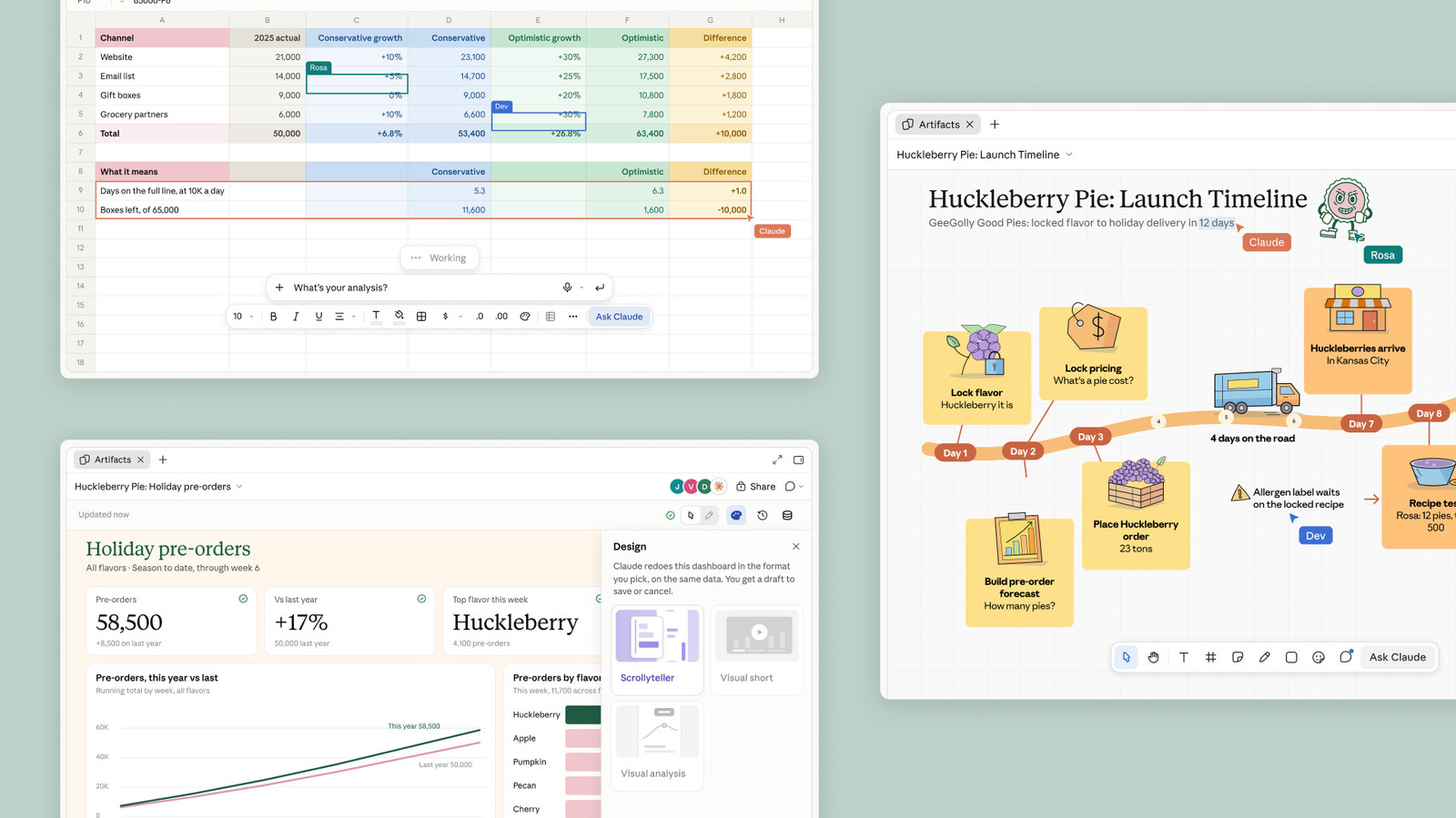
Anthropic takes on Google and Microsoft with Claude Sheets
Anthropic's launch of Claude Sheets and new productivity tools offers competitive alternatives to existing AI solutions from Google and Microsoft, enhancing workplace collaboration capabilities.
- Anthropic introduced Claude Sheets, a tool for generating and editing spreadsheets, during a recent event in San Francisco.
- Claude Sheets features collaborative capabilities, allowing multiple users to edit files while tracking changes made by Claude.
- The company also unveiled Claude Meetings, which records notes during video calls, starting with Google Meet for Team and Enterprise customers.
- Claude Whiteboards was launched as a brainstorming app that organizes team ideas by theme and drafts action items.
- Anthropic is also renaming Claude Dashboards to Claude Data and enhancing plugin functionality to connect with various applications.
Anthropic is a company specializing in artificial intelligence tools, and Claude is its AI assistant designed for workplace productivity. The recent introduction of new tools aims to provide collaborative and organizational support for users, competing against larger services like those offered by Google and Microsoft. Users should watch for further integrations and expansions in functionality as these tools move beyond beta testing.
Read the original ↗