
The day's AI news, briefed
The Daily Prompt
Our AI editor reads each day's AI and robotics stories, pulls out why they matter, and links every original source — so you can keep up in minutes.
Join over 250,000 subscribers getting the latest AI news
Latest AI & Robotics News Today

AI delivers ‘zero financial payoff’ to most companies, Apollo economist says
Understanding the lack of financial returns from AI adoption helps stakeholders reassess investment strategies and expectations regarding technology's role in business profitability.
- AI technology has not improved profit margins or revenue per worker for companies outside the tech sector, according to Apollo's chief economist Torsten Slok.
- Slok analyzed the S&P 493, which excludes major tech companies, and found that their financial performance remains flat despite significant AI investments.
- He noted that AI lacks essential human factors like judgment, accountability, and understanding of culture, which affect business outcomes.
The analysis comes from Apollo Global Management, a private equity firm, highlighting the disparity between tech and non-tech companies in realizing AI benefits. Previous studies also indicate limited productivity gains attributable to AI, prompting questions about future corporate adaptability in leveraging the technology.
Read the original ↗
Hugging Face Releases Carbon-X, a 14B Open DNA Language Model that...
The release of Hugging Face's Carbon-X model advances research capabilities in DNA analysis, which could enhance applications in biotechnology and genomics.
- Hugging Face has released Carbon-X, an open DNA language model with 14 billion parameters.
- This model is designed to analyze and process genetic data, promoting advancements in biological research.
Hugging Face is a leading AI company known for developing open-source machine learning models. The introduction of Carbon-X builds on the growing trend of AI being applied to life sciences, particularly in genomics.
Based on the headline only — the full article could not be fetched.
Read the original ↗
The hottest AI wearables and gadgets you should know about
The emergence of AI wearables and gadgets signifies a shift in personal technology, integrating AI into daily routines for enhanced productivity and companionship.
- New AI wearables aim to integrate artificial intelligence into everyday life, with products for productivity and emotional support.
- Amazon's acquisition of the wearables startup led to the launch of new devices like the Bee Frontier and Bee Eclipse.
- Friend, an emotional support pendant, recently updated to version 2.0, enhancing communication capabilities with a new speaker.
AI wearables offer various functionalities, from task management to emotional support. Major companies like Amazon, Meta, and startups are entering this growing market. Future developments are expected as these devices evolve and new features are introduced.
Read the original ↗
Cognition Open-Sources an Agent Plugin that Helps Secure Systems against Recent...
This story highlights a new open-source tool that enhances digital security by addressing critical vulnerabilities in widely used programming components, crucial for maintaining system integrity.
- Cognition released the Devin Vulnerability Fixes plugin to patch three critical remote code execution vulnerabilities in PHP, Node.js, and GitLab.
- The plugin utilizes three agent skills and operates on multiple coding platforms, including Devin and GitHub Copilot.
- The tool allows developers to manage security fixes through a structured workflow, requiring inventory checks and testing before application.
Cognition specializes in developing AI tools for software security. The Devin plugin addresses vulnerabilities with high CVSS scores, crucial for safeguarding applications. Future updates may enhance its performance metrics and integration features.
Read the original ↗
Anthropic Launches OSS Scanner, a Free AI Vulnerability Scanner
The introduction of a free AI vulnerability scanner addresses growing concerns about security risks in artificial intelligence systems, promoting safer deployment practices in the industry.
- Anthropic has launched OSS Scanner, a free tool for identifying vulnerabilities in AI systems.
- The tool is designed to enhance security measures within AI applications.
Anthropic is an AI safety and research-focused company that aims to develop reliable and safe AI technologies. This launch follows increasing interest in AI security, with many organizations seeking tools to ensure safer AI usage.
Based on the headline only — the full article could not be fetched.
Read the original ↗
What Is Data Poisoning? How Attackers Corrupt AI Models and Datasets
Data poisoning poses significant risks to the integrity of AI systems, potentially leading to harmful outcomes if not properly managed and understood.
- Data poisoning manipulates various forms of data to cause AI systems to learn corrupted behaviors or produce desired outcomes by attackers.
- The process of data poisoning includes gaining control over data sources, inserting misleading examples, and altering learned models.
- Understanding the stages of data poisoning is crucial for identifying vulnerabilities and ensuring the reliability of AI systems.
Data poisoning is a method of attack where malicious data influences the training of AI models, compromising their reliability. Addressing data poisoning requires recognition of its distinct phases to mitigate its impact effectively. The discussion around data poisoning highlights the need for robust AI governance and evaluation practices.
Read the original ↗
What the US Movement Against Data Centers Can Learn From Everywhere Else
The resistance against data centers in the U.S. highlights significant environmental and social challenges, raising questions about sustainability and energy use amid growing demands from technologies like AI.
- Paris Marx's book, 'Hyperscale,' discusses the worldwide history of opposition to data centers and its implications for the U.S.
- Opposition to data centers in Ireland led to a moratorium in Dublin due to strain on energy resources, impacting the industry’s expansion plans.
- In the U.S., the increasing demand for data centers is linked to the rise of generative AI, raising concerns about environmental sustainability and resource allocation.
Data centers are facilities used to house computer systems and associated components for data storage and processing. Increasing opposition in the U.S. reflects ongoing concerns over energy consumption and environmental impact seen in other countries. Observations from global experiences highlight potential challenges for U.S. infrastructure as data demands grow.
Read the original ↗
AI21 Labs Releases LIFT-Bench to Curb Reward Hacking in RL Training
LIFT-Bench aims to reduce reward hacking in reinforcement learning training, potentially leading to more reliable AI models that follow complex instructions accurately.
- AI21 Labs launched LIFT-Bench on October 25, 2026, to improve instruction-following benchmarks in AI training.
- The benchmark features scoped constraints to limit reward hacking by scoring task performance based on document sections.
- LIFT-Train, developed alongside LIFT-Bench, applies the benchmark's score as the reward across 34,258 training tasks.
AI21 Labs focuses on advancing natural language processing technology and AI models. The need for effective instruction-following benchmarks arose from observed shortcomings in existing benchmarks that allow reward hacking. Future developments will likely focus on refining these benchmarks and ensuring more accurate model training.
Read the original ↗
Anthropic Investigates Elevated Errors Across Five Claude Models
This investigation could impact the reliability of multiple AI services, highlighting potential vulnerabilities in critical technology used by various industries.
- Anthropic is investigating elevated errors affecting five Claude models, including Claude Mythos 5.1 and Claude Fable 5.1.
- The incident was posted on the Claude Status page at 06:14 UTC on October 25, 2026.
- At the time of the report, four components were marked with partial outages, including claude.ai and the Claude API.
Claude models are AI systems developed by Anthropic, a company focused on AI research and safety. The current incident follows a series of elevated error reports impacting various services in the past weeks. Observers will be watching for updates on the resolution and potential implications for users of the affected models.
Read the original ↗
Kimi K3.1 Pro Review: Near-Opus Quality at 1/5th the Cost
The Kimi K3.1 Pro presents an open-weight AI model that challenges leading closed models in coding, 3D modeling, and finance, signaling advancements in accessible AI capabilities.
- Kimi K3.1 Pro is Moonshot AI's latest open-weight model featuring a 1-million-token context window, enhancing coding, 3D modeling, and financial tasks.
- Its benchmark results demonstrate competitive performance, trailing the Opus 5.5 by only 0.7 points in coding and posting the best score in financial document analysis.
- The model shows significant improvements in hallucination rates, dropping from 23.4% to 8.3%, indicating better factual accuracy than its predecessor, K3.
Kimi K3.1 Pro is a successor to the Kimi K3 model and is noted for its ability to handle complex tasks across multiple domains. Its full weights will be available on November 4, 2026, allowing for independent testing of its capabilities against leading models.
Read the original ↗
The UK is investing $134 million into an AI Biosecurity Lab
This investment establishes the UK as a leader in the intersection of artificial intelligence and biosecurity, addressing emerging biological threats globally.
- The UK government has allocated £100 million ($134 million) to fund the new AI Biosecurity Lab (AIBL) under its National AI Biosecurity Initiative.
- OpenAI, Anthropic, and Google DeepMind are supporting AIBL by providing access to advanced AI models and technical expertise in biosecurity.
- AIBL will operate as a non-profit organization, collaborating with public-sector organizations and academic institutions to enhance global resilience.
- The lab aims to use AI to detect biological threats and accelerate the development of vaccines and treatments, responding to new risks in biothreats.
The AI Biosecurity Lab is part of the UK's effort to integrate AI into biosecurity measures, responding to challenges posed by advances in biological research. Previous developments have highlighted how AI can create both opportunities and risks in biotechnology, necessitating proactive measures in safety. The lab aims to set a global standard in biosecurity research and practice.
Read the original ↗
Forced to pick, Grok’s AI model chooses Republicans. OpenAI’s picks Democrats.
The study raises significant questions about the potential for political bias in AI systems, which could influence public perception and voting behavior during elections.
- A study found Grok's AI model recommended Republican candidates in 92% of cases, while OpenAI's GPT favored Democrats in 97%.
- The two models agreed on candidate selection in less than 10% of nearly 500 election races analyzed.
- Researchers noted that biases could appear even in general political discussions, not just direct voting questions.
- The results suggest that Grok and GPT have different sources and focus areas when providing political recommendations.
Grok and OpenAI's GPT are AI models used for generating responses based on natural language prompts, including political queries. Previous research has indicated that AI models can unintentionally exhibit biases based on their training data and response sourcing. As the upcoming elections approach, the focus on AI's influence on public opinion continues to grow.
Read the original ↗
Criminals Beware: New Technology Allows Forensic Crime Scene Investigators to Capture Your DNA From Thin Air
The development of technology to capture DNA from the air could significantly enhance criminal investigations, particularly in cases where traditional evidence is absent or compromised.
- An international research team has demonstrated the capability to collect airborne DNA evidence from home invaders, potentially revolutionizing crime scene investigations.
- The study involved simulated home invasions in real households, showing that DNA could be recovered even if intruders attempted to clean the scene afterward.
- Environmental conditions, such as air temperature and humidity, affected the effectiveness of DNA recovery, indicating a need for further research and standardization.
This research on environmental DNA (eDNA) aims to improve forensic evidence collection by capturing DNA particles that linger in the air after a crime. As traditional evidence is often degraded or absent, particularly in brief home invasions, this approach offers a novel solution for law enforcement. Future studies will focus on refining collection methods and improving reliability under varying conditions.
Read the original ↗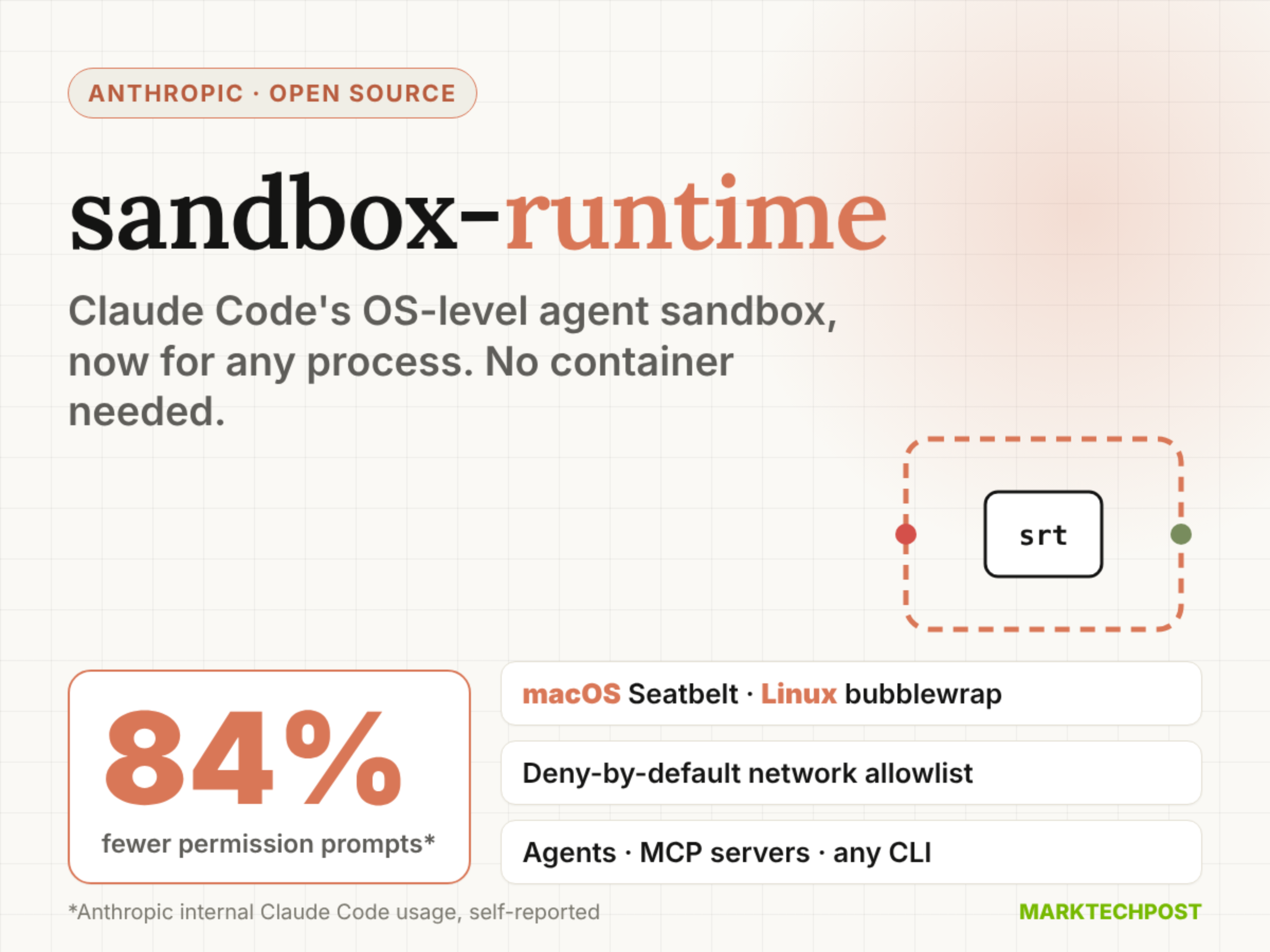
Meet Anthropic’s sandbox-runtime: OS-Level Sandboxing for AI Agents, No Containers
Anthropic's sandbox-runtime enables enhanced security for AI agents by providing OS-level process isolation, potentially reducing the risk of unauthorized access and data exfiltration.
- Anthropic's sandbox-runtime allows AI agents to operate with process restrictions without using containers.
- The tool decreased permission prompts in Claude Code by 84% during internal tests, streamlining agent functionality.
- It runs on macOS and Linux, utilizing Seatbelt and bubblewrap for process isolation, with Windows support in alpha.
Anthropic's sandbox-runtime is an open-source tool designed to enhance security by restricting filesystem and network access for processes. This approach represents a shift toward safer operational environments for AI, reducing approval fatigue and intrusion risks. Future developments will likely focus on improving Windows support and expanding functionality.
Read the original ↗
How Do AI Video Generators Work? From Diffusion to World Simulation
Understanding the mechanisms of AI video generation is crucial for discerning its capabilities and limitations, which can influence applications across industries from entertainment to education.
- AI video generation creates connected video frames from various inputs, including text and images, while ensuring motion and scene consistency.
- The process involves five stages: encoding, initializing a space-time representation, predicting motion, denoising sequences, and checking temporal consistency.
- A common misconception is treating AI video generation as simple image generation applied to each frame, which undermines its true complexity.
AI video generation uses algorithms to create videos by understanding and synchronizing different signals such as visual and audio cues. The technology is rapidly developing, with applications in fields like marketing, gaming, and content creation. Future developments may enhance realism and interactivity in generated videos.
Read the original ↗
The PHP Meltdown Shows How AI Makes Bugs More Exploitable
The identification of vulnerabilities in the PHP programming language demonstrates how AI tools can amplify the exploitation of software flaws, highlighting urgent security concerns for developers and users alike.
- Security researchers found vulnerabilities in the PHP language, collectively named PHP2Shell, using AI-assisted methods.
- Millions of exploitation attempts occurred shortly after these flaws were publicly disclosed, according to Cloudflare.
- AI models helped uncover potential exploitations of long-known vulnerabilities previously considered too complex to exploit.
PHP is a widely used scripting language for web development, and vulnerabilities in it pose risks to numerous applications. The PHP Foundation had prior knowledge of these vulnerabilities, but the advancement of AI tools has brought them to the surface. Observers are now cautious of the potential for more long-standing bugs to become active threats due to AI technologies.
Read the original ↗
Meta is delaying its controversial new business terms amid scraping concerns
Meta's postponement of its business terms could impact how companies protect their content online, affecting their relationship with Meta and other potential AI developers.
- Meta has delayed the implementation of its updated Commercial Terms and Self-Serve Ad Terms from October 30 to November 20.
- The initial terms would have allowed Meta to use web scrapers to access and use content from business accounts for AI training and other purposes.
- In response to concerns from businesses and publishers, Meta revised the language to remove AI training references and is facing antitrust complaints.
- The News Media Alliance has called for the withdrawal of the revised terms, arguing it would compel publishers to provide content without compensation.
Meta is a major social media platform that recently proposed changes to its business terms allowing content scraping for AI purposes. The backlash from publishers has prompted a reconsideration of the terms, impacting the ongoing debates about content ownership and AI training. Observers should watch for further developments in Meta's negotiations with partners and any regulatory responses.
Read the original ↗
Microsoft AI diagnostic tool outperforms doctors in clinical tests
The performance of Microsoft's AI diagnostic tool indicates significant advancements in artificial intelligence applications within the medical field, potentially influencing future diagnostic practices.
- Microsoft's AI diagnostic tool has shown to outperform human doctors in clinical tests.
- The tool's development suggests a shift towards integrating AI in diagnosing medical conditions.
As artificial intelligence technology continues to evolve, companies like Microsoft are exploring its potential in healthcare applications. Previous developments in AI diagnostics have raised questions about the role of human expertise in medical evaluations.
Based on the headline only — the full article could not be fetched.
Read the original ↗
Top 9 AI Orchestration Tools in 2026 (Free Options Included)
Understanding AI orchestration tools can enhance workflows and operational efficiency by enabling seamless collaboration among AI agents, which is crucial for businesses increasingly relying on AI technologies.
- The article lists nine AI orchestration tools available in 2026, including options that offer free trials or plans.
- AI orchestration tools manage how AI agents interact and execute tasks, improving workflows by tracking steps and facilitating human oversight.
- Popular options include n8n, Zapier, and Make, each offering distinct features and pricing structures tailored to different user needs.
AI orchestration tools help streamline and coordinate tasks between multiple AI agents and applications. These tools emerged to address the complexities of multi-agent interactions, providing businesses with efficient ways to integrate AI capabilities into their operations. Users should evaluate these tools based on their specific requirements, such as ease of use and cost considerations.
Read the original ↗
Moonshot AI Releases Kimi K3.1 Pro: A 2.8T Total/104B Active Params...
The release of Kimi K3.1 Pro highlights advancements in open-weight AI models, offering developers a competitive alternative to proprietary options, with significant implications for API pricing and performance metrics.
- Moonshot AI has launched the Kimi K3.1 Pro, a 2.8 trillion parameter open-weight model with a context window of 1 million tokens.
- Kimi K3.1 Pro scores 65.7% on Terminal-Bench 4.0 and leads in SWE-Marathon performance at 51.7%.
- The model introduces lower API pricing compared to its predecessor K3, with costs set at $2 and $10 per million tokens for input and output, respectively.
- Open weights for Kimi K3.1 Pro are expected to be released in November 2026.
- The model utilizes joint reinforcement learning and optimizes for long-context inference support.
Moonshot AI specializes in developing AI models, and Kimi K3.1 Pro is part of its K3 series, targeting performance similar to proprietary models. The previous K3 model laid the groundwork for this enhanced version, which incorporates advanced training techniques. Upcoming developments to watch include the open weights release and how K3.1 Pro performs in further benchmarks against competitors.
Read the original ↗