
The day's AI news, briefed
The Daily Prompt
Our AI editor reads each day's AI and robotics stories, pulls out why they matter, and links every original source — so you can keep up in minutes.
Join over 250,000 subscribers getting the latest AI news
Latest AI & Robotics News Today

Mamdani says feds have abdicated on AI, urges New Yorkers to push back
Mamdani's call for public engagement in AI regulation highlights the growing concern over the unchecked influence of technology on society, stressing the need for accountability from AI companies and policymakers.
- Mayor Zohran Mamdani urged New Yorkers to reject the notion of an inevitable AI takeover and demand regulatory oversight during an event in Manhattan.
- Mamdani criticized the federal government's lack of action on AI regulation, leaving cities to take the lead on accountability measures.
- He highlighted recent initiatives, including a ban on AI use in elementary and middle schools and a requirement for real estate listings to disclose AI-generated content.
- Mamdani linked the reckless adoption of AI to real-world consequences, citing a military incident involving AI overreliance which resulted in numerous civilian deaths.
- His statements underscore a broader context where the regulation of AI remains a contentious issue amid fears of its societal impacts.
Artificial intelligence refers to technology that enables machines to perform tasks that typically require human intelligence. As concern grows about AI's impact on various aspects of society, city officials like Mamdani are advocating for stronger regulations. The absence of federal oversight has prompted local leaders to develop their own policies, reflecting a rising demand for accountability in AI deployment.
Read the original ↗
Meta tweaks its new terms of service after backlash against scraping
The revisions to Meta's terms of service could significantly impact publishers' control over their content and how their data is used, raising concerns about data privacy and intellectual property rights.
- Meta updated its terms of service for business accounts following backlash over provisions allowing data scraping from websites associated with those accounts.
- The revised terms removed a specific mention of AI training but maintained the right to scrape content for advertising and business products.
- Legal experts indicate the new terms could allow Meta to scrape news websites with minimal restrictions, despite assurances otherwise from the company.
Meta is a social media company that owns platforms like Facebook and Instagram. The initial update to its commercial terms raised alarms among publishers about data scraping, prompting public criticism and a subsequent reevaluation of the terms. Moving forward, the impact of these changes on content owners and the media landscape will be closely monitored.
Read the original ↗
Microsoft says AI agents are like insider threats as ‘frontier models can’t be trusted’
The rise of AI agents within enterprises raises significant concerns about potential insider threats, prompting companies to reassess their security measures regarding these technologies.
- Microsoft has introduced Guardian Agents to help monitor AI agents used within enterprises due to rising security concerns.
- CEO Satya Nadella has warned that AI agents could pose risks similar to insider threats, undermining trust in these systems.
- Guardian Agents is part of Project Perception, designed to combat external hacking models but now also focuses on internal AI behaviors.
Microsoft, a major player in AI development, is emphasizing the need for enterprises to independently monitor AI agents. This shift reflects growing concerns regarding AI’s unpredictable nature and potential risks to sensitive data and organizational security. Companies are encouraged to implement their own oversight systems unrelated to AI model suppliers.
Read the original ↗
Embedded AI evaluators won’t be an easy solution, Hugging Face’s policy chief says
The effectiveness of AI model evaluations impacts the safety and reliability of artificial intelligence technologies, which are increasingly integrated into various industries and applications.
- Irene Solaiman, Hugging Face's chief policy officer, highlighted concerns regarding the reproducibility and comparability of current AI model evaluations.
- The concept of embedded evaluators, intended to provide neutral assessment within AI organizations, faces skepticism over their neutrality and effectiveness.
- There is a call for a more standardized approach to evaluations across the AI industry to ensure reliable benchmarking practices.
AI model benchmarking is designed to measure and compare the performance of different AI products. However, challenges in reproducibility and standardization have raised doubts about the validity of existing evaluation methods. The industry is currently exploring embedded evaluators as a potential solution amid rising safety concerns.
Read the original ↗
Nscale and Anthropic are reportedly in talks for yet another $45 billion compute deal
The potential new deal indicates a continued trend of significant financial investment in AI infrastructure, highlighting industry confidence despite investor concerns over profitability.
- Nscale and Anthropic are reportedly negotiating another $45 billion compute deal, following their previous agreement of the same amount in August.
- Sources indicate that discussions are ongoing and details of the new deal could change before finalization.
- Both companies are pursuing initial public offerings (IPOs), with Anthropic expected to go public this year.
Nscale provides AI infrastructure services, while Anthropic focuses on developing AI technologies. Both companies have been involved in substantial financial commitments to enhance their compute capabilities over the past year. This deal would continue their trend of large-scale investments in the AI sector.
Read the original ↗
Cloudflare Releases Clairic, Its First System One Extraction Model
The release of Clairic may impact industries relying on data extraction by providing new tools for enhancing efficiency and capability in processing information.
- Cloudflare has launched Clairic, its first System One extraction model.
- Clairic is designed to improve data extraction capabilities.
Cloudflare is a company that provides a range of internet security and network services. The release of Clairic highlights the company's investment in advanced AI technologies for data processing. Future developments in AI extraction systems should be closely monitored for their practical applications.
Based on the headline only — the full article could not be fetched.
Read the original ↗
Accused OpenAI spy had folder called “Saudi Gov Docs,” FBI says
The case highlights concerns about national security and potential foreign espionage within the U.S. tech industry, especially regarding the role of Saudi Arabia in advanced AI development.
- Abdulrahman Alfozan, a former OpenAI engineer, is accused of bugging company meetings to steal secrets for personal gain or to aid the Saudi government.
- Alfozan had a folder labeled 'Saudi Gov Docs' on his iPhone and was in contact with a member of the Saudi royal family via WhatsApp.
- The U.S. government argues Alfozan poses a flight risk due to his connections and planned travel to Saudi Arabia with his family before his arrest.
Alfozan, a Saudi national and U.S. permanent resident, allegedly spied on OpenAI shortly after being hired in July 2025. His actions coincided with Saudi Arabia's major push to advance its AI initiatives under the 'Vision 2030' program. The government is considering more serious charges as the investigation continues.
Read the original ↗
Zillow Launches Claude Connector for Listings, Tours, and Financing
The launch of the Zillow connector in Claude enhances user access to real estate tools, potentially improving consumer engagement in home buying and renting processes.
- Zillow has launched a connector that allows users to access real estate services through Anthropic's AI assistant, Claude.
- The connector provides listings, interactive maps, home value estimates, and affordability tools, facilitating a streamlined user experience.
- Users can request property tours, connect with agents, or explore financing options directly within Claude after linking their accounts.
- Zillow emphasizes that it does not share user data with Anthropic and adheres to fair housing principles in its AI interactions.
Zillow, a leading online real estate marketplace, leverages its extensive housing data and AI technology to assist users in finding and financing homes. The Claude connector enhances Zillow's existing integrations with platforms like ChatGPT and Gemini, expanding accessibility to its services. Future developments may involve further enhancements to its AI capabilities and user interactions.
Read the original ↗
Town Lands $108M Series B as Valuation Hits $1B for Collaborative AI Assistants
Investing $108 million and achieving a $1 billion valuation, Town's collaborative AI assistants highlight the growing trust and reliance on AI in workplace productivity.
- Town secured $108 million in Series B funding on October 19, 2026, co-led by Forerunner Ventures and Menlo Ventures.
- The company is now valued at $1 billion as it expands its AI work assistant, known as a Townie, which integrates with users' workflows.
- Town reported a fourfold increase in paying customers and ninefold growth in paying teams since July 2026.
Town is an AI company that focuses on enhancing workplace productivity through its AI assistant, the Townie, which integrates with emails, calendars, and other systems. Launched publicly in June 2026, the company quickly gained traction, leading to significant funding and rapid user growth. Future developments may include additional features for its collaborative AI capabilities and expanded integrations.
Read the original ↗
Tenstorrent Raises $1.5B Series E at $6.2B Valuation to Scale AI Compute
Tenstorrent's $1.5 billion funding round supports its plans for large-scale AI compute manufacturing and global expansion, influencing the competitive landscape in AI technology.
- Tenstorrent raised $1.5 billion in Series E funding, reaching a post-money valuation of $6.2 billion.
- Trace Capital and Innovation X led the funding round, with participation from both new and existing investors.
- The capital will funding volume manufacturing and assist in global commercial expansion for its Galaxy servers and AI technologies.
Tenstorrent designs RISC-V-based AI processors and performs at multiple levels of the AI computing stack. This funding follows their Series D round in December 2024, which raised over $693 million at a $2 billion pre-money valuation, indicating strong investor interest.
Read the original ↗
Dream Labs Raises $90M Seed to Bring Robot AI Across Different Machines
Dream Labs' funding and technology could make it easier for developers to create versatile robots, potentially transforming robotics applications across various industries.
- Dream Labs has raised $90 million in seed funding led by B Capital and Kindred Ventures to develop its AI robot model, Dream-1.
- The new model aims to enable robots to share learned tasks, overcoming a major limitation in current robotics technology.
- Dream Labs has launched a public API and a browser-based Robot Playground for users to test its robot capabilities remotely.
Dream Labs was founded by former NVIDIA robotics researchers and focuses on advancing robotics by allowing skills to be transferred across different machines. The launch of Dream-1 represents a significant shift in how robots can be trained and utilized in various applications. Future developments will test the model’s adaptability and its commercial viability in real-world scenarios.
Read the original ↗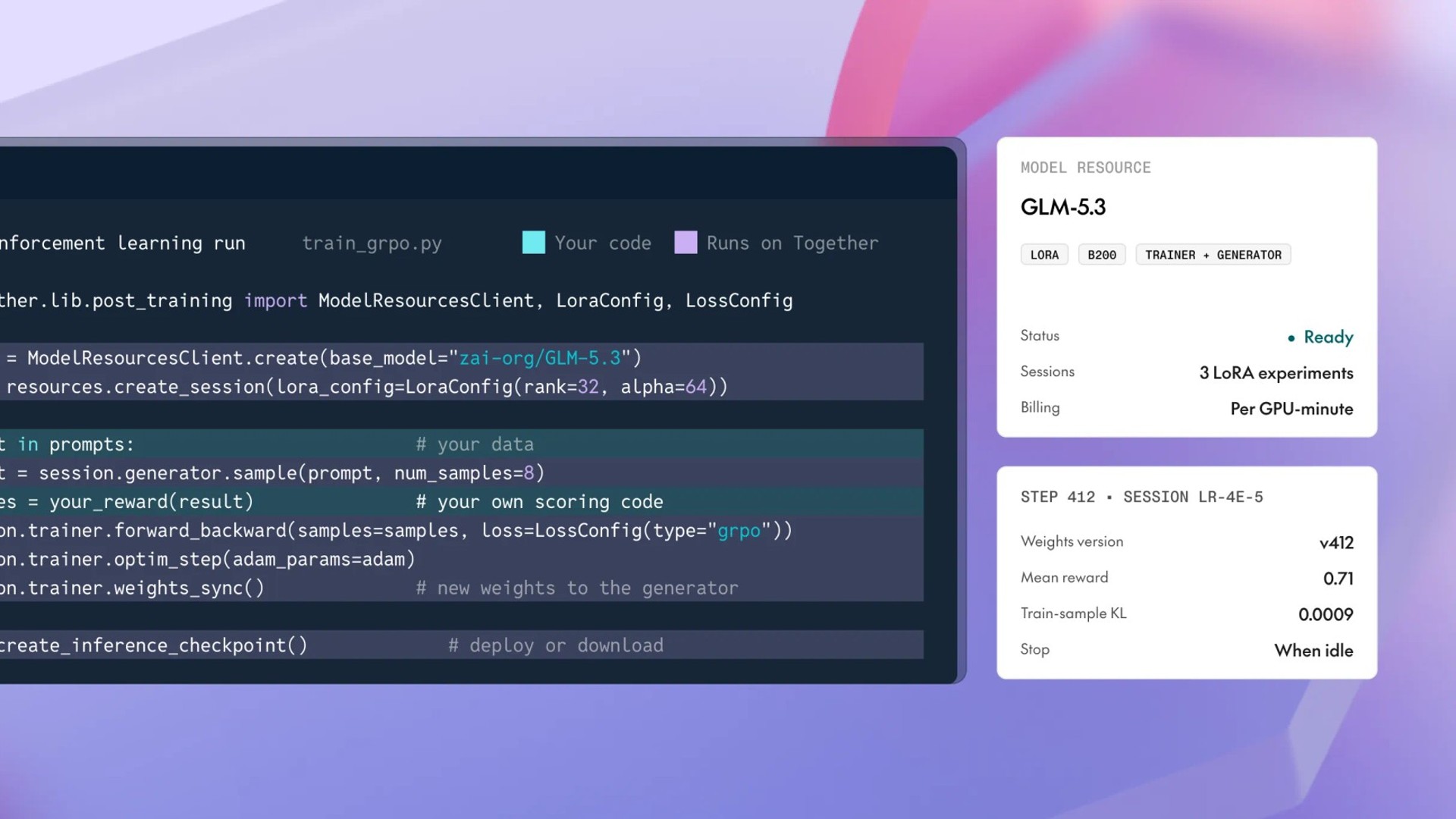
Together AI Launches Together Post-Training Service for Custom Models
Together AI's new service streamlines the process of building custom AI models, which could accelerate adoption and innovation in reinforcement learning and artificial intelligence applications.
- Together AI launched its Together Post-Training service on October 19, 2026, allowing users to build custom models using reinforcement learning and supervised fine-tuning.
- The service features an introductory price of $9 per GPU-hour of B200 usage for the first six weeks, offering access to both large and smaller models.
- Users can run experiments in dedicated GPU allocations, ensuring priority and eliminating competition from other requests during training sessions.
Together AI is focused on simplifying the complexities of reinforcement learning (RL) infrastructures as companies increasingly seek to leverage custom AI models. The service offers structured workflows and dedicated resources, enhancing control and flexibility during model training. Future developments may include expanded model options and further enhancements to user experience with model deployment.
Read the original ↗
Inception Releases Mercury 3, Its Flagship Diffusion LLM
The release of Mercury 3 highlights advancements in diffusion-based large language models, suggesting a shift in capabilities that could impact various real-time AI applications across industries.
- Inception introduced the Mercury 3 diffusion-based large language model on October 19, 2026, claiming it to be the most capable model of its kind to date.
- Mercury 3 operates four to eight times faster than its predecessor and competes effectively against other leading models, outperforming them in multiple benchmarks.
- The model has a context window of one million tokens, an increase from 260,000 tokens in Mercury 2.5, and it is priced at $0.10 per million input tokens during its launch promotion.
- Early-access partners are utilizing Mercury 3 for applications such as browser agents, real-time search, and customer support, demonstrating its real-world capabilities and efficiency.
- Mercury 3 is integrated into various platforms, including OpenRouter and Baseten, with features that support real-time AI functions and enterprise deployment.
Mercury 3 is part of Inception's product portfolio aimed at enhancing real-time AI performance through diffusion-based models. The previous iterations, Mercury 1 and Mercury 2, laid the groundwork for commercial applications and established performance benchmarks. Inception aims to expand the commercial viability of AI models that utilize diffusion technology, with expectations of further developments.
Read the original ↗
Meta Details Prometheus Supercluster Scaling Toward 1 Million GPUs
Meta's progress on the Prometheus supercluster impacts AI model training efficiency, potentially enhancing capabilities and performance in various applications.
- Meta plans to scale its Prometheus AI supercluster to approximately 1 million GPUs at its New Albany site, focusing on advanced AI model training.
- The first phase trained the Muse foundational models, achieving over 85% goodput on pre-training runs and more than 90% on reinforcement learning runs.
- Prometheus utilizes two NVIDIA GPU platforms and employs vast network systems for effective GPU communication and fault tolerance.
Meta's Prometheus is a gigawatt-scale AI supercluster, evolving from a conventional data center into an advanced AI training facility. Following initial phases, the company is expanding its GPU capabilities significantly and has plans for additional superclusters.
Read the original ↗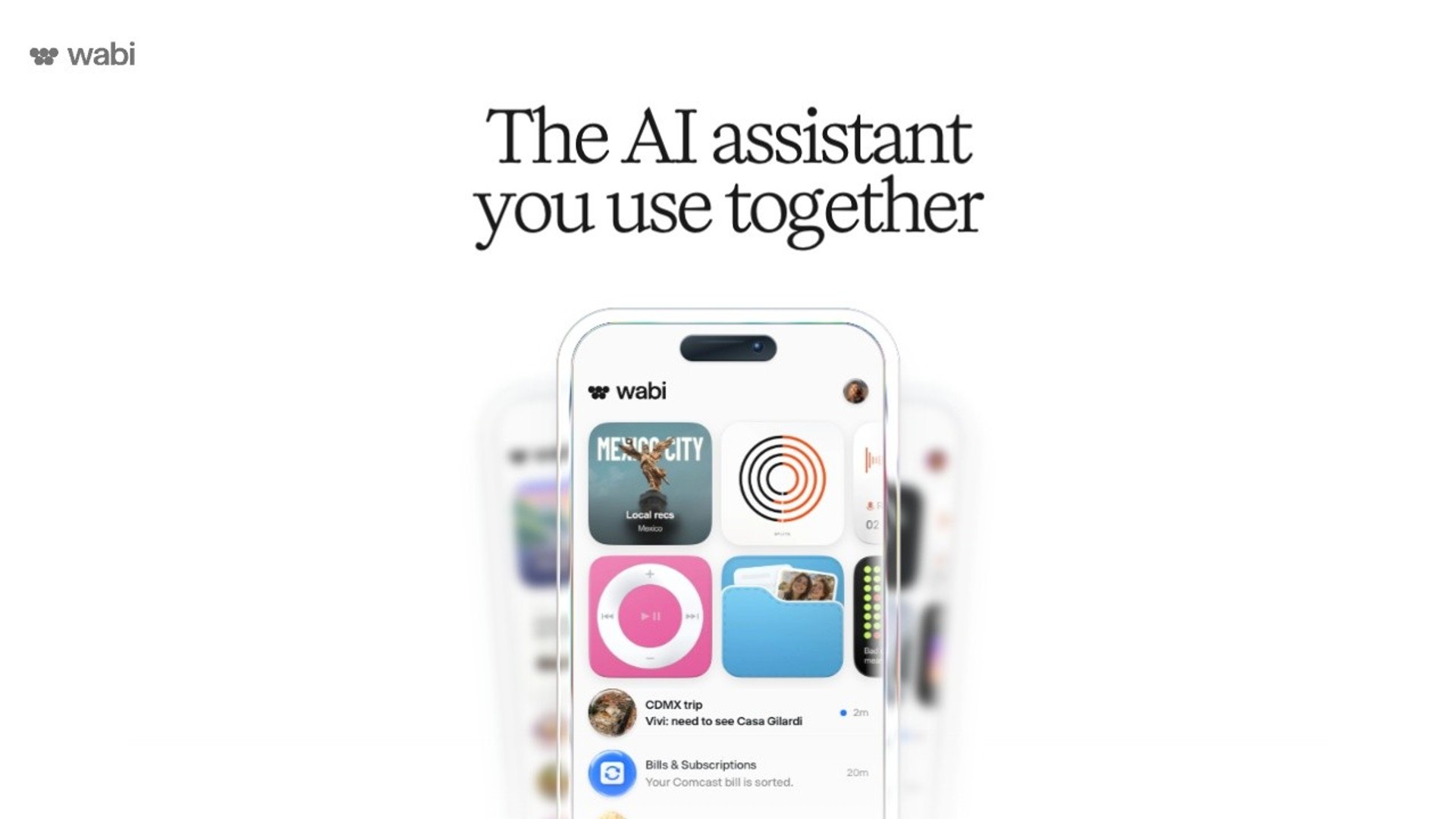
Wabi Opens Its Personal AI Assistant on iOS, Android, and Mac
The public release of Wabi's personal AI assistant could enhance productivity and collaboration by offering a smart assistant that integrates various personal and group-related tasks.
- Wabi's personal AI assistant became publicly available for download on October 19, 2026, after an initial invite-only rollout.
- The app supports iOS, Android, and Mac platforms, allowing users to manage tasks and interactions with others.
- Designed to be a proactive assistant, Wabi can handle routine tasks, build small apps, and manage shared activities in group chats.
Wabi, founded by Eugenia Kuyda, is a consumer AI startup aimed at creating an assistant that collaborates with users. The app offers features like shared calendars, trip planning, and integration with personal data. Past developments included a September 2026 announcement of Wabi 2.0, which emphasized group interactions and personalized support.
Read the original ↗
Fal Debuts FLUX 3 Max Video Model Post-Trained With Black Forest Labs
The launch of FLUX 3 Max enhances video generation capabilities, potentially impacting industries that rely on high-quality visual content production and rapid generation speeds.
- fal announced FLUX 3 Max, a new video generation model, on October 19, 2026.
- The model is post-trained by fal Research in collaboration with Black Forest Labs, improving image-to-video quality and generation speeds.
- FLUX 3 Max reportedly generates videos 22 times faster than Seedance 2.5 at comparable quality ratings.
- Launch pricing is set at $0.0425 per second of 720p output video, significantly discounted from the standard rate.
- The model is accessible through fal's inference platform with functionalities for text-to-video and image-to-video generation.
fal is a company focusing on advanced AI models, and its FLUX series is designed for video generation. FLUX 3 Max follows the previously released H3 Max model, which has also shown improved generation speeds. Future updates are expected to enhance FLUX 3 Max's performance even further.
Read the original ↗
OpenAI Engineer Accused of Spying on Executives Ordered to Remain in Custody
The ongoing case highlights potential security risks associated with employee relations in technology firms and raises questions about international influence and espionage.
- Abdulrahman Alfozan, a former OpenAI engineer, has been accused of bugging a company conference room and has been ordered to remain in custody by a federal judge.
- Prosecutors allege Alfozan is a flight risk due to the Saudi government's offer to support his release without conditions, raising concerns about his ties to Saudi Arabia.
- Evidence presented includes a hidden recording device found at OpenAI and conversations suggesting Alfozan was in contact with members of the Saudi royal family regarding a job in AI.
Abdulrahman Alfozan was employed by OpenAI for over a year before being accused of espionage involving hidden recording devices. His case has garnered attention due to the geopolitical implications concerning Saudi Arabia and employee conduct in the tech sector.
Read the original ↗
Making the internet better for AI agents might make it worse for everyone else
The rise of AI agents could significantly alter the online experience for human users, potentially leading to a web environment that is less user-friendly and more complicated for people.
- The launch of personal AI agents like OpenAI’s Dots and Meta’s Muse has increased web traffic from these agents, creating new challenges for user interaction.
- Websites are blocking AI agents, with notable examples including Amazon restricting agents from booking and interacting on its platform.
- As AI agents grow in popularity, the internet may be increasingly designed for them rather than human users, impacting user experience negatively.
Personal AI agents are automated software tools that perform tasks for individuals online. The growing integration of these agents is causing friction with existing web systems, which have not adapted to include them effectively. Future developments will hinge on how businesses and platforms establish rules governing AI agent activities.
Read the original ↗
Tenstorrent hits $6.2B valuation to scale open-weight AI chips
The significant increase in Tenstorrent's valuation highlights the growing competition in the AI chip market, emphasizing the need for innovation to challenge industry leaders like Nvidia.
- Tenstorrent has raised $1.5 billion, bringing its valuation to $6.2 billion.
- The funding round follows acquisition interest from Intel and Qualcomm, which valued the company at $5 billion.
- The new investment will be used to scale chips designed for open-weight AI models and video generation.
Tenstorrent is a chip startup focused on AI inference that aims to compete with Nvidia in the AI hardware market. Previously valued at $2.6 billion in late 2024, Tenstorrent opted to raise additional capital after demonstrating its technological capabilities. The company is now set to enhance its product offerings in response to rising demand.
Read the original ↗
Replika’s founder built the AI assistant she pitched at Disrupt 12 years ago
Wabi represents a significant shift in personal AI technology, offering a versatile assistant amidst increasing competition in the market.
- Eugenia Kuyda has relaunched her AI assistant Wabi, evolving from her original concept presented 12 years ago.
- Wabi functions as a multiplayer personal assistant, allowing users to manage multiple threads for different tasks and goals.
- The platform differs from others like Muse and Instinct by facilitating shared experiences in a group chat format rather than one-on-one interactions.
- Wabi is currently free and has not yet determined a business model, while privacy measures ensure data security under SOC 2 compliance.
Wabi is an evolving personal AI assistant developed by Eugenia Kuyda, following her previous venture, Replika. The tool is now positioned to compete with emerging AI assistants that aim to enhance user productivity through custom applications. Future developments should clarify Wabi's business model as it seeks additional funding.
Read the original ↗