
The day's AI news, briefed
The Daily Prompt
Our AI editor reads each day's AI and robotics stories, pulls out why they matter, and links every original source — so you can keep up in minutes.
Join over 250,000 subscribers getting the latest AI news
Latest AI & Robotics News Today

US orders federal agencies to remove China’s DeepSeek AI from their systems
This decision impacts the operations of federal agencies and raises concerns about national security and data privacy related to foreign technology.
- The U.S. has ordered federal civilian agencies to remove DeepSeek AI products and related third-party services due to national security risks.
- The Department of Homeland Security cited concerns that sensitive U.S. user data could be accessible to Chinese authorities under Chinese law.
- This directive builds on a previous law from December 2025 that limited DeepSeek's use in national security systems.
DeepSeek is a Chinese AI startup that has faced scrutiny for its data handling practices. The U.S.-China tech rivalry has intensified, with both countries implementing measures to restrict AI technologies deemed a security threat. Future actions may include increased scrutiny of other Chinese tech companies and their data practices.
Read the original ↗
Agility Robotics Signs AGCO Deal to Pilot Digit Humanoid Robots
Integrating humanoid robots into manufacturing may significantly enhance operational efficiency and workplace safety, which are critical in a competitive industrial landscape.
- Agility Robotics and AGCO signed a commercial agreement to pilot Digit humanoid robots in AGCO's manufacturing operations, beginning in 2027.
- The pilot will focus on automating repetitive and hazardous tasks to improve operational efficiency and ergonomic safety at AGCO's facility in Hesston, Kansas.
- Digit is designed to learn and adapt to workflows, enabling greater flexibility and productivity in manufacturing operations.
Agility Robotics develops humanoid robots powered by AI, and this partnership aims to enhance manufacturing processes. AGCO is a global manufacturer focusing on agricultural machinery, and companies like Toyota and GXO are also adopting Agility's robots. Future developments will hinge on how effectively these robots integrate into current practices.
Read the original ↗
AI Doesn’t Eliminate Human Bias. It Scales It.
AI systems can perpetuate human biases at scale, impacting decision-making in hiring and healthcare without transparency or accountability, which raises significant ethical concerns.
- AI systems learn from human history, causing them to replicate existing biases in decisions.
- A Stanford analysis found that 26% of Black applicants faced discrimination in job applications filtered by AI.
- An AI healthcare algorithm misclassified Black patients as healthier than equally ill white patients due to historical funding disparities.
- To combat bias, organizations should assign human owners to AI decisions and audit training data before use.
Artificial intelligence systems are increasingly used to make decisions in various sectors, but they can replicate human biases present in historical data. As organizations adopt AI, ensuring transparency and accountability in decision-making processes remains crucial to mitigate these biases and enhance fairness.
Read the original ↗
Llm-D 1.0 Debuts at PyTorch Conference with Production Inference Stack
The release of llm-d 1.0 signals a significant advancement in distributed inference technology, promising to reduce deployment costs and improve performance for organizations leveraging AI models.
- The llm-d 1.0 inference stack was announced on October 20, 2026, at the PyTorch Conference North America.
- It enables organizations to deploy AI models cost-effectively by supporting any model on various cloud platforms and hardware accelerators.
- Key contributors include Red Hat, IBM, Google, CoreWeave, and NVIDIA, among others, with llm-d hosted as a sandbox project by the Cloud Native Computing Foundation.
llm-d is designed for managing AI model inference at scale, addressing the rising costs associated with model deployment. This version introduces features for multi-tenant operations and improved operational maturity, which are crucial for organizations seeking efficient AI solutions. Future updates may focus on enhancing performance and integration with more inference engines.
Read the original ↗
xMEMS Begins Mass Production of Solid-State Cooling Chips for AI Glasses and Data Center Hardware
The mass production of solid-state cooling chips by xMEMS could enhance the performance and efficiency of AI devices by effectively managing heat in compact hardware.
- xMEMS has begun mass production of its XMC-2400 and XMC-4800 µCooling chips for AI applications and data center hardware.
- The XMC-2400 chip is designed for compact edge devices, while the XMC-4800 targets smartphones and enterprise SSDs.
- The first commercial products featuring the XMC-2400 are expected in early 2027, though mass production does not equate to immediate consumer availability.
xMEMS Labs, based in Santa Clara, specializes in solid-state micro-cooling technology to address heat management in devices with high AI processing demands. The XMC-2400 and XMC-4800 chips utilize a piezoelectric system to create airflow without traditional fans. Future developments may include integration with other edge AI technologies.
Read the original ↗
Homebase Launches AI Assistant to Fill Shifts and Ease Hiring and Payroll
Homebase Assistant can streamline scheduling and hiring for small businesses, potentially saving time and reducing administrative burdens for owners managing hourly teams.
- Homebase has launched an AI assistant designed to assist with scheduling, hiring and payroll for small businesses.
- The assistant identifies replacement staff when employees call in sick and manages scheduling conflicts based on availability and labor costs.
- The tool aims to help business owners handle over 4.7 million administrative tasks and save significant time in managing hourly employees.
Homebase is a platform that supports small businesses in managing their hourly workforce through scheduling, payroll, and hiring tools. This launch comes amid growing interest in AI-driven solutions that automate administrative functions in various industries. Observers will watch how effectively the assistant integrates into existing workflows and improves efficiency for its users.
Read the original ↗
Homebase Launches AI Assistant to Fill Shifts and Manage Hourly-Team Admin
The launch of Homebase Assistant could significantly streamline staffing processes for small businesses, reducing the time owners spend on administrative tasks and improving shift coverage.
- Homebase Assistant automates staffing, hiring, and payroll tasks for hourly teams, aiming to ease the administrative burden on small business owners.
- The Assistant can identify available employees and fill shifts based on owner preferences and historical context.
- It incorporates functionalities like scheduling, timecard checks, and labor-cost monitoring to address staffing efficiency.
- The product is currently available to a limited number of businesses, providing a controlled environment for early feedback on its efficacy.
Homebase provides scheduling, payroll, hiring, and team communication tools for small businesses. The new AI Assistant extends its existing services by automating shift coverage and administrative tasks. Ongoing observations will assess the Assistant's performance and user control features in real-world applications.
Read the original ↗
Vectorial Raises $3M Seed to Test Products Against Simulated Customers
Vectorial's innovative approach to product development could significantly reduce the time businesses need to assess consumer interest, potentially transforming how companies validate new ideas.
- Vectorial raised $3 million in seed funding to enhance its platform that uses human behavior models to test product ideas with simulated audiences.
- The funding includes contributions from investors like Smilegate, SenseAI Ventures, and Dent Capital, as well as support from product leaders at Meta, Shopify, and Mastercard.
- The company's SAPIENS model simulates audience reactions based on demographic, psychological, and behavioral data, aiming to predict consumer behavior with higher accuracy.
- Vectorial has conducted over 30,000 simulations and claims its models achieve more than 85% accuracy in forecasting user study results compared to actual behaviors.
Vectorial aims to integrate behavioral modeling into the product development cycle, creating a system to simulate audience reactions before real-world testing. The company's approach contrasts with traditional market research by focusing on ongoing insights rather than isolated studies. Future developments will focus on expanding data partnerships and evolving their predictive model to enhance accuracy across diverse market segments.
Read the original ↗
Asymptote Labs Raises $5.5M Seed to Monitor and Control Enterprise AI Agents
The funding enables Asymptote Labs to enhance tools for monitoring and controlling enterprise AI agents, addressing critical security and operational challenges as AI capabilities expand.
- Asymptote Labs raised $5.5 million in an oversubscribed seed round to develop infrastructure for monitoring and controlling AI agents in enterprises.
- The funding, led by Tower Research Ventures, will support engineering, product development, hiring, and market expansion.
- The company integrates an open-source layer called Beacon for recording agent activity, alongside an enterprise platform for detection and governance of AI actions.
Asymptote Labs focuses on providing security initiatives for enterprise AI agents that are increasingly involved in complex tasks. The growing reliance on AI necessitates effective monitoring solutions to mitigate risks and enhance operational reliability. Industry observers should anticipate advancements from Asymptote in addressing AI governance and security challenges.
Read the original ↗
Sarawak expands voice AI trials for government services
The expansion of voice AI trials for government services could enhance accessibility and efficiency in public administration, improving how citizens interact with their government.
- Sarawak is expanding trials of voice AI technology for government services.
- This initiative aims to improve citizen engagement and service delivery in the region.
Voice AI technology allows users to interact with systems using spoken language, making services more accessible. This expansion follows earlier trials aimed at integrating AI into public services. Future developments may include broader implementation and additional features for these services.
Based on the headline only — the full article could not be fetched.
Read the original ↗
Yelp can now call on your behalf to check wait times at a restaurant
Yelp's new voice feature enables users to check restaurant wait times more efficiently, enhancing user experience through automation and AI-driven communication.
- Yelp is introducing a feature called Check for Me, allowing users to inquire about restaurant wait times via an AI voice agent.
- Users can enter their party size and phone number to receive updates about wait times through text messages from the AI agent.
- Yelp's existing voice solution for restaurants has been enhanced to include consumer-facing capabilities, though agent-to-agent communication may vary in effectiveness.
- The company is also enhancing its AI assistant for personalized restaurant recommendations and integrating OpenTable for direct bookings inside the app.
- A new feature called Smart Lead Reply will be launched as a paid product for business owners to streamline customer engagement.
Yelp is a platform that helps users find and review local businesses, especially restaurants. The company has previously developed voice solutions primarily for service providers and is now expanding its use of AI to improve user interactions and personalization. Future updates will include enhanced personalized recommendations and improvements to customer support features.
Read the original ↗
Otter.ai raises $320 million from General Catalyst’s growth fund for its meeting tool
The significant funding for Otter.ai highlights the growing demand for efficient meeting tools in the competitive landscape of enterprise software solutions.
- Otter.ai raised $320 million from General Catalyst’s Customer Value Fund for its meeting note-taking tool.
- The funds will be used for enterprise growth, international expansion, and product innovation.
- Otter.ai has achieved over $100 million in annual recurring revenue and serves 40 million users, an increase from 25 million last year.
- The funding comes as Otter faces competition from several other well-funded note-taking products in the market.
Otter.ai is a meeting note-taking software that converts voice data into actionable insights. The company has been operational for nearly a decade and previously raised $50 million. It is expanding its features to enhance meeting productivity and efficiency.
Read the original ↗
Claude Opus 5.5 vs Sonnet 5.5: Which Is Better for Content Creation?
The differentiation between Claude Opus 5.5 and Sonnet 5.5 illustrates how AI can be tailored for specific roles in content generation and enhances efficiency for companies using these models.
- Anthropic released Opus 5.5 on September 22 and Sonnet 5.5 shortly after, with each designed for different tasks.
- Opus 5.5 is aimed at complex tasks requiring judgment, while Sonnet 5.5 excels at creating polished documents for routine use.
- Sonnet 5.5 is half the cost per token compared to Opus 5.5, making it a more economical choice for drafting content.
- Utilizing Opus 5.5 for planning and Sonnet 5.5 for drafting can streamline the content creation process effectively.
- Anthropic advises adjusting the effort level based on task type to optimize performance when using these models.
Claude Opus and Sonnet are AI writing models developed by Anthropic, tailored for different stages of the content creation process. Opus focuses on strategy and judgment, while Sonnet is optimized for clear and concise drafts. Companies are encouraged to evaluate which model suits their specific content needs and adjust usage accordingly.
Read the original ↗
Otter.ai Closes $320M Growth Financing From General Catalyst’s CVF
The closure of this significant financing round highlights the growing importance of AI tools in enterprise productivity and showcases investor confidence in Otter.ai's business model and growth potential.
- Otter.ai has secured $320 million in growth financing from General Catalyst’s Customer Value Fund.
- The company intends to use the funding to accelerate its enterprise growth and product innovation.
- Otter.ai reports over 40 million users and has transcribed more than 1 billion meetings worldwide.
- General Catalyst's investment strategy involves pre-funding sales and marketing budgets, sharing the created customer value based on performance.
Otter.ai provides an AI notetaking and conversational knowledge platform, serving teams in various industries including education and professional services. The company aims to enhance organizational efficiency through captured conversations and contextual insights. Moving forward, developments in Otter's enterprise AI capabilities and its market expansions will be significant to watch.
Read the original ↗
Enterprise AI Needs Cumulative Context Before It Can Earn Autonomy
Establishing a trustworthy AI requires a cumulative business context to ensure it interprets data correctly and makes reliable recommendations, impacting how organizations leverage AI for decision-making.
- Cumulative business context, which involves an organization's historical understanding of its data, is essential for AI to make reliable decisions.
- Only 25% of AI initiatives met expected ROI, highlighting that access to AI does not guarantee successful implementation in enterprises.
- 76% of organizations reported low agent deployment across business functions, indicating issues with enterprise readiness for AI autonomy.
Enterprise AI refers to artificial intelligence systems used by businesses to improve operations. Many organizations have deployed AI, but struggle with effective integration and governance over AI use. The future will see a greater emphasis on building contextual understanding to enhance AI reliability and authority in decision-making.
Read the original ↗
NEURA Robotics, NXAI Team Up to Give Cognitive Robots Lasting Memory
The partnership between NEURA Robotics and NXAI aims to enhance cognitive robots' capabilities through improved memory, crucial for their effectiveness in various tasks.
- NEURA Robotics and NXAI are collaborating to develop a memory component for cognitive robots, integrating NEURA's Physical AI stack with NXAI's xLSTM architecture.
- The planned integration will allow companies to customize NXAI's model for specific tasks within the Neuraverse platform, a toolchain for robotics.
- The announcement states that the distinct types of memory—working and episodic—are essential for robots to operate effectively in real-world scenarios.
NEURA Robotics, founded in 2019 in Metzingen, develops cognitive robots capable of sensory perception and learning. NXAI, based in Austria, specializes in xLSTM models which enable efficient state-tracking for AI applications, especially in robotics.
Read the original ↗
10 Best Free AI Video Clipping Tools in 2026 (Verified Free Plans)
Free AI video clipping tools are increasingly relevant for content creators seeking efficient ways to produce engaging short videos across platforms, particularly as demand for such content rises.
- YouTube Shorts averages over 200 billion daily views, indicating a high demand for engaging short-form video content.
- The article provides a ranked list of ten free AI video clipping tools that do not require credit card information for access.
- Each tool is verified based on its free plan, assessing factors like video quality, storage limits, and usability.
- OpusClip offers 60 credits monthly and automatically reframes videos to vertical, but exports stop being available after three days.
- WayinVideo stands out for providing exports without watermarks, allowing users to create content more freely.
AI video clipping tools automate the process of extracting highlights from longer videos for social media sharing. The rise of platforms like YouTube Shorts has emphasized the need for efficient solutions in video content creation. These tools simplify the workflow, catering to a wide range of users from podcasters to social media creators.
Read the original ↗
Xiaomi-Lens-0 Technical Report
Xiaomi-Lens-0 enhances visual reasoning capabilities in multimodal large language models, potentially improving applications in areas requiring fine-grained image comprehension, like visual search and robotics.
- Xiaomi-Lens-0 is a 4 billion parameter multimodal model designed to improve referring comprehension and fine-grained region reasoning.
- It incorporates a lightweight decoder to predict masks from visual representations without requiring a separate segmentation encoder.
- The model demonstrates a 5.6 point improvement on average in referring comprehension over its predecessor, Qwen3.5, across multiple benchmark datasets.
- Xiaomi-Lens-0 achieves the highest segmentation intersection-over-union (cIoU) among compared models, indicating superior performance in segmentation tasks.
Xiaomi-Lens-0 is based on the Qwen3.5 architecture and specifically addresses challenges in visual reasoning for multimodal language models. Its development is significant as it provides a new approach to understanding visual elements in relation to language. Future enhancements in this area may lead to more intuitive AI applications in diverse fields including search and automated reasoning systems.
Read the original ↗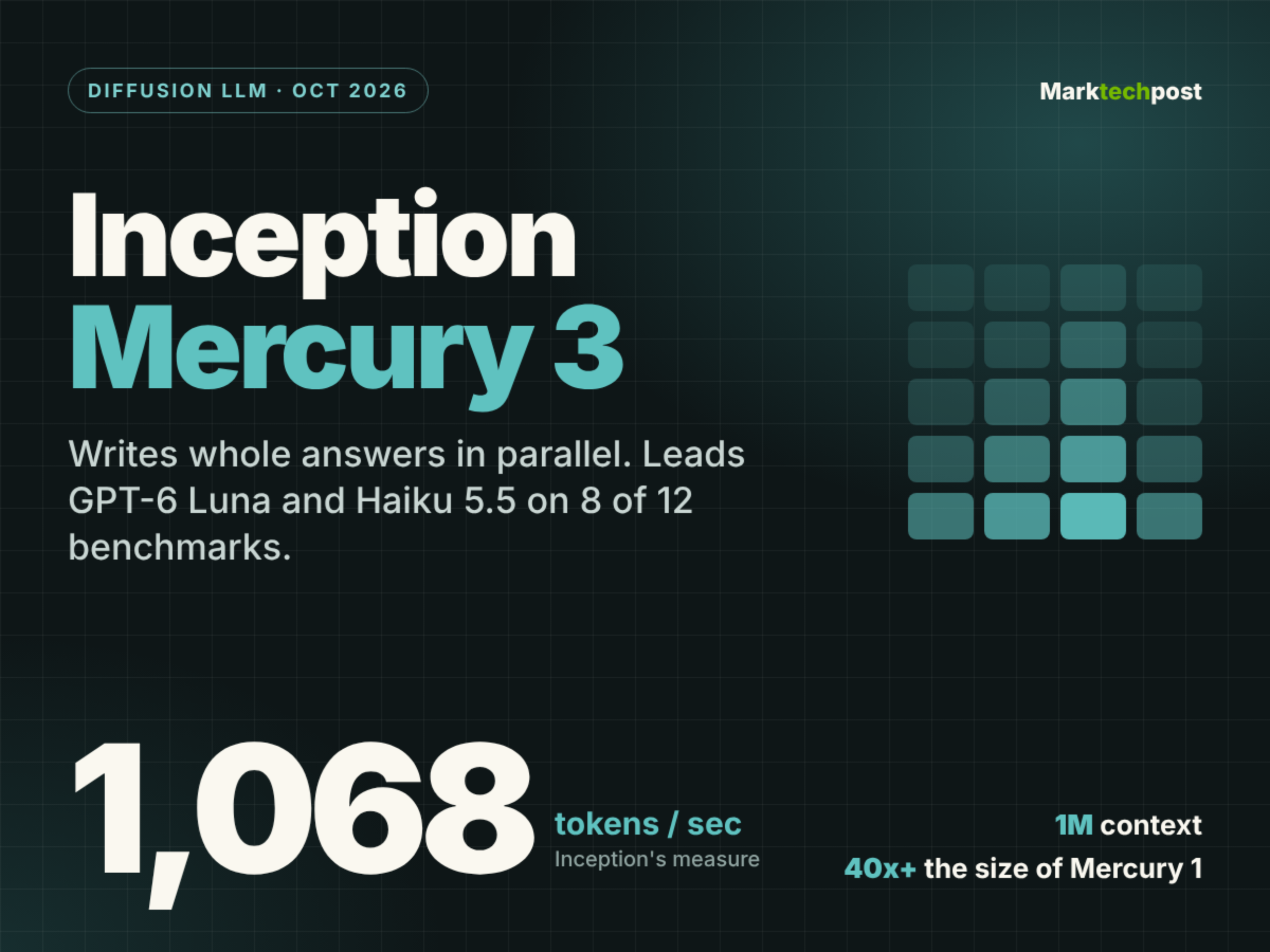
Inception Releases Mercury 3 Diffusion LLM at 1,068 Tokens per Second
The release of the Mercury 3 diffusion LLM marks a significant advancement in language model performance, with implications for faster processing times in various AI applications.
- Inception has released the Mercury 3 diffusion LLM.
- The Mercury 3 operates at a speed of 1,068 tokens per second.
Inception is a company focused on developing advanced language models. The Mercury 3 represents their latest achievement in increasing the efficiency and speed of AI-driven text generation. Future updates may provide additional features or performance enhancements.
Based on the headline only — the full article could not be fetched.
Read the original ↗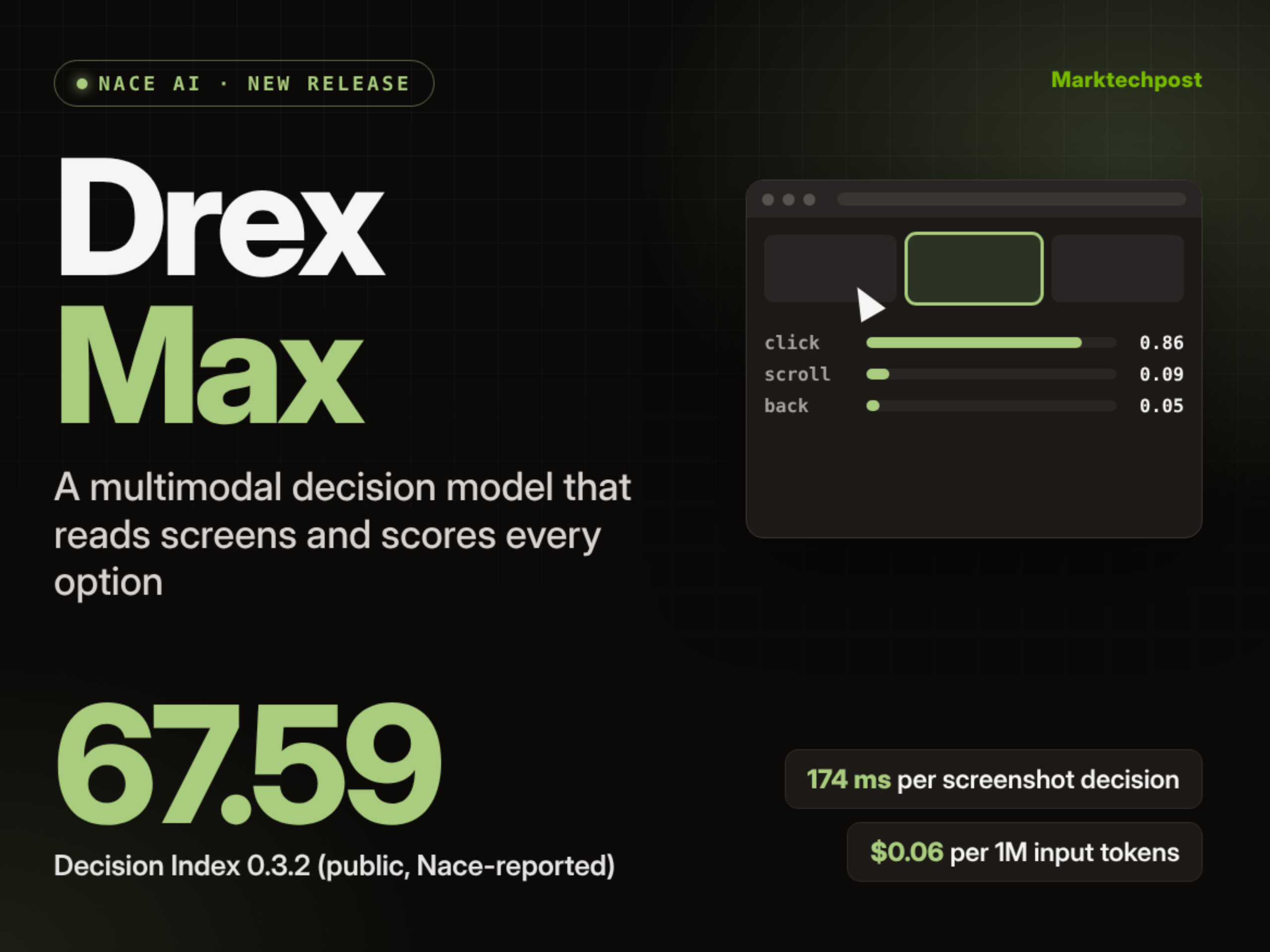
Meet Drex Max: Nace AI’s Multimodal Decision Model for Computer-Use Agents...
The development of multimodal decision models like Drex Max could enhance the capabilities of computer-use agents in various applications, affecting productivity and efficiency.
- Nace AI has introduced Drex Max, a multimodal decision model for computer-use agents.
- Drex Max is designed to facilitate improved decision-making in AI systems.
Nace AI focuses on developing advanced artificial intelligence solutions, including decision models that leverage multiple modes of data. The rise of multimodal models illustrates a trend in AI to better understand and interpret complex data sets. Future developments in this area may further integrate AI into everyday applications.
Based on the headline only — the full article could not be fetched.
Read the original ↗