
The day's AI news, briefed
The Daily Prompt
Our AI editor reads each day's AI and robotics stories, pulls out why they matter, and links every original source — so you can keep up in minutes.
Join over 250,000 subscribers getting the latest AI news
Latest AI & Robotics News Today

PaperFlow: Profiling, Recommending, and Adapting Across Daily Paper Streams
The development of PaperFlow could improve the personalization of scientific paper recommendations, enhancing researchers' ability to stay updated with relevant literature as their interests evolve.
- PaperFlow is a framework designed for scientific paper recommendation that focuses on user profiles, daily streams, and changing interests.
- The process includes three key stages: Profiling, Recommending, and Adapting, to enhance user engagement over time.
- A longitudinal benchmark involving 24 users, 50 daily streams, and 1,200 episodes was utilized to test PaperFlow's effectiveness against existing recommendation methods.
PaperFlow addresses the dynamic nature of scientific reading, which is influenced by evolving user interests rather than static rankings. Previous recommendation systems typically utilized fixed candidate sets, while PaperFlow aims for a more adaptive approach. Future developments may include broader implementation and further refinement of its recommendation algorithms.
Read the original ↗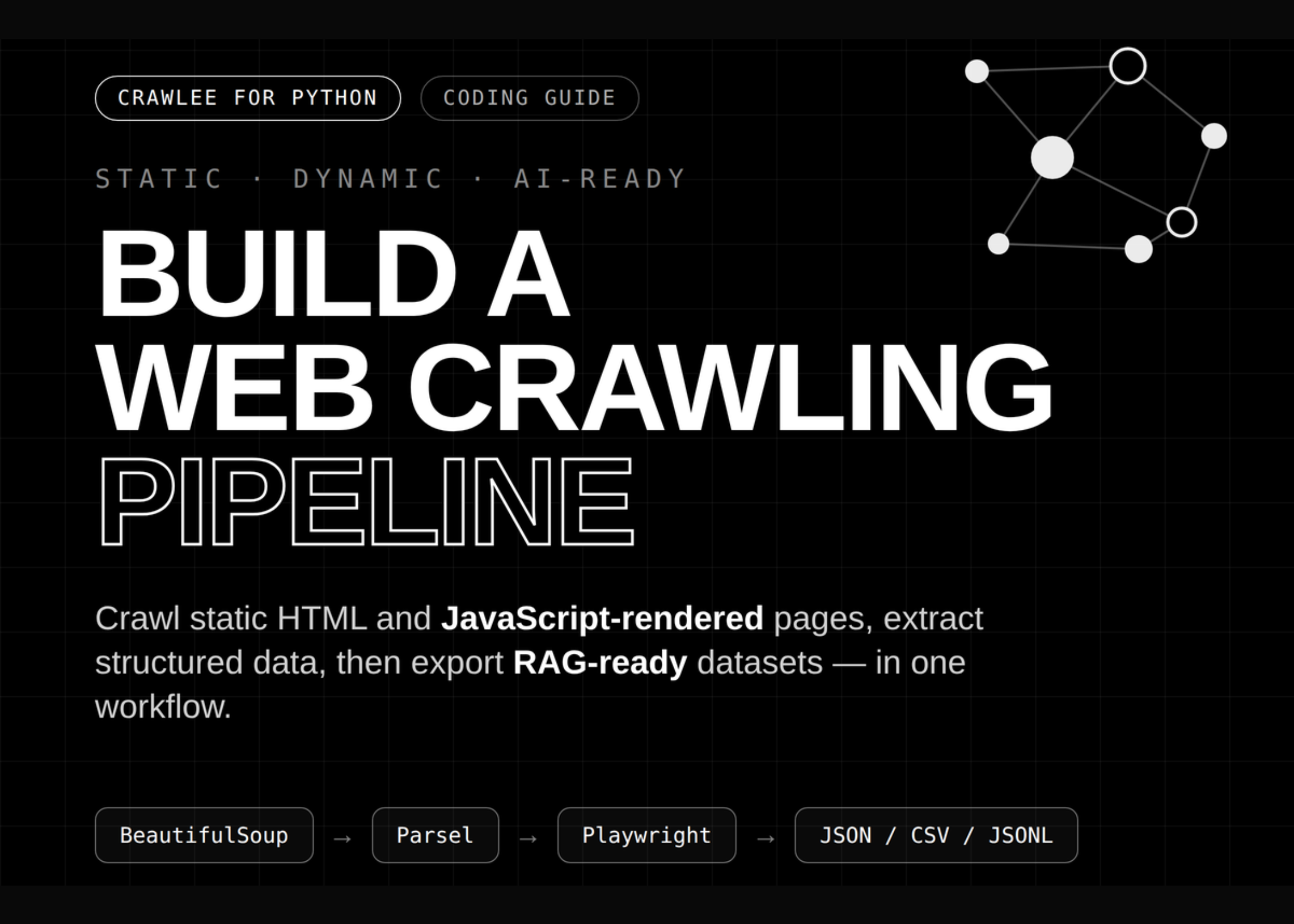
Crawlee for Python: Build a Web Crawling Pipeline with Robots Handling, Link Graphs, and RAG Chunk Export
Web crawling is essential for data collection and analysis, and tools like Crawlee for Python help developers streamline this process.
- Crawlee for Python enables the creation of a web crawling pipeline featuring robots handling, link graphs, and RAG chunk export.
Crawling technologies are designed to help gather information from the web efficiently. Previous tools have emphasized functionality but varied in user accessibility and complexity. Increasing interest in data-driven insights suggests tools like Crawlee will play a significant role in future web operations.
Based on the headline only — the full article could not be fetched.
Read the original ↗
#6 Washington a gelé Anthropic. Trump vient de tout annuler.
Changes to regulatory measures could significantly impact the development and deployment of AI technologies by companies like Anthropic, affecting innovation and competition in the sector.
- Washington put a stop to Anthropic's activities.
- Trump has annulled all prior agreements or regulations.
Anthropic is an AI company focused on developing advanced AI models. Regulatory environments in the U.S. have been evolving, impacting how AI companies operate. The future of AI regulation and company activities remains uncertain after these changes.
Based on the headline only — the full article could not be fetched.
Read the original ↗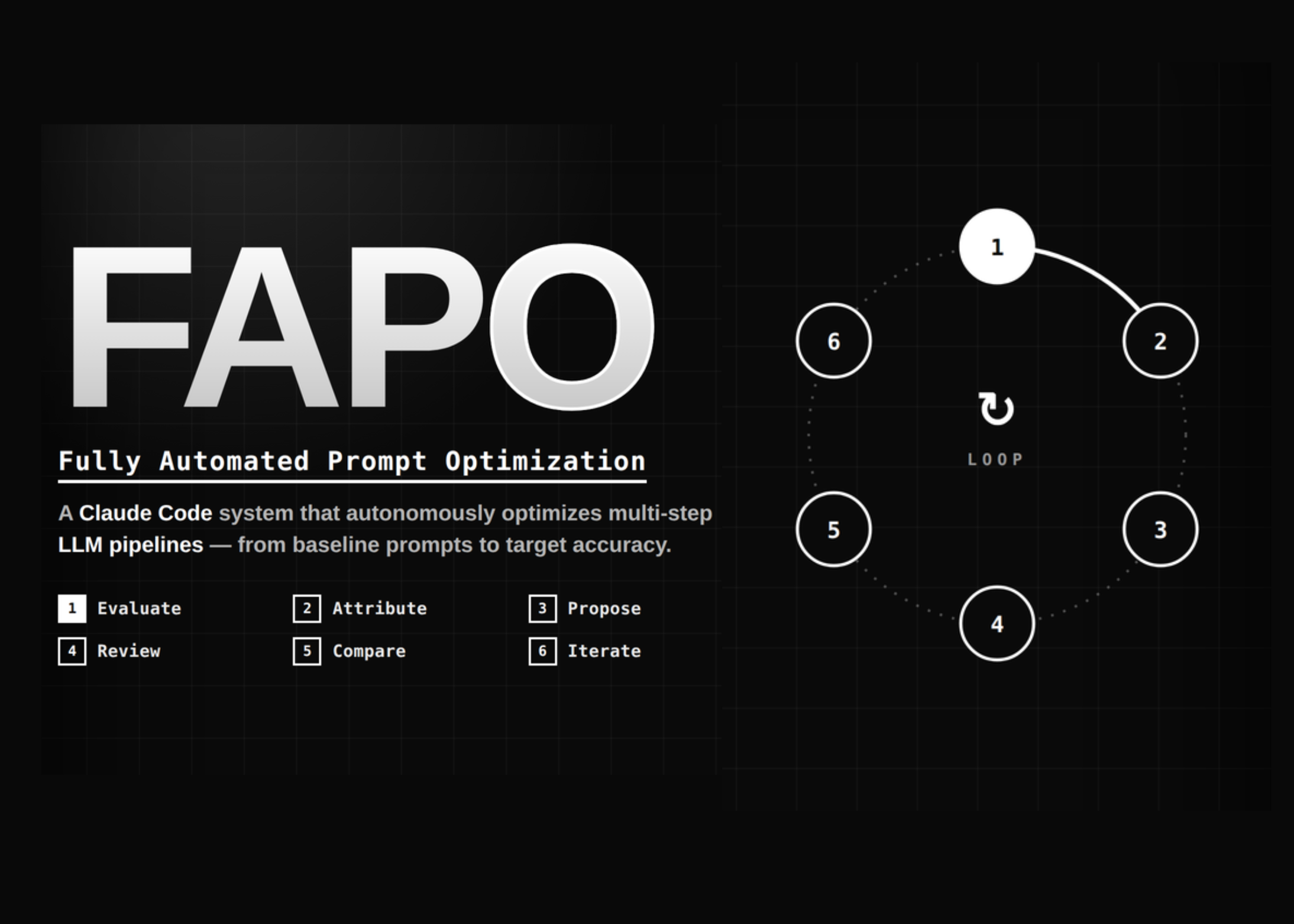
Cisco AI Introduces FAPO: Pipeline-Aware Prompt Optimization With Step-Level Failure Attribution and Claude Code Orchestration
This development in AI prompt optimization could enhance the efficiency of AI workflows, enabling better identification and resolution of failures in the process.
- Cisco AI has introduced FAPO, which stands for Pipeline-Aware Prompt Optimization.
- FAPO features step-level failure attribution, allowing for precise identification of failure points in AI pipelines.
Cisco is known for its networking and cybersecurity solutions and is expanding into AI technologies. The introduction of FAPO represents an advancement in optimizing AI operations, which is critical as businesses increasingly rely on AI. Further developments in prompt optimization technologies are expected as the AI field evolves.
Based on the headline only — the full article could not be fetched.
Read the original ↗
Signal’s Meredith Whittaker wants you to remember that AI chatbots ‘are not your friends’
The statements by Meredith Whittaker highlight concerns about privacy and trust regarding AI chatbots, emphasizing the need for critical understanding of their limitations and risks.
- Signal President Meredith Whittaker stated that AI chatbots like ChatGPT and Claude are not conscious beings or friends.
- Whittaker expressed concerns about the privacy risks associated with AI systems having access to sensitive personal information.
- She criticized the potential for AI tools, such as Microsoft Copilot, to eavesdrop on private conversations for commercial purposes.
Signal is a privacy-focused messaging application advocating for user security and data protection. Concerns surrounding the privacy implications of AI tools have intensified as their use becomes more common in everyday tasks. Observers should monitor developments on AI's integration into personal and sensitive applications.
Read the original ↗
In the Weights is your new AI-centric vanity search
In the Weights offers a novel perspective on personal visibility in the age of AI, reflecting shifts in how individuals are represented and remembered in technology.
- In the Weights is a new website created by Thomas Dimson and Joey Flynn that measures how well AI models can recall individuals without using conventional web search.
- Users receive a strength score based on AI-generated descriptions from various models such as GPT and Claude, indicating their perceived importance in AI training data.
- The site highlights the evolving landscape of information retrieval, as industry trends show a shift towards large language models (LLMs) for understanding public figures.
In the Weights responds to the changing nature of online identity as search engines evolve. The founders previously worked at OpenAI and sought to inspire creativity in AI representation. It highlights the contemporary relevance of AI memory and identity in digital spaces.
Read the original ↗
Nobel laureate John Jumper is leaving DeepMind for rival Anthropic
Jumper's departure from DeepMind to Anthropic highlights the ongoing competition in the AI sector, potentially impacting both companies' future research directions and innovations.
- John Jumper announced he is leaving Google DeepMind for Anthropic after nearly nine years with the company.
- Jumper was a key member of the team that developed AlphaFold, which predicts protein structures from genetic sequences.
- His departure follows another high-profile exit from DeepMind, with co-founder Noam Shazeer moving to OpenAI.
John Jumper is recognized for his contribution to the development of AlphaFold, a significant AI model in biological science. This trend of tech talent moving between rival companies indicates a competitive atmosphere in the AI industry. Moving forward, further shifts in personnel between major AI organizations may influence research priorities and innovations.
Read the original ↗
QUEST: Training Frontier Deep Research Agents with Fully Synthetic Tasks
The development of QUEST enables more capable open-source deep research agents, enhancing the quality and efficiency of information retrieval and knowledge synthesis for various applications.
- QUEST is a family of deep research agents trained with synthesized data and reinforcement learning.
- These agents can perform well across diverse long-horizon search tasks, which require strong reasoning capabilities.
- Built using a curated data synthesis pipeline, QUEST achieves competitive performance even with a limited number of synthesized tasks.
- The models range in size from 2 billion to 35 billion parameters and are capable of fact seeking, citation grounding, and report synthesis.
QUEST represents a new approach to creating open-source deep research agents that can effectively synthesize knowledge, as opposed to relying solely on proprietary search engines. This development addresses the limitations of existing models that often struggle to generalize across various tasks. The paper details the training methods and capabilities of QUEST, paving the way for future advancements in open research technologies.
Read the original ↗
Elephant Trunk’s Hidden Design Could Inspire a New Generation of Soft Robots
Understanding the biomechanical design of the elephant's trunk could advance soft robotics by improving the balance between strength and sensitivity in robotic systems.
- Researchers analyzed the elephant trunk's design to understand its ability to perform both powerful and delicate tasks.
- The study highlights the role of the skin's architecture, differentiating between the stiff upper surface and softer lower surface for functionality.
- Findings suggest that the trunk's structure could inspire new designs in robotic gripping devices, integrating protection for sensors and flexibility.
The elephant’s trunk has been a subject of engineering interest due to its unique capabilities. Previous studies have explored its biomechanical properties, prompting research into soft robotics applications. Future developments may focus on creating robotic systems that mimic this natural design to overcome existing challenges in sensitivity and durability.
Read the original ↗
NASA’s JPL Is Testing the Next Generation of Autonomous Martian and Lunar Technology
Advancements in autonomous technology for lunar and Martian exploration enhance NASA's capacity to reach uncharted territories, paving the way for future missions and scientific discoveries.
- NASA is testing the Exploration Rover for Navigating Extreme Sloped Terrain (ERNEST) prototype in Southern California, designed for challenging surface conditions on the Moon and Mars.
- ERNEST features advanced mobility and an intelligent decision-making system, allowing it to traverse rough terrains more efficiently than previous rovers like Curiosity and Perseverance.
- The ERNEST prototype, measuring four feet long, has already shown improved performance by traversing 16 miles in 37 hours during testing.
- The rover's active suspension system improves balance and energy efficiency, accommodating various terrains through adaptable movement capabilities.
- Since the project began in 2022, ERNEST has undergone significant upgrades, moving from smaller test prototypes to the current version capable of more ambitious exploration.
NASA's Jet Propulsion Laboratory (JPL) is developing ERNEST to enhance lunar and Martian exploration capabilities. Previous rovers have limitations in traversing difficult landscapes, leading to new design innovations aimed at extending exploration reach. Future versions of the rover will focus on improving autonomy and efficiency for long-distance travel.
Read the original ↗
I Let Siri AI Show Me Around San Francisco
The updated Siri AI enhances user experience on iPhones, reflecting significant advancements in voice assistant technology that could shape personal digital interactions.
- The new Siri AI, part of iOS 27, is designed to be more conversational, personalized, and integrated into the iPhone's interface.
- It employs hyper-personalization by utilizing data from messages, photos, and emails to tailor responses and suggestions.
- Apple's partnership with Google significantly contributes to Siri's improved functionalities, tapping into advanced Apple Foundation Models.
- This voice assistant integrates with various apps and can access both Apple and non-Apple services for tasks like texting.
- Siri AI is expected to be fully released later this year and is compatible with several iPhone models, with some older models lacking full support.
Siri AI is Apple's revamped voice assistant, aiming to provide a more effective and user-friendly experience. This version has been enhanced significantly since its last release, incorporating new technologies and deeper integration into the device's features. Future developments to watch for include broader availability and updates across Apple devices.
Read the original ↗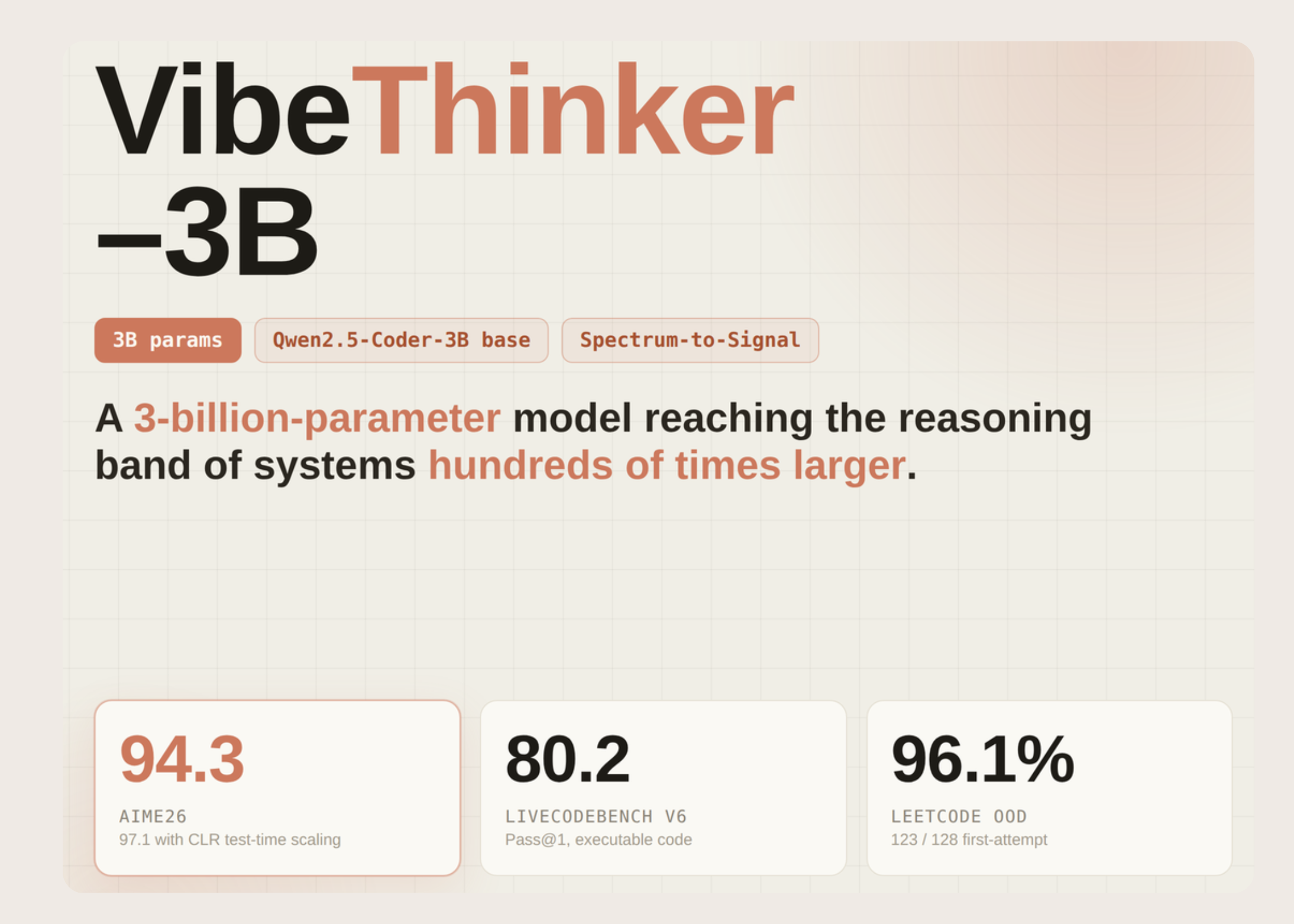
VibeThinker-3B: A 3B Dense Reasoning Model Built on Qwen2.5-Coder-3B With the Spectrum-to-Signal Post-Training Pipeline
The introduction of VibeThinker-3B demonstrates advancements in AI dense reasoning models, potentially improving tasks that require complex understanding and processing of information.
- VibeThinker-3B is a 3 billion parameter dense reasoning model.
- It is built on the Qwen2.5-Coder-3B architecture.
VibeThinker-3B represents a new development in AI reasoning capabilities, leveraging advancements in large language models. It follows the trend of enhancing model performance through innovative training techniques. Future developments may focus on practical applications and efficiency improvements of such models.
Based on the headline only — the full article could not be fetched.
Read the original ↗
NVIDIA AI Introduce SpatialClaw: A Training-Free Agent That Treats Code as the Action Interface for Spatial Reasoning
The introduction of a training-free AI agent by NVIDIA could simplify spatial reasoning tasks, potentially increasing efficiency in coding and machine learning applications.
- NVIDIA has introduced SpatialClaw, a new AI agent designed for spatial reasoning.
- SpatialClaw utilizes code as the action interface, eliminating the need for training in its operational processes.
NVIDIA is a leading company in AI and graphics technology, known for developing innovative tools and platforms. The advancement of training-free AI agents represents a significant shift in the approach to AI-enabled spatial reasoning. Future developments may further enhance AI functionality and usability in various applications.
Based on the headline only — the full article could not be fetched.
Read the original ↗
OpenAI Just Poached Google’s $2.7 Billion Man and a Trump White House Insider
These strategic hires underscore OpenAI's efforts to enhance its technological and political positioning as it moves towards an IPO, indicating potential shifts in the AI landscape.
- OpenAI hired Noam Shazeer, co-author of the influential 'Attention Is All You Need' paper, and Dean Ball, a former AI adviser in the Trump White House.
- Shazeer previously worked at Google, where he was co-lead on its Gemini project, before departing for OpenAI as it prepares for an IPO.
- Dean Ball will lead a new team at OpenAI focused on strategic issues like AI governance and labor market impacts, starting July 6.
OpenAI is a leading artificial intelligence research organization known for developing advanced AI models like GPT. Recently, the company has been ramping up its talent acquisition as it files for an IPO, signaling confidence in its market position. The hires of Shazeer and Ball highlight OpenAI's focus on both technical innovation and policy influence in the evolving AI space.
Read the original ↗
30+ AI Agent Examples That Actually Work in 2026 (Organized by What They Do)
The diversity of AI agents, optimized for specific tasks, illustrates their growing effectiveness and market presence, which could significantly alter workflows across various sectors.
- The article lists 33 AI agent examples categorized by their functions, including coding, sales, and support.
- AI agents are projected to increase the market size from $15 billion in 2025 to $100 billion by 2030.
- Claude Code is highlighted as a leading coding agent that automates debugging and coding tasks, significantly reducing time spent.
- Claude Cowork acts as a personal assistant for task execution directly on Mac computers, enabling complex operations without human intervention.
- OpenClaw is the most accessible AI agent for non-technical users, operated through common messaging platforms.
AI agents are software that autonomously accomplish goals by executing predefined steps and adapting to results. This new category is distinct from traditional chatbots, which handle single queries. The growing market for specialized AI agents aims to enhance workplace productivity across various industries.
Read the original ↗
Norway imposes broad restrictions on AI for elementary school kids
Norway's ban on generative AI for elementary students aims to promote traditional learning, potentially influencing educational policies globally as concerns over children's reliance on technology grow.
- Norway will ban the use of generative AI tools by elementary school children starting in late August.
- The ban applies to students aged six to 13, specifically those in first through seventh grade.
- Teens aged 14 to 16 can use generative AI only under teacher supervision, while those 17 and older can use it independently.
- Norway previously banned smartphones in classrooms in 2024, which led to improved academic performance and reduced mental health issues among students.
- A similar social media ban for children under 16 is expected to be introduced by the end of the year.
Norway's government, led by Prime Minister Jonas Gahr Stoere, is taking steps to limit technology's role in education, following previous restrictions on smartphones. As nations reconsider children's engagement with technology, this move aligns with increasing caution about AI's impact. The US is also debating legislation to regulate AI use among minors, indicating a broader trend.
Read the original ↗
AI’s Role in the Next Era of Pentesting
As organizations enhance security measures through AI, understanding its strengths and limitations in penetration testing is crucial for effectively managing vulnerabilities and protecting systems.
- AI is transforming penetration testing by accelerating tasks, enabling security teams to analyze large environments more efficiently.
- 23% of organizations are scaling AI systems for cybersecurity, while 39% are experimenting with them, reflecting a growing reliance on AI tools.
- AI can identify patterns and speed up documentation but may generate false positives and low-value findings, complicating vulnerability management for security teams.
Penetration testing involves simulating cyberattacks to identify vulnerabilities in systems. AI is increasingly used in this field to enhance efficiency but must be paired with human expertise for best results. With evolving threats and complexity in IT environments, continuous pentesting is becoming a strategic priority for organizations.
Read the original ↗
System Design for ML Interviews: 10 Real Problems Walked Through
Understanding machine learning (ML) system design is crucial for candidates in ML interviews, as it emphasizes practical applications beyond theoretical knowledge.
- ML system design interviews assess candidates' ability to explain data collection, feature creation, predictions serving, and system improvement processes.
- The article provides ten real-world examples to help prepare for these interviews, emphasizing a clear understanding of product goals, success metrics, and system components.
- Effective ML systems require a balance of model metrics, product metrics, and system metrics to monitor performance and success.
Machine learning system design focuses on creating algorithms that improve decision-making in applications like ranking, recommendation, and fraud detection. This article serves as a guide for preparing for ML interviews with practical examples. Candidates should demonstrate their understanding of both the technical and business aspects of ML systems.
Read the original ↗
Billionaire Ambani wants AI in every call, app, and home
Reliance's integration of AI into telecom services represents a significant step in establishing India as a key player in the global AI landscape, potentially reshaping consumer technology interactions.
- Billionaire Mukesh Ambani is positioning Reliance Industries to lead India's AI efforts by introducing AI services for over 500 million phone users.
- The Jio Call Agent AI assistant will transcribe calls and perform tasks like ordering food and booking cabs, activating with the phrase "Hey Jio."
- Reliance is also rolling out an AI-enhanced version of its MyJio app for user tasks, marking its commitment to AI integration in daily activities.
- The company aims to invest $110 billion in AI infrastructure, and partnerships with firms like Google and Meta are enhancing its capabilities.
- Reliance's initiatives will support applications in healthcare, education, and agriculture, targeting local needs across 22 Indian languages.
Reliance Industries is a major conglomerate in India, notably expanding into artificial intelligence to compete globally. The company previously launched its AI infrastructure initiative, Reliance Intelligence, aimed at consumer and business applications. Observers are watching how these developments impact Reliance's upcoming stock market debut and further AI advancements.
Read the original ↗
S-Agent: Spatial Tool-Use Elicits Reasoning for Spatial Intelligence
The development of S-Agent could significantly enhance the capabilities of visual language models in understanding and interacting with dynamic 3D environments, improving applications in various fields.
- S-Agent is a spatial reasoning framework that enhances visual language models by incorporating temporal memory and hierarchical spatial tools.
- It transforms spatial reasoning into a process of accumulating evidence across time, rather than relying on isolated visual frames.
- Experiments show that S-Agent improves VLM performance in training-free scenarios and yields a compact agent, S-Agent-8B, that outperforms several baselines.
Visual language models (VLMs) are AI systems designed to understand and generate language based on visual inputs. Traditional models struggle with dynamic environments; S-Agent offers a solution by integrating spatial tools and temporal memory for better reasoning. Future developments may focus on expanding its applications in real-world scenarios such as robotics and augmented reality.
Read the original ↗