
The day's AI news, briefed
The Daily Prompt
Our AI editor reads each day's AI and robotics stories, pulls out why they matter, and links every original source — so you can keep up in minutes.
Join over 250,000 subscribers getting the latest AI news
Latest AI & Robotics News Today

AI Agents Are Getting Smarter and Their Attack Surface is Getting Bigger
As AI agents gain increased capabilities, understanding their cybersecurity risks has become critical for organizations to safeguard their infrastructures against evolving threats.
- AI agents have evolved from basic text generators to autonomous systems that can perform complex tasks like executing code and managing workflows.
- The rise of AI agents has significantly expanded the attack surface for cybersecurity threats, as they can interact with various tools and APIs.
- Prompt injection has emerged as a prominent attack vector, allowing malicious actors to manipulate the instructions given to AI agents.
- Organizational security measures are often inadequate; many have not implemented basic safeguards against the dynamic vulnerabilities posed by AI agents.
- Effective security for AI agents requires layered responses, including strict access controls, observability, and adversarial testing to identify vulnerabilities.
AI agents are software systems that autonomously perform tasks across tools and APIs, significantly changing the landscape of enterprise operations. Previously, their capabilities were limited to generating text, but advancements now allow them more expansive interaction with organizational infrastructures. The evolving nature of these agents necessitates heightened cybersecurity measures to mitigate new risks associated with their operation.
Read the original ↗
Simbian Launches Cyber Defense Benchmark, Reveals Major Gap in AI Security Capabilities
This revelation highlights critical vulnerabilities in AI security, emphasizing the need for improved protections as reliance on AI systems grows.
- Simbian has launched a new cyber defense benchmark for AI security.
- The benchmark reveals significant gaps in current AI security capabilities.
Simbian is a technology company focused on enhancing cybersecurity measures, particularly in AI. This benchmark aims to provide a standard for assessing AI security, which has become increasingly crucial as AI technology advances. Future developments may include recommendations for improving AI security based on the identified gaps.
Based on the headline only — the full article could not be fetched.
Read the original ↗
Sysdig Unveils “Headless” Cloud Security Built for AI Agents
The introduction of headless cloud security may enhance response times against cyber threats, which have evolved to occur within minutes due to automation and AI integrations.
- Sysdig has launched what it claims is the industry's first headless cloud security platform, designed to operate within AI coding environments instead of traditional dashboards.
- The headless model allows AI agents to investigate threats and respond automatically, embedding security within the development workflow.
- This development aims to reduce delays in threat response, which have become critical as attack timelines have shortened significantly.
Sysdig focuses on cloud security solutions and is adapting to the rapid evolution of cybersecurity caused by AI advancements. Previous methods reliant on dashboards are proving inadequate against fast-paced threats, prompting shifts to more automated approaches. As organizations look to enhance their security infrastructure, Sysdig's approach signifies a substantial change in how security can be integrated into software development processes.
Read the original ↗
OpenAI’s Daybreak Wants to Own the Patch, Not Just the Bug
This development underscores OpenAI's strategy to streamline vulnerability patching in software security, addressing a significant bottleneck that can affect various software implementations.
- OpenAI expanded its Daybreak security program on June 22, 2026, launching GPT-5.5-Cyber and other tools to improve software patching processes.
- Codex Security has scanned over 30 million commits, resolving more than 70,000 vulnerabilities, highlighting its capacity to reduce time in security remediation.
- Patch the Planet initiative aims to support overworked open-source maintainers by deduplicating bug reports and facilitating fixes with AI assistance.
OpenAI's latest update in its security program reflects a shift in focus from discovering vulnerabilities to patching them, addressing a common challenge in software security. Previously, tools primarily focused on identifying flaws, while now, effective remediation is becoming the new priority. Future developments should be monitored, particularly regarding the impact of AI tools on open-source software maintenance.
Read the original ↗
OpenAI Launches Full-Scale Effort to Patch Open-Source Bugs as It Takes on Anthropic’s Mythos
OpenAI's new initiative aims to enhance the security of open-source software, which is crucial in mitigating increasing vulnerabilities as AI technologies rapidly evolve.
- OpenAI has launched the Patch the Planet initiative in collaboration with Trail of Bits and HackerOne to support open-source software security.
- The program plans to provide free security consulting to open-source maintainers and help them patch vulnerabilities effectively.
- Currently, over 30 open-source projects are participating in Patch the Planet, with more expected to join as the initiative expands.
OpenAI, known for its advanced AI models, is responding to rising AI-related cybersecurity concerns by enhancing support for open-source software projects. Previously, similar efforts were less coordinated, often leaving maintainers overwhelmed with bug reports. Future developments from this initiative will likely focus on ongoing assistance and innovative tools for open-source security.
Read the original ↗
Three things to watch amid Anthropic’s latest feud with the government
The ongoing feud between Anthropic and the government underscores the complexities of AI regulation and the implications for future technology governance.
- Anthropic is currently engaged in a conflict with the government.
- This situation has arisen following Amazon CEO's discussions with U.S. officials.
Anthropic is an AI research company focused on developing safe AI systems. The tensions arise from growing concerns about AI safety and regulation, especially in light of increasing governmental oversight.
Based on the headline only — the full article could not be fetched.
Read the original ↗
SpaceX inks compute deal with Reflection AI, an open source AI lab
The partnership enhances the availability of AI computing resources for open-source projects, reflecting a shift toward open-weight AI models, which could influence the future landscape of artificial intelligence development.
- Reflection AI will pay $150 million a month starting July 1, 2026, for access to Nvidia's GB300 AI chips at SpaceX's Colossus 2 data center in Tennessee.
- The total value of the deal is up to $6.3 billion, with a flexible cancellation option for either party after three months.
- Reflection AI's strategy focuses on open-weight AI models, positioning itself against closed models from companies like Anthropic and OpenAI.
Reflection AI is an open-source AI startup founded by former Google DeepMind researchers in 2024. The trend towards open-source alternatives gained traction following government restrictions on closed AI models. This deal is significant as it marks one of the largest commitments to open AI infrastructure.
Read the original ↗
#506 Washington Blocked One AI Lab. China Blacklisted 56 Companies.
The mutual imposition of export controls between Washington and Beijing signifies a significant escalation in the geopolitical tensions surrounding AI technology regulation.
- Washington restricted access to Anthropic's top AI models, citing security concerns.
- In retaliation, China blacklisted 56 American companies, including rare-earth miners and drone manufacturers.
- China's measures align with the Pentagon's updates to its entity list, affecting US defense contractors among others.
Anthropic is a major AI company focused on developing advanced models. Recently, the US has increased restrictions on AI technology exports to prevent adversaries from gaining access, leading to China's countermeasures that further escalate the situation. Observers should watch for continued tit-for-tat actions regarding AI technology between the two powers.
Read the original ↗
Humanoid Robots Move From Concept to Factory Floor as Humanoid Partners With Schaeffler
The collaboration between Humanoid and Schaeffler marks a significant step in integrating humanoid robots into industrial settings, potentially transforming factory operations.
- Humanoid has partnered with Schaeffler to bring humanoid robots to factory floors.
- This partnership signifies a shift from conceptual designs to practical applications in robotics.
Humanoid robots are designed to replicate human movements and tasks. Schaeffler is a global supplier for automotive and industrial sectors, which may benefit from advanced robotics integration. This collaboration could influence future developments in manufacturing automation.
Based on the headline only — the full article could not be fetched.
Read the original ↗
OpenAI Taps Cerebras for $10 Billion in Low-Latency Compute
This partnership signifies a substantial investment in low-latency computing, which could enhance the performance of AI applications significantly.
- OpenAI has partnered with Cerebras for a $10 billion agreement.
- The deal focuses on low-latency computing, a critical technology for AI efficiency.
OpenAI is a leader in artificial intelligence research, known for developing advanced models like ChatGPT. Cerebras specializes in chip technology that enables faster processing for AI tasks. This collaboration may indicate a growing demand for powerful computational resources in AI development.
Based on the headline only — the full article could not be fetched.
Read the original ↗
Opentrons & NVIDIA Launch a New Era of AI-Powered Labs, Turning Robots Into Learning Scientists
This partnership could significantly accelerate drug discovery and other biological research processes by integrating AI and robotics in laboratory settings, potentially reducing research time and costs.
- Opentrons has announced a partnership with NVIDIA to enhance laboratory operations with physical AI integration.
- The companies aim to transform over 10,000 standardized lab robots into a continuous learning system for scientific experiments.
- AI systems will now learn from real experimental outcomes instead of solely relying on simulations, enhancing their predictive capabilities.
- This collaboration seeks to compress drug discovery timelines from years to weeks by improving experimental throughput and reproducibility.
Opentrons is known for its automated laboratory robots used in research and biopharma. Traditionally, AI in life sciences has focused on predictions without effective execution. Future developments may include fully autonomous laboratories that can conduct experiments and adapt over time.
Read the original ↗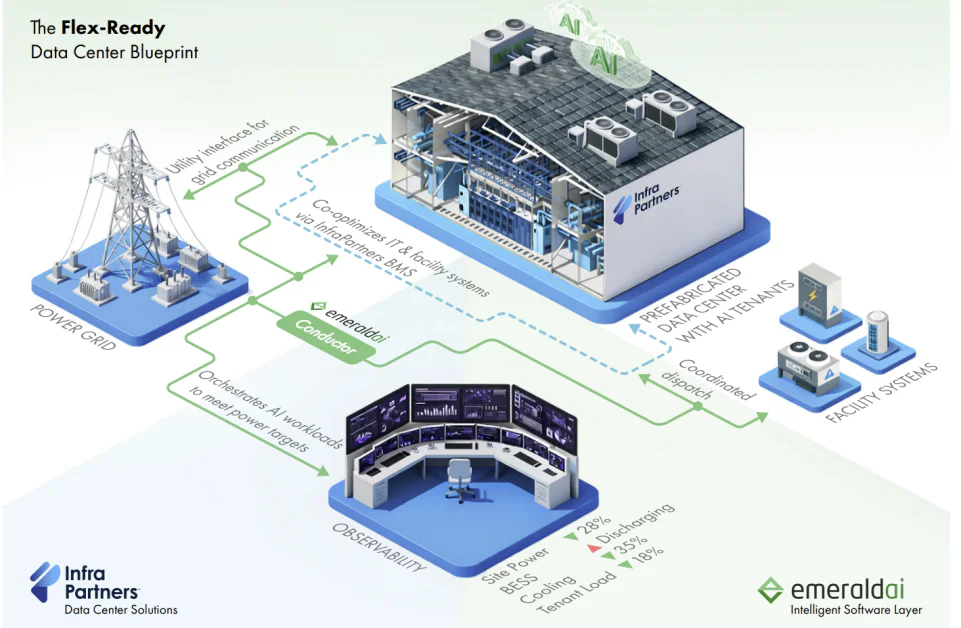
InfraPartners and Emerald AI Introduce “Flex-Ready Data Centers” to Address AI’s Power Bottleneck
Addressing AI's power bottleneck is crucial for the growth and efficiency of AI technologies, as demand for energy-intensive applications continues to rise.
- InfraPartners and Emerald AI have introduced new 'Flex-Ready Data Centers' designed to alleviate AI's power bottleneck.
- These data centers aim to provide more efficient energy management for AI systems.
The introduction of Flex-Ready Data Centers is a response to the increasing energy demands of AI technologies. As AI applications grow, the need for efficient power solutions becomes more critical. Future developments may include enhancements in energy management and scalability for AI infrastructures.
Based on the headline only — the full article could not be fetched.
Read the original ↗
Rackspace and Uniphore Partner to Deliver “Infrastructure-to-Agents” Architecture for Enterprise AI
This partnership seeks to facilitate the transition from experimental AI projects to effective enterprise implementations by integrating critical infrastructure and AI capabilities.
- Rackspace Technology and Uniphore are partnering to launch an 'Infrastructure-to-Agents' architecture for enterprise AI deployment.
- The collaboration combines Rackspace's cloud infrastructure with Uniphore's AI platform to create a unified environment for AI systems.
- The aim is to help organizations move from pilot experiments to operational AI solutions while ensuring security and compliance.
Rackspace provides hybrid and private cloud services, while Uniphore focuses on enterprise AI solutions. This partnership reflects a growing trend of integrating AI systems into business processes instead of merely testing models. Companies are increasingly seeking reliable ways to implement AI in compliance-heavy industries such as finance and healthcare.
Read the original ↗
Nebius Signs Massive AI Infrastructure Deal with Meta Built on NVIDIA’s Vera Rubin Platform
This deal emphasizes the critical importance of AI infrastructure in supporting the development and deployment of advanced AI systems, potentially shaping the future landscape of AI technology.
- Nebius Group has signed a long-term agreement with Meta potentially valued at $27 billion for AI infrastructure using NVIDIA's Vera Rubin platform.
- Nebius will provide $12 billion worth of dedicated AI compute capacity across multiple data centers starting in early 2027.
- Meta may purchase an additional $15 billion in compute capacity, demonstrating increasing reliance on specialized AI cloud providers.
Nebius is an Amsterdam-based cloud company focused on AI infrastructure and is listed on NASDAQ as NBIS. The deal with Meta reflects a trend towards establishing long-term AI compute supply agreements as the demand for high-performance compute resources grows.
Read the original ↗
Persistent Systems and NVIDIA Partner to Accelerate AI-Driven Drug Discovery
This partnership could significantly speed up the process of drug discovery, potentially leading to faster development of new therapies.
- Persistent Systems and NVIDIA have teamed up to enhance AI-driven drug discovery efforts.
- The collaboration aims to leverage AI technology to streamline and accelerate the drug development process.
Persistent Systems is a technology services company, and NVIDIA specializes in AI computing technologies. This partnership signifies a growing trend of using AI to improve the efficiency of drug discovery processes.
Based on the headline only — the full article could not be fetched.
Read the original ↗
OpenAI Shuts Down Sora and Ends Its $1 Billion Disney Deal
The closure of Sora and the ending of the Disney partnership underscores the challenges of monetizing AI video technology, affecting the competitive landscape for generative AI products.
- OpenAI is discontinuing Sora, its AI video-generation platform, just six months after its launch.
- The shutdown also ends a planned $1 billion partnership with Disney, which was set to include licensing agreements and investment in OpenAI.
- Sora had aimed to compete with platforms like TikTok, but faced unsustainable costs and resource allocation issues.
- OpenAI's focus will now shift toward higher-margin products and robotics research, following Sora’s closure.
OpenAI launched Sora as a competitive AI video generation tool but faced high operational costs, leading to its discontinuation. The company has since decided to reallocate resources to more profitable applications, reflecting broader industry challenges in AI video monetization.
Read the original ↗
NanoClaw Partners with Vercel to Bring Human Oversight to AI Agents
This partnership aims to enhance the safety and accountability of AI agents by integrating human oversight into their operations, addressing concerns about autonomous decision-making.
- NanoClaw has partnered with Vercel to improve human oversight in AI agents.
- The collaboration focuses on making AI interactions more accountable and transparent.
NanoClaw develops technologies for AI management, while Vercel specializes in cloud solutions for developers. This partnership reflects the growing emphasis on integrating human elements in AI systems to ensure responsible usage.
Based on the headline only — the full article could not be fetched.
Read the original ↗
Chainguard and Cursor Partner to Secure the Future of AI-Generated Code
This partnership aims to enhance security for AI-generated code, addressing an important need as reliance on AI in software development grows.
- Chainguard and Cursor are collaborating to improve security for AI-generated code.
- The partnership focuses on ensuring the safety and reliability of code produced by AI technologies.
Chainguard specializes in securing software and infrastructure, while Cursor focuses on AI-driven code solutions. The collaboration highlights the increasing focus on security in AI deployment as usage expands.
Based on the headline only — the full article could not be fetched.
Read the original ↗
Skillit Secures Strategic Backing From Construction Giants as AI Moves Into Workforce Infrastructure
The integration of AI into workforce infrastructure could significantly enhance efficiency and innovation in the construction industry, addressing labor shortages and optimizing project management.
- Skillit has received strategic support from major construction companies.
- This collaboration is part of a broader trend of AI entering workforce infrastructure.
Skillit is a company focused on workforce solutions that leverage AI technology. The construction industry faces challenges such as labor shortages, prompting companies to seek innovative solutions like AI. Future developments may include enhanced project management tools and better resource allocation in construction.
Based on the headline only — the full article could not be fetched.
Read the original ↗
Prosper AI Raises $30 Million Series A to Expand AI Across the Entire Patient Journey
The funding will enable Prosper AI to enhance its applications of artificial intelligence in healthcare, potentially improving patient experiences throughout their medical journeys.
- Prosper AI has raised $30 million in a Series A funding round.
- The company aims to expand the use of AI across the entire patient journey, which includes various stages of healthcare.
Prosper AI is a company focused on using artificial intelligence to improve healthcare outcomes. The Series A funding round follows a growing trend of investment in AI technology for medical applications. Future developments will likely center on implementing these AI solutions in clinical settings.
Based on the headline only — the full article could not be fetched.
Read the original ↗