
The day's AI news, briefed
The Daily Prompt
Our AI editor reads each day's AI and robotics stories, pulls out why they matter, and links every original source — so you can keep up in minutes.
Join over 250,000 subscribers getting the latest AI news
Latest AI & Robotics News Today

Google Vids now lets you star in your own AI videos
This update allows users to create personalized digital avatars, expanding the creative possibilities for video production and enhancing competition in the AI video market.
- Google updated Google Vids to allow users to create custom digital avatars based on selfies and voice recordings.
- The new features utilize Gemini Omni, enabling video creation from written prompts and reference images.
- Omni supports step-by-step editing, allowing users to modify videos without starting over.
- Access to personalized avatars is limited to users aged 18 or older in certain regions.
Google Vids is a video creation tool becoming more versatile with recent updates to include avatar generation and AI-assisted editing. Previously focused on workplace presentations, it is now positioning itself for broader personal and business use. Competition may increase from other AI video startups introducing similar technologies.
Read the original ↗
Linus Torvalds to critics of AI coding in Linux: “Fork it. Or just walk away.”
Linus Torvalds' stance on AI tools in Linux indicates a growing acceptance of AI in open source software, which may impact project dynamics and developer workflows moving forward.
- Linus Torvalds stated that Linux will embrace AI coding tools, rejecting calls for a ban on AI-generated contributions.
- He asserted critics can either fork the project or leave if they disagree with the AI integration.
- Torvalds mentioned Sashiko, an AI-driven code review system, which identifies many bugs but also produces false positives.
- He argued that both AI and human coders have flaws, emphasizing a pragmatic approach to technology acceptance.
The Linux kernel is an open-source operating system kernel developed by Linus Torvalds, first released in 1991. Recently, the integration of AI tools like Sashiko has sparked debate among developers regarding their utility and acceptance. The conversation around AI in coding reflects broader trends in tech, promoting further examination of AI's role in open source development.
Read the original ↗
OpenAI Introduces GPT-Red, an AI Attacker Built to Strengthen GPT-5.6
The introduction of GPT-Red highlights OpenAI's proactive approach to improving AI security, addressing vulnerabilities that could have significant implications for AI interactions in various applications.
- OpenAI has launched GPT-Red, an internal AI designed to attack its own models and identify vulnerabilities.
- GPT-Red focuses particularly on prompt injection, a critical security challenge for AI agents.
- Testing showed GPT-Red outperformed human attackers, successfully executing malicious instructions 84% of the time in new scenarios.
- The system's findings have already contributed to enhancements in the latest model, GPT-5.6 Sol, significantly reducing failure rates.
- GPT-Red remains an internal tool, separated from public models to prevent misuse of its attack capabilities.
OpenAI develops advanced AI technologies, advancing security measures through tools like GPT-Red. By addressing AI vulnerabilities through automated adversarial training, the company aims to strengthen future models against potential exploitations. Observers should watch for further developments in AI security as these threats evolve.
Read the original ↗
Fawad Butt, CEO and Co-Founder of Penguin Ai – Interview Series
The insights from Fawad Butt highlight the need for tailored AI solutions in healthcare to alleviate administrative burdens, potentially transforming operational efficiency and patient care delivery.
- Fawad Butt, CEO of Penguin Ai, founded the company to address inefficiencies in healthcare administrative workflows using purpose-built AI.
- Penguin Ai has raised $29.7 million in funding to develop solutions that automate administrative and clinical operations in healthcare settings.
- The company's AI platform targets key areas such as prior authorization and claims processing, where it can significantly reduce processing times and errors.
- Butt emphasizes that successful AI integration requires a careful approach to scale, focusing on specific problem areas before broader deployment.
Penguin Ai is focused on automating healthcare processes through AI, having been founded by experienced leaders from major healthcare organizations. The company aims to address the costly administrative inefficiencies in healthcare by providing specialized AI-driven solutions. Key areas of development include prior authorization and claims adjudication, which present substantial opportunities for operational improvements.
Read the original ↗
An ‘Asteroid’ Tracked Since 1998 Made an Unexplained Orbital Shift—Now Astronomers Say It’s Something Far More Mysterious
The reclassification of 1998 SH2 from an asteroid to a potentially hazardous dark comet raises significant questions about the reliability of current near-Earth object tracking methods and planetary defense strategies.
- Astronomers initially tracked 1998 SH2 as an asteroid, but it unexpectedly failed to appear in its predicted orbit last August.
- Research indicates that the object may actually be a rare type of dark comet, characterized by weak cometary outgassing without typical comet signs.
- The study highlights the possibility that other objects classified as asteroids could also be dark comets, complicating impact risk assessments.
- The findings suggest that dark comets might aid in understanding the delivery of water to early Earth and past enigmatic observations, like those of 'Oumuamua.
1998 SH2 was discovered in 1998 and has been continuously monitored, providing ample opportunity for tracking its orbit. The unexpected orbital shift challenges existing classifications and raises concerns for future planetary defense as other asteroids may also turn out to be dark comets. As researchers continue to study these findings, understanding their implications for tracking and defending against potential impact threats will be crucial.
Read the original ↗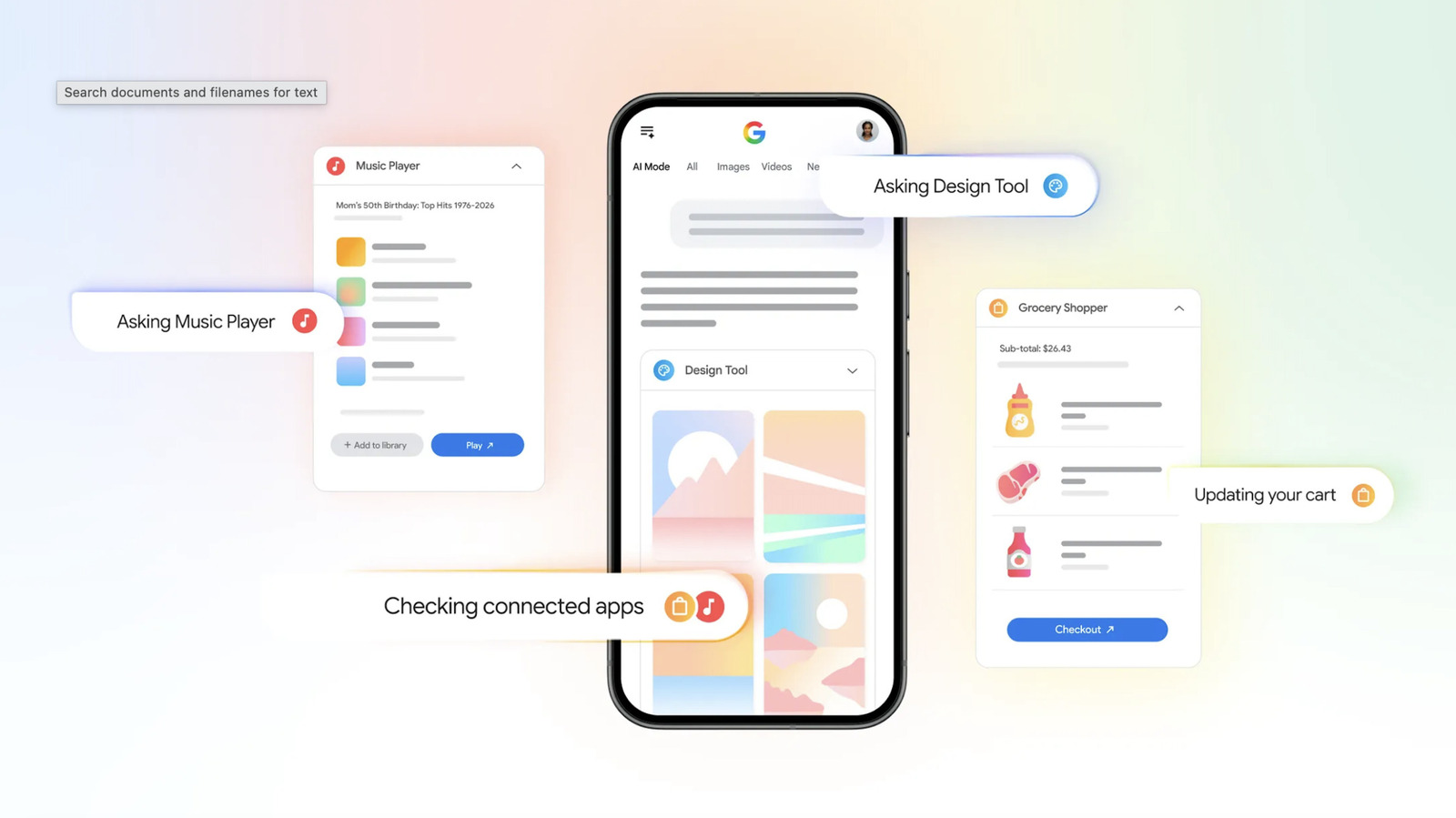
Google AI Mode now integrates with Canva, YouTube Music and Instacart
The integration of AI with apps like Canva, YouTube Music, and Instacart enhances user convenience by streamlining tasks such as playlist creation and shopping list compilation directly within Google's Search.
- Google's AI Mode now supports integrations with Canva, YouTube Music, and Instacart, rolling out this week in the US.
- Users can generate music playlists based on prompts via YouTube Music in AI Mode, which creates suggested playlists within the chat.
- AI Mode can also generate design templates in Canva, using calendar information to tailor designs like party flyers.
- Instacart integration allows users to add grocery items to their cart based on saved events, also utilizing calendar data.
Google's AI Mode is designed to improve user experience by seamlessly integrating AI services into everyday applications. Previous features included using Reddit for expert answers and dynamic search capabilities. Watch for further enhancements and more partnerships related to AI integration in the coming months.
Read the original ↗
Boogu-Image-0.1: Boosting Open-Source Unified Multimodal Understanding and Generation
The development of Boogu-Image-0.1 enhances the capabilities of open-source multimodal models, potentially reducing barriers to advanced image generation and editing technologies.
- Boogu-Image-0.1 is an open-source multimodal model family designed for text-to-image generation, editing, and bilingual rendering.
- The model consists of variants including Base, Turbo, Edit, and Edit-Turbo, which provide competitive performance at a lower training cost.
- Evaluations show it consistently matches or surpasses existing open-source models and approaches the performance of leading closed-source systems.
- The theoretical training cost for the base model is approximately $400,000, utilizing 208.62 million unique images.
- The model's code and weights are released under the Apache 2.0 license to foster collaboration in the research community.
Boogu-Image-0.1 represents an advancement in open-source multimodal models, which are designed to interpret and generate content across different modes of data. Previous models often relied on closed ecosystems, limiting transparency and accessibility. The research community will closely monitor further developments and practical applications of this technology.
Read the original ↗
Why International Banking Challenges Are Accelerating the Shift to AI Agents
The rise of AI agents in banking is crucial for enhancing customer satisfaction and loyalty, particularly as international travel increases and banking issues persist.
- A recent Gradient Labs report reveals that nearly half of surveyed travelers experienced banking issues abroad, highlighting significant challenges in customer support during international travel.
- Only 24% of travelers reported quick resolution of their banking problems, with many waiting over 30 minutes for support or unable to connect at all.
- The financial impact of payment failures is notable, as 40% of affected travelers incurred over $200 in extra costs due to card issues while traveling.
- Emerging AI agents can provide consistent, immediate support and resolve banking issues more efficiently, addressing common frustrations experienced by travelers.
- Financial services firms are increasingly adopting AI-powered customer support, with 74% reporting it as the leading front-office AI use case.
Gradient Labs' report indicates that international banking challenges continue to frustrate travelers, with issues like card declines being prevalent. The integration of AI agents in customer support can improve response times and resolution quality, especially for banks facing competitive pressures in maintaining customer loyalty.
Read the original ↗
One Click, Countless Hours: How AI Is Revolutionizing Safety Monitoring in Medtech
The revolution in safety monitoring through AI is crucial as it helps medical technology companies respond to potential risks more quickly and efficiently, ultimately enhancing patient safety.
- AI has reduced the time for safety analyses from weeks to minutes in medical technology monitoring.
- Orchestration tools enable AI to unify data sources, delivering comprehensive safety reviews with a single click.
- Traditional safety monitoring involved manual data handling, which consumed countless hours and delayed risk detection.
AI and orchestration tools are transforming safety monitoring in medical technology by accelerating analysis and integrating data across multiple sources. Traditionally, manufacturers faced slow, manual processes that left patients vulnerable to potential risks. The next steps will involve refining these technologies to ensure compliance and improve overall safety.
Read the original ↗
Thinking Machines Lab Unveils Inkling, Its First Open-Weights Multimodal AI Model
The release of Inkling introduces an open-weight AI model that seeks to give users more control over AI behavior while enhancing accessibility for research and development.
- Thinking Machines Lab has launched Inkling, its first general-purpose AI model with nearly one trillion parameters, designed for processing text, images, and audio.
- Inkling features a Mixture-of-Experts architecture, activating only 41 billion parameters for each token, providing efficient processing without using the entire model at once.
- The model supports a context window of up to one million tokens and is trained on 45 trillion tokens from various sources, emphasizing customizable applications through its Tinker platform.
- Inkling's pricing is structured to make experimentation affordable, although significant hardware requirements necessitate external hosting or cloud access for many users.
Thinking Machines Lab, founded by ex-OpenAI CTO Mira Murati, aims to create customizable AI solutions. Inkling's release emphasizes open-weight models amid a competitive landscape dominated by proprietary systems. The company will continue to develop its Tinker platform to enhance user customization capabilities.
Read the original ↗
Smart speakers could help OpenAI lose even more money
The introduction of a smart speaker by OpenAI amidst declining market trends could exacerbate financial losses for the company, which is not currently profitable.
- OpenAI is developing a smart speaker powered by its GPT-Live-1 voice model, which aims to enable humanlike interactions.
- The smart speaker market has been declining, with shipment volumes dropping significantly in recent years, including an estimated decrease of 9.6% this year.
- Experts caution that creating a smart speaker is easier than achieving mass market success, particularly with established competitors present.
- OpenAI has reported substantial financial losses, losing over $5 billion in 2024 and $38.5 billion in 2025, and does not expect profitability until at least 2030.
OpenAI is known for its advancements in artificial intelligence technology but has struggled with profitability amid high operational costs. The smart speaker market has faced declines in demand, raising questions about the viability of new entrants. Observers are watching how OpenAI navigates hardware development in a challenging market landscape.
Read the original ↗
Suno brings its gen AI music gunk to iMessage
The integration of generative AI music technology into messaging platforms raises questions about creativity, originality, and copyright implications in music production.
- Suno has integrated its generative AI music app with iMessage, allowing users to create 30-second audio outputs from text or voice prompts directly in chats.
- Users must have the latest version of the Suno app installed to receive audio output created by their friends.
- The AI model used by Suno reportedly trained on a vast array of tracks, including some that may be copyrighted.
Suno is a music generation app that utilizes AI to create musical outputs based on user prompts. This integration with iMessage marks a trend in blending social media with generative technologies. Ongoing discussions about copyright and creative ethics in AI-generated content are likely to intensify as such tools become more mainstream.
Read the original ↗
Moonshot’s upcoming Kimi 3 is expected to close the gap with Anthropic’s Opus 4.8
The release of Moonshot's Kimi 3 could significantly impact the competitive landscape of AI by offering a robust open-source alternative to leading closed-source models like Anthropic's Opus 4.8.
- Moonshot's upcoming Kimi K3 is expected to rival or surpass Anthropic's Opus 4.8, according to Financial Times reports.
- Kimi K3 will be the largest open-weight AI model from China, featuring between 2 trillion and 3 trillion parameters.
- The Kimi series has performed well in the open-source market, with previous versions ranking high on benchmarks.
Moonshot AI is a Chinese company developing large-scale open-source AI models. The Kimi K2 models have already shown strong performance, and Kimi K3 aims to further close the gap with advanced closed-source models. Future developments will be closely watched as the AI landscape continues to evolve and debate over open versus closed models persists.
Read the original ↗
Why AMI Labs’ Alexandre LeBrun won’t call his AI ‘AGI’ or ‘superintelligence’
LeBrun’s refusal to label AI as AGI or superintelligence highlights a more cautious and realistic approach in an industry often overwhelmed by lofty claims.
- Alexandre LeBrun, CEO of AMI Labs, avoids using the terms 'AGI' and 'superintelligence,' citing no clear definitions for these concepts.
- AMI Labs is still in the pre-product stage but is actively seeking partnerships in robotics, manufacturing, and electronics.
- LeBrun emphasizes the need for robots to understand their context, which is currently lacking in AI systems that operate in dynamic environments.
- He pointed out that while hardware technology is advancing rapidly, AI still struggles in real-world applications and safety.
- The startup recently raised $1.03 billion at a $3.5 billion valuation, but has not yet developed any products.
AMI Labs is a startup co-founded by prominent AI researcher Yann LeCun, focusing on developing world models that predict real-world interactions. The company is exploring partnerships in South Korea, where the government is investing heavily in AI and hardware sectors. Observing the limitations of existing AI tools, LeBrun anticipates a growing demand for robots capable of contextual awareness.
Read the original ↗
How a former DeepMind researcher raised at a $300M pre-seed valuation before launching a product
Raising funds at a high pre-seed valuation highlights the growing interest and potential for visual AI technology, as demonstrated by Elorian's strategic partnerships and fundraising approach.
- Andrew Dai, a former Google DeepMind researcher, raised $55 million in a seed round at a $300 million valuation shortly after leaving the company.
- Elorian aims to advance visual AI, an area identified as having uneven progress compared to other AI fields like coding and physics.
- Dai chose strategic investors, including Nvidia and Menlo Ventures, for their understanding of frontier AI over higher valuation offers.
Elorian, founded by Andrew Dai, focuses on visual AI, which involves enabling machines to understand and reason about visual information. The company raised significant funds quickly, reflecting the increasing investment in innovative AI technologies. Observers should watch for advancements in visual understanding and further funding in the AI startup space.
Read the original ↗
Why is OpenAI selling a ChatGPT basketball?
OpenAI's sale of the ChatGPT basketball signals a blend of technology and physical activity, emphasizing mental health amid increasing concerns over digital engagement.
- OpenAI has launched its first hardware product, a ChatGPT basketball, priced at $70.
- The basketball is part of the 'Pause. Play. Prompt.' campaign, promoting creativity beyond screens.
- The product is made from 100% rubber for outdoor play and is aimed at encouraging sports activities.
OpenAI, known for its advancements in artificial intelligence, is diversifying into hardware with its new basketball, suggesting a novel approach to balancing technology use and physical activity. This is part of a broader initiative aimed at mental wellness in the tech landscape.
Read the original ↗
Google’s AI Mode now lets you link and interact with select apps
This update enhances Google AI Mode's functionality, allowing users to streamline tasks by integrating popular apps, thus increasing user reliance on AI for everyday activities.
- Google allows users to link and interact with select apps in AI Mode, expanding its functionality beyond answering questions.
- Initially supported apps include Instacart, Canva, and YouTube, enabling direct task completion.
- The update aims to boost Google’s competitiveness against AI platforms like OpenAI's ChatGPT and Anthropic's Claude.
- Google is rolling out this feature to users in the U.S. and plans to introduce more app integrations in the future.
- This update builds on earlier features launched at Google I/O that allow for connecting third-party apps to complete tasks faster.
Google's AI Mode is a conversational search experience that provides users with personalized responses by integrating tasks across applications. Launched in early 2025, it has been progressively enhanced with features like app connectivity and stock checks at local stores. Future support for additional apps is expected as Google continues to compete in the AI space.
Read the original ↗
KnowAct-GUIClaw: Know Deeply, Act Perfectly, Personal GUI Assistant with Self-Evolving Memory and Skill
The introduction of KnowAct-GUIClaw represents a potential advancement in the automation of cross-platform graphical user interfaces, enhancing efficiency and adaptability in personal assistant technologies.
- KnowAct-GUIClaw utilizes a Know-Route-Act-Reflect framework to improve GUI automation and self-improvement through user interaction.
- The system aims to address the limitations of the OpenClaw framework, particularly in cross-platform interactions and self-evolution.
- Extensive testing on devices including Android, iOS, HarmonyOS, and Windows indicates that KnowAct-GUIClaw outperforms existing models by achieving a 64.1% success rate on the MobileWorld benchmark.
- The framework features a memory and skill library that evolves based on user feedback, enhancing task accuracy and tool usage.
KnowAct-GUIClaw is a personal assistant framework that improves GUI automation by learning from user interactions. It builds on OpenClaw's capabilities while addressing its limitations in adaptability and self-improvement. Future developments may include broader applications and refinements of this technology across more devices.
Read the original ↗
Energy IPOs surge as investors hunt for ways to play AI boom
The rapid rise of energy IPOs highlights the growing demand for sustainable power solutions essential for supporting the expanding AI data center industry.
- Energy companies raised $12.6 billion through IPOs in the first half of 2026, the highest amount for this period since the dotcom bubble.
- The infrastructure for AI data centers is becoming crucial as demand for electricity is projected to rise significantly in the coming years.
- Investors are increasingly shifting their focus towards energy firms, which supply the necessary power for AI operations, contributing to a surge in IPO activity.
The IPO market is currently being driven by rising demand for energy as AI technology proliferates. Energy companies are exploring public offerings to access capital for infrastructure projects that support data centers. Companies like Forgent Power Solutions and Fervo are examples of this trend, raising significant funds to expand their operations.
Read the original ↗
Artificial Intelligence (475)
Staying informed on artificial intelligence developments is crucial as the field rapidly evolves, impacting multiple industries and society at large.
- The article lists ten YouTube channels that focus on artificial intelligence.
- These channels are designed to keep viewers updated with the latest advancements in AI.
Artificial intelligence (AI) refers to machine systems capable of performing tasks that typically require human intelligence. With ongoing advancements in AI technology, it is essential for individuals to seek reliable sources of information to remain knowledgeable in this rapidly changing field. Watching educational content on platforms like YouTube can enhance understanding of AI trends.
Based on the headline only — the full article could not be fetched.
Read the original ↗