
The day's AI news, briefed
The Daily Prompt
Our AI editor reads each day's AI and robotics stories, pulls out why they matter, and links every original source — so you can keep up in minutes.
Join over 250,000 subscribers getting the latest AI news
Latest AI & Robotics News Today

Can You See It? This Stealth Drone Deploys a Human Perception “Hack” to Become Nearly Invisible to the Eye
The development of the Phantom Twist drone represents a significant advancement in stealth technology, potentially impacting wildlife monitoring and military applications by offering a near-invisibility capability.
- The Phantom Twist drone rotates 25 times per second, making it nearly invisible to the human eye due to motion blur.
- Developed by a team from Northwestern University, the drone's design prioritizes perception-based stealth over traditional camouflage methods.
- The drone's single propeller and unique spinning design allow it to blend into its surroundings while capturing wildlife behaviors without disturbing them.
- The design process utilized AI to simulate and optimize the arrangement of drone components for minimal visibility.
- Future iterations aim to reduce visible components and engine noise to further enhance the drone's invisibility.
The Phantom Twist is a new drone that utilizes rapid spinning to create the illusion of invisibility, based on how humans perceive motion. Previous stealth techniques focused on camouflage and materials, while this innovation shifts emphasis to movement. Researchers plan to refine its design for greater invisibility and quieter operation.
Read the original ↗
Your AI Security Tool Isn’t Protecting You – It’s Just Making You Feel Better
Understanding the limitations of AI security tools is crucial for organizations to avoid dangerous misconceptions that can lead to increased vulnerability to attacks.
- Microsoft patched a zero-click vulnerability known as CVE-2025-32711 in Microsoft 365 Copilot in June 2025, which could exfiltrate sensitive information through crafted emails.
- An analysis revealed that AI-powered security tools demonstrated a prevention effectiveness of only 62%, down from 69% the previous year, with 98% of attacks using valid credentials succeeding.
- Research indicates that perceived improvements in security can lead organizations to take greater risks, as seen in the behaviors of security leaders in the AI sector.
AI security tools aim to protect organizations from various cyber threats but often fail to deliver on their promises, leading to misperceptions of security. Recent studies reveal significant gaps in the effectiveness of these tools, highlighting the need for continuous validation and basic cybersecurity practices. The ongoing evolution of AI threats necessitates a reevaluation of security measures and tools deployed in real-world environments.
Read the original ↗
The Big Shift: How Real-World AI Can Be a Win for Investors—and Earth
The shift in AI investment strategies highlights potential growth for innovative companies addressing real-world challenges while emphasizing a necessary recalibration of overvalued AI sectors.
- AI investment funds are expected to redeploy following a market correction, moving away from dominant players to companies focused on real-world solutions.
- Gartner predicts that by 2030, over 80% of enterprises will adopt industry-specific AI agents, a significant increase from less than 10% in 2025.
- The article compares a potential industry shakeout to a forest fire, suggesting it will benefit smaller companies and reset valuations in the AI market.
As AI continues to grow, its ecosystem has seen significant investment, with AI companies receiving a large share of venture capital. Experts believe that capital will shift to smaller innovators focused on practical applications, moving away from overvalued giants.
Read the original ↗
Cloud vs Local GPU: Which Gives the Best AI Inference Performance?
Understanding the performance factors between cloud and local GPUs is crucial for organizations to optimize AI inference tasks, affecting decision-making on infrastructure investments.
- AI inference performance varies based on factors such as workload shape, GPU class, and data path.
- Local GPUs benefit workloads requiring data-local inference and stable utilization, whereas cloud GPUs support bursty demand and experimentation.
- Latency and throughput are critical metrics for measuring AI inference performance, affecting behavior under load.
AI inference involves processing data inputs through trained AI models, where performance can vary significantly between cloud services and local hardware. Companies must analyze their specific needs and workloads to choose the appropriate GPU deployment that maximizes efficiency and cost-effectiveness.
Read the original ↗
A $10K Bounty Aims to Make Sony’s PlayStation 5 a Computer Again
This initiative highlights ongoing concerns about consumer rights and device ownership in the face of restrictive software policies and changing production practices in gaming consoles.
- Fulu is offering a $10,000 bounty for disabling Sony's software locks on PlayStation 5 consoles to install alternative operating systems like Linux.
- The organization aims to promote user control over their devices amidst increasing concerns about restrictions from manufacturers, particularly following Sony's decision to end physical disc production for new games.
- Since its inception in late 2025, Fulu has awarded bounties for work on products from Google and Molekule.
Fulu is a consumer advocacy group focused on promoting ownership rights by challenging restrictive software features from manufacturers. The recent move by Sony to stop producing physical game discs has raised alarms about gaming ownership and control, leading to increased interest in repurposing existing hardware.
Read the original ↗
San Francisco Demands Apple and Google Delete AI ‘Nudify’ Apps From App Stores
The demand to remove these apps highlights ongoing concerns regarding nonconsensual deepfake technology, which poses significant risks to individuals' privacy and safety.
- San Francisco city attorney David Chiu sent cease-and-desist letters to Apple and Google demanding the removal of 13 face-swapping apps that create nonconsensual nude images.
- Chiu has previously taken legal action against deepfake websites, asserting that the companies have profited significantly from such harmful apps.
- Both tech giants have policies forbidding pornography and have previously removed dozens of similar apps following reports from researchers and watchdogs.
Deepfake technology allows for the creation of realistic fake media, which has seen a rise in popularity for generating explicit content. Recent reports have revealed ongoing issues with such apps persisting in major app stores despite previous removals. Moving forward, scrutiny and legal actions targeting these technologies are likely to increase.
Read the original ↗
A Humanoid Company Backed by Eric Trump Is Preparing Its Robots for War
The emergence of military humanoid robots raises critical questions about the future of warfare and ethics in autonomous systems.
- Foundation Future Industries aims to develop humanoid robots with weapons capabilities.
- The company has received high-profile backing, including from Eric Trump, a chief strategy advisor.
- Foundation has existing government contracts worth millions, primarily inherited from previous ventures.
- Tests have been conducted with the Ukrainian military, exploring the utility of humanoids in combat situations.
- Roboticists express skepticism about the feasibility of fully autonomous combat humanoids in the near term.
Foundation Future Industries focuses on creating humanoid robots for military applications, augmenting traditional soldier roles. Established in 2024, it has gained attention and funding from prominent figures. The military's interest in humanoid technology is growing, driven by the need for enhanced capabilities in challenging environments.
Read the original ↗
Artificial Intelligence (476)
Access to free resources on agentic AI can aid researchers and practitioners in developing more complex AI systems that act autonomously and intelligently.
- Five free resources on agentic AI have been highlighted for users.
- These resources aim to support learning and development in artificial intelligence.
Agentic AI refers to artificial intelligence systems that can operate independently and take actions based on their programming and environment. Increased interest in agentic AI has prompted more educational resources to be made available. Understanding these resources is crucial for advancements in AI capabilities.
Based on the headline only — the full article could not be fetched.
Read the original ↗
NVIDIA AI Releases Nemotron 3 Embed: An Open Embedding Collection Whose 8B Checkpoint Ranks #1 on RTEB
NVIDIA's release of the Nemotron 3 Embed collection enhances retrieval capabilities in AI models, impacting multilingual enterprises and advanced coding applications significantly.
- NVIDIA introduced the Nemotron 3 Embed model, providing three open checkpoints for various applications such as agent retrieval and memory.
- The 8B checkpoint ranks #1 on the Retrieval Embedding Benchmark (RTEB) with a score of 78.46, showcasing its high performance.
- The model supports a maximum input sequence length of 32,768 tokens and has been trained in 34 languages.
- NVFP4, one of the model variations, provides up to 2x higher throughput compared to BF16 with over 99% accuracy retention.
- The collection operates under the OpenMDW License Agreement, version 1.1, allowing for broad use in AI development.
NVIDIA is a leading technology company specializing in graphics processing units and AI solutions. The Nemotron 3 Embed is part of a growing trend to improve natural language processing capabilities through advanced embeddings, which determine the relevance of content seen by AI agents. Upcoming advancements may focus on enhancing model efficiency and expanding language support.
Read the original ↗
Should AI Usage Be Explicitly Disclosed in Movies and TV Shows?
The increasing use of generative AI in media raises questions about transparency and viewer awareness, particularly as over 300 Netflix titles utilize this technology without specific disclosure in credits.
- Netflix has disclosed that over 300 of its titles incorporate generative AI technology.
- The horror film 'Heretic' is cited as the first to carry a 'No AI' disclaimer regarding its production methods.
- Concerns are growing about the impact of AI on visual effects jobs in the film industry, contrasting with past innovations in CGI.
Generative AI refers to technologies that can create content autonomously, and its use in media is becoming more prevalent. Past industry practices, like disclaimers for animal welfare, may inspire similar calls for AI disclosure. Observers will watch how public reaction influences policy changes around this issue.
Read the original ↗
Why Apple Sued OpenAI, New York Takes on Data Centers, and What to Know about Cyclosporiasis
The legal dispute between Apple and OpenAI over alleged hardware theft highlights significant tensions in the tech industry, particularly around talent acquisition and proprietary information rights.
- Apple has sued OpenAI, claiming it stole confidential hardware secrets and designs through former employees.
- OpenAI staff have formed a super PAC to advocate for stronger regulations on AI technology.
- New York has enacted the first statewide moratorium on data center construction, which could influence similar actions in other states.
OpenAI is a key player in artificial intelligence, often in competition with other tech giants like Apple. The data center moratorium signifies a growing concern over the environmental impact of such facilities, reflecting broader societal shifts toward sustainability. Observers should monitor the legal proceedings and their implications on industry practices and regulations.
Read the original ↗
Moonshot AI Releases Kimi K3: A 2.8 Trillion Parameter Open MoE Model With Kimi Delta Attention and 1M Context
The release of Kimi K3 marks a significant advancement in open AI model technology, enabling enhanced performance in tasks requiring long context lengths and reasoning capabilities.
- Moonshot AI released Kimi K3, a 2.8 trillion-parameter open Mixture-of-Experts model featuring a 1-million-token context window.
- Kimi K3 incorporates innovations like Kimi Delta Attention, which improves decoding speed by up to 6.3 times for large contexts, and Attention Residuals for better training efficiency.
- In performance evaluations, K3 leads in several benchmarks but still trails proprietary models, including Claude Fable 5 and GPT 5.6 Sol.
- The model activates 16 of 896 experts to achieve a sparse architecture, enhancing efficiency and performance compared to previous models like Kimi K2.
- Kimi K3 is available through multiple platforms, compatible with OpenAI SDK, and priced with flat rates based on context usage.
Kimi K3 is designed to handle complex tasks like long-horizon coding and knowledge work, representing the latest iteration in Moonshot AI's Kimi model series. Previous models have set the benchmark in terms of parameter size for open models, with K3 achieving 2.8 trillion parameters. Future developments may focus on overcoming limitations identified within current evaluations.
Read the original ↗
The Explosive Diarrhea Outbreak Claims New Victims—Salad Chains
The fear of an explosive diarrhea outbreak linked to contaminated lettuce is impacting consumer behavior and stock prices in salad chains across the United States, showing the far-reaching effects of food safety concerns.
- A cyclospora outbreak, possibly connected to contaminated lettuce, has led to a decline in foot traffic at salad chains, with Chopt down 7.1% and Panera down 7.4% on July 11.
- Quick-service chains like McDonald's reported an increase in traffic, up 0.8%, while salad-heavy chains experienced an overall decline of 2.4%.
- Sweetgreen's stock fell 23.3% over five days due to the outbreak's impact, although no salad chain has been officially linked to the cyclospora outbreak.
- Taco Bell is under investigation after some locations in Detroit reported lettuce-related shortages due to a nationwide recall, with its foot traffic down 5.8%.
- Health officials in Michigan have reported over 4,300 cases of the outbreak, raising concerns about consumer safety and contributing to fear of salad consumption.
Cyclospora is a parasite that can cause gastrointestinal illness, often linked to produce like lettuce. Previous outbreaks have tied infections to raw herbs and berries. Observers are interested in consumer responses and regulatory actions as the outbreak evolves.
Read the original ↗
MLB bans using dugout iPads for AI-powered in-game strategy calls
The ban on AI in-game strategy calls underscores MLB's commitment to preserving the human element of decision-making in baseball amidst growing technological influences.
- Major League Baseball has banned the use of dugout iPads for AI-generated strategy calls, marking a significant mid-season policy change.
- The policy aims to prevent reliance on AI for decisions such as substitutions and pitch calling, which are traditionally made by players and coaches.
- As many as a third of MLB teams were reportedly using these tablets for unintended AI purposes prior to the ban.
The MLB, which governs professional baseball in the U.S., enforced this policy due to concerns following a 2021 sign-stealing scandal. The new rules, effective immediately, reflect the league's ongoing efforts to manage technology's role in the game.
Read the original ↗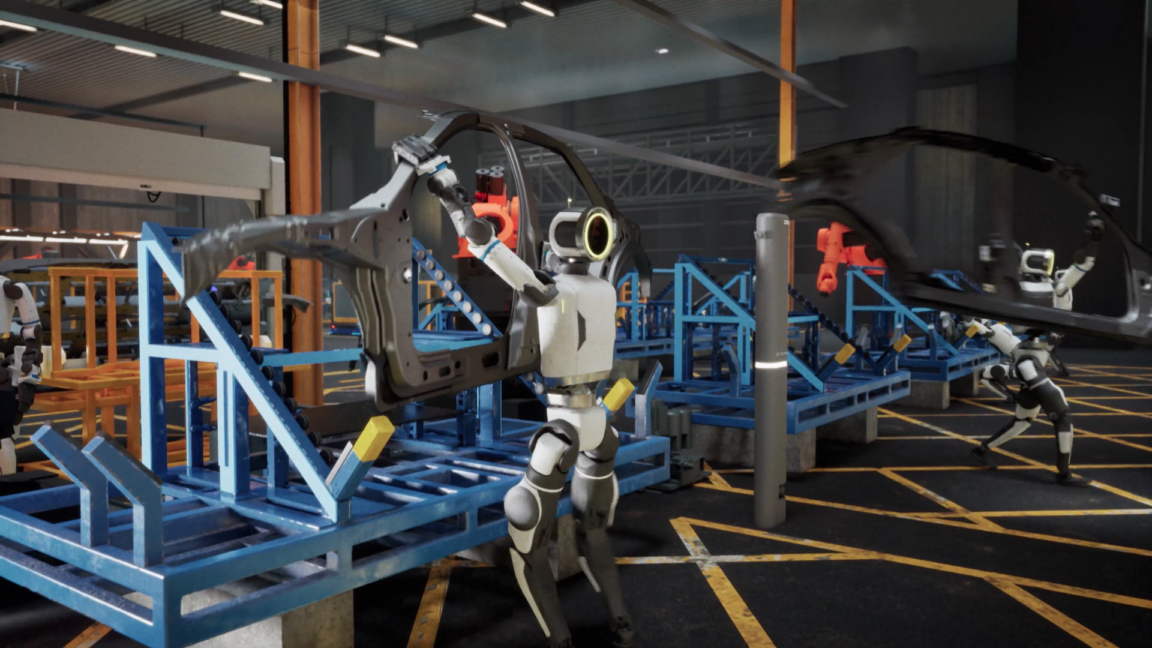
Fear of humanoid robots spurs human workers to strike at Hyundai auto factory
The strike highlights labor concerns over automation as companies like Hyundai plan to deploy humanoid robots, potentially impacting job security and wages for workers.
- Thousands of unionized Hyundai workers began a partial strike due to concerns over humanoid robots after negotiations with the company failed.
- Workers ended shifts early from July 13 to 15 and plan to stage further strikes from July 20 to 22 after 15 negotiation rounds.
- Hyundai plans to deploy over 25,000 Atlas humanoid robots across its manufacturing plants, starting in US facilities in 2028.
- The union representing workers demands job security measures including fixed hourly pay and increased worker bonuses in response to automation fears.
Hyundai is aiming to introduce humanoid robots, specifically the Atlas model from Boston Dynamics, to enhance automaking efficiency. Labor resistance is significant as unions push for worker rights amid increasing automation in the automotive industry, a trend seen in other companies like Tesla and BMW. Future developments will test how automation affects labor demands and job security.
Read the original ↗
xAI can’t deny Grok makes CSAM anymore. So it’s suing users.
This lawsuit highlights ongoing concerns regarding the responsibility of AI companies for user-generated illegal content, which has significant implications for legal accountability in technology.
- xAI filed a lawsuit against Terry Wayne Harwood, accused of using the Grok chatbot to generate child sexual abuse materials (CSAM).
- Harwood has been charged with various offenses related to the distribution of CSAM, allegedly using Grok to create illegal content.
- The lawsuit comes amid pressure on xAI to address claims of Grok generating non-consensual images, following a proposed class action by victims.
- The lawsuit argues that users should bear liability for Grok-generated CSAM, asserting that Harwood violated xAI's terms of service.
xAI, founded by Elon Musk, developed Grok, a generative AI chatbot that can produce images based on user prompts. Recent allegations against Grok have triggered lawsuits, raising concerns about the platform's use for harmful purposes. The court's decision on user liability could set important precedents for AI companies and user accountability.
Read the original ↗
It’s official: EU will force Google to share search data and open up AI on Android
This development could reshape competition in digital services by enabling greater access for rival companies, potentially impacting user choice and privacy in the European market.
- The European Commission has mandated Google to share search data with competing search providers under the Digital Markets Act.
- Google must allow access to competing AI platforms on Android phones, which could increase competition for users.
- Google claims these new rules threaten user privacy and security, particularly regarding how data will be shared and managed.
The Digital Markets Act is a European regulation aimed at curbing the market dominance of big tech companies like Google. This initiative follows previous fines and compliance demands on tech firms to increase market competition. Upcoming deadlines require Google to comply with these measures by January and July of 2027.
Read the original ↗
OpenAI Details GPT-Red: An Internal Automated Red-Teaming Model That Beat Human Red-Teamers 84% To 13% On Prompt Injection
The performance of GPT-Red highlights the need for more robust defenses against prompt injection attacks in AI models, which can expose critical vulnerabilities.
- OpenAI has introduced GPT-Red, an internal automated red-teaming model, which surpassed human testers in identifying prompt injection vulnerabilities.
- GPT-Red achieved an 84% success rate in breaking models compared to 13% for human red-teamers during its training on various scenarios.
- The model uses self-play reinforcement learning, allowing it to evolve its attacks as defender models become more resistant.
- GPT-Red discovered a new type of attack called 'Fake Chain-of-Thought' that exploits weaknesses in the models' reasoning processes.
- OpenAI plans to implement new safeguards based on the vulnerabilities GPT-Red uncovered, while acknowledging that not all attack types can be handled autonomously.
OpenAI's GPT-Red is designed to find vulnerabilities in AI models before they are deployed. The tool is part of OpenAI's broader safety measures, as AI systems are becoming increasingly complex and accessible. Future developments may focus on enhancing defenses against multi-turn and image-based attacks, which currently require human oversight.
Read the original ↗
Here’s Why Anthropic Is Pushing States to Regulate AI Faster
Anthropic's push for stronger AI regulations reflects growing concerns about safety risks, illustrating the increasing tension between innovation and oversight in the rapidly advancing AI landscape.
- Anthropic endorsed AI transparency laws in California and New York last year, but now argues they are outdated.
- The company is advocating for tougher regulations that include third-party safety evaluations and mechanisms to block unsafe AI deployments.
- Anthropic has faced criticism for potentially benefiting from stringent regulations that could hinder smaller AI startups.
Anthropic, valued at nearly $1 trillion, aims to lead in AI development while ensuring safety through regulatory measures. Following initial transparency laws, the company is pushing for more extensive regulations to match AI advancements and mitigate risks. Ongoing debates about AI safety and its implications continue to shape industry policies.
Read the original ↗
Roblox launches an AI-powered game-creation feature in its mobile app
The introduction of AI-powered game creation in Roblox could significantly alter the landscape of game development, impacting content quality and competition among developers.
- Roblox has introduced a new feature called 'Build' that allows users to create games on mobile devices using AI-generated game mechanics from text prompts.
- The AI feature will enter public alpha testing on July 28, starting with users in New Zealand aged nine and older who have verified their age.
- Roblox plans to rank AI-generated games based on player retention to address concerns about quality and competition on its platform.
- The Build feature is part of Roblox's broader investment in AI, which includes tools for creating 3D game assets and supporting developers in game building.
Roblox is a popular online platform that allows users to create and share games. The introduction of AI into game development may democratize game creation but raises concerns about potential low-quality content. Future developments include AI agents to assist developers and improvements in content discovery algorithms.
Read the original ↗