
The day's AI news, briefed
The Daily Prompt
Our AI editor reads each day's AI and robotics stories, pulls out why they matter, and links every original source — so you can keep up in minutes.
Join over 250,000 subscribers getting the latest AI news
Latest AI & Robotics News Today
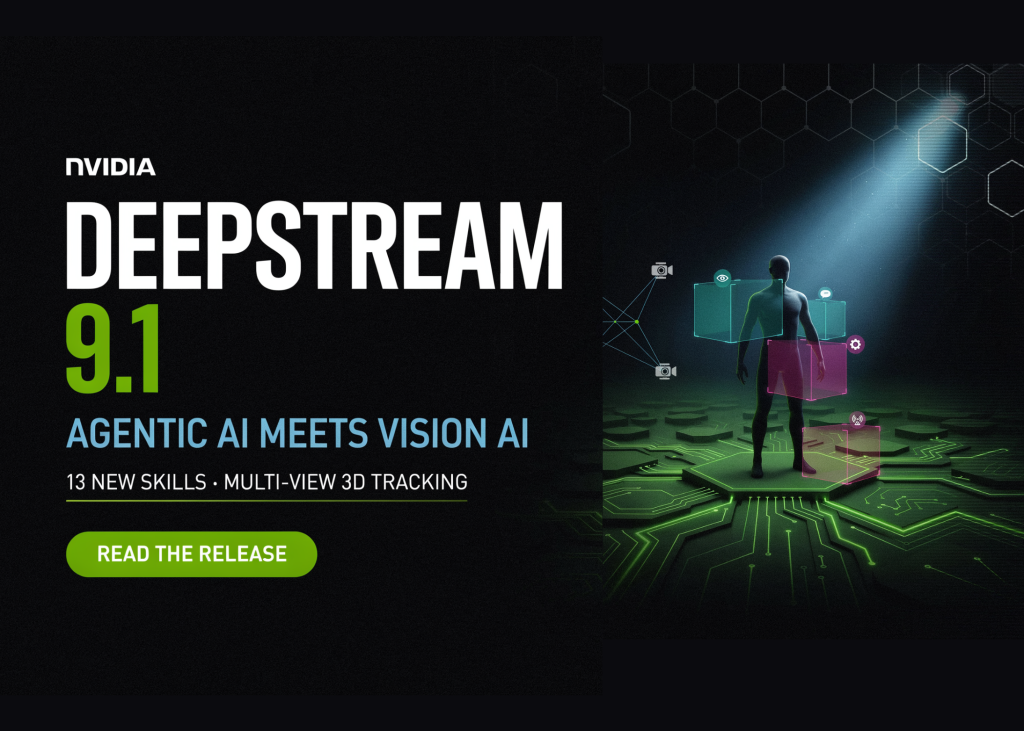
NVIDIA Released DeepStream 9.1: Bringing Agentic AI to Vision AI With 13 Skills and Multi-View 3D Tracking
The launch of NVIDIA's DeepStream 9.1 introduces significant advancements in video analytics, streamlining multi-camera tracking and calibration processes, which could enhance various industry applications.
- NVIDIA released DeepStream 9.1, adding 13 agentic skills including Multi-View 3D Tracking (MV3DT) and AutoMagicCalib (AMC).
- MV3DT projects object detections into a unified 3D coordinate system, maintaining a consistent object ID across multiple camera views.
- AMC automates camera calibration by using tracked objects from existing video, eliminating the need for manual methods.
- DeepStream 9.1 also supports NVIDIA JetPack 7.2 for Jetson Orin and Thor edge devices, expanding deployment options.
- The skills allow developers to use natural language for setup, speeding up the transition from concept to operational pipeline.
DeepStream is NVIDIA's toolkit designed for streaming analytics and video understanding, utilizing a GStreamer-based framework for efficient multi-model inference on NVIDIA GPUs. The previous versions focused on basic video processing, while version 9.1 enhances functionality with automated tracking and calibration capabilities. Future updates may improve integration with more AI tools or expand supported device architectures.
Read the original ↗
Narration Box Review: I Made Expressive AI Voiceovers
The growing demand for efficient audio content production highlights innovative AI tools like Narration Box, which facilitate faster and more expressive voiceovers, crucial for content creators.
- Narration Box features over 1,500 AI voices in 80 languages and accents, allowing for diverse audio productions.
- Users can create voice clones in 10 seconds, ensuring consistent audio across multiple projects.
- The platform includes advanced features for emotional expression, making AI voiceovers sound more natural and engaging.
Narration Box is an AI voice production platform designed to help creators produce high-quality voiceovers without manual recording. It enhances traditional text-to-speech capabilities by offering features like voice cloning and emotional tagging, addressing a growing need in the expanding text-to-speech market projected to reach $7.6 billion by 2029.
Read the original ↗
Google Cloud’s Always-On Memory Agent Replaces RAG and Embeddings With Continuous LLM Consolidation on Gemini 3.1 Flash-Lite
The Always-On Memory Agent could enhance AI systems by providing continuous memory management, potentially improving the efficiency and relevance of responses in various applications.
- Google Cloud has introduced the Always-On Memory Agent, a continuous memory management tool leveraging the Google ADK and Gemini 3.1 Flash-Lite.
- This agent eliminates the need for a vector database and embeddings by using an LLM to read and write structured memory into SQLite.
- It operates 24/7, consolidating memories every 30 minutes and enabling the processing of 27 file types across multiple media.
- The system is structured around three sub-agents: Ingest, Consolidate, and Query, each performing specific memory functions.
- Set up requires minimal effort, allowing engineers to deploy it easily and interact with it via an HTTP API.
Google Cloud has developed the Always-On Memory Agent to improve AI's memory retention capabilities. This tool addresses limitations of traditional methods like RAG by actively managing memory in real time. The implementation focuses on seamless integration for various workloads needing enduring context.
Read the original ↗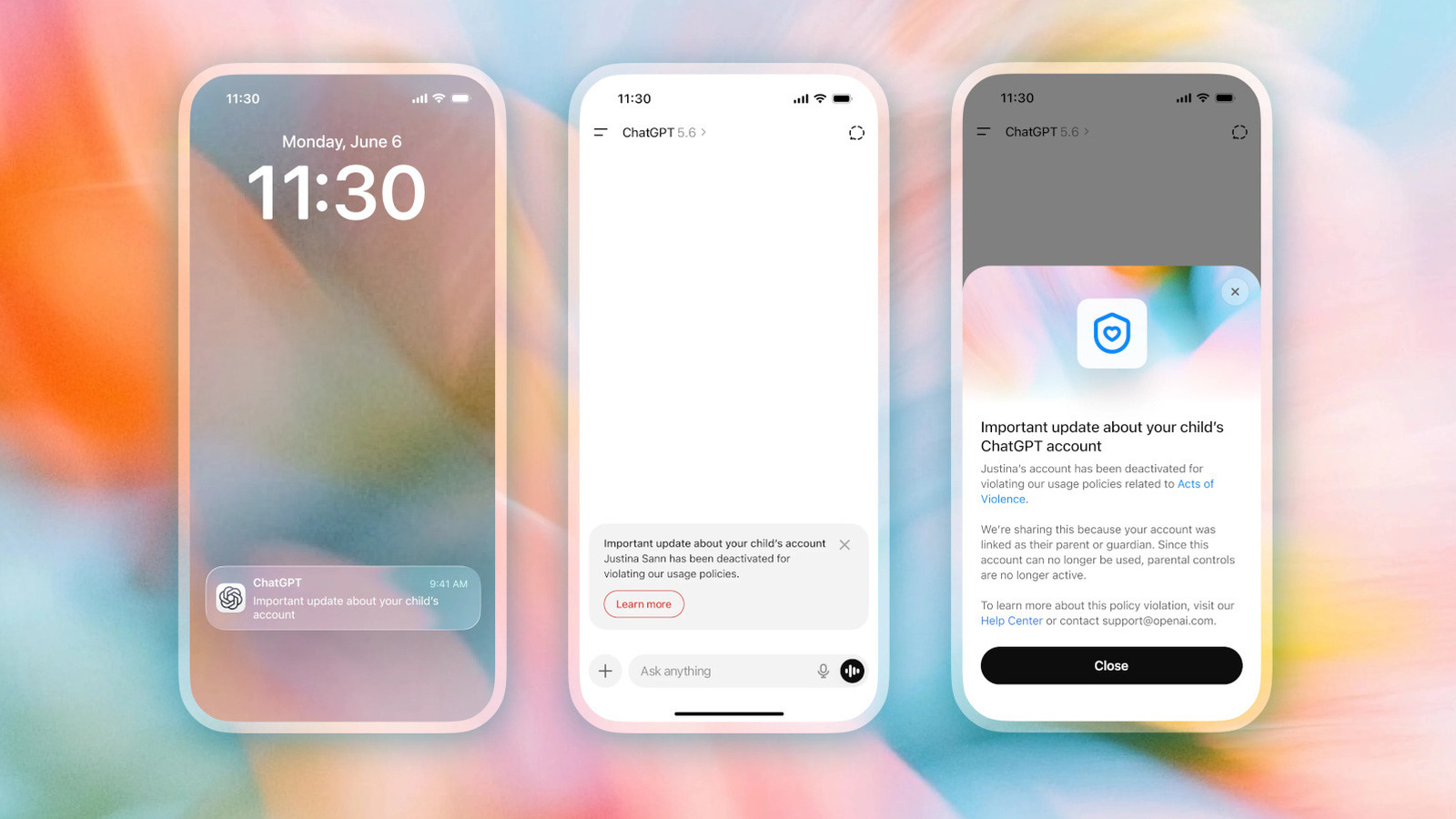
OpenAI will start notifying parents if their teen has been kicked off of ChatGPT
This new notification system allows parents to intervene and seek help if their child poses a risk to themselves or others, addressing online safety concerns.
- OpenAI will notify parents if their teen's account is deactivated for violating policies against violent threats or acts of violence.
- The feature is part of a broader set of parental controls launched last year, allowing account linking and usage scheduling.
- Parents can receive alerts detailing the nature of their child's account violation and access additional context.
- OpenAI developed this feature in collaboration with Moonshot, a firm focused on countering online violence.
- The update comes after scrutiny related to a mass shooting suspect's use of ChatGPT, prompting OpenAI to enhance safety protocols.
OpenAI is a leading artificial intelligence company known for developing language models like ChatGPT. It has implemented parental controls to help monitor and safeguard teenage users. Recent incidents have highlighted the necessity for enhanced safety measures regarding the chatbot's use.
Read the original ↗
Will AI fix prior authorization—or make it worse?
The integration of AI into prior authorization processes could significantly impact patient access to medical care and the efficiency of health insurance decision-making, raising concerns among healthcare professionals.
- The Trump administration is piloting a program using AI for prior authorization in six states to reduce unnecessary medical spending.
- A survey revealed 61 percent of physicians are concerned AI might increase wrongful denials of necessary treatments.
- Approximately one in five American working-age adults reported being denied coverage for physician-recommended medical care in 2025.
- The WISeR model uses AI and machine learning combined with human review to assess medical procedures for potential overuse or fraud.
- Despite the introduction of AI, critics argue that it may exacerbate existing issues in receiving timely care.
Prior authorization is a process health insurers use to determine coverage for certain medical services. Recent governmental initiatives aim to streamline this process, especially in Medicare; however, concerns persist about the impact of AI on patient access to necessary treatments. Observers are watching the outcomes of the WISeR pilot program closely as it represents a significant shift in how prior authorizations may be handled in the future.
Read the original ↗
Sakana AI’s Error Diffusion Trains Dale-Compliant Dual-Stream Networks, Reaching 96.7% MNIST...
Sakana AI's new approach to training networks without backpropagation could lead to advancements in neural network designs that align more closely with biological principles, improving efficiency and flexibility.
- Sakana AI's research introduces Error Diffusion, a technique that trains Dale-compliant networks without backpropagation, achieving 96.7% accuracy on MNIST and 61.7% on CIFAR-10.
- Error Diffusion uses excitatory and inhibitory streams to avoid the problem of weight transport, requiring approximately four times more parameters than single-stream networks.
- The study enhances Error Diffusion for multi-class classification with innovations such as layer-specific sigmoids and batch-centered error, addressing specific task challenges.
- The new method integrates with Proximal Policy Optimization (PPO) in reinforcement learning, outperforming traditional backpropagation-based methods on certain tasks.
- Dale's principle limits performance due to the non-negative weight requirement, costing 0.9 to 7.4 accuracy points compared to more flexible approaches.
Error Diffusion is a learning rule that relies on local updates instead of global backpropagation, making it more biologically plausible. The technique aims to imitate how the brain processes information, focusing on local synaptic connections. Future developments will likely explore efficiency improvements and broader applications of this learning model in various tasks, including reinforcement learning.
Read the original ↗
Neil Rimer thinks the AI money is coming back out
Neil Rimer's insights on potential wealth redistribution in Silicon Valley due to AI successes underscore increasing tensions around wealth inequality and philanthropic responsibility among tech leaders.
- Neil Rimer, co-founder of Index Ventures, predicts a need for wealth redistribution in Silicon Valley from AI gains, whether voluntary or involuntary.
- He highlights that only four families signed the Giving Pledge in 2024, signaling a decline in voluntary philanthropy among wealthy tech figures.
- Rimer's comments arise amidst California's proposed billionaires' wealth tax and skepticism about voluntary giving, indicating possible legislative responses to wealth concentration.
Neil Rimer has been a notable venture capitalist in Silicon Valley for decades, focusing on the impactful tech landscape. The ongoing conversation about wealth inequality in tech resonates with historical contexts of concentration and redistribution of wealth.
Read the original ↗
Best AI for Persistent Memory in 2026: 7 Tools That Actually Remember You (and Your Data)
As AI applications grow, understanding which tools can remember specific user data and preferences is crucial for selecting the right technology for different needs.
- This article reviews seven AI tools that offer persistent memory, categorized for individual users and developers building memory infrastructure.
- Notion AI serves knowledge workers by storing project-related information while lacking memory beyond its platform.
- Lindy allows users to create specialized AI agents with selective memory for specific tasks like email and scheduling.
- Mem0 is highlighted as an open-source memory layer for developers, offering user personalization through an API.
- Zep provides a temporal memory solution, tracking when events occurred, enhancing the context for AI agents.
Persistent memory in AI refers to the ability of tools to remember user preferences and contextual information. The article distinguishes between consumer-focused AI assistants and developer tools that build memory capabilities into applications. This differentiation is essential for users looking to optimize their digital interactions based on long-term memory.
Read the original ↗
Agility Robotics Just Opened a Training Gym for Humanoid Robots in Tesla’s Neighborhood
Agility Robotics' establishment of a new training facility highlights the competitive landscape in humanoid robotics and emphasizes the growing demand for practical applications in industry.
- Agility Robotics has opened a 60,000-square-foot training facility in Fremont, California, near Tesla's factory.
- The facility will be used to train the Digit humanoid robot for real-world industrial skills, operating in conditions similar to customer warehouses.
- Agility has secured $300 million in multi-year contracts for its next-generation Digit v5 and is in talks with over 30 additional clients.
- The company plans to hire nearly 200 employees in various sectors, including AI and software engineering.
- Agility's robots are already in use, handling logistics tasks for major companies like Amazon and Toyota.
Agility Robotics, founded in 2015, focuses on developing bipedal humanoid robots for industrial applications. The company is finalizing a reverse merger to become the first publicly listed pure-play humanoid robot firm. The new facility aims to accelerate innovation and customer integration in the growing robotics market.
Read the original ↗
Databricks hits $188B valuation, extending its run as AI’s favorite second act
Databricks' substantial valuation highlights the increasing investment and interest in AI technologies, reflecting broader industry shifts towards advanced data management and analytics solutions.
- Databricks has announced a funding round that values the company at $188 billion, led by Coatue.
- The company did not disclose the exact funding amount but previous reports suggest it is around $3 billion.
- This funding round continues a trend for Databricks, which recently raised $5 billion at a $134 billion valuation and earlier amounts in previous months.
- Databricks has transitioned its focus from big data solutions to AI products, launching tools like Lakebase and Unity.
- The company is noted for utilizing affordable open-weight AI models for coding, exemplifying a significant industry trend for cost control in 2026.
Founded in 2013, Databricks initially gained traction in big data analytics before pivoting to AI solutions. As companies increasingly seek AI tools with secure enterprise features, Databricks has successfully redefined its market position and continues to raise significant funding. Future developments in AI applications and costs will be critical to monitor.
Read the original ↗
Vertu wants executives to pay $6,880 for an AI agent — here’s how it actually performs
The performance of Vertu's $6,880 Alphafold smartphone raises questions about the effectiveness and reliability of AI agents in executive settings.
- Vertu's Alphafold smartphone, targeting affluent executives, is priced at $6,880 and features a built-in AI agent called Hermes.
- Hermes is designed to automate executive tasks but showed mixed results in performance during testing against Samsung's Gemini.
- Testing revealed Hermes could execute multi-step tasks but struggled with detail accuracy, unlike Gemini, which confirmed details before acting.
Vertu, a luxury phone maker, differentiates itself by offering high-end devices with an AI agent instead of competing on technical specifications. Prior reviews have highlighted Vertu's use of existing ZTE hardware with luxury finishes. This blend of luxury and functionality will be crucial to its appeal among high-end users.
Read the original ↗
Meta is reportedly considering a multibillion-dollar data center deal with Anthropic
If the deal proceeds, it could significantly diversify Meta's revenue sources and position the company as a player in the cloud services market.
- Meta is reportedly in talks with Anthropic to lease data centers in a potential deal worth up to $10 billion over two years.
- The arrangement would tap into Meta's extensive data center investments, aimed at fueling its AI ambitions.
- Although Meta and Anthropic are competitors in AI, this deal could benefit both by providing Anthropic with essential compute resources.
Meta, the parent company of Facebook and Instagram, is exploring entry into the cloud services business, an area traditionally outside its focus on advertising revenue. Previously, Meta CEO Mark Zuckerberg indicated interest in monetizing data center space, mentioning frequent requests it receives for such services. Anthropic is a leading AI start-up that has previously formed partnerships to secure computing resources and is in need of significant compute power.
Read the original ↗
AI-driven memory crunch jolts India’s smartphone market
The rising smartphone prices in India underscore how AI-driven demand for memory chips is reshaping consumer electronics, affecting market dynamics and affordability for consumers.
- Smartphone shipments in India fell 10% year-over-year in Q2 2026, the steepest decline in six years, due to rising costs associated with memory chips.
- Manufacturers are prioritizing memory chips for AI data centers, leading to less availability for consumer electronics and driving higher smartphone prices.
- Samsung was the only major smartphone brand to report growth in shipments in India during Q2, while Apple experienced a 3% decline in shipments influenced by supply constraints.
- The sub-₹15,000 smartphone segment saw shipments plummet 45% from the previous year, reflecting the impact of rising costs on budget devices.
- Analysts predict that high component costs and elevated smartphone prices in India will persist until at least the end of 2027.
India is the world's second-largest smartphone market and has become crucial for global brands seeking growth. The recent shift in consumer demand highlights the increasing impact of AI technology on hardware availability and pricing. Market experts are closely monitoring how these dynamics will evolve, especially regarding consumer behavior and brand competition.
Read the original ↗
Agility Robotics plants its flag in Tesla’s backyard
Agility Robotics' new training center enhances its competitive position in humanoid robotics, potentially accelerating its technology development against emerging industry players.
- Agility Robotics is opening a 60,000-square-foot facility in Fremont, California, to train its humanoid robots, Digit.
- The facility aims to support over 30 ongoing customer discussions for deploying Digit in various industries.
- Agility has secured $300 million in contract orders for its Digit robots, which are already in use by companies like Amazon and Toyota.
- The new training center will help Digit learn skills in environments similar to real-world deployments, enhancing its operational capabilities.
Agility Robotics, founded in 2015, specializes in humanoid robots, particularly the Digit model, which is designed for warehouse and manufacturing tasks. Currently, Agility is preparing for a reverse merger aimed at becoming a public company, positioning itself as a key player in the humanoid robotics market.
Read the original ↗
9 Best AI Tools for Ecommerce (July 2026)
Understanding the best AI tools for e-commerce can enhance operational efficiency, boost sales, and improve customer engagement, impacting business growth significantly.
- The article ranks the top nine AI tools for e-commerce, highlighting their specific capabilities and operational focuses.
- StoreClaw leads the list, enabling merchants to coordinate growth across multiple storefronts and marketplaces by turning store signals into actionable insights.
- Shopify Magic integrates AI assistance for tasks like product descriptions and customer service, streamlining online store management.
- OptiMonk AI automates website testing and personalization to optimize conversions, letting online stores boost sales without needing specialist expertise.
- Prediko helps Shopify stores manage inventory through AI forecasts and integrated financing options, addressing stockouts and overstock issues.
AI tools for e-commerce enhance various aspects of online retail, including inventory control, customer engagement, and sales optimization. These tools increasingly support businesses as they adapt to growing digital shopping demands. Future developments may focus on improving integration and operational simplicity.
Read the original ↗
10 Best AI Email Marketing Software Tools (July 2026)
The growing sophistication of AI in email marketing tools significantly enhances campaign effectiveness, impacting businesses' communication strategies and customer engagement.
- The article evaluates the top ten AI email marketing software tools for July 2026, highlighting their features and usability.
- GetResponse is ranked first due to its comprehensive AI-assisted workflow that integrates campaign creation, automation, and analytics.
- Omnisend is noted for its strong focus on ecommerce automation, combining email and SMS-driven campaigns for customer engagement.
- HubSpot is recognized for connecting email marketing within a CRM ecosystem to support broader sales and service workflows.
- ActiveCampaign excels in detailed behavioral automation, leveraging advanced features for targeted customer interactions.
AI email marketing software has evolved beyond simple subject-line generation, now offering integrated solutions for campaign management, segmentation, and behavior analysis. Leading platforms focus on enhancing user experience and improving outreach effectiveness through automation and data integration. Future developments may further refine these tools, emphasizing personalization and seamless customer journeys.
Read the original ↗
10 Best AI Accessibility Tools for Websites (July 2026)
The ability to employ AI in website accessibility testing can significantly improve digital accessibility, addressing the needs of users with disabilities and ensuring compliance with legal standards.
- AI tools are evaluated on their ability to prioritize defects, recognize patterns, and monitor large digital estates for accessibility testing.
- Deque axe ranks first for its comprehensive features for developer-led accessibility testing, integrating testing into development workflows.
- Level Access, ranked second, offers a complete digital accessibility platform with services that cater to large organizations seeking governance across various platforms.
- Siteimprove ranks third, providing continuous site-wide accessibility monitoring and governance suitable for large editorial teams.
The article discusses the best AI-based accessibility tools for websites, emphasizing the benefits of automating parts of the testing process. It highlights that while AI can assist, it cannot fully replace manual testing or inclusive design practices. Upcoming trends may focus on deeper integrations of AI in digital accessibility frameworks.
Read the original ↗
10 Best AI Humanizer Tools (July 2026)
The analysis of AI humanizer tools highlights their utility in enhancing machine-generated text while emphasizing the need for careful editorial oversight to maintain accuracy and integrity.
- The article evaluates various AI humanizer tools that improve rhythm, tone, and readability of machine-generated text.
- Tools like StealthGPT and Phrasly offer multiple rewriting modes and integrated workflows suited for high-volume editing needs.
- WriteHuman and Humanize AI focus on revising text to enhance conversational tone while necessitating human review to ensure accuracy.
- Surfer's AI Humanizer is integrated into broader content tools, making it effective for SEO teams, albeit less compelling as a standalone solution.
- QuillBot provides a comprehensive writing suite that aids users in editing and enhancing text, but requires final user decisions to ensure accuracy.
AI humanizer tools assist users in rewriting text to improve its quality, often addressing issues of originality and flow in machine-generated content. The tools vary in functionality and best practices dictate that outputs should be reviewed by humans to prevent inaccuracies. With the rise of AI in content creation, understanding these tools is crucial for effective writing.
Read the original ↗
7 Best LLM Tools To Run Models Locally (July 2026)
As more developers and businesses seek to ensure data privacy, the availability of tools for running large language models locally is increasingly important for controlling access to AI workflows.
- A variety of tools now exist to run large language models (LLMs) on local hardware, offering options for developers, privacy-conscious teams, and hobbyists.
- Popular tools such as Ollama, LM Studio, and Open WebUI cater to different needs, providing user-friendly interfaces, model management, and API accessibility.
- Running LLMs locally can enhance security and privacy, allowing users to manage prompts and documents without relying on external servers.
Large language models are advanced AI systems that have previously required significant computing power often only available to researchers. The growing landscape of local LLM tools democratizes access, allowing more users to leverage AI technology without compromising privacy.
Read the original ↗
Top 10 AI Practice Management Solutions for Healthcare Providers (July 2026)
Healthcare providers increasingly require integrated AI practice management solutions that streamline operations, enhance patient care, and improve financial performance in a competitive environment.
- AI practice management platforms now focus on connected clinical, administrative, financial, and patient-engagement workflows.
- AthenaOne is ranked first for its comprehensive ambulatory platform combining electronic health records, practice management, and revenue-cycle services.
- Tebra is designed for independent medical practices, integrating clinical records and administrative tasks to improve efficiency.
- Carepatron offers a cloud-based solution suitable for smaller providers, emphasizing usability and AI-assisted documentation.
- AdvancedMD combines practice management software with EHR and telemedicine, though it may require significant configuration.
AI practice management solutions streamline various healthcare processes for providers, emphasizing documentation efficiency and patient engagement. The products are evolving beyond simple transcription tools to meet the needs of diverse medical practices. Continued innovation and integration in this sector are likely as technological demands increase.
Read the original ↗