
The day's AI news, briefed
The Daily Prompt
Our AI editor reads each day's AI and robotics stories, pulls out why they matter, and links every original source — so you can keep up in minutes.
Join over 250,000 subscribers getting the latest AI news
Latest AI & Robotics News Today

Guideless Raises €1M Pre-Seed to Turn Software Workflows Into AI Training Guides
Guideless' innovation in AI-driven documentation could streamline training processes, potentially transforming operational knowledge management within organizations and impacting productivity.
- Guideless, a Lithuanian startup, secured €1 million in pre-seed funding to enhance software workflow documentation.
- The funding round was led by Superhero Capital and included investments from several angel investors associated with Vinted.
- The platform uses a Chrome extension to capture user actions within a browser, creating detailed, editable training guides.
- Guideless currently has over 3,000 users and is active in 15 markets, with notable clients including Vinted and the Nevada Hospital Association.
- The funding will support product development and expansion into markets in the United States, United Kingdom, and Europe.
Guideless is designed to improve software training by creating detailed guides from user workflows instead of traditional video tutorials. By enabling organizations to adapt training materials dynamically, it addresses inefficiencies in existing methods of documentation. Future developments may focus on integrating AI systems with the operational knowledge captured by the platform.
Read the original ↗
Binance Opens Its Trading Infrastructure to AI Agents With Agent OS
The introduction of Agent OS enables AI agents to interact with Binance's trading system, potentially revolutionizing how users engage in cryptocurrency trading and financial management.
- Binance has launched Agent OS, a platform to connect AI agents to its trading and wallet infrastructure.
- The platform allows AI to read markets, manage portfolios, and place trades on behalf of users.
- Agents operate within a dedicated 'Agentic sub-account' that users fund manually, restricting fund movement across accounts.
- The architecture includes strict permissions for agents, requiring user approval for any financial actions.
- User responsibility is outlined, with Binance not liable for agent-generated trading decisions, and an emergency stop feature for risk management.
Binance is a major cryptocurrency exchange with over 300 million registered users. Agent OS builds on existing functionalities and aims to streamline AI integration in trading processes. Future developments will likely include enhancements and adjustments based on user feedback and performance.
Read the original ↗
AI data centre regulation just got a template that needs no new law
This regulatory template could serve as a model for other states to enhance transparency and community engagement in AI data centre development without the need for new legislation.
- Pennsylvania's Governor signed an executive order that requires AI data centre developers to secure local approval and commit to certain conditions before permitting.
- The order mandates public disclosure of data centre operations, including energy and water consumption, and prohibits nondisclosure agreements for Commonwealth agencies.
- Developers not complying with the new requirements can still apply for permits, but their applications will face additional scrutiny and delays.
AI data centres are facilities that house computer systems and associated components for data storage and processing. This new regulatory framework in Pennsylvania is a significant shift in oversight, emphasizing local community consent and transparency. Future monitoring of how this template influences regulations in other states will be crucial.
Read the original ↗
SANY Ships First Autonomous Electric Mining Trucks to South America
The deployment of autonomous electric mining trucks in South America highlights advancements in sustainable mining technology and its potential impact on resource extraction operations.
- SANY has shipped its first autonomous electric mining trucks to South America.
- The trucks are designed for use in mining operations, likely aiming to enhance efficiency and reduce emissions.
SANY is a manufacturer specializing in construction and mining equipment, including advanced machinery that incorporates automation and electric technology. The introduction of autonomous electric trucks reflects a growing trend in the mining industry toward sustainable and efficient operations. Future developments to watch include potential expansions of this technology to other regions and industries.
Based on the headline only — the full article could not be fetched.
Read the original ↗
Unlucid AI Pricing: Are Gems Really Worth It?
Understanding Unlucid AI's gem-based pricing model is crucial for users to predict their expenses based on content output, particularly for different media types like images and video.
- Unlucid AI offers a gem-based pricing model, starting at $8.99 for gem bundles, without a recurring subscription.
- Image generation costs about 1 gem per image, photo edits around 2 gems each, and video effects approximately 10 gems per clip.
- Retry attempts significantly impact the overall cost per output, potentially tripling expenses if multiple tries are needed before a usable asset is achieved.
- Gems are suitable for casual, image-focused creators, but can quickly become costly for high-volume video production due to the high gem cost per clip.
- Free daily gems allow users to test the platform, but the amount received is only enough for limited usage and should not be considered for regular production.
Unlucid AI is an AI content creation platform that uses a gem-based currency instead of traditional subscriptions. Previously, many AI tools charged flat monthly fees regardless of usage, which this model aims to address by linking costs to actual production. It is important to consider individual content needs when evaluating the best pricing strategy moving forward.
Read the original ↗
OpenAI seeks to one-up Anthropic with new customer privacy protections
OpenAI's new privacy-centric approach may set a new standard in customer data protection, responding to rising concerns over data misuse in AI technologies.
- OpenAI announced a new service called Private Safety Processing to enhance monitoring for misuse without retaining customer data.
- This approach contrasts with Anthropic's data-retention policy, which allows retention of user data for 30 days for safety purposes.
- OpenAI's system aims to analyze multiple conversations for signs of abuse, potentially identifying malicious activity across sessions.
OpenAI and Anthropic are competing to provide the best privacy protections for enterprise customers amid increasing scrutiny of data misuse in AI systems. OpenAI's new monitoring technology builds on its existing Zero Data Retention policy, which allows customers to report abuse without their data being stored.
Read the original ↗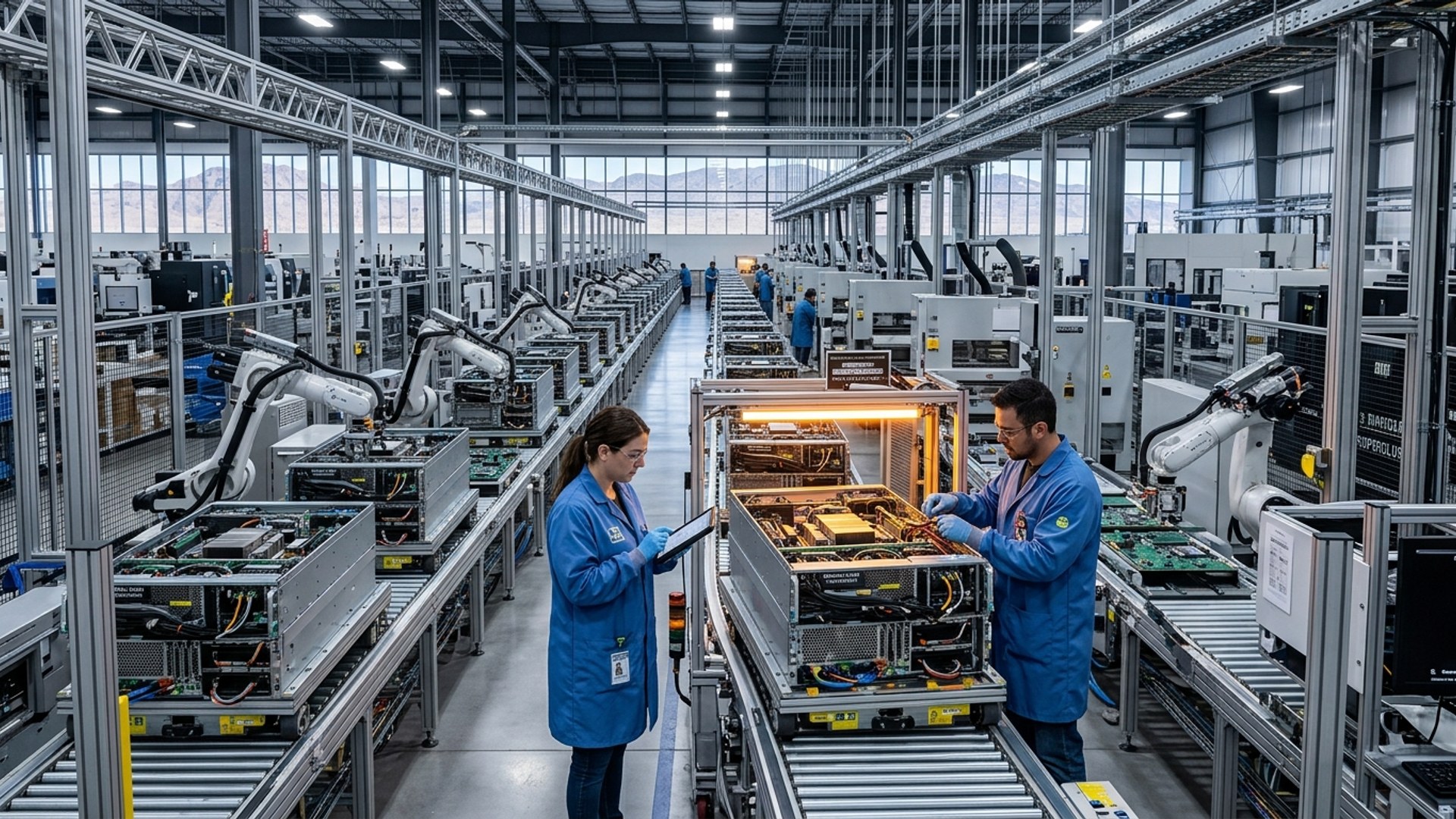
Hyve Solutions Picks Nevada for Two AI Server Manufacturing Campuses
The establishment of two AI server manufacturing campuses in Nevada signifies a substantial commitment to U.S. job creation and bolsters domestic production to meet rising AI infrastructure demands.
- Hyve Solutions plans to build two advanced manufacturing campuses in Nevada, including a 624,000-square-foot flagship site in Reno and a second facility in North Las Vegas.
- The projects are expected to create approximately 3,000 jobs as part of an expansion of U.S. production for AI data centers.
- Nevada's Governor’s Office of Economic Development approved tax abatements for these projects, which are expected to generate significant local tax revenue and capital investment.
- Hyve Solutions designs and manufactures servers used by large cloud providers and aims to expand its domestic manufacturing capacity, thus reducing reliance on overseas production.
Hyve Solutions, a subsidiary of TD SYNNEX, specializes in server design and manufacturing, particularly for cloud infrastructures. The company is expanding its operations in response to growing demands in the AI sector by establishing manufacturing facilities in Nevada, where favorable economic conditions and support from the state government facilitate business growth.
Read the original ↗
Japan to Create AI Model to Understand the Deep Ocean
This initiative represents a significant advancement in underwater research, potentially leading to better understanding of marine ecosystems and enhanced capabilities for monitoring environmental changes.
- NEC Corp has secured a contract to build an AI model for understanding underwater acoustic data.
- The project is part of a Japanese defense research initiative under the Agency for Defense Equipment.
- Self-supervised learning will enable the AI to identify patterns in scarce underwater acoustic data without extensive human labeling.
NEC Corp is a major tech firm based in Tokyo focusing on AI development. The project aims to create a sophisticated model for underwater sound analysis, utilizing existing acoustic data. This technology could revolutionize ocean research and defense applications.
Read the original ↗
Is the Scribbr AI Detector Good? I Tested It Against 3 Competitors
The Scribbr AI Detector's reliability issues can undermine academic integrity, as it misidentifies both AI-generated texts and human essays, which has serious implications for students and educators.
- Scribbr's AI detector has a detection accuracy of 72.8%, missing roughly 1 in 4 AI-generated texts.
- The tool incorrectly flags human-written essays about 9.2% of the time, complicating the grading process.
- Scribbr uses QuillBot's detection technology but does not provide the same level of accuracy as competitors like GPTZero and Originality.ai.
Scribbr is a Netherlands-based company specializing in academic services like proofreading. Its AI detector is free and accessible, but it has been criticized for low accuracy and high false positive rates. Observers recommend using Scribbr for initial checks, but advise against relying solely on its results for formal assessments.
Read the original ↗
I Saw the Future of AI in a Robot That Can Learn on the Spot
The ability for robots to learn tasks on the spot could transform industries by enhancing efficiency and adaptability in tasks such as manufacturing and service operations.
- Generalist AI's robots learn without specific training by ingesting instructional videos and improvising when tools are removed.
- One robot creatively used a dustpan as a brush and adapted its methods when struggling to grasp banknotes from a purse.
- Generalist AI co-founders have backgrounds at Google DeepMind and Boston Dynamics, underscoring their expertise in robotics.
- The company's innovative approach collects large-scale physical interaction data and builds AI models independently rather than using open-source models.
- Despite promising developments, Generalist's robots only complete tasks with about 59 percent reliability, indicating room for improvement.
Generalist AI, a startup based in Cambridge, Massachusetts, specializes in creating robots that demonstrate physical intelligence similar to human toddlers. Previous methods for training robots typically required extensive example-based learning, but Generalist’s models aim for improved efficiency through physical interaction. Observers are interested in how these advancements might lead to practical applications in commercial settings.
Read the original ↗
Google is offering college students a year of its AI Pro plan for free
Offering students free access to Google's AI Pro service could significantly enhance their engagement with AI tools while providing valuable resources for academic and personal use.
- Google is providing eligible college students in the US with a year of its AI Pro subscription for free, a service typically costing $200 annually.
- The subscription includes benefits such as 5TB of cloud storage and access to various AI tools integrated within Google Workspace apps like Gmail and Docs.
- Students outside the US can access a different offer, receiving a year of Google AI Plus for free, which provides basic AI features and 400GB of cloud storage.
Google's AI Pro plan is designed to enhance the user experience with its Gemini AI model and related services. Previously, college students had limited access to advanced AI resources; now, they can utilize these tools for free with the promotion. Future engagement statistics may highlight increased user adoption due to this initiative.
Read the original ↗
Google packs Search and Gemini with new AI study tools
Google's new study tools aim to enhance learning experiences for students, positioning Gemini as a competitive AI educational resource against other companies in the sector.
- Google announced new study tools for students across Search and Gemini, featuring AI-generated interactive visuals and customized practice quizzes.
- Students can generate custom simulations and practice quizzes related to various subjects directly in Search.
- Gemini will include a dedicated hub for educational tools, allowing users to create study notebooks, flashcards, and practice quizzes.
Google's Gemini is an AI assistant designed to support students with learning and studying. The introduction of these study features reflects Google's ongoing effort to innovate in the educational technology sector amidst increased competition. Future developments may include more interactive learning experiences and enhanced integrations.
Read the original ↗
Researchers say OpenAI revoked their access to limited cyber program
The revocation of access to OpenAI's cybersecurity program for some researchers highlights potential barriers in collaboration aimed at enhancing digital security measures.
- Several security researchers reported that OpenAI revoked their access to the Trusted Access for Cyber (TAC) program due to a technical error.
- OpenAI stated that affected users need to reapply and complete the verification process to regain access.
- Daybreak Blue, the latest tier of TAC, offers access to advanced AI models for cybersecurity research with fewer restrictions.
- Researchers affected by the revocation primarily reside outside of the U.S. and Europe, indicating potential regional limitations.
OpenAI's Trusted Access for Cyber (TAC) program provides vetted researchers with specialized access to its AI tools aimed at improving cybersecurity. This program is critical for identifying and fixing vulnerabilities in software, and similar offerings exist within the cybersecurity field. Observing how OpenAI manages user access and resolves technical issues will be important moving forward.
Read the original ↗
AI was supposed to win people over by now — it hasn’t
Growing consumer unease about AI technology presents significant challenges for tech companies that must address public trust while delivering on promises of human benefits.
- A Pew Research study found that 52% of Americans are more concerned than excited about the increased use of AI, up from 37% in 2021.
- Over 70% of Americans believe AI is advancing too quickly according to a May Economist/YouGov poll.
- Tech companies are facing a public relations crisis as they plan to build AI data centers in the U.S., leading to offers of local incentives like job guarantees and bonuses.
- Young consumers are increasingly expressing interest in retro technologies while showing skepticism towards AI innovations in everyday products.
- Airbnb's CEO acknowledged that the AI backlash reveals a need for technology that resonates positively with ordinary consumers.
AI technology, which includes systems that can perform tasks requiring human-like intelligence, has made rapid strides but is facing significant public backlash. Concerns over trust and the perceived benefits of AI have grown, particularly among younger users. It is essential for the industry to effectively communicate how AI can improve daily life and address these growing concerns.
Read the original ↗
Waymo Brings Gemini Assistant Into Its Custom Ojai Robotaxis
The integration of Gemini Assistant into Waymo's Ojai robotaxis enhances passenger interaction, potentially improving user experience and engagement in autonomous vehicles.
- Waymo has integrated its Gemini voice assistant into its custom-built Ojai robotaxis, providing cabin controls and information through voice commands.
- Gemini operates independently of the Waymo Driver, enhancing rider privacy and safety by not accessing real-time vehicle data.
- The Ojai features a redesigned tri-screen interface tailored for passengers, offering individual displays based on seating arrangements.
Waymo's Ojai robotaxis are purpose-built for autonomous ride-hailing, designed to accommodate passengers instead of drivers. The vehicles are still early in their rollout, with plans for wider public access later in 2026. As Waymo expands its service, it competes with other companies like Pony.ai and Uber in the autonomous vehicle market.
Read the original ↗
Prevalent AI Raises $22M to Scale Trusted Enterprise Context for AI Systems
Prevalent AI's funding reinforces the crucial role of data context in AI systems, vital for effective decision-making within organizations increasingly relying on AI technology.
- Prevalent AI has raised $22 million from Integrity Growth Partners, marking its first outside investment in nine years.
- The funding will help expand Prevalent AI's commercial organization and accelerate its entry into the U.S. market.
- Founded in 2017, Prevalent AI has been profitable since its inception, growing its annual recurring revenue significantly over the past year.
Prevalent AI specializes in improving decision-making for enterprises by connecting fragmented data from various systems, particularly in cybersecurity. Companies face increasing challenges as AI systems become more capable but rely heavily on the quality of their data.
Read the original ↗
Meta AI Comes to Mac With Screen Sharing and Business Account Access
The launch of the Meta AI Mac app provides new tools for businesses and creators, allowing them to integrate marketing data directly within a desktop environment, enhancing productivity.
- Meta launched a standalone Mac app for Meta AI on August 19, 2026, marking its first desktop version.
- The app allows screen sharing and connects to both Instagram and Facebook professional accounts, providing access to Meta’s analytics and advertising tools.
- Users can now receive tailored guidance on crafting posts and ads by accessing performance data from their accounts and public insights about competitors.
- The app integrates with Google Workspace, allowing users to pull information from their email and documents for comprehensive business insights.
- Enhanced features are expected to be introduced soon as Meta continues to expand its business-focused tools.
Meta AI is a chatbot designed to assist users with marketing on Facebook and Instagram. Prior to the Mac app launch, Meta AI existed primarily as a mobile app since April 2025, with ongoing updates to enhance its capabilities for business users.
Read the original ↗
Meta AI Lands on Mac With Screen Sharing and a Business Pitch
The introduction of Meta AI on Mac, with features like screen sharing, enhances productivity tools for users and can redefine business collaboration dynamics.
- Meta AI is now available on Mac, offering features such as screen sharing.
- The integration includes a business pitch component to improve professional interactions.
Meta is a technology company specializing in social media and AI, aiming to enhance user experiences through innovative tools. The arrival of Meta AI on Mac is part of the company's ongoing efforts to expand its artificial intelligence capabilities.
Based on the headline only — the full article could not be fetched.
Read the original ↗
Coders Say They Already Found Workarounds to Claude’s Invisible Watermarks
The rapid development of workarounds for Claude's watermarking system highlights challenges in enforcing AI transparency and compliance with regulations, raising concerns about content integrity and misuse.
- Guillaume Meyer created a tool to remove invisible watermarks from Claude-generated text shortly after Anthropic announced the feature.
- Meyer’s tool has gained significant attention on GitHub, with over 20,000 bookmarks and contributions from numerous developers.
- The EU AI Act mandates labeling AI-generated content to avoid fines, necessitating compliance from model providers like Anthropic and OpenAI.
Anthropic introduced invisible watermarks to its AI text generator, Claude, to comply with European Union regulations aimed at ensuring transparency in AI-generated content. Similar watermarking methods have been developed by other companies, and ongoing discussions about their effectiveness continue as workarounds emerge.
Read the original ↗
Flock is testing a new AI tool that tracks and identifies people based on their driving habits
The development of Flock's AI tool raises significant concerns about privacy and potential misuse in law enforcement, impacting public trust in surveillance technology.
- Flock is testing a new AI tool named OS Investigate, designed to track and identify drivers based on their driving habits.
- The software utilizes a network of cameras in 6,000 communities and analyzes vehicle movements without requiring a license plate or specific crime incident.
- Officers can input descriptions and prompts to search for potential witnesses in a specified area and time frame.
- Concerns have been raised regarding the potential for misuse, including enabling police to conduct broad searches without accountability.
- Several law enforcement agencies have halted partnerships with Flock amid growing public backlash over privacy issues.
Flock originally focused on automated license plate reading but has expanded its technology to track behaviors based on driving habits. This new tool follows historical concerns over privacy and allegations of abuse involving Flock's previous surveillance products. Ongoing scrutiny will likely continue as the tool is tested with law enforcement partners.
Read the original ↗