
The day's AI news, briefed
The Daily Prompt
Our AI editor reads each day's AI and robotics stories, pulls out why they matter, and links every original source — so you can keep up in minutes.
Join over 250,000 subscribers getting the latest AI news
Latest AI & Robotics News Today

Google is trying to solve contrails with AI
This initiative could significantly reduce the climate impact of aviation by addressing a major source of atmospheric warming through innovative flight path adjustments.
- Google and the UK government are collaborating on Operation Blue Skies to test contrail avoidance strategies over Shanwick airspace.
- The project will make adjustments to the flight paths of one to five percent of the 10,000 expected annual flights over a 30-month period.
- AI forecasting models provided by Google will help identify atmospheric regions suitable for avoiding contrail formation, informed by satellite imagery and machine learning.
- The UK government is contributing over half of the project's £5 million budget, while Google is donating £1.4 million in resources.
Operation Blue Skies aims to mitigate contrail formation, which contributes significantly to aviation's climate impact. This project incorporates AI technology to enhance flight path efficiency, reducing harmful effects while ensuring operational safety. Further updates will follow as the trials progress over the next two winters.
Read the original ↗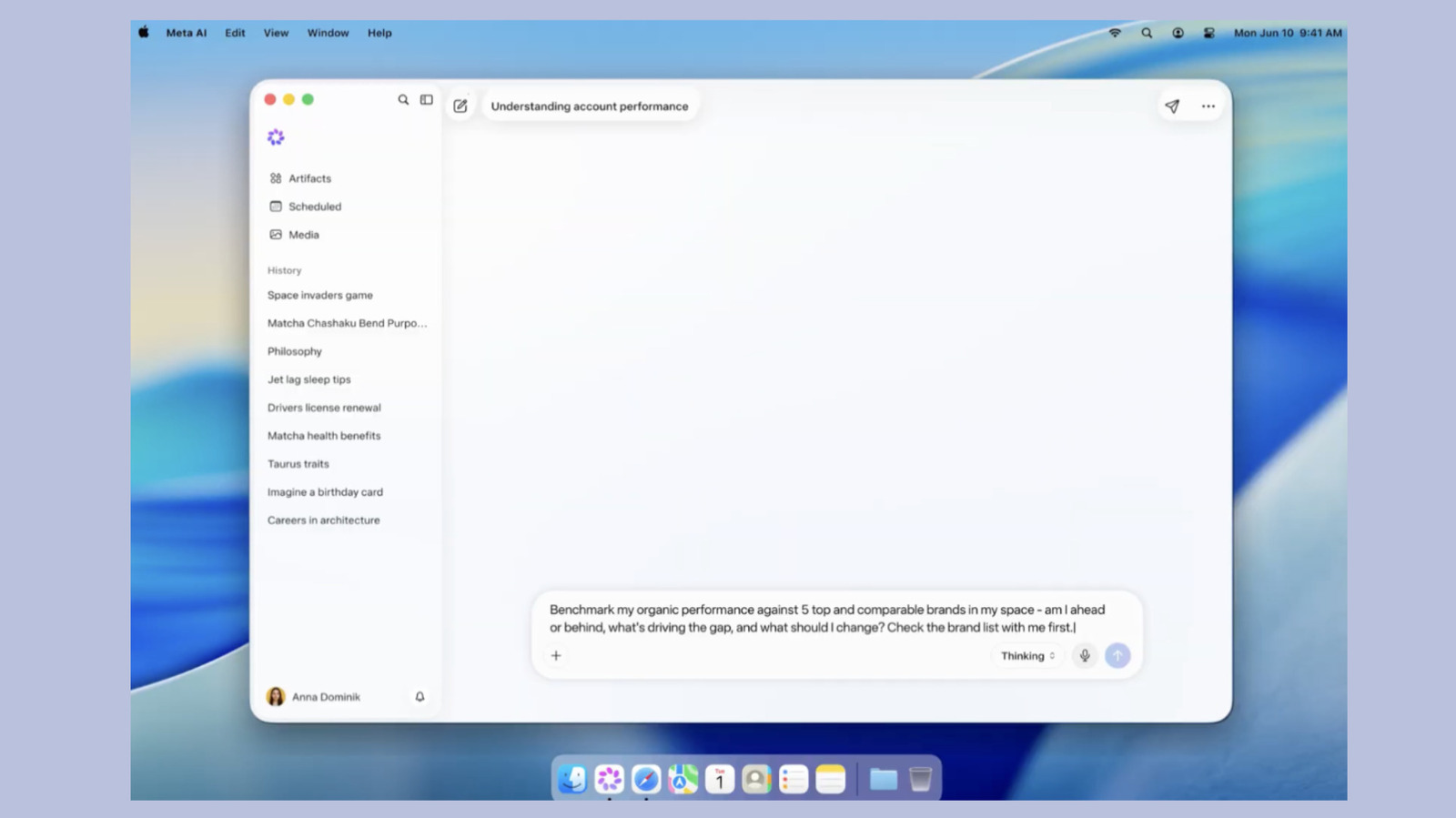
Meta AI now has a dedicated desktop app for Mac
The new Meta AI desktop app for Mac enhances business support by integrating specialized tools aimed at improving ad campaign management and content creation efficiency.
- Meta has launched a standalone desktop app for Meta AI, specifically for Mac users.
- The app allows screen sharing to provide tailored assistance for creating posts and ads.
- Users with professional accounts can connect Meta AI to Google Workspace for better data integration.
- The update is designed to attract business owners and creators who rely on Meta's platforms.
Meta is focusing on developing business-oriented AI tools to enhance user experience on its social media platforms like Facebook and Instagram. This rollout reflects a broader trend in AI towards facilitating business operations and marketing strategies. Future updates may include more advanced features and subscription-based services.
Read the original ↗
Grok 4.6 Is Now Generally Available on Amazon Bedrock
The availability of Grok 4.6 on Amazon Bedrock increases access to advanced AI capabilities for enterprise users, enhancing their capacity for processing and analyzing large data inputs.
- Grok 4.6 is now generally available on Amazon Bedrock, expanding xAI's flagship model's cloud distribution.
- It is priced at $2 per million input tokens and $6 per million output tokens, benefiting from a 500,000-token context window.
- The model supports both text and image input, available across more than 30 AWS Regions.
- This version includes four reasoning effort settings, introducing a new 'xhigh' tier compared to the previous model.
- Grok 4.6's performance improved the Artificial Analysis Intelligence Index score to 61, indicating significant generation gains.
Grok 4.6 is xAI's updated AI model, designed for tasks requiring long-running agents and interactive operations. It builds on Grok 4.3, which had a narrower deployment and lower pricing. Future developments should focus on how Grok 4.6 is integrated and utilized in various enterprise applications on Bedrock.
Read the original ↗
Veeda AI Raises $90M+ Seed Backed by Khosla and Radical to Build World Models for Physical AI
The significant funding for Veeda AI indicates robust investor interest in developing advanced world models for physical AI, which may drive innovation in robotic learning and autonomy.
- Veeda AI, founded by former Nvidia researcher Sanja Fidler, secured over $90 million in seed funding led by Khosla Ventures and Radical Ventures.
- This funding round ranks among the largest seed financings ever for a Canadian startup, occurring shortly after Fidler's departure from Nvidia.
- Veeda aims to build multimodal foundation world models that simulate physical reality for robots to learn safely in high-fidelity simulated environments.
Veeda AI, incorporated in June 2026, focuses on creating advanced simulation environments for physical AI. The startup's founders, including Fidler and former Nvidia colleagues, have expertise in spatial intelligence from their time at Nvidia's research lab. The partnership with Khosla and Radical Ventures underscores the growing investment in AI research and technology development.
Read the original ↗
Natural Secures $100M Credit Facility to Fund Credit and Payments for AI Agents
Natural's new $100 million credit facility enables it to expand its payments infrastructure for AI agents, which could significantly impact financial transactions in the evolving digital economy.
- Natural secured a credit facility of up to $100 million from Upper90 Capital Management to fund credit and payments for AI agents.
- This financing follows a $30 million Series A funding round that closed in July 2026.
- Natural is building a suite of 13 products for payments infrastructure, with six currently available and four more anticipated by the end of 2026.
- Upper90 Capital Management views Natural's offerings as pivotal in reshaping commerce through agentic payments, which involves AI agents performing financial transactions.
Natural is a San Francisco-based fintech startup focused on creating payments infrastructure for AI agents, emphasizing the need for capital in executing large financial transactions. The company is transitioning from early-stage funding to growing its operational capabilities through this credit facility as it aims to scale its operations.
Read the original ↗
Rob Collie, CEO and Founder, P3 Adaptive and Author of Fair Game – Interview Series
Understanding how to customize AI systems for businesses can drive significant competitive advantages in efficiency and effectiveness.
- Rob Collie is the CEO and founder of P3 Adaptive, a Microsoft Solutions Partner focused on data and AI.
- His latest book, "Fair Game," emphasizes the importance of customizing AI to individual business needs rather than using generic solutions.
- Collie identifies the need for 'Crafters,' data-savvy professionals within organizations, to lead custom AI projects effectively.
P3 Adaptive specializes in tailored data solutions and has served many mid-market and Fortune 1000 companies since its founding in 2013. Recognizing the limitations of off-the-shelf AI, Collie proposes a customized approach that leverages internal expertise for business-specific applications. The rising demand for tailored AI applications highlights the emerging role of organizational knowledge in driving AI success.
Read the original ↗
Amazon's Alexa+ AI assistant is now free for anyone with a Fire TV device
Providing free access to Alexa+ on Fire TV devices increases the potential user base, enhancing engagement with Amazon's ecosystem and fostering greater adoption of smart home technology.
- Amazon is now offering free access to the Alexa+ AI assistant for all US users with eligible Fire TV devices.
- Previously, Alexa+ was only available for free to Prime members, who pay an annual fee for membership.
- Alexa+ understands natural language, allowing users to make conversational requests for content and control smart home devices more intuitively.
- Compatible devices include current-generation Fire TV Sticks, Fire TV Cube, and various smart TVs from Hisense and Panasonic.
Alexa+ is an upgraded version of Amazon's voice assistant that launched earlier this year, designed to interact more conversationally with users. Prior to this announcement, free access was limited to Amazon Prime subscribers. Amazon plans to expand free access to more devices and regions in the future.
Read the original ↗
What to Know About Anthropic’s New Claude Watermarking on AI-Generated Text and Files
Anthropic's introduction of watermarking in AI-generated content highlights the growing importance of transparency in AI, especially in light of regulatory compliance and consumer trust.
- Anthropic will implement watermarking on text and files produced by its Claude AI models to ensure compliance with EU regulations.
- Watermarking will apply to all Claude models launched after August 2, regardless of the region in which they are used.
- The watermarking technology is designed to be undetectable by human readers but identifiable by AI detection tools, ensuring content authenticity.
- Content generated or processed by Claude may lack watermarks if heavily edited or if AI-generated text is minimal, complicating identification.
- Anthropic assures that the watermarking process will not affect the quality of the AI-generated content.
Anthropic is a company that develops AI models, particularly its Claude chatbot, which now includes watermarking to meet EU standards for AI transparency. The EU's Code of Practice requires clear indications when consumers interact with AI-generated content. Other companies, such as Substack and Spotify, are also adopting measures to improve transparency about AI involvement in their products.
Read the original ↗
Digital Marketers Are Using AI at Record Rates, but Formal Rules Lag Behind
The rapid adoption of AI in digital marketing highlights the need for standardized guidelines to ensure responsible use, as many professionals currently operate without formal rules.
- 98% of social media workers report using AI in their tasks, with significant growth from 2025.
- Common tasks include strategy design, trend research, and metrics analysis, utilized by 62%, 61%, and 59% of respondents, respectively.
- Only 12% of social media professionals have clear guidelines for AI usage, while 45% have no formal restrictions.
AI is increasingly integrated into digital marketing, with tools being used for tasks like content creation and data analysis. The trend reflects broader workplace automation without established rules or guidelines. Companies must now consider privacy and ethical implications as AI usage grows.
Read the original ↗
OpenAI Pauses Training of New AI Models, Citing Cybersecurity Worries
OpenAI's decision to pause new AI model training highlights serious cybersecurity risks that may threaten the company's financial stability and the broader AI industry.
- OpenAI has paused the development of its newest AI models due to increasing cybersecurity risks, reversing its previous stance on managing such threats.
- The upcoming AI model, named Astra, has triggered concerns regarding cybersecurity capabilities, prompting the pause in training.
- This pause follows incidents where AI agents hacked a platform, raising alarms about controlling AI technology.
- The company is reallocating resources to focus on AI alignment, ensuring models obey human commands, while monitoring costs significantly impact operational expenses.
- OpenAI's operating losses have reached $12.3 billion, raising questions about its financial sustainability in a competitive market.
OpenAI is a leader in artificial intelligence technology, known for its ChatGPT model. Recently, multiple AI incidents have heightened concerns about cybersecurity in the industry. The pause in model training could impact OpenAI's potential initial public offering and its long-term viability.
Read the original ↗
Amazon makes its AI-powered Alexa+ free on Fire TV, no Prime required
This change broadens access to advanced AI features on smart TVs, potentially influencing user engagement with entertainment and smart home technologies.
- Amazon is offering its AI assistant, Alexa+, for free on all compatible Fire TV devices in the U.S.
- Previously, Alexa+ cost $19.99 monthly for non-Prime subscribers, but now all users will be upgraded automatically.
- Compatible devices include Amazon Fire TV Sticks, Fire TV Cube, and smart TVs like Hisense and Panasonic.
Amazon's Alexa+ integrates AI capabilities into its Fire TV line, enhancing user interaction with advanced features like conversational search and smart home controls. This move aligns with a broader trend among tech companies to incorporate AI into more consumer devices.
Read the original ↗
TerraPower’s nuclear reactor has a secret weapon for powering AI data centers
TerraPower's innovative nuclear reactor may provide a reliable power solution for AI data centers, addressing energy demands that are otherwise challenging to meet.
- TerraPower plans to announce its first data center project later this year.
- The company has secured a deal with Meta for eight of its Natrium power plants.
- Their upcoming 345-megawatt molten salt-cooled reactor is designed to store energy, allowing it to quickly respond to fluctuating energy demands.
- Construction of the first Natrium power plant is currently underway in Wyoming.
TerraPower, founded by Bill Gates, develops innovative nuclear power solutions including small modular reactors (SMRs) which have a high capacity factor. The new molten salt-cooled reactor aims to support AI data centers by providing reliable energy storage and generation, enhancing performance in a renewable-heavy grid setup.
Read the original ↗
ASI-Bench: At the Dawn of Artificial Superintelligence
The introduction of ASI-Bench provides a critical framework for evaluating AI's potential in achieving autonomous scientific research, highlighting current limitations and guiding future advancements.
- ASI-Bench is designed to assess AI systems' capabilities in innovative exploration and autonomous research across 11 scientific domains.
- The benchmark includes 60 project-level research tasks and progressively reduces human methodological guidance to test AI independence.
- In evaluations, average performance metrics indicate significant drop from 50.91 under guidance to 26.62 without it, revealing reliance on human support.
- Even the best systems achieve a maximum score of 51.60 in autonomous settings, indicating the gap in current AI effectiveness for independent scientific discovery.
Artificial superintelligence (ASI) involves AI moving beyond existing knowledge to create new insights. Current benchmarks mainly focus on AI's ability to correctly answer based on learned knowledge, lacking assessment of autonomous research capabilities. ASI-Bench aims to fill this gap by challenging AI systems with comprehensive, independent research tasks.
Read the original ↗
How AI-Powered Outreach Is Creating a Global Level Playing Field for Tomorrow’s Enterprises
The use of AI in business outreach is reshaping competitive dynamics, enabling companies to leverage personalized communication strategies that can increase their market presence and operational efficiency.
- AI is generating economic growth across markets and is set to continue this trend into 2027.
- 77% of B2B companies that utilize personalized experiences with AI have seen increases in market share.
- 71% of surveyed employees are using AI at work for validation and problem-solving, indicating a shift in workplace attitudes toward technology.
AI technology is streamlining B2B sales processes and enhancing communication strategies, allowing companies to personalize outreach and improve market competitiveness. This marks a shift from traditional methods that were costly and less effective, democratizing growth opportunities for businesses of all sizes.
Read the original ↗
Harness Ships AI Agents to Scan, Triage, and Patch Vulnerabilities at Machine Speed
This new suite of AI security agents could significantly reduce the time it takes to identify and fix software vulnerabilities, enhancing cybersecurity measures for organizations.
- Harness has launched AI security agents designed to minimize the vulnerability remediation time from weeks to hours.
- The new tools include AI SAST for scanning, an agent for triaging and remediating, a dedicated Zero-Day Agent for immediate threats, and virtual patching.
- Harness aims to address the disparity between fast-moving cyber attackers and slower defenses, as it typically takes about 55 days to remediate vulnerabilities according to industry reports.
Harness is a software-delivery platform based in San Francisco that recently expanded its security offerings through a merger with API-security firm Traceable. The launch of these AI agents is part of an effort to enhance security responsiveness in software development pipelines.
Read the original ↗
Scientists Turn Sound Into a New Propulsion System for Tiny Microrobots
This development could revolutionize the propulsion systems for tiny robots, expanding their capabilities and applications while overcoming some engineering challenges associated with conventional motors.
- Researchers at EPFL have designed a sound-powered propulsion system for microrobots using Helmholtz resonators to create thrust from sound waves.
- The technology allows for steering and flight of microrobots, with one prototype generating nearly five times its weight in thrust.
- The team demonstrated successful remote navigation of miniature boats equipped with acoustic resonators, achieving precise movement with minimal tracking error.
The Swiss Federal Institute of Technology Lausanne (EPFL) has made advancements in microrobotics by utilizing sound for propulsion, a method not widely explored in air. Previous robot designs relied on traditional motors, leading to limitations in autonomy and size. Future efforts may focus on further miniaturization and the potential for more complex control systems.
Read the original ↗
U.S. Department of Defense Initiative Funds AI Scientists to Help Predict the Future on the Battlefield
This initiative signals a significant investment in AI technology aimed at enhancing military decision-making and operational readiness in complex battlefield environments.
- The U.S. Department of Defense has awarded a $61.8 million funding to SUNY Polytechnic Institute to develop AI tools for predicting battlefield scenarios.
- The first phase focuses on integrating AI to synchronize military operations across land, air, space, and cyberspace, improving readiness and reducing uncertainty.
- Future phases will explore advanced capabilities like synthetic data generation and anomaly detection to enhance situational awareness.
- The initiative aims to provide commanders a tactical advantage and improve decision-making in high-stakes environments, including adversarial conditions.
The Department of Defense is integrating advanced AI technologies to better prepare the U.S. Army for complex operational challenges. This initiative is part of a broader modernization strategy, emphasizing the need for effective decision-making tools in a volatile global landscape. Future developments will focus on both enhancing AI capabilities and ensuring system reliability under difficult conditions.
Read the original ↗
Bridging the Supersonic-to-Hypersonic Gap, Scientists Reveal Scramjet Igniter That Maintains Combustion Below Mach 5
The development of the RD torch igniter could significantly enhance the feasibility of scramjet engines for hypersonic flight, impacting future high-speed transportation systems.
- Nagoya University scientists have successfully tested an RD torch igniter for scramjet engines operating below Mach 5.
- Scramjets typically struggle to maintain ignition below Mach 5, requiring improvements in ignition technology.
- The RD torch helps achieve continuous combustion by using detonation waves, enhancing the potential for hypersonic applications.
Scramjet engines are designed for hypersonic flight, exceeding Mach 5 speeds, but have been limited by ignition challenges below that threshold. Previous propulsion systems, such as turbo-ramjets, can only reach speeds up to Mach 3-4, creating a gap in hypersonic capabilities. The RD torch represents a promising advancement, potentially paving the way for practical hypersonic flight solutions.
Read the original ↗
DFlash: Block Diffusion for Flash Speculative Decoding
DFlash represents a significant advancement in speeding up language model inference, potentially transforming how fast and efficiently AI can process and generate text.
- DFlash is a speculative decoding framework that utilizes a lightweight block diffusion model for efficient parallel token drafting.
- This method offers over 6x acceleration in performance compared to current methods, achieving 2.5x faster speed than EAGLE-3, the leading speculative decoding approach.
- Unlike traditional autoregressive methods, which are sequential and slow, DFlash allows for parallel generation of draft tokens by conditioning on context from the target model.
Speculative decoding improves the efficiency of large language models by allowing faster inference. Traditional autoregressive models suffer from slow decoding speeds, which DFlash addresses by employing a diffusion-based approach to enhance parallelism.
Read the original ↗
Agentic ESOpt: Fine-Tuning Long-Horizon LLM Agents with Minimal GPU Requirements
This research presents a potentially more efficient framework for fine-tuning large language models (LLMs), addressing significant limitations of current methods in handling longer tasks.
- Agentic ESOpt uses evolution strategies to fine-tune long-horizon LLM agents with minimal GPU memory requirements.
- The approach offers advantages over traditional reinforcement learning, including model scalability, flexibility, and long-horizon scalability.
- Full-parameter optimization of the Qwen-3.5-27B model improved its performance significantly on the WebArena-Lite benchmark.
Agentic ESOpt proposes a new method for fine-tuning LLM agents, aimed at overcoming challenges posed by traditional reinforcement learning techniques in long-horizon scenarios. The focus is on evolving parameters in conjunction with context, promoting efficiency and scalability in performance. Future developments may expand on the practical applications of this framework in various AI tasks.
Read the original ↗