
The day's AI news, briefed
The Daily Prompt
Our AI editor reads each day's AI and robotics stories, pulls out why they matter, and links every original source — so you can keep up in minutes.
Join over 250,000 subscribers getting the latest AI news
Latest AI & Robotics News Today

AI data startup Micro1 reaches $500M gross run rate amid AI training boom
Micro1's significant revenue growth highlights the increasing demand for AI training data, indicating a competitive and expanding market that could shape AI development and capabilities.
- Micro1's gross annual run rate rose from $100 million to $500 million in just eight months due to surging demand for AI training data.
- The company retains 60% to 70% of its gross revenue, resulting in a net annual run rate between $150 million and $200 million.
- Micro1, unlike some competitors, does not sell data to Chinese AI developers, as stated by its founder.
- The demand for data is expected to grow, potentially rivaling future AI spending on compute-related resources.
Micro1 is a four-year-old startup focused on providing AI training data through data-labeling services. Previously an AI recruiting startup, it pivoted to data labeling as it recognized demand from its clients. The firm is part of a wider trend in which competition for data is intensifying among various providers.
Read the original ↗
Binance to Let AI Agents Trade With Your Money
The introduction of AI agents for automated trading on Binance could significantly transform how users interact with cryptocurrency markets and manage their investments.
- Binance has launched Agent OS, allowing AI agents to analyze markets and execute trades on behalf of users.
- Users can create sub-accounts for AI agents, controlling their trading capabilities and ensuring limited access to funds.
- The platform integrates with established AI tools like OpenAI's ChatGPT and allows for various trading activities, subject to user-defined permissions.
Binance is the world's largest cryptocurrency exchange, providing a platform for digital asset trading. The introduction of Agent OS follows similar offerings from competitors like Kraken, Coinbase, and OKX, which are also exploring AI integration in trading.
Read the original ↗AI Labels Are Big Tech’s Most Basic Responsibility, Even Those Claude Watermarks
The implementation of watermarks on AI-generated content, as mandated by new regulation, highlights the urgent need for transparency in AI usage amidst growing public concern over misinformation.
- Anthropic plans to watermark AI-generated text and files to comply with new legal requirements in Europe.
- The company's decision generated backlash, with some users canceling their subscriptions in protest.
- Watermarks aim to increase transparency around AI-generated content, which many see as a necessary responsibility for AI companies.
Anthropic, a company specializing in AI, has introduced watermarking to distinguish AI-generated content, responding to regulatory pressures in Europe. This move reflects ongoing discussions about the responsibility of AI firms to ensure clarity in the creation and use of AI technologies.
Read the original ↗Oura Faces Lawsuit Over Alleged Innacurate AI Sleep Tracking
The lawsuit underscores growing consumer concerns over the accuracy of AI technology in health tracking devices, potentially impacting Oura’s market position and consumer trust.
- A proposed class-action lawsuit claims Oura misled users about the accuracy of its AI-generated sleep tracking.
- The suit argues Oura's algorithms cannot accurately measure sleep stages and rely on 'AI-generated guesses.'
- Oura’s marketing includes claims of '95% Sleep Staging Accuracy,' which the lawsuit disputes based on clinical requirements.
- Oura states its sleep tracking uses various physiological signals and is validated by scientific studies, differentiating it from medical devices.
Oura is a smart ring company known for its sleep tracking capabilities using AI. The lawsuit highlights ongoing scrutiny of wearable health trackers and their claims. This follows a previous class-action lawsuit regarding Oura's handling of personal data.
Read the original ↗
ChatGPT can now send texts for you with new Apple Messages plug-in
The integration of ChatGPT with Apple Messages not only streamlines messaging but also raises important considerations around privacy and data management for users.
- OpenAI has launched a plug-in for ChatGPT that integrates with Apple Messages, enabling users to automate texting tasks.
- The plug-in allows users to send, draft, and delete messages using ChatGPT, enhancing both personal and professional communication.
- Privacy concerns have emerged, as users must enable Full Disk Access for the plug-in to function, though no full index of messages is created.
OpenAI's ChatGPT is a conversational AI model that can automate various text-based tasks. This integration with Apple Messages allows users to leverage AI for messaging while raising important privacy considerations. Users should monitor their permissions and settings when using this feature to ensure privacy protection.
Read the original ↗
OpenAI is gaining on Anthropic with business users, new data indicates
The shift in market share between OpenAI and Anthropic indicates ongoing volatility in enterprise AI spending, reflecting how businesses may rapidly change preferences based on new developments.
- OpenAI is regaining market share among U.S. business users after losing it to Anthropic in May.
- As of July, Anthropic held nearly 44% market share, while OpenAI had nearly 40%.
- Data from Ramp, a corporate credit card company, covers over 70,000 American businesses and their AI spending patterns.
OpenAI and Anthropic are competing in the AI market, with both companies targeting business customers. Recent data shows fluctuating preferences, likely influenced by advancements in AI models. The overall growth of AI adoption among these businesses suggests strong market dynamics ahead.
Read the original ↗
ChatGPT Plugin Reads and Sends Apple Messages on Apple Silicon Macs
This new plugin enhances the integration of AI in daily communications by allowing ChatGPT to interact with Apple Messages on Mac, streamlining text responses and management.
- OpenAI has launched a ChatGPT plugin for reading and sending messages on Apple Silicon Macs, available since August 20, 2026.
- The plugin allows users to draft, summarize, and send iMessage, SMS, and RCS conversations, contingent on user approval.
- It operates only on the Apple Silicon version of the desktop app and is unavailable on Intel Macs or within regular ChatGPT chats.
- Workspace administrators can disable the Messages feature through existing controls, emphasizing its suitability for enterprise environments.
OpenAI's ChatGPT is a conversational AI tool that has integrated various capabilities into a single desktop app, merging task management with conversational interfaces. Previously, OpenAI had focused on enhancing user interaction with AI across multiple platforms, indicating a trend towards more personalized AI tools. Future developments may include more features targeting enterprise use and further integrations with messaging services.
Read the original ↗
OpenAI Closes on Anthropic in Ramp’s Business Spending Data
The shift in AI spending data indicates a possible recovery for OpenAI, highlighting competitive dynamics in enterprise technology adoption and signaling changing preferences among businesses.
- OpenAI's growth outpaces Anthropic in U.S. business spending during Q3 2026, marking a potential reversal of recent trends.
- As of July 2026, Anthropic had 43.5% of U.S. businesses using its services, while OpenAI had 39.7%.
- OpenAI's GPT-5.6 Sol reportedly increased its share, comprising 25% of its token purchases, compared to Anthropic's Fable 5 at 6%.
- According to the Ramp AI Index, overall AI adoption among business customers rose to 55.7% from around 50% in March 2026.
- The Ramp data reflects the spending habits of businesses using Ramp's platform, implying that actual adoption may be higher.
OpenAI and Anthropic are competing AI research firms providing models for businesses. Both companies have experienced fluctuating spending by enterprises, with Anthropic previously leading but facing challenges from OpenAI's newer offerings. Observers will look for future data to understand if OpenAI can maintain its current growth trajectory.
Read the original ↗
TVA Board Creates Data Center Rate to Shield Households From AI Power Costs
The new tariff for data centers aims to protect residential customers from rising electricity costs as demand from AI technologies increases, potentially stabilizing household energy bills.
- The Tennessee Valley Authority (TVA) approved a new wholesale rate class for data centers to be effective October 1, 2026.
- Data centers with loads above 5 megawatts will incur a Capacity Commitment Charge to recover specific costs associated with increased electricity demand.
- TVA plans to spend over $13 billion on generation and transmission through fiscal year 2029, addressing rising demand primarily driven by population growth and data center development.
The Tennessee Valley Authority is the largest public power supplier in the U.S. and provides electricity to millions of customers. The new rate structure responds to the increased demand for electricity due to AI-driven technologies and offers measures to ensure affordability for residential consumers. The approved plan includes significant capital investments for new generation capacity in the coming years.
Read the original ↗
Something Struck the Moon—and NASA’s Lunar Reconnaissance Orbiter Just Found the Crater
This discovery provides important insights into lunar geology and highlights the unpredictability of space debris trajectories, impacting future space mission planning.
- NASA's Lunar Reconnaissance Orbiter captured high-resolution images of a 60-foot-wide crater formed on August 5, 2026.
- The crater was created when the upper stage of a SpaceX Falcon 9 rocket impacted the Moon after deviating from its intended orbit.
- NASA collaborated with global astronomers and space agencies to predict the impact's location and confirmed it within 0.6 miles of their initial estimate.
- The images reveal distinct patterns in the lunar regolith resulting from the impact, showcasing both darker and lighter surface materials.
- This incident offered an opportunity for NASA's Center for Near-Earth Object Studies to test its prediction tools for tracking space objects.
NASA's Lunar Reconnaissance Orbiter is a mission designed to map the Moon's surface in high detail. The impact occurred from a leftover rocket stage from Firefly Aerospace's Blue Ghost Mission. As space debris becomes a more prominent issue, monitoring its impact on celestial bodies is increasingly crucial.
Read the original ↗
Silicon Valley Doesn't Get Why You Hate AI
Understanding public skepticism towards AI is crucial for Silicon Valley, as misinterpretations can hinder the adoption and development of AI technologies in society.
- A significant portion of the global population, particularly over half of Americans under 30, expresses more concern than excitement about AI.
- More than 70% of people surveyed believe that AI will lead to fewer jobs, reflecting widespread anxiety about employment impacts.
- Industry leaders, including Mark Zuckerberg and Dario Amodei, are struggling to grasp the deeper societal concerns driving the backlash against AI.
- Recent polling indicates that public fears about AI extend beyond job loss to include impacts on youth relationships and critical thinking skills.
Tech leaders are attempting to address growing criticism of AI technologies, but often miss the underlying societal issues contributing to public distrust. Previous discussions have led to concerns about data privacy, job displacement, and authenticity in interpersonal relationships. Ongoing public polling may reveal increasing or changing attitudes towards AI in the future.
Read the original ↗
Audio Deepfakes Are Here: How to Protect Yourself From AI-Impersonation Scams
The rise of audio deepfakes could lead to increased scams, posing threats to personal security and trust in communication.
- Scammers are using AI technology to create audio deepfakes that impersonate celebrities and politicians.
- These deepfakes can be used in scams to deceive victims and gain sensitive information.
- Understanding how to identify and protect against audio deepfakes is critical for personal security.
Audio deepfakes utilize artificial intelligence to generate convincing audio imitations, which can be manipulated for fraudulent purposes. As these technologies evolve, awareness and protective measures are increasingly important for individuals and organizations.
Read the original ↗
Google gives publishers a new way to fight AI-driven traffic losses
This initiative allows publishers to regain some control over traffic loss caused by AI-driven search changes, highlighting the ongoing impact of AI on content discovery.
- Google has introduced a 'Preferred Sources' button for online publishers, allowing readers to mark them as favorite sources.
- This feature aims to enhance visibility across Google Search, Discover, and Google News, potentially increasing web traffic for publishers.
- The launch follows a similar tool released in May, indicating over 345,000 unique sources have been selected by users so far.
- Readers will soon be able to customize their Discover feed using natural language commands, refining their content preferences in real time.
Google's new feature is part of its ongoing efforts to support content creators amidst changes in AI search that have affected website traffic. Previously introduced tools like AI Mode and AI Overviews were aimed at improving user access to trusted content. The search giant continues to evolve its services in response to the impact of AI on information distribution.
Read the original ↗
SPADE: Self-Play in Adaptive Synthetic Executable Environments
SPADE represents a significant advancement in self-play reinforcement learning, enabling language models to autonomously create and learn within customized training environments, potentially enhancing AI adaptability.
- SPADE is a self-play reinforcement learning framework where a language model acts as both Environment Designer and Reasoning Agent.
- It generates adaptive, executable training environments while learning to solve them, utilizing a method known as regret-based environment targeting.
- In experiments, SPADE improved performance by an average of +5.3 over fixed-environment baselines across various benchmarks at a model scale of 30 billion parameters.
SPADE stands for Self-Play in Adaptive Synthetic Executable Environments, a framework that allows AI language models to self-generate training tasks. Previous training models relied on fixed environments, limiting adaptability. SPADE aims for continuous self-improvement by dynamically generating diverse challenges for learning agents.
Read the original ↗
#524 What AI models are actually coming in the next six months?
The release of new AI models from major tech firms and startups could significantly impact corporate AI strategies and the accessibility of advanced AI tools in the workplace.
- Key players like OpenAI, Google, Meta, and several Chinese labs are preparing new AI model releases within the next six months.
- OpenAI's next model, Astra, awaits security validation, while Meta's Watermelon faces potential delays in its development.
- Google's Gemini 3.5 Pro and 4 are both experiencing scheduling issues, with Pro reportedly behind schedule and Gemini 4 in pretraining.
- Chinese startup MiniMax is expected to release an open-weight AI model with 2.7 trillion parameters by October, potentially reshaping the AI landscape.
- Nvidia is set to release physical AI models, Cosmos 3 and GR00T N2, focused on robot control and synthetic world generation by year-end.
The race for advanced AI models is intensifying, with major firms and new entrants vying for market dominance. Recent trends show a split between closed models from established companies and open models promising lower costs. Upcoming releases may redefine operational capacities and accessibility in various industries.
Read the original ↗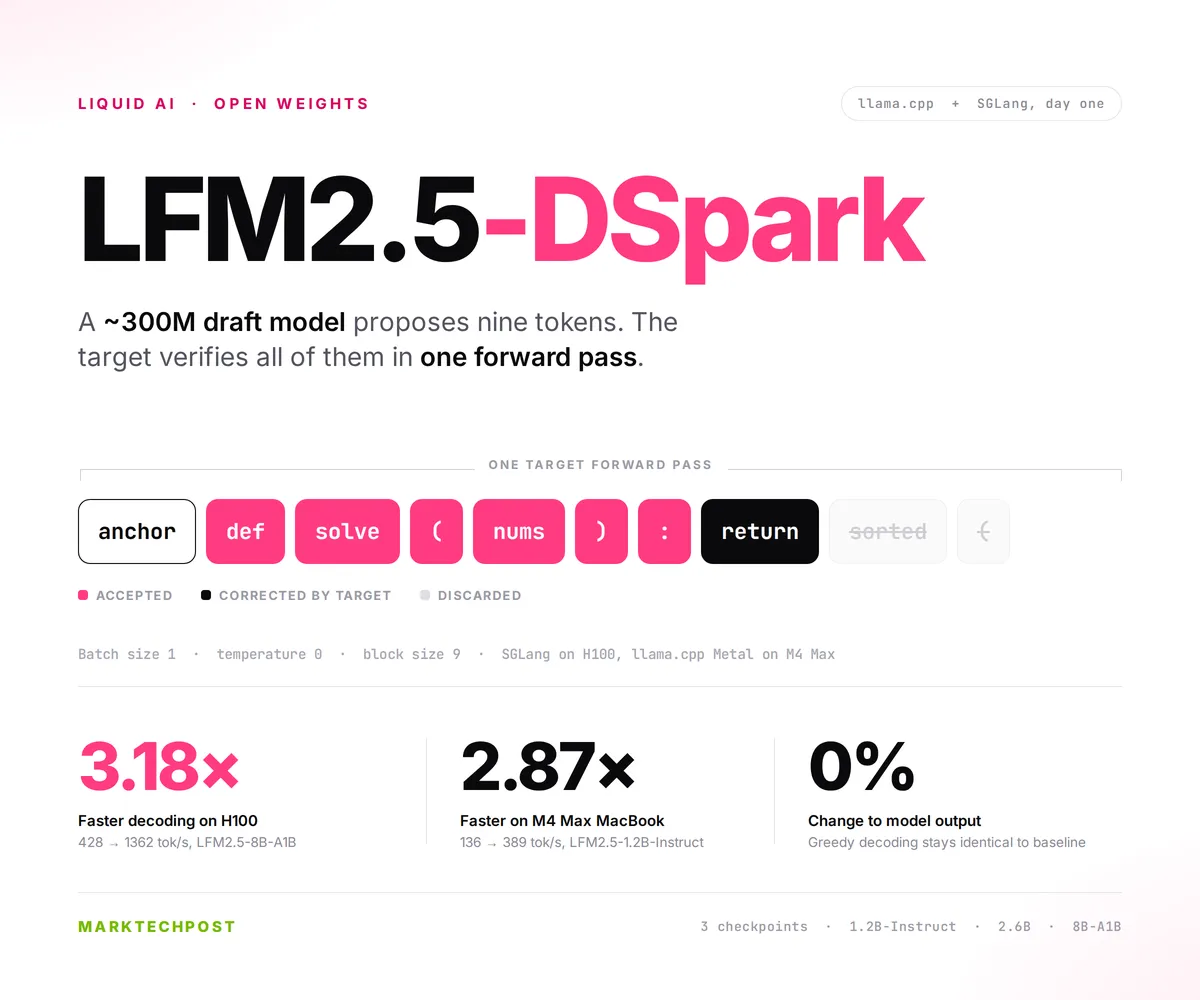
Liquid AI Releases LFM2.5-DSpark Draft Models That Deliver Up to 3.18x...
The release of Liquid AI's DSpark draft models significantly enhances decoding efficiency, potentially improving the performance of AI applications across various industries.
- Liquid AI released DSpark draft model checkpoints for its LFM2.5 family, which includes LFM2.5-1.2B-Instruct, LFM2.5-2.6B, and LFM2.5-8B-A1B.
- The DSpark models achieve decoding speeds up to 3.18 times faster on NVIDIA's H100 GPU, without changing output accuracy.
- The models incorporate a speculative decoding mechanism that uses a smaller draft model to propose candidate tokens for verification by the larger target model.
Liquid AI specializes in AI technologies and recently launched the LFM2.5 draft models to enhance on-device AI performance. The introduction of speculative decoding aims to reduce the time spent in processing by speeding up token generation for multiple applications, including coding assistance and embedded systems. Users should monitor Liquid AI's ongoing model enhancements and their implications for AI deployments.
Read the original ↗
Claude Outage Hits Claude.ai, API, Claude Code and Cowork as Errors Spread Across Models
The ongoing disruptions to Anthropic's Claude models may affect users' operations, raising concerns about reliability and dependency on the service amidst a series of outages.
- Anthropic reported elevated errors affecting its Claude models and services including claude.ai and the Claude API as of August 20, 2026.
- This incident marks the third disruption for Anthropic in a 24-hour period and the latest in a series of elevated-error events spanning eight days.
- Two components, Claude Console and Claude for Government, remain operational, suggesting the outage is tied to model-serving rather than administrative infrastructure.
Anthropic is a company that develops AI models, and its Claude product line is key to its offerings. The company has faced several service disruptions recently, prompting questions about system reliability and user dependencies. Users are urged to monitor updates on the status page as the situation unfolds.
Read the original ↗
Mystery Russian “Space Hazard” Warning Forces U.S. Air Force Flight to Turn Back from Antarctica
The incident highlights potential geopolitical tensions and the implications of unexpected space-related alerts on military operations and international airspace management.
- A U.S. Air Force C-17 Globemaster returned to New Zealand after receiving a warning about a "potentially hazardous" space-related activity during its flight to Antarctica.
- The warning, attributed to Russia's air traffic management, prompted New Zealand authorities to issue a NOTAM advising pilots of the potential hazard.
- There is uncertainty regarding the actual occurrence of a Russian missile launch that reportedly triggered the alert.
The U.S. military C-17 was en route to McMurdo Station in Antarctica, a logistics hub operated by the National Science Foundation. This incident is indicative of ongoing tensions and operational challenges involving Russia and Western nations in the context of airspace safety and military readiness.
Read the original ↗
Ramp launches its own AI model router, called Router
Ramp's launch of Router signifies its strategic entry into the AI model routing market, offering new capabilities for users and businesses through streamlined access to various language models.
- Ramp has introduced Router, an AI model routing service that allows users to access and switch between various large language models via an API.
- The service is currently only available in the United States and is free to use for the remainder of 2026, with users responsible for AI model inference costs.
- Router supports models from several providers, including OpenAI and Nvidia, and features options to help users route AI queries based on their preferences.
- Ramp intends to capitalize on the growing AI inference market and provide a complementary model routing service to its existing expense management products.
Ramp is a corporate expense management platform that provides tools for managing AI token usage and costs. The company has proactively developed its Router service to enhance user experiences with AI model interactions. Looking forward, Ramp may establish partnerships with AI labs and inference providers, thereby expanding its customer base.
Read the original ↗
A third of web pages published since ChatGPT’s launch show signs of AI authorship, study finds
The increasing prevalence of AI-generated content raises questions about content quality, reliability, and the impact on web information sources as AI tools become more integrated into writing processes.
- A study from Pew Research found that over one-third of web pages published after ChatGPT's launch show signs of AI authorship.
- Pew analyzed nearly half a million web pages and found that 10% of a random sample from July 2026 exhibited significant AI authorship.
- URLs with a .com domain showed AI authorship signs at around 10 times the rate of .edu or .gov domains, which were approximately 1%.
ChatGPT, released in November 2022, is an AI language model that can generate and edit text. The study highlights a growing trend of Internet content authored or significantly modified by AI, with implications for content creation moving forward. Observers will be watching how these trends evolve and their potential impact on information quality.
Read the original ↗