
The day's AI news, briefed
The Daily Prompt
Our AI editor reads each day's AI and robotics stories, pulls out why they matter, and links every original source — so you can keep up in minutes.
Join over 250,000 subscribers getting the latest AI news
Latest AI & Robotics News Today

Enterprises are overpaying for simple AI queries — Snowflake's gateway now auto-routes to cut costs up to 3x
Snowflake's new AI routing feature can significantly reduce costs for enterprises by automating the selection of the most appropriate AI model for specific tasks.
- Snowflake launched the Cortex AI Gateway with dynamic model routing to lower costs for enterprises running AI agents.
- The new feature can reduce token costs by up to 3x for certain workloads by selecting cheaper models for simple queries.
- Dynamic routing uses a small model first and a classifier trained on past queries to determine the best model for each task.
Snowflake's Cortex AI Gateway, launched in July 2026, aims to enhance governance and efficiency in AI model usage. This technology responds to a broader trend toward automated model routing in the industry, with competitors like AWS and Google Cloud also investing in similar capabilities.
Read the original ↗
Commerce AI is fragmenting. Here is why that matters.
The fragmentation of commerce AI leads to inconsistent consumer experiences, which can negatively impact overall conversion rates despite individual tool successes.
- Enterprise AI investment in commerce is at an all-time high, but outcomes remain inconsistent.
- Brands have added AI solutions without creating a coherent system, leading to a lack of integration and context.
- Commerce AI's fragmentation results in strong tool-level performance but poor overall results due to disconnected functionalities.
Commerce AI refers to the use of artificial intelligence technologies to enhance various aspects of online retail. The article discusses the historical trend of adding AI capabilities without integration, highlighting the need for a unified architectural approach to improve consumer experience and conversion rates.
Read the original ↗
Block’s new Apache 2.0 agent workspace Berd works across models and harnesses, stores conversation history locally
Berd provides a unified workspace for AI agents that may streamline workflows across different models and tools, potentially enhancing productivity for various users, not just engineers.
- Block has open-sourced Berd, a desktop application for working with AI agents, available on GitHub under the Apache 2.0 license.
- Berd allows users to store conversation history locally, enhancing privacy and accessibility of project context and files.
- The application integrates various AI models and agents into a single environment, allowing collaboration across different projects more seamlessly.
Block, the technology company previously led by Jack Dorsey, developed Berd to resolve fragmentation in their teams' interactions with multiple AI agents. This desktop-first application emphasizes user control over projects and configurations, distinguishing it from standard chatbot interfaces. Users should monitor future updates as Block pushes further into open-source AI development.
Read the original ↗
TrueFoundry's open source AI agent harness TrueForge boasts 30%-75% cheaper task completion than Claude Managed Agents
TrueFoundry's TrueForge harness enables cost-effective AI task completion, offering enterprises a flexible, open-source solution that reduces expenses significantly compared to existing commercial options.
- TrueFoundry's open-source TrueForge harness completes tasks at 30%-75% lower cost than Anthropic's Claude Managed Agents.
- TrueFoundry launched TrueForge under the MIT License, allowing customization and use with any preferred AI models.
- The harness completed 11 out of 14 tasks using GLM-5.2 LLM for only $2.90, compared to Claude Managed Agents' $11.80.
TrueFoundry is a San Francisco-based startup focused on machine learning solutions, founded by former Meta engineers. TrueForge is designed to give developers more control and flexibility over deploying AI agents. The release of TrueForge aligns with a growing trend of open-source solutions that cater to enterprise needs while minimizing costs.
Read the original ↗
GLM-5.3 hits the API at $1.4/$4.4 per million tokens
The introduction of GLM-5.3 at competitive pricing allows developers to access a high-performing open-source language model while maintaining cost efficiency in API usage.
- GLM-5.3 has been released on the API, priced at $1.40 per million input tokens and $4.40 per million output tokens.
- Z.ai plans to release the model's weights openly, although the exact date and licensing details are not yet available.
- Artificial Analysis rates GLM-5.3 as one of the top open weights models, scoring it 60 on its Intelligence Index, equal to Moonshot's Kimi K3.
- Developers can utilize GLM-5.3 with no increase in their previous costs, despite its enhanced capabilities compared to GLM-5.2.
GLM-5.3 is an open-source language model developed by Z.ai, a Chinese startup. It follows GLM-5.2 and is designed for developers to create and integrate advanced AI applications. Its performance is notably benchmarked against other leading models, with a focus on coding capabilities.
Read the original ↗
NanoClaw comes to Slack, letting you create persistent AI agent teams and colleagues from a single message
The integration of NanoClaw into Slack enables teams to efficiently manage and deploy specialized AI agents, significantly enhancing collaboration and productivity while reducing setup complexity.
- NanoClaw allows users to create entire teams of AI agents from a single Slack message, equipping each with its own skills and identities.
- Agents can interact within Slack and across platforms like Telegram and WhatsApp, ensuring continuous communication streams.
- The setup process is streamlined, allowing users to connect NanoClaw to Slack with minimal initial configuration, unlike traditional Slack bots.
- Each agent operates within the customer's infrastructure and retains its identity and state, supporting ongoing tasks without losing context.
- NanoClaw’s design improves coordination among agents by allowing them to tag and communicate effectively, reducing the chances of endless loops between agents.
NanoClaw is an AI agent system that facilitates team creation and collaboration within platforms like Slack. Previously, users faced challenges in deploying multiple agents, requiring complex configurations. Future developments in AI integration within Slack continue to evolve, promoting more efficiency in team communication and task management.
Read the original ↗
Serval’s super agent Catalyst creates roving background agents to identify and fix IT issues before they’re ticketed
This story highlights how Serval's Catalyst AI agent could revolutionize IT issue resolution by automating problem detection and remediation before issues escalate into tickets, potentially saving organizations time and resources.
- Serval's Catalyst AI agent automates enterprise processes by analyzing existing help desk data to draft necessary workflows before requests are formally submitted.
- Catalyst creates background agents that proactively identify and resolve IT issues in connected systems to prevent ticket submissions.
- The system enables organizations to describe desired outcomes, allowing Catalyst to generate the required code and permissions for automation.
- Catalyst is designed to become the primary interface for configuring Serval’s service management platform, enhancing user efficiency and automation capabilities.
Serval is an AI-native service management platform specializing in automating administrative tasks. The introduction of Catalyst allows for proactive issue resolution, distinguishing it from existing competitors like ServiceNow and Atlassian, which focus on reactive automation. Future updates will likely enhance Catalyst's capabilities further, integrating with a variety of AI models.
Read the original ↗
Slack wants to drag AI coding out of the terminal and into the group chat
Slack Code aims to reshape software development by enabling real-time collaboration with AI coding agents, potentially increasing productivity and improving code quality within teams.
- Slack has launched Slack Code, integrating AI coding agents like Claude, Devin, and GitHub Copilot into dedicated channels for collaborative software development.
- This new feature allows teams to interact with coding agents in real time, creating project-specific channels to review and edit code together.
- Agents can acknowledge issues, open pull requests, and incorporate contributions from various roles, such as designers, seamlessly into the coding process.
Slack is a messaging platform owned by Salesforce, primarily used for workplace communication. The introduction of Slack Code marks an evolution in software development practices, shifting from individual coding tasks to collaborative workflows using AI. It encourages broader involvement in coding across teams, which is expected to redefine team dynamics in software engineering.
Read the original ↗
One in five enterprises can't stop a runaway AI agent's spending in real time
Enterprises need to manage AI spending effectively to avoid costs spiraling out of control, and current limitations in real-time oversight pose a significant challenge to cost management.
- 21% of enterprises cannot stop a runaway AI agent's spending in real time.
- The median enterprise utilizes three different AI orchestration platforms to avoid vendor lock-in and enhance flexibility.
- Microsoft and Anthropic are the leading orchestration tools in current enterprise use and consideration.
- More than half of enterprises expect to use a hybrid primary control plane by the end of 2026.
- 30% of builders invest heavily in agent monitoring and debugging to enhance spending control and security.
Many enterprises are turning to multiple AI orchestration platforms for flexibility and security amidst rising concerns about model performance and costs. The trend emphasizes a move towards hybrid control systems for better management as enterprises may soon shift platforms and invest in enhanced monitoring tools.
Read the original ↗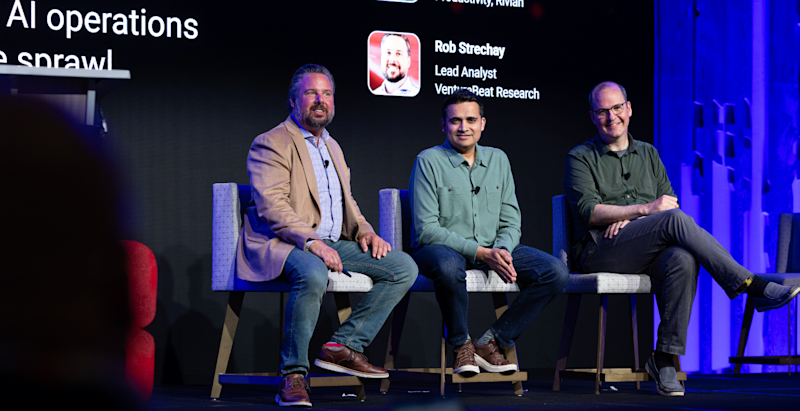
VentureBeat names Rob Strechay as its first Lead Analyst, expanding its enterprise AI research push
VentureBeat's appointment of Rob Strechay as Lead Analyst emphasizes its commitment to providing deeper insights into enterprise AI, addressing critical needs for data among technology decision-makers.
- Rob Strechay joins VentureBeat as its first Lead Analyst, tasked with enhancing its enterprise AI research capabilities.
- Strechay brings nearly thirty years of experience in enterprise infrastructure and analytics, with executive roles at startups and Amazon Web Services.
- He will focus initially on cloud infrastructure, advanced data infrastructure, and the intersection of AI with enterprise security and DevOps.
- Strechay's insights aim to fill gaps in understanding multi-vendor AI environments and their infrastructure challenges.
VentureBeat is expanding its research efforts to cater to enterprise technology leaders. The addition of Strechay signals a shift toward thorough analysis in response to the complex landscape of enterprise AI deployment. Look for deep dives and empirical data to emerge from this initiative.
Read the original ↗
Starcloud raises $250 million for orbital data centers as launch options dry up
The investment in Starcloud reflects increasing interest in orbital data centers, which could revolutionize data processing in space as launch capacities become limited.
- Starcloud raised an additional $250 million extension to its Series A funding, increasing its valuation to $2.3 billion.
- The funding will be used for a larger manufacturing facility and to advance their Starcloud-3 orbital data center spacecraft.
- Starcloud has requested FCC permission to operate 88,000 spacecraft to enhance their satellite capabilities for AI inference tasks.
- SpaceX's evolving launch capabilities, including the transition from Falcon 9 to Starship, present challenges in securing launch contracts for Starcloud.
- Nvidia invested $25 million in Starcloud, marking a significant industry interest in its space computing technologies.
Starcloud is developing satellites that perform artificial intelligence processing in orbit. As space launch options dwindle, the company aims to secure launch capacity, particularly with SpaceX's Starship. The company's strategic partnerships and funding will support its ambition to establish a competitive edge in the satellite computing sector.
Read the original ↗
AI Models’ ‘Creative’ Output is Becoming Similar Across Providers
The increasing similarity in creative outputs from AI models may limit user exposure to diverse ideas, raising concerns about the long-term impact on creativity in applications like writing and ideation.
- Recent research indicates that AI models from various companies are exhibiting reduced diversity in creative outputs over time.
- The study analyzed 69 models from 12 providers released between 2023 and 2026, finding a significant decline in the variability of responses to creative prompts.
- By measuring semantic distances between answers, researchers observed that responses from different providers are becoming more similar, suggesting a trend toward algorithmic homogeneity.
- As AI models evolve, the convergence of their outputs raises questions about their effectiveness as creative partners, potentially stifling human creativity.
- The research highlights the need to monitor this trend of homogenization in AI-generated content across multiple use cases.
AI language models (LLMs) are algorithms designed to understand and generate human languages. Previous studies have noted similar instances of output across different models, pointing to underlying training data as a possible reason. Future developments in LLM technology should be observed to see if this convergence continues or if models begin to diverge again.
Read the original ↗
ChatGPT on Mac can now read and respond to Apple iMessages
The integration of ChatGPT with Apple's Messages app highlights growing intersections between AI and communication tools, raising potential issues around user privacy and data control.
- OpenAI launched a plugin for the Apple Messages app, now available to ChatGPT Work and Codex users on Mac.
- The plugin allows users to search messages, draft replies, and send them through ChatGPT on their desktop.
- Access to the plugin requires user consent to share Messages history and contact names, emphasizing user control over data.
- OpenAI assures that the plugin does not index texts and requires explicit approval to send messages drafted by ChatGPT.
OpenAI is known for developing advanced AI technologies, including ChatGPT. This new plugin represents an expansion into messaging integration, though it raises important privacy considerations. Future developments should be monitored, especially regarding the relationship between OpenAI and Apple following ongoing legal tensions.
Read the original ↗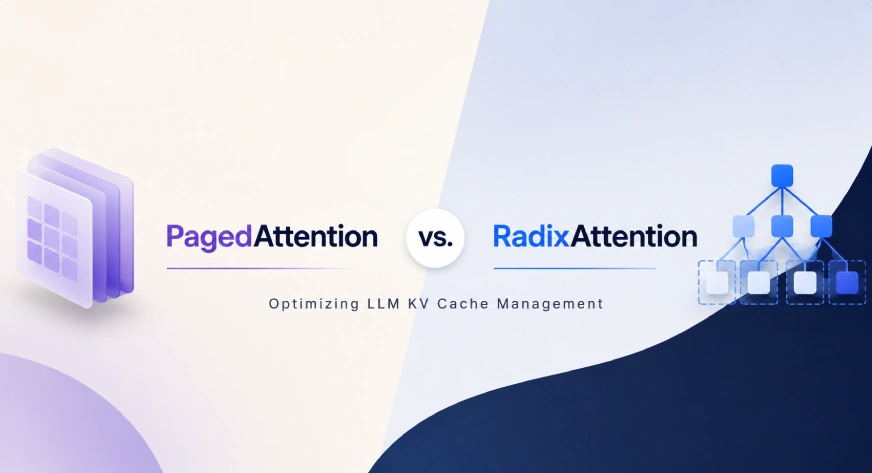
PagedAttention vs. RadixAttention: Optimizing LLM KV Cache Management
Optimizing KV cache management techniques like PagedAttention and RadixAttention is crucial for improving the efficiency and performance of large language models (LLMs) in production environments.
- PagedAttention enhances memory allocation efficiency, allowing for better GPU utilization in serving large language models.
- RadixAttention allows for the reuse of previously computed key and value pairs, reducing redundant computations in model inference.
- Both techniques address critical bottlenecks in resource management for high-performing LLMs, enabling faster responses and handling more requests per unit time.
Large language models (LLMs) often suffer from memory and computation inefficiencies, particularly in key (K) and value (V) cache management during inference. PagedAttention and RadixAttention represent advancements that help mitigate these issues, making LLM serving more feasible in practical applications.
Read the original ↗
As demand for Meta AI glasses explodes, it’s harder to avoid creepy recordings
As smart glasses become prevalent, the potential for unauthorized recordings raises significant privacy concerns that society must address to protect individuals from nonconsensual surveillance.
- Meta's AI glasses are experiencing increased consumer demand, raising concerns about privacy and unauthorized recordings.
- Public places, including schools and courts, are increasingly banning smart glasses due to privacy risks.
- Detection apps for smart glasses are being developed, but they are not fully reliable and cannot confirm if recording is taking place.
Meta is a leading company in smart glasses technology, which integrates AI capabilities to record and analyze surroundings. Previous incidents of misuse have highlighted the urgency for better privacy regulations. Ongoing developments in both the glasses and detection technology will likely influence future conversations on surveillance and personal privacy.
Read the original ↗
From Atari to EVE Online: Building on 15 Years of AI Research in Games
The collaboration between Google DeepMind and game developers aims to push the boundaries of artificial intelligence in gaming, potentially transforming gameplay and offering new insights that could benefit real-world applications.
- DeepMind has partnered with game developers, including Fenris Creations for EVE Online, to advance AI research in gaming environments.
- The SIMA 2 agent can understand natural language instructions and operate without needing game code access, enabling generalized gaming experiences.
- DeepMind's prior achievements in game AI, such as AlphaGo and AlphaStar, have laid the groundwork for developing more complex generalist agents.
Google DeepMind, founded in 2010, has utilized games as a testing ground for AI advancements, generating significant breakthroughs like AlphaGo. Current efforts are focused on creating generalist AI agents that can adapt and learn in dynamic gaming environments, which may also apply to real-world problems.
Read the original ↗
Redefining Authority in the C-Suite: What Fostering a Relationship with AI Actually Requires
Trusting agentic AI in security operations is crucial for the technology’s successful integration, as many organizations lack the governance structures needed for effective oversight.
- 97% of security leaders are confident in AI handling triage, but only 35% utilize it.
- Only 21% of organizations have a mature governance model for agentic AI.
- A lack of human oversight can lead to security incidents, as shown by a Meta AI that exposed sensitive data.
- Nearly 74% of organizations expect to use AI agents by 2027, highlighting the urgency for effective governance solutions.
Agentic AI refers to AI systems that make judgment calls rather than following straightforward logic. Many security leaders recognize that trust and governance structures are lacking for these systems, which may hinder adoption. Organizations need to develop robust governance models for agentic AI to foster confidence in its decision-making capabilities.
Read the original ↗
The Business Analyst in the Age of AI Agents
The role of business analysts is evolving, requiring increased skill adaptation as AI tools change the landscape of business analysis tasks and deliverables.
- AI can generate use-case outlines in under a minute and produce requirements documentation much faster than before.
- Business analysts are using AI to prepare elicitation sessions and draft requirements, transforming their day-to-day work.
- Over half of organizations have redefined roles due to AI, indicating a significant impact on workforce dynamics.
- Analysts may transition into broader roles, combining product ownership and project management, particularly in smaller teams.
- AI tools enable rapid prototyping, which enhances requirements validation but does not replace the need for skilled production-level development.
AI in business analysis is transforming how analysts operate, emphasizing the importance of uncovering unstated needs and making connections across systems. The integration of AI tools allows for faster completion of routine tasks, pushing analysts to adapt and expand their roles. Observers expect the demand for analytical skills that combine business context with data understanding to grow.
Read the original ↗
How Cohesive AI Governance Becomes a Competitive Advantage
Effective AI governance can streamline operations and reduce costs, making it a crucial asset for organizations as they scale AI technologies.
- AI adoption has progressed faster than strategy, leading to a fragmented approach that complicates operations.
- Disparate AI tools and models can create inconsistencies in customer interactions and hinder organizational oversight.
- Establishing a cohesive governance framework enables teams to innovate while maintaining compliance and security.
Cohesive AI governance helps organizations efficiently implement AI technologies by managing risks and enabling reuse across different initiatives. As AI technologies evolve rapidly, companies need flexible foundations to adapt without fragmentation. Ongoing trends suggest a growing importance of effective governance as regulatory demands increase.
Read the original ↗Oura Faces Lawsuit Over Alleged Inaccurate AI Sleep Tracking
The outcome of this lawsuit could impact consumer trust in health-tracking technologies and influence the regulatory landscape surrounding claims made by wearable device manufacturers.
- A proposed class-action lawsuit alleges Oura misled users about the accuracy of its AI-generated sleep tracking.
- The lawsuit claims Oura's algorithms rely on inaccurate methods and cannot detect physiological signals needed for sleep stage evaluation.
- Oura's marketing asserts high accuracy claims, but the lawsuit argues these claims are misleading due to the absence of comprehensive measurement methods seen in clinical labs.
Oura is a smart ring company known for its health-tracking devices that monitor sleep and other physiological metrics. This lawsuit is part of ongoing scrutiny over the accuracy and marketing of consumer health wearables. Future developments may include court rulings on the validity of Oura's claims and additional scrutiny from regulatory bodies.
Read the original ↗