
The day's AI news, briefed
The Daily Prompt
Our AI editor reads each day's AI and robotics stories, pulls out why they matter, and links every original source — so you can keep up in minutes.
Join over 250,000 subscribers getting the latest AI news
Latest AI & Robotics News Today

Fireworks AI Makes Training API Generally Available
The release of Fireworks AI's Training API aims to enhance machine learning workflows, enabling better control and efficiency for researchers managing custom training loops.
- Fireworks AI announced the general availability of its Training API and Fireworks Lab on August 31, 2026.
- The Training API allows customers to connect their Python training loops to Fireworks-managed distributed compute for custom training on open models.
- Two compute options are available: serverless training with per-token billing, and dedicated training billed per GPU hour, aimed at larger-scale runs.
Fireworks AI provides managed infrastructure for machine learning training and rollout. The Training API addresses common constraints faced by ML teams, enhancing control and performance. Future developments are likely to include more sophisticated training workflows and capabilities.
Read the original ↗
AMD Instinct MI430X GPUs, EPYC CPUs Power €387.8M LUMI-AI Supercomputer
The establishment of the LUMI-AI supercomputer signifies a significant enhancement in Europe's AI capacity and computing power, which is crucial for research and innovation across various sectors.
- The EuroHPC Joint Undertaking has contracted Bull for €387.8 million to deliver the LUMI-AI supercomputer powered by AMD Instinct MI430X GPUs and EPYC CPUs.
- LUMI-AI aims to provide ten times the AI capacity and nearly double the high-performance computing capability of its predecessor, the current LUMI supercomputer.
- Installation of LUMI-AI will occur at the CSC data center in Kajaani, Finland, with deployment expected in the second half of 2027.
- The supercomputer will support industrial AI innovation, academic research, and large-scale scientific simulations, particularly benefiting startups and SMEs.
- It will be part of a hybrid platform integrated with LUMI-IQ, a quantum computer for advanced workloads combining HPC, AI, and quantum computing.
The LUMI-AI project is part of the EuroHPC initiative to enhance supercomputing capabilities in Europe. Previous investments have established the existing LUMI supercomputer, operational since 2022, addressing various fields such as health and climate research. Future developments will focus on how these resources will be allocated to maximize research benefits.
Read the original ↗
Instagram will demote AI-generated influencers if they don't clearly label their account
This change in Instagram's policy could significantly impact the visibility of AI-generated influencers, affecting how users perceive and interact with these accounts.
- Instagram now requires accounts featuring AI-generated personas to label themselves as 'AI-generated profile.'
- Failure to use the new label will result in reduced reach for those accounts.
- The update follows growing user concern over misleading AI influencers that appear human but are not.
- Previously, an optional 'AI creator' label was in use, but it has now been replaced to better identify AI-generated content.
Instagram is a social media platform owned by Meta that allows users to share photos and videos. As AI technology advances, concerns have arisen regarding the authenticity of AI-generated content and its implications for misinformation. Observing social media trends, Instagram is implementing this labeling requirement for AI-generated accounts to enhance transparency.
Read the original ↗A Foldable iPhone? Siri AI in a HomePod? What to Expect at the iPhone Event
The upcoming iPhone event is significant as it may introduce innovative features such as a foldable iPhone and enhanced AI capabilities in Apple's HomePod, impacting the tech market.
- Apple's September iPhone Event will showcase potential new products like a foldable iPhone and upgraded smart speakers.
- The event will be led by a new CEO, indicating a shift in leadership and strategy.
- Anticipated features include advanced AI integrations and powerful smartwatches.
Apple is a leading technology company known for its consumer electronics, software, and online services. This event follows a series of innovations in their product lineup, and industry observers are eager to see how new leadership will influence future developments.
Read the original ↗
ContextPilot: Teaching Agents for Proactive Context Management via Fine-grained RL
The development of ContextPilot advances the capability of language models in managing context, improving their performance in complex, long-term tasks which could enhance user interactions significantly.
- ContextPilot improves long-horizon agent reasoning by expanding context-editing tools and using reinforcement learning.
- It addresses limitations in proactive context management such as limited toolsets and inefficient exploration.
- Experiments show that ContextPilot outperforms existing baselines in long-context question answering and deep search tasks.
ContextPilot is a framework aimed at enhancing context management for long-horizon tasks in large language models. Before this, existing methods faced constraints in tool availability and context efficiency. Future developments will likely focus on further refining context management techniques and performance evaluations on diverse tasks.
Read the original ↗
Beyond Data Scaling: Representation-Centric Continued Pre-training for Vision-Language-Action Models
This research offers a method for improving Vision-Language-Action models that could significantly enhance robotics performance, enabling more efficient learning with less computational resource dependence.
- VLAct introduces a representation-centric approach to pre-training Vision-Language-Action models using diverse robot data.
- The method achieves 92.5% success on RoboTwin 2.0 and ranks sixth on RoboDojo, outperforming other industrial VLA systems.
- Continued pre-training improves transfer performance across simulations and real-world applications while using only a modest 16-GPU setup.
Vision-Language-Action (VLA) models combine visual, textual, and action data to enhance robotics tasks. As collecting comprehensive robot data is challenging, this study focuses on improving representation quality for better model performance. Key advancements in robotics are expected as the technology scales and evolves.
Read the original ↗
Code as Worlds: Agentic Discovery of Executable World Representations for Physical Reasoning
This research could advance physical reasoning capabilities in AI, enhancing how machines model and interact with the physical world.
- The Code-as-World paradigm represents physical environments as executable code for improved reasoning in vision-language models.
- It introduces an agentic discovery loop for creating and refining executable world representations from multimodal observations.
- Experiments indicate this approach achieves state-of-the-art results in quantitative physical reasoning, outperforming leading proprietary models.
Code-as-World is a new approach that utilizes executable code to model physical environments effectively. This builds on existing vision-language models, which have previously struggled with explicit physical representation. Ongoing developments may further enhance AI's understanding and interaction with physical realities.
Read the original ↗
ChatGPT and Reddit now face EU’s toughest online safety rules
The classification of ChatGPT and others as very large online platforms under the EU Digital Services Act imposes stringent compliance obligations affecting their operations and accountability.
- OpenAI's ChatGPT, Reddit, and Roblox are now classified as very large online platforms under the EU's Digital Services Act.
- These platforms must comply with obligations to remove illegal content and protect minors' privacy and security.
- Failing to meet these requirements could result in fines of up to 6 percent of their global revenue.
- This move follows these platforms surpassing 45 million monthly users in the EU, triggering additional scrutiny under the DSA.
- The EU is enforcing its AI Act, regulating rapidly developing AI technologies alongside the DSA.
The EU's Digital Services Act is a regulation aimed at improving online safety by holding large tech companies accountable for content on their platforms. This classification signifies the EU's commitment to controlling the impact of AI services following their significant user growth. As enforcement intensifies, businesses must adapt to remain compliant with these evolving regulations.
Read the original ↗
NVIDIA and MediaTek Expand Partnership to Build AI Edge-to-Cloud Platforms
The expanded partnership between NVIDIA and MediaTek aims to advance AI technology, particularly in infrastructure, computing, and automotive applications, impacting the future of AI-integrated systems.
- NVIDIA and MediaTek announced an expanded partnership to develop AI computing platforms on August 31, 2026.
- NVIDIA invested $3.5 billion in convertible bonds issued by MediaTek as part of this collaboration.
- The partnership will focus on AI infrastructure, local AI computing, and automotive technology.
- MediaTek will adopt NVIDIA's NVLink Fusion platform for developing custom AI infrastructure and accelerators.
- The companies plan to release RTX Spark-powered laptops in Fall 2026.
NVIDIA is a leader in AI and graphics computing, while MediaTek specializes in semiconductor technology, particularly system-on-chip designs. Their long-term collaboration aims to enhance AI capabilities across multiple domains. Future developments are expected to focus on integrating advanced AI features into various technologies, including consumer and automotive applications.
Read the original ↗
California Legislature Passes Independent AI Safety Verification Bill
This legislation establishes a framework for independent risk assessments of AI systems, potentially influencing AI safety standards nationally amidst growing concerns over the technology's impact.
- The California Legislature approved SB 813, aimed at creating independent verification organizations (IVOs) for AI safety assessments.
- The bill requires the Government Operations Agency to develop criteria for IVO designation and oversight procedures by January 1, 2028.
- IVOs must demonstrate expertise in assessing AI risks and maintain independence from the parties they evaluate, with annual reporting on their findings.
- The framework is voluntary and does not impose liability on AI developers for non-compliance, though audits performed under the framework are relevant in legal cases.
SB 813, authored by Senator Jerry McNerney, is a pioneering move in AI regulation, reflecting growing concerns about the safety of AI technologies. California's effort aligns with recommendations from Governor Newsom's panel on AI and aims to enhance accountability within the industry. Observers will watch how this could set a precedent for similar legislative initiatives in other states.
Read the original ↗
OpenGov Showcases AI Tools as Kansas City Cuts $4B Maintenance Backlog
Kansas City's successful integration of OpenGov's AI platform significantly reduces a $4 billion maintenance backlog, illustrating the transformative potential of technology in urban infrastructure management.
- Kansas City adopted OpenGov's Enterprise Asset Management platform to enhance road maintenance and address a projected maintenance backlog of $4 billion.
- The city's annual street resurfacing output nearly tripled from 180 to 519 lane miles, while maintenance funding increased from $20 million to $40 million.
- Kansas City eliminated over 900 hours of manual survey work annually and reduced its maintenance backlog by more than half over three years.
OpenGov provides an AI platform designed for government use, enhancing infrastructure management and operational efficiency. Kansas City's move to this technology demonstrates a shift from outdated manual processes to data-driven decision making in public works.
Read the original ↗
Instagram Renames AI Creator Label and Restricts Unlabeled AI-Generated Profiles
This story highlights Instagram's efforts to improve transparency regarding AI-generated content, impacting how users interact with AI profiles on the platform.
- Instagram renamed its AI creator label to 'AI-generated profile' to reflect clearer identification of AI personas.
- Profiles featuring AI-generated persons without the correct label will face restrictions on their reach.
- Users can edit their profiles to self-identify as AI-generated, or they risk being deemed non-recommendable by Instagram.
Instagram is a popular social media platform where users share content. In early 2026, it began testing AI creator labels, responding to user feedback for clearer labeling of AI-generated profiles. This policy update aims to increase transparency for users regarding content origins.
Read the original ↗
You Know Who Really Hates AI? Insurance Claims Adjusters
The overwhelming criticism of AI by insurance claims adjusters highlights significant concerns about technology's impact on job security and the quality of service in the sector.
- 98 percent of reviews mentioning AI from claims adjusters on Glassdoor are negative, indicating a widespread dislike of AI in the profession.
- Adjusters report increased workloads due to AI errors, leading to misclassified claims and frustrated clients.
- The Bureau of Labor Statistics forecasts a 5 percent decline in claims adjuster employment over the next decade, partly due to increased AI adoption in the industry.
- Some adjusters fear that AI could threaten their job security, while companies like Lemonade prioritize automation to streamline claims processes.
Insurance claims adjusters are responsible for evaluating and settling claims for insurance companies. The rise of AI in the industry promises efficiency but has raised alarms about job displacement and reduced service quality. Moving forward, the industry's reliance on AI may continue to evolve, impacting employment and service dynamics.
Read the original ↗
ATM Flaws Reveal Key Weaknesses in the Software Supply Chain
These ATM vulnerabilities highlight critical weaknesses in software supply chains, affecting various industries and emphasizing the need for improved security measures across embedded systems.
- Security researcher Matt Burch identified nine vulnerabilities in ATM encryption and authentication software called CryptoPro Secure Disk.
- The flaws could allow unauthorized access to encrypted devices, impacting not only ATMs but also various critical systems across industries.
- CryptWare, the software's maker, has patched the vulnerabilities and maintains a notification process for their clients regarding security updates.
CryptoPro Secure Disk is used in ATMs and various embedded devices by organizations across industries such as automotive and healthcare. The identification of these vulnerabilities raises concerns about the security of widely implemented software and the challenges of timely updates in complex supply chains.
Read the original ↗
Pocket’s AI made my game ideas real. Now Meta controls the results.
The development of Pocket highlights both the potential and limitations of AI-assisted game creation, raising questions about user ownership and the impact of platform control over creative works.
- Pocket is a mobile app that simplifies game development by allowing users to create interactive projects through simple text prompts, without coding experience.
- Meta launched Pocket after acquiring the staff of the now-defunct app Gizmo, aiming to make game creation comparable to social media posting.
- Users can share their creations through posts on the Pocket platform, restricted to a curated algorithmic feed rather than broader distribution.
- Despite its ease of use, Pocket's creations can feel generic due to default graphics and sound effects, limiting user creativity.
- Game prototypes can be developed quickly, but sharing and modifying projects is constrained by Pocket's platform controls.
Pocket leverages AI to transform how users create games by streamlining the coding process into a chat-like input system. Previously, coding tools required significant technical skill, making game development challenging for beginners. Future developments will likely focus on user accessibility and potential expansions beyond Meta's platform.
Read the original ↗
Andreea Pleşea, PhD, COO and Co-Founder of Druid AI – Interview Series
Druid AI's advancements in automated agentic technologies could transform how businesses manage complex workflows and improve efficiency across various sectors.
- Andreea Pleşea co-founded Druid AI in 2018, focusing on AI agents that automate complex business processes.
- Druid AI's platform integrates with enterprise systems such as ERP and CRM, serving over 300 enterprise customers globally.
- The current shift towards agentic AI represents an evolution from basic conversational interfaces, enabling agents to execute multi-step workflows autonomously.
Druid AI is an enterprise AI company that specializes in automating and orchestrating business processes using conversational AI technologies. Founded in 2018, the company has rapidly gained traction in several industries, emphasizing the need for simpler technology to support complex tasks. Future developments should focus on enhancing agentic technologies and orchestration capabilities.
Read the original ↗
Nonprofits Are Losing Engagement. AI Could Help Them Rebuild It
Nonprofits facing declining donor engagement can leverage AI to streamline operations and improve engagement strategies, potentially enhancing fundraising efforts amidst a more competitive landscape.
- Nonprofits in the U.S. are seeing a decline in the number of donors, even as total donations rise.
- About 47% of nonprofit executives believe AI can increase productivity and efficiency in their organizations.
- Approximately 85.6% of nonprofits are exploring AI tools, yet only 24% have a formal deployment strategy, indicating a gap between interest and planning.
- AI can enhance fundraising by automating administrative tasks, thus allowing fundraisers to manage larger donor portfolios without sacrificing personal interaction.
Nonprofits are increasingly adopting AI to address operational inefficiencies and improve donor engagement as funding becomes more concentrated among fewer donors. Historically, the sector has relied heavily on individual donor relationships, but recent trends challenge their traditional approaches. In light of these shifts, AI presents an opportunity to enhance productivity and refine fundraising strategies without displacing essential human roles.
Read the original ↗
The Technology Investments That Matter Most in an Uncertain Market
Effective technology investments can enhance operational efficiency and ensure returns in a volatile market, helping organizations adapt and thrive amidst uncertainty.
- Many organizations are struggling to see meaningful returns on technology investments despite increased spending.
- Investments should focus on solving specific business problems rather than just acquiring new platforms.
- Successful technology scaling requires ownership, trustworthy data, daily usage, and measurable outcomes.
- Quiet investments like process automation often yield the highest ROI despite not being flashy or high-profile.
Organizations today are shifting from questioning the value of AI investments to determining where to allocate funds effectively. Previous efforts to pilot AI have shown varied success, focusing now on integrating tools into daily operations remains critical for maximizing returns. The market expects enterprises to categorize their technology initiatives effectively to achieve real impact and sustainability.
Read the original ↗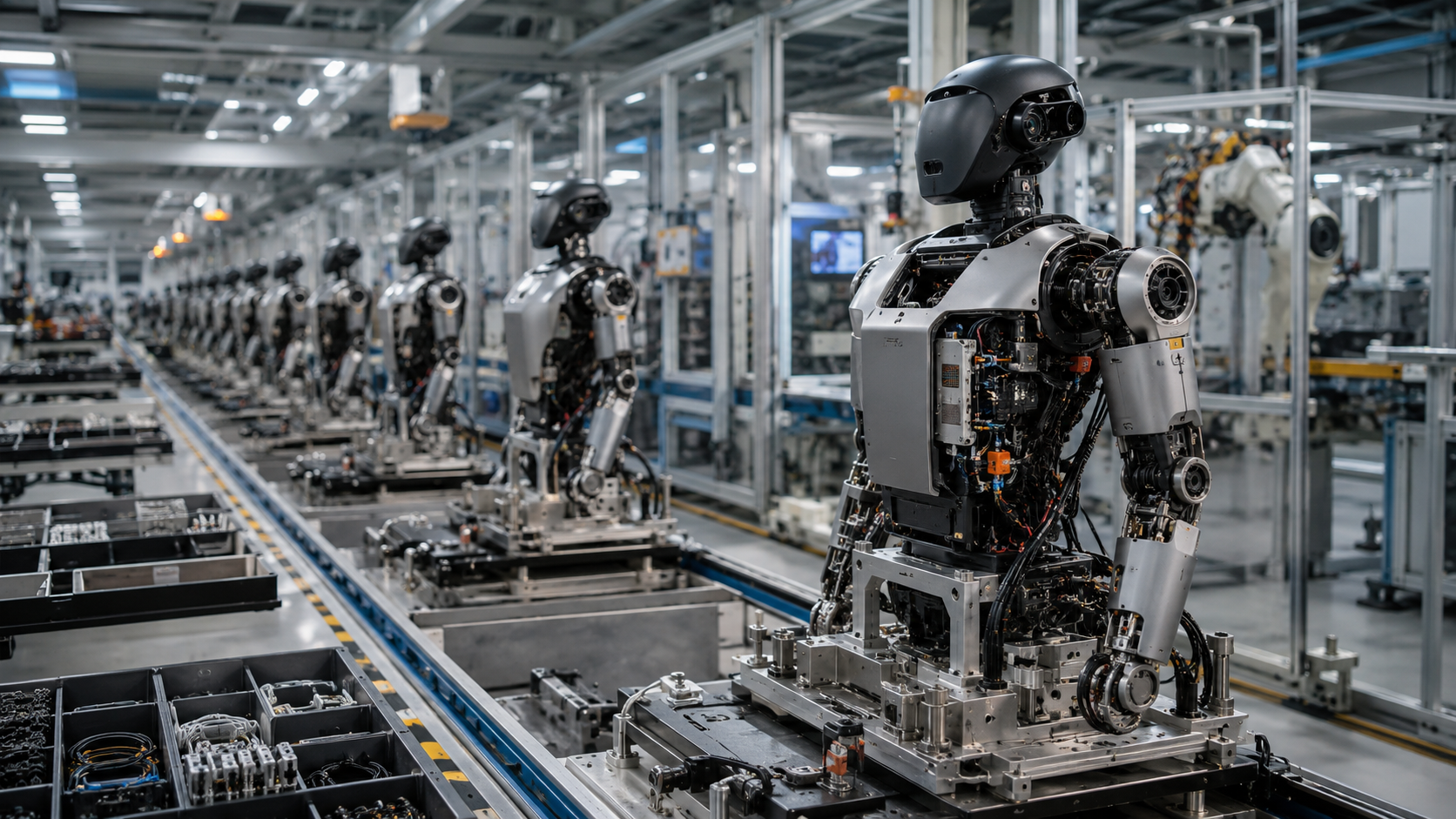
The Biggest Challenge Facing Physical AI May Be Physical, Not Artificial
Understanding the challenges in scaling Physical AI production reveals the critical importance of supply chain resilience and efficient manufacturing processes in the industry's future success.
- The Physical AI industry faces significant challenges in transitioning from prototype robots to scalable production.
- Manufacturing robots requires addressing supply chain vulnerabilities, component reliability, and production scaling costs.
- The shift from artificial intelligence to physical infrastructure is key to successfully deploying Physical AI at scale.
Physical AI refers to robotic systems that operate in the real world, combining AI with hardware. This industry is struggling to move beyond prototype stages to reliable and cost-effective mass production, unlike software that can scale rapidly. Future developments will heavily depend on overcoming manufacturing challenges and establishing robust supply chains.
Read the original ↗
What Is AI Inference? How Trained Models Produce Answers in Production
Understanding AI inference is critical as it defines how trained models operate in real-world applications, impacting performance and decision-making across AI systems.
- AI inference is the process where a trained model receives inputs and computes predictions or actions during production.
- The performance of AI inference depends on various system properties including model architecture and hardware.
- AI inference differs from training in that training alters model parameters, while inference utilizes these models to make decisions or predictions.
AI inference is a key process in AI systems that uses trained models to generate outputs based on new information. Its importance has grown as AI applications have become more complex and integrated into everyday tasks. Observing how inference functions can inform improvements in AI deployment and usage.
Read the original ↗