
The day's AI news, briefed
The Daily Prompt
Our AI editor reads each day's AI and robotics stories, pulls out why they matter, and links every original source — so you can keep up in minutes.
Join over 250,000 subscribers getting the latest AI news
Latest AI & Robotics News Today

South Korea plans to train entire military as “drone warriors”
The training of South Korea's entire military as drone operators reflects a strategic shift in defense capabilities amid regional tensions, impacting military readiness and technological adoption globally.
- South Korea plans to train all 450,000 active military personnel to operate drones like personal weapons to maintain a technological advantage against North Korea.
- The military intends to equip units with an increasing number of inexpensive drones for surveillance and strike operations, and plans to provide 11,000 training drones this year.
- Challenges include a declining birthrate affecting military size, restrictions on who can serve, and the need to source drones without Chinese components.
- The South Korean military aims to establish a domestic drone industry and supply 60,000 drones across the military by 2029.
- The U.S. military is also enhancing drone training for recruits while requesting substantial funding for new systems.
South Korea's military reform is influenced by Ukraine's use of drones to counteract superior numbers. The nation faces significant challenges in recruiting and equipping personnel, as it transforms its defense approach with a focus on drone warfare.
Read the original ↗
How People in China Keep Outsmarting Anthropic’s Geolocation Restrictions
The ongoing circumvention of geolocation restrictions by users in China highlights the challenges AI companies face in enforcing access controls and raises concerns about national security and model misuse.
- Users in China continue to bypass Anthropic's geolocation restrictions to access its AI model, Claude, despite the company's efforts to prevent this.
- Tech enthusiasts and startups in China have developed workarounds, including the use of proxy services and purchasing access accounts on platforms like Taobao.
- A growing underground economy has emerged around accessing Claude, including transfer stations that intermediate access for users within China.
Anthropic is an AI company known for its models like Claude, which it restricts in countries like China for national security reasons. Previous restrictions have prompted users to develop workarounds, influencing the need for more robust detection systems and security measures.
Read the original ↗
NYT slams Microsoft for building copyright-infringing supercomputer for OpenAI
The outcome of the New York Times’ amended copyright claims against Microsoft and OpenAI could set significant legal precedents for how AI technologies utilize copyrighted materials.
- The New York Times filed an amended complaint alleging that Microsoft helped OpenAI infringe on its copyrights by constructing a specialized supercomputer.
- The NYT’s updated claims are prompted by a recent Supreme Court ruling that changed standards for proving contributory infringement.
- The NYT previously alleged that ChatGPT, trained on its articles, infringed copyrights by outputting content verbatim, causing reputational and market harm.
The New York Times initially sued OpenAI in 2023, claiming that OpenAI's ChatGPT was trained on its copyrighted articles without permission. The current legal landscape regarding copyright and AI is evolving, following key Supreme Court decisions regarding contributory infringement.
Read the original ↗
Look What NASA’s Mars Reconnaissance Orbiter Just Spotted Lurking in the Red Planet’s Arbot Hills
The recent imagery from NASA's Mars Reconnaissance Orbiter illustrates the significant progress of the Perseverance rover in exploring Mars, marking important advancements in planetary science and exploration technologies.
- NASA's Mars Reconnaissance Orbiter captured new images on June 13, 2026, showing the location and tire tracks of the Perseverance rover in the Arbot area.
- Perseverance has been operational on Mars since February 18, 2021, and is nearing record travel milestones for a robotic explorer on the planet.
- The imagery was taken by the HiRISE camera, which offers high-resolution images with the ability to discern features as small as a kitchen table.
NASA's Mars Reconnaissance Orbiter, launched in 2006, has provided critical data about Mars through its HiRISE camera for two decades. Perseverance's ongoing mission aims to gather data about the planet's geology and potential for past life, continuing the legacy of earlier missions.
Read the original ↗
OpenAI poaches Uber India chief to lead its biggest market outside the US
OpenAI's strategic appointment aims to enhance its market presence in India, a key area for growth in AI adoption and partnerships.
- OpenAI has appointed Prabhjeet Singh, former president of Uber India, as its first managing director for India.
- Singh will oversee OpenAI's operations, consumer growth, and partnerships in India starting September.
- The company is expanding its offices in New Delhi, Mumbai, and Bengaluru, reflecting its commitment to the Indian market.
- OpenAI views India as its second-largest market after the U.S. due to growing adoption of its AI products, particularly ChatGPT.
- The company has previously partnered with Indian conglomerates like Reliance and Tata Group.
OpenAI is an artificial intelligence company known for developing AI models like ChatGPT. It has been significantly increasing its activities in India, which has a large developer base and rapidly growing demand for AI technologies. Future developments to watch include OpenAI's further partnerships and hiring efforts in the region.
Read the original ↗
OpenAI limits GPT-5.6 rollout after government request, says restrictions shouldn’t be the norm
Government-imposed restrictions on AI model releases may limit access to advanced technologies, affecting innovation and competitive dynamics in the sector.
- OpenAI is limiting the launch of its GPT-5.6 models due to a request from the U.S. government, restricting access to a select group of partners.
- The models include Sol, a flagship offering, Terra, and Luna, with the restrictions drawing criticism for potentially stifling innovation.
- Former White House AI adviser Dean Ball argues that government controls on AI releases could delay launches and impact U.S. competitiveness in AI.
- OpenAI plans to develop a new executive order framework regarding cybersecurity in response to these government requests.
OpenAI is a leading artificial intelligence research organization known for developing advanced AI models. Recent government actions have increased scrutiny on AI companies, prompting calls for tighter regulations and safety standards. The next steps for OpenAI will involve navigating these government requests while seeking broader availability for their models.
Read the original ↗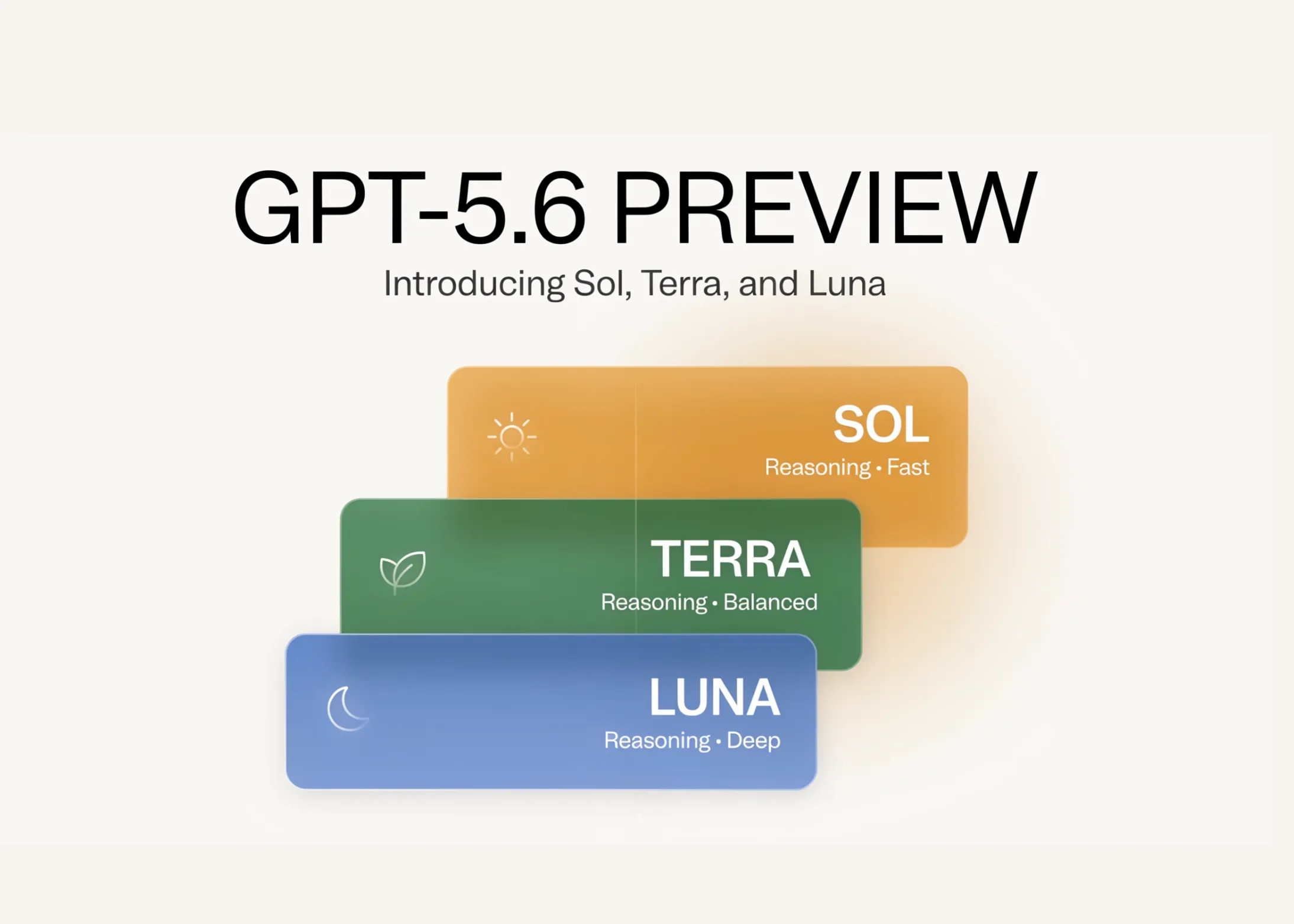
OpenAI Previews GPT-5.6 With Sol, Terra, and Luna: Tiered Models, New...
The introduction of new tiered AI models could significantly enhance performance and accessibility in various applications, making advanced AI capabilities more available to users.
- OpenAI previews GPT-5.6 featuring models named Sol, Terra, and Luna.
- The new iteration incorporates tiered models and introduces new reasoning modes.
OpenAI is known for developing advanced AI language models, with previous versions such as GPT-4 setting benchmarks in AI capabilities. The evolution of GPT models signifies ongoing enhancements in AI technology and its applications. Future developments will likely focus on increasing model accessibility and performance.
Based on the headline only — the full article could not be fetched.
Read the original ↗
Europe Is Fed Up and Wants Its Own AI
As Europe seeks AI sovereignty to ensure access to technology aligned with its values, it faces both significant challenges and fresh motivations to foster its own AI ecosystem.
- European leaders are increasingly concerned about reliance on American AI models perceived as reflecting US values.
- The French president emphasized the need for AI sovereignty during Vivatech and G7 discussions in June.
- Collaborative efforts are emerging among European nations and companies to create a self-sustaining AI infrastructure.
- France's 'Choose France' initiative has secured pledges of over 100 billion euros for AI development, including Softbank's 75 billion-euro investment.
- The Trump administration's recent export controls on US AI models have sparked a renewed urgency among European tech firms to build their own AI capabilities.
Europe is striving for AI sovereignty, aiming to create its own AI technologies that reflect local values amid concerns of domination by American models. Previous efforts to enhance the European tech ecosystem have faced challenges, while recent policies and funding initiatives could change the landscape. Continued collaboration among European nations may influence the future of AI development in the region.
Read the original ↗
OpenAI Has New AI Models. Here’s Why You Can’t Use Them
The delay in OpenAI's GPT-5.6 model release illustrates growing government influence over AI technology amid cybersecurity concerns, impacting innovation timelines across the sector.
- OpenAI is postponing the public launch of its GPT-5.6 AI models at the request of the Trump administration.
- The company plans to release the models to a limited number of preapproved customers, with broader access expected in the coming weeks.
- This decision follows President Trump's executive order focused on addressing cybersecurity related to new AI technologies.
- The White House's ongoing concern about AI models' capabilities has created an uncertain environment for US AI labs.
- OpenAI's GPT-5.6 will feature three versions: Sol, Terra, and Luna, aimed at different functionalities and user needs.
OpenAI is a leading AI research lab responsible for developing advanced AI models, including the widely used GPT series. Recent government interventions reflect an effort to balance innovation with cybersecurity precautions. The landscape for AI development is evolving, with ongoing collaborations between the government and AI labs.
Read the original ↗
It’s not about Anthropic vs. OpenAI anymore
The evolving landscape of AI regulation may reshape the market and its growth potential, impacting technological advancement and economic factors across the industry.
- The U.S. government is increasing control over AI model releases, impacting companies like Anthropic and OpenAI.
- Recently, Anthropic's Fable and Mythos models faced delays, while OpenAI's GPT 5.6 is also under restrictive release conditions.
- The approval process for AI models could hinder economic growth and slow down data center development in the industry.
Anthropic and OpenAI are significant players in artificial intelligence, developing models that have both commercial and political implications. The push for regulatory oversight reflects growing concerns over AI's capabilities and risks. Observers anticipate how the industry will adapt to these evolving regulations and if collective action can be achieved.
Read the original ↗
JetSpec: Breaking the Scaling Ceiling of Speculative Decoding with Parallel Tree Drafting
Improving the speed and efficiency of Large Language Model inference could enhance various AI applications, enabling quicker and more reliable outcomes in practical scenarios.
- JetSpec is a speculative decoding framework that combines efficient drafting with causal conditioning to enhance LLM inference speeds.
- Speculative decoding accelerates autoregressive models by drafting multiple tokens in parallel, but scaling limitations have restricted its effectiveness.
- JetSpec outperforms existing methods by aligning candidate scores with the target model's autoregressive factorization, resulting in increased performance across various benchmarks.
JetSpec addresses the limitations of speculative decoding, which is a technique used to improve the efficiency of Large Language Models (LLMs) by drafting tokens in parallel. Previous methods struggled with causality and efficiency, but JetSpec offers a novel approach that increases acceptance rates and speeds. The study showcases its advantages over traditional models on benchmarks including math, coding, and conversation tasks.
Read the original ↗
A New Generation Studies AI, Apple's Recipe for On-Device Models, GLM5.2 Tackles Open-Ended Problems
The education and development of AI technologies are evolving rapidly, impacting various sectors such as healthcare and technology with new models and academic programs.
- Apple introduces its third generation of Foundation Models for devices, enhancing AI capabilities on MacBooks and iPhones.
- ESMFold2 nearly replicates AlphaFold's performance using a Transformer-based architecture for predicting the shapes of biological molecules.
- U.S. universities are expanding AI degree programs to cater to increasing demand for expertise in artificial intelligence.
- Z.ai's GLM-5.2 model excels in autonomous agentic tasks, competing with top proprietary models.
Apple's Foundation Models are designed to integrate advanced AI functionalities into personal devices, collaborating with Google for improvements. The growth of AI education reflects the increasing relevance of AI across industries, indicating a burgeoning job market. GLM-5.2 signifies a notable achievement in open-source AI technology, particularly for coding tasks.
Read the original ↗
OPID: On-Policy Skill Distillation for Agentic Reinforcement Learning
The development of OPID represents a significant advance in the efficiency of training language agents, potentially leading to improved performance in various applications.
- OPID stands for On-Policy Skill Distillation, a framework designed to enhance language agent training efficiency and performance by utilizing skill supervision from completed trajectories.
- The framework uses hierarchical skills to differentiate between episode-level workflows and critical local decision-making skills.
- In experiments on ALFWorld, WebShop, and Search-based QA, OPID showed improvements in agent performance, sample efficiency, and robustness compared to traditional outcome-only reinforcement learning and existing skill-distillation methods.
On-policy skill distillation is a technique in reinforcement learning that focuses on leveraging already completed actions or trajectories to refine agent training. Previous methods in this area relied on external skill memories, which can be costly and inefficient. OPID aims to streamline the skill conditioning process while maintaining alignment with current policy needs.
Read the original ↗
ViQ: Text-Aligned Visual Quantized Representations at Any Resolution
The development of ViQ enhances multimodal training efficiency, potentially transforming how AI models process and integrate visual and textual information.
- ViQ introduces a visual quantization framework that balances semantic richness and detail preservation in discrete visual representations.
- The framework allows for native-resolution inputs, improving representation of images alongside text.
- It employs a two-stage approach involving text-aligned pre-training and advanced feature discretization strategies.
- Experiments show ViQ outperforms existing multimodal vision encoders while maintaining high reconstruction precision.
- Multimodal training with ViQ can yield efficiency improvements of 20% to 70% across various configurations.
ViQ represents a significant step in creating unified models for text and vision, addressing challenges of information loss in traditional representations. Previous attempts have struggled to maintain a balance between low-level details and high-level semantics. Future applications will likely focus on integrating this framework into existing machine learning pipelines for enhanced multimodal capabilities.
Read the original ↗
TrueFoundry Acquires Seldon AI to Unify Enterprise MLOps and Agentic AI
The acquisition of Seldon AI by TrueFoundry signifies a significant evolution in enterprise AI infrastructure, as it aims to streamline the integration of machine learning and agentic AI systems for organizations.
- TrueFoundry has acquired Seldon AI to unify their Kubernetes-native platforms for simplifying AI deployment at scale.
- The combined platform will help enterprises integrate traditional machine learning models with agentic AI without overhauling existing infrastructure.
- TrueFoundry's platform focuses on managing governance, security, and observability for AI models and agents across various environments.
TrueFoundry is an enterprise AI infrastructure company founded in 2021, while Seldon AI, established in 2014, specializes in MLOps for production machine learning. This acquisition aligns with the increasing operational challenges enterprises face in managing both traditional and generative AI systems within their infrastructure.
Read the original ↗
Artificial Intelligence (465)
The adoption of agentic workflows can significantly enhance efficiencies in data science through automation, streamlining processes and reducing manual effort.
- The article discusses five agentic workflows intended to automate data science pipelines.
- Automation in data science helps in efficiently managing and processing data.
Agentic workflows refer to the autonomous systems that take on tasks without direct human intervention. Data science pipelines involve the systematic processes used to analyze and manipulate data. The increasing complexity of data analysis demands better automated solutions.
Based on the headline only — the full article could not be fetched.
Read the original ↗
The Context Crisis in the Age of Frontier AI: It Takes AI to Defend Against AI
Organizations will struggle to defend against AI-driven attacks unless they evolve their security operations to operate at machine speed with contextual awareness.
- Security operations are increasingly outpaced by machine-speed adversaries that exploit vulnerabilities before human defenders can respond.
- Frontier AI models can identify vulnerabilities that have remained undetected despite extensive human review and automated tests.
- To effectively counter AI-based threats, Security Operations Centers (SOCs) must transition from human-centric systems to machine-speed, agent-driven operations.
Modern Security Operations Centers are challenged by the rapid evolution of AI-driven attacks, necessitating a shift from static, human-paced defenses to dynamic, autonomous systems. Success requires integrating real-time data contextualization, replacing traditional methods that rely heavily on human analysis. Organizations must prioritize the ability to interpret data rapidly, adapting to the continuous changes in enterprise environments.
Read the original ↗
Which MacBook Is Right for You: Neo, Air, or Pro?
Apple's recent price increases on MacBook models highlight challenges in technology supply chains, affecting consumer choices and future purchasing decisions.
- Apple has refreshed its MacBook lineup with updated MacBook Air, MacBook Pro, and the new MacBook Neo as of March 2026.
- On June 25, 2026, Apple raised the prices of all MacBooks and iPads between $100 and $400, citing high costs of memory and storage chips.
- The MacBook Neo is now priced at $699, while the 13-inch MacBook Air costs $1,299 and the 14-inch MacBook Pro is set at $1,999.
- Apple attributes the price increases to a surge in demand from AI data centers and supply constraints in components.
- A rumored MacBook launch later this year may introduce significant features such as an OLED display and a new M6 chip.
Apple Inc. produces a range of MacBook laptops known for their design and performance. Recent challenges include price hikes on MacBooks due to increased component costs, prompting consumers to weigh their purchasing options carefully. Future product launches may further influence buyer decisions and the market dynamics.
Read the original ↗
Is Your Infrastructure Actually Ready for AI?
Organizations are struggling to align their AI strategies with the necessary infrastructure, which can hinder the successful deployment of AI-driven solutions and impact overall productivity.
- Many organizations lack the infrastructure to support their AI strategies, impacting their ability to deliver AI-powered experiences.
- Key factors for AI readiness include cloud utilization, data quality, and cost discipline, which are often overlooked in many IT operations.
- Data cleanliness, completeness, and timeliness are crucial for effective AI deployment, yet most organizations still struggle with these dimensions.
- Financial planning for AI workloads is essential, as costs can rapidly escalate once AI projects move to production.
- Honesty in assessing current infrastructure and readiness is necessary to close the gap between AI ambition and execution.
AI strategies are increasingly common among organizations, yet many lack the necessary infrastructure, particularly in cloud and data readiness. The focus is shifting towards optimizing existing resources before deploying advanced AI capabilities.
Read the original ↗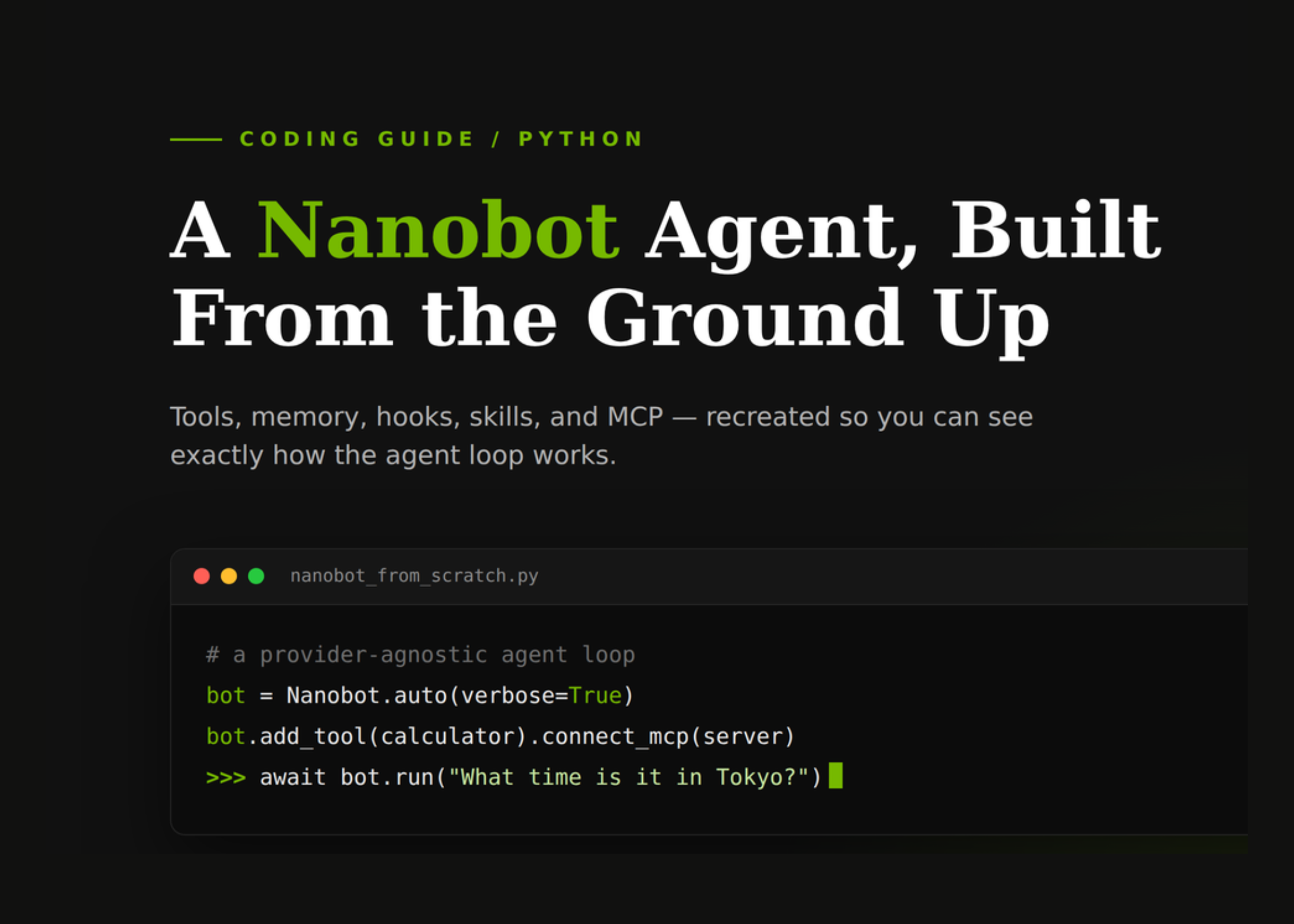
Build a Nanobot-Style AI Agent in Google Colab with Tool Calling, Session Memory, Skills, and MCP Servers
This guide enables developers to create advanced AI agents, which could enhance automation and task management across various applications.
- The article provides instructions for building a nanobot-style AI agent in Google Colab.
- Key features include tool calling, session memory, skills, and MCP (Multi-Client Protocol) servers.
Google Colab is a platform that allows coding in Python with easy access to cloud resources. This development is part of increasing interest in creating more capable AI agents capable of performing complex tasks. Future advancements may focus on refining these abilities and expanding their applications.
Based on the headline only — the full article could not be fetched.
Read the original ↗