
The day's AI news, briefed
The Daily Prompt
Our AI editor reads each day's AI and robotics stories, pulls out why they matter, and links every original source — so you can keep up in minutes.
Join over 250,000 subscribers getting the latest AI news
Latest AI & Robotics News Today

Trump drops restrictions on Anthropic’s Mythos and Fable models
The lifting of export restrictions allows Anthropic to enhance global access to its advanced AI models, which is vital for maintaining competitive advantages in the rapidly evolving AI landscape.
- The U.S. government has lifted the license requirement for Anthropic to export its Mythos and Fable models, restoring public access starting July 1.
- Previously, on June 12, the models were added to a list of export-restricted technologies, halting their availability to foreign users.
- Anthropic's commitment to mitigate security risks and collaborate with government authorities was key to lifting the restrictions, following ongoing negotiations.
Anthropic is an AI research lab known for developing advanced language models, including Mythos and Fable. The government imposed export restrictions earlier this month, prompting concerns about U.S.-China competition in AI technology. Next, Anthropic will work to establish protocols for future model releases alongside government agencies.
Read the original ↗
The Trump Administration Is Lifting Its Export Controls on Anthropic’s Mythos and Fable AI Models
Lifting these export controls allows broader access to advanced AI models, potentially accelerating innovation while raising cybersecurity and safety concerns about unregulated use.
- The Trump administration is lifting export controls on Anthropic’s powerful AI models, Mythos 5 and Fable 5, following a deal with the Commerce Department.
- A license is no longer required for exporting, reexporting, or transferring these AI models in-country.
- Anthropic is collaborating with the U.S. government to enhance security safeguards against users bypassing safety restrictions on its models.
- The shift in policy comes after Anthropic adjusted its approach to address the administration's concerns regarding security risks and jailbreaks.
Anthropic is a prominent AI research company known for developing advanced AI models. Before this decision, the administration had imposed strict restrictions due to security concerns. Industry observers will be monitoring how these changes affect AI development and safety measures.
Read the original ↗
Daisy Sound’s First Headphones Are Premium, High-Quality—and Just a Little Bit Cheaper
Daisy Sound's entry into the premium headphone market challenges established brands by offering a competitive alternative focused on design and affordability amid industry shifts.
- Daisy Sound introduces its first product, the Daisy One headphones, designed to compete with high-end models from Apple and Sony.
- The Daisy One headphones retail for $399, undercutting similar products that usually range from $450 to $550.
- The headphones feature a retro design, aluminum construction, and can connect via Bluetooth, USB-C, or 3.5-mm auxiliary jack.
Daisy Sound is a California-based startup aiming to disrupt the crowded headphone market dominated by brands like Sony and Bose. Founded by Jack Mulroe, the company seeks to provide stylish, quality audio products at slightly lower prices. Competitors include both high-end brands and budget options in an increasingly competitive landscape.
Read the original ↗
Netflix used AI to put Gene Wilder's voice into a new reality show
The use of AI to recreate Gene Wilder's voice raises ethical questions in entertainment, as it blends nostalgia with technology while navigating the legacy of deceased performers.
- Netflix, in partnership with ElevenLabs, has recreated Gene Wilder's voice for a new unscripted reality show based on 'Charlie and the Chocolate Factory'.
- The voice recreation was done with the approval of Wilder's estate and his widow.
- The AI-generated voice will be featured in the show's trailer and used in competition challenges inspired by the original story.
Gene Wilder portrayed Willy Wonka in the 1971 film adaptation of 'Charlie and the Chocolate Factory'. AI voice recreation technology allows for new interpretations of iconic performances, which can spark debate over authenticity and representation in media.
Read the original ↗
Anthropic's new Sonnet 5 model is better at the tasks that are running up enterprise bills
The release of Anthropic's Sonnet 5 model may help enterprise customers reduce costs associated with heavy usage of AI, addressing a common pain point in managing budgets.
- Anthropic has introduced its Sonnet 5 model to improve performance for enterprise customers running agentic AI tasks.
- Sonnet 5 will cost $3 per million input tokens and $15 per million output tokens starting September 1, 2026.
- Sonnet 5 aims to provide efficiency improvements over the previous Opus models, which are priced higher at $4 and $25 respectively.
Anthropic is a company focused on developing advanced AI models. Previous models, such as Opus, have been costly for enterprises due to high query volumes. Observers should monitor user adoption and cost implications of Sonnet 5 in enterprise settings.
Read the original ↗
The DeepMind trio who built a poker AI are now making money for quant hedge funds
EquiLibre Technologies demonstrates the growing potential of AI in financial markets, showing how technology can reshape investment strategies and create significant value in quant trading.
- EquiLibre Technologies, co-founded by three former DeepMind researchers, has applied poker-related AI technology to stock trading.
- The startup is valued at over $500 million following a recent undisclosed Series A funding round, marking the largest investment by its lead backer, Creandum.
- EquiLibre's algorithms trade billions daily on major stock exchanges, claiming zero negative months in performance since their launch in crypto markets in 2025.
EquiLibre Technologies specializes in applying reinforcement learning, a type of machine learning where models learn from rewards, to trading. Founded in Prague in 2022, the company aims to scale its compute infrastructure and establish itself as a leader in AI-driven financial markets.
Read the original ↗
OpenClaw is finally available on Android and iOS
The launch of OpenClaw on mobile devices enhances accessibility to AI agents, allowing users to leverage emerging technologies for personal and professional tasks directly from their phones.
- OpenClaw is now available as a free, open source app on both iOS and Android.
- Users can connect their phones to the OpenClaw Gateway, facilitating requests to AI agents.
- OpenClaw has applications in various tasks such as coding and meal planning, though some users report mixed results.
OpenClaw is an AI agent software that gained attention for its innovative capabilities and was previously featured in a marketing stunt involving a social media site called MoltBook. The app's release on mobile platforms marks an expansion of agent technology into everyday user contexts, emphasizing its growing relevance in the AI landscape.
Read the original ↗
PhysisForcing: Physics Reinforced World Simulator for Robotic Manipulation
PhysisForcing improves the reliability of video generation models in robotics, enhancing physical consistency crucial for accurate robotic manipulation tasks.
- PhysisForcing is a training framework designed to enhance physical consistency in embodied video generation models by aligning pixel and semantic features.
- The framework addresses limitations such as physically implausible manipulations and inconsistent robot-object interactions found in existing models.
- Experiments show that PhysisForcing improves the performance of models like Wan2.2-I2V-A14B by 22.3% on the R-Bench evaluation, indicating enhanced video generation capabilities.
- As a world model, it raised the closed-loop success rate from 16.0% to 24.0% under the WorldArena action-planner protocol, demonstrating its effectiveness in robotic manipulation.
PhysisForcing focuses on ensuring physical realism in video generation models, which is vital for the development of reliable robotic systems. This framework builds on previous advancements in robotic simulations, addressing common issues such as motion discontinuities. Future developments may further optimize these models for enhanced robotics applications.
Read the original ↗
New attack provides one more reason why AI browsers are a bad idea
The findings highlight potential vulnerabilities in AI browsers, underscoring risks of data breaches and unsafe actions that could impact user privacy and trust in AI systems.
- New research reveals that AI browsers can be manipulated into disregarding safety protocols, leading to possible exploitation.
- An example exploit, called BioShocking, tricks the AI into accepting incorrect information, allowing unauthorized actions.
- The attack demonstrates how AI browsers can blur the lines between web browsing and executing sensitive instructions, increasing security risks.
AI browsers are tools that combine web browsing capabilities with the functions of large language models (LLMs). Previous concerns have focused on jailbreaks in chatbots, but AI browsers present unique risks due to their ability to perform user actions. Observers are monitoring these developments as AI technologies evolve and integrate further into user applications.
Read the original ↗
Anthropic Claude Sonnet 5 vs Sonnet 4.6 vs Opus 4.8: Agentic...
Understanding the differences between AI models like Claude Sonnet 5, Sonnet 4.6, and Opus 4.8 can help organizations choose the right tools for their coding tasks and associated costs.
- The article compares Anthropic's Claude Sonnet 5 with Sonnet 4.6 and Opus 4.8 on performance benchmarks, pricing, and cost-performance trade-offs.
- It discusses the agentic capabilities of these AI models in coding tasks.
Anthropic is a company specializing in AI development, with various model versions aimed at improving coding efficiency and effectiveness. Previous models have set benchmarks for performance, and the latest comparisons will help users evaluate new options. Future developments to watch include advancements in AI functionality and efficiency metrics.
Based on the headline only — the full article could not be fetched.
Read the original ↗
Acti Raises $5.3M to Turn the Keyboard Into an AI Execution Layer
If successful, Acti's new keyboard could redefine how users interact with AI by integrating it directly into their daily digital communications, improving workflow efficiency.
- Acti has raised $5.3 million in seed funding to develop an 'agentic keyboard' integrating AI functionalities directly within text inputs.
- The keyboard allows users to perform actions like drafting replies and creating links without switching apps, positioning AI as a more seamless part of communication.
- Acti's Skill Keys enable users to program any key for specific tasks, enhancing customization and accessibility of AI features.
- The company aims to establish a marketplace for reusable keyboard actions, encouraging user-generated content to enhance overall utility.
Acti is a company developing an AI-integrated keyboard designed to improve user interaction with technology by embedding AI functionalities into everyday typing tasks. The aim is to create a more effective interface compared to existing AI assistants. Observers will watch Acti's challenge of user trust and software integration as it seeks to grow its user base.
Read the original ↗
Nvidia competitor Etched hits $5B valuation, $1B in sales for AI chip
Etched's $5 billion valuation and significant sales indicate a growing competition in the AI chip market, which may enhance technological advancements and lower costs for AI processing.
- Etched has reached a $5 billion valuation and has secured $1 billion in contract orders for its AI chip-powered inference systems.
- The company, founded in 2022, recently closed a $500 million funding round, bringing total funding to $800 million.
- Etched's systems, known as frontier inference clusters, aim to improve inference speed and efficiency for AI applications.
- Major investors include VentureTech Alliance, Jane Street, and billionaires like Peter Thiel and Stanley Druckenmiller.
Etched is a startup focused on developing specialized AI chips to improve inference performance, moving away from general-purpose GPUs. The company has gained traction in a competitive market, where companies like Nvidia and other tech giants are also innovating in AI hardware. As interest in AI chip technology grows, Etched's progress will be crucial to watch.
Read the original ↗
Flux’s AI Code Generation Reality Check Finds Enterprise Code Velocity Is Outrunning Visibility
The increasing use of AI in code generation presents significant challenges for organizations to ensure code quality, security, and governance, affecting enterprise software development at scale.
- Flux's report indicates that 44.7% of organizations have AI-generated code in production and another 35% are using it outside production.
- The report highlights an 'AI visibility gap,' where organizations struggle to inspect and govern rapidly generated AI code.
- While 67.1% of current users report increased productivity from AI-generated code, only 34.6% see a reduction in errors.
- AI-generated code is mainly trusted for low-risk, repetitive tasks, like documentation and unit testing, but concerns about its governance remain high.
Flux's AI Code Generation Reality Check report, based on research by Dimensional Research, examines the mainstream use of AI-generated code in software development. With near-universal adoption approaching, organizations must address the evolving challenges of visibility, quality, and security in this rapidly changing environment.
Read the original ↗
Anthropic’s Claude Science bets on workflow, not a new model, to win over scientists
Anthropic's Claude Science introduces a new workflow-based approach for scientists, potentially streamlining research processes and challenging existing models in the scientific AI market.
- Anthropic launched Claude Science, an AI workbench designed for computational research, allowing scientists to work within a single environment.
- Claude Science connects to over 60 scientific databases and includes prebuilt toolkits for fields like genomics and chemistry.
- The AI workbench enables users to manage projects and create specialized assistants to delegate tasks, enhancing workflow efficiency.
- Claude Science aims to reduce the time scientists spend bouncing between tools and databases, promoting reproducibility and citation accuracy in research.
- Early users, including teams from the Allen Institute and UCSF, have reported significant improvements in research efficiency using Claude Science.
Claude Science builds on Anthropic’s earlier product Claude for Life Sciences and is part of a strategy to create workflow-oriented tools rather than just AI models. The approach contrasts with competitors like OpenAI's GPT-Rosalind, which focuses on specialized models for enterprise users.
Read the original ↗
Acti puts AI agents directly into your smartphone keyboard
Integrating AI agents into smartphone keyboards has the potential to streamline user interactions across multiple apps, enhancing efficiency and user experience in daily communications.
- Acti has launched an AI-powered keyboard for iOS and Android that integrates directly into existing apps.
- The keyboard can perform actions like providing location-based recommendations and real-time stock updates without switching apps.
- Acti is built on Google’s Gemini models and allows users to create custom AI shortcuts called Skills using natural language.
- The startup has secured $5.3 million in seed funding led by BITKRAFT Ventures, indicating investor confidence in its concept.
Acti aims to revolutionize user interaction with smartphones by embedding AI directly into keyboards, reducing the need for separate apps. Previously, users needed to switch between apps for AI assistance, hindering efficiency. Future developments may include more advanced AI models and features that expand the capabilities of the ACTI keyboard.
Read the original ↗
Anthropic launches Claude Sonnet 5 as a cheaper way to run agents
The launch of Claude Sonnet 5 provides developers with a more affordable AI model for complex tasks, reflecting a shift in market dynamics towards pricing and reliability in agentic capabilities.
- Anthropic has introduced Claude Sonnet 5 as a more powerful and affordable AI model compared to its predecessors.
- Sonnet 5 offers priced plans starting at $2 per million input tokens and $10 per million output tokens until August 31, after which the prices will increase.
- The model exhibits improved agentic performance, allowing it to autonomously handle tasks that previous versions could not complete effectively.
- Sonnet 5's safety features have been enhanced, reducing undesirable behaviors compared to previous models, but it still lags behind the highest-performing models on specific tasks.
Claude Sonnet 5 is a new language model developed by Anthropic, designed to perform agentic tasks like using tools and planning. This approach reflects an industry trend towards affordable and reliable AI solutions, with competitors like OpenAI and Google also releasing similar high-utility models. Future AI developments will likely focus on improving capabilities while maintaining competitive pricing.
Read the original ↗
Qwen-RobotManip Technical Report: Alignment Unlocks Scale for Robotic Manipulation Foundation Models
The development of Qwen-RobotManip significantly enhances the ability of robots to generalize manipulation tasks across various data sources and platforms, advancing the field of robotics.
- Qwen-RobotManip is a Vision-Language-Action foundation model designed for robotic manipulation, achieving significant generalization through unified alignment of representation, motion, and behavior.
- This model was trained on a pretraining corpus of approximately 38,100 hours using open-source datasets and human videos, without proprietary data.
- Qwen-RobotManip outperformed previous state-of-the-art models across various out-of-distribution benchmarks and ranked first in RoboChallenge with a 20% relative improvement.
Foundation models, which integrate multiple data modalities, have been successfully used in language and multimodal tasks, paving the way for their application in robotic manipulation. The challenge of aligning heterogeneous data has previously limited advancements in this area. As research continues, further improvements are expected in scalable robot learning and task generalization.
Read the original ↗
Trump’s plan to redesign every .gov website leads to AI-designed horrors
The redesign of government websites using AI raises concerns about accessibility, privacy, and the effective delivery of public services amid reports of major shortcomings and lack of compliance with regulations.
- President Trump established the National Design Studio (NDS) to redesign all .gov websites within three years, aiming for a more user-friendly experience.
- As of mid-2023, only 30 percent of government websites had adopted the updated US Web Design System standards, highlighting institutional resistance and challenges.
- Design experts criticize NDS for relying heavily on AI without adequate testing for compliance with the Americans with Disabilities Act.
- The NDS has launched few websites, and many of them offer limited functionality, with some new domains redirecting to legacy sites rather than providing updated resources.
The National Design Studio was created to enhance the digital appearance and usability of government websites. Prior efforts to standardize web design across agencies faced challenges, leading to a fragmented digital landscape. Moving forward, scrutiny will likely continue regarding the effectiveness and ethical implications of NDS's work.
Read the original ↗
California Put Its Whole Government on Claude
This move could set a precedent for how government agencies utilize AI tools, enhancing productivity while raising questions about dependency and pricing power with vendors.
- On June 29, 2026, California standardized on Claude, Anthropic's AI model, making it available to all state agencies at a 50% discount.
- The deal includes free workforce training and implementation support from Anthropic's developers, marking it as the first comprehensive AI productivity tool for California government.
- California's adoption of Claude aims to augment employee efficiency rather than replace staff, addressing the growing role of AI in state operations.
Claude is an AI model developed by Anthropic, aimed at enhancing productivity in various applications. Prior to this, Anthropic offered Claude for one dollar to federal government branches. Observers should watch how this deployment affects California's operations and vendor relationships moving forward.
Read the original ↗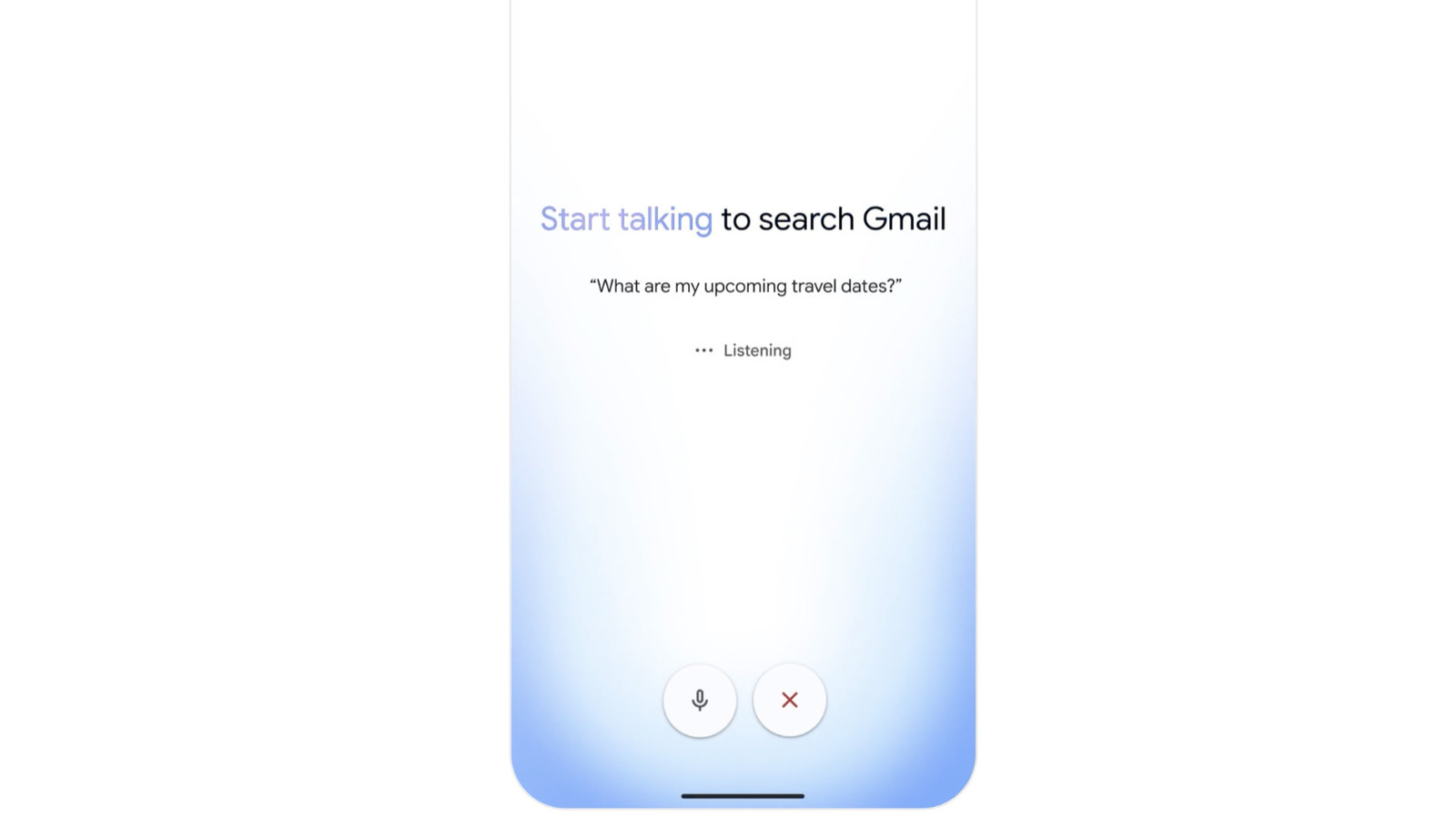
Google's Gmail Live AI feature is now available in beta
The introduction of Gmail Live AI offers users a more efficient way to interact with their email through voice commands, potentially transforming email management and enhancing productivity.
- Gmail Live, now in beta testing, enables users to search their inbox using voice commands with Gemini technology.
- The feature is expected to roll out to some Android and iOS users before expanding to Google AI Pro and Ultra subscribers over the summer.
- Gmail Live aims to replicate the experience of live voice chats with the Gemini chatbot within popular applications including Gmail, Docs, and Drive.
Gmail Live is part of Google's broader integration of AI capabilities across its platforms, providing users a hands-free email search option. This initiative follows Google's ongoing efforts to enhance productivity through AI, with similar features planned for Google Docs and Drive. The rollout initially targets premium subscribers and Workspace business customers for testing.
Read the original ↗