
The day's AI news, briefed
The Daily Prompt
Our AI editor reads each day's AI and robotics stories, pulls out why they matter, and links every original source — so you can keep up in minutes.
Join over 250,000 subscribers getting the latest AI news
Latest AI & Robotics News Today
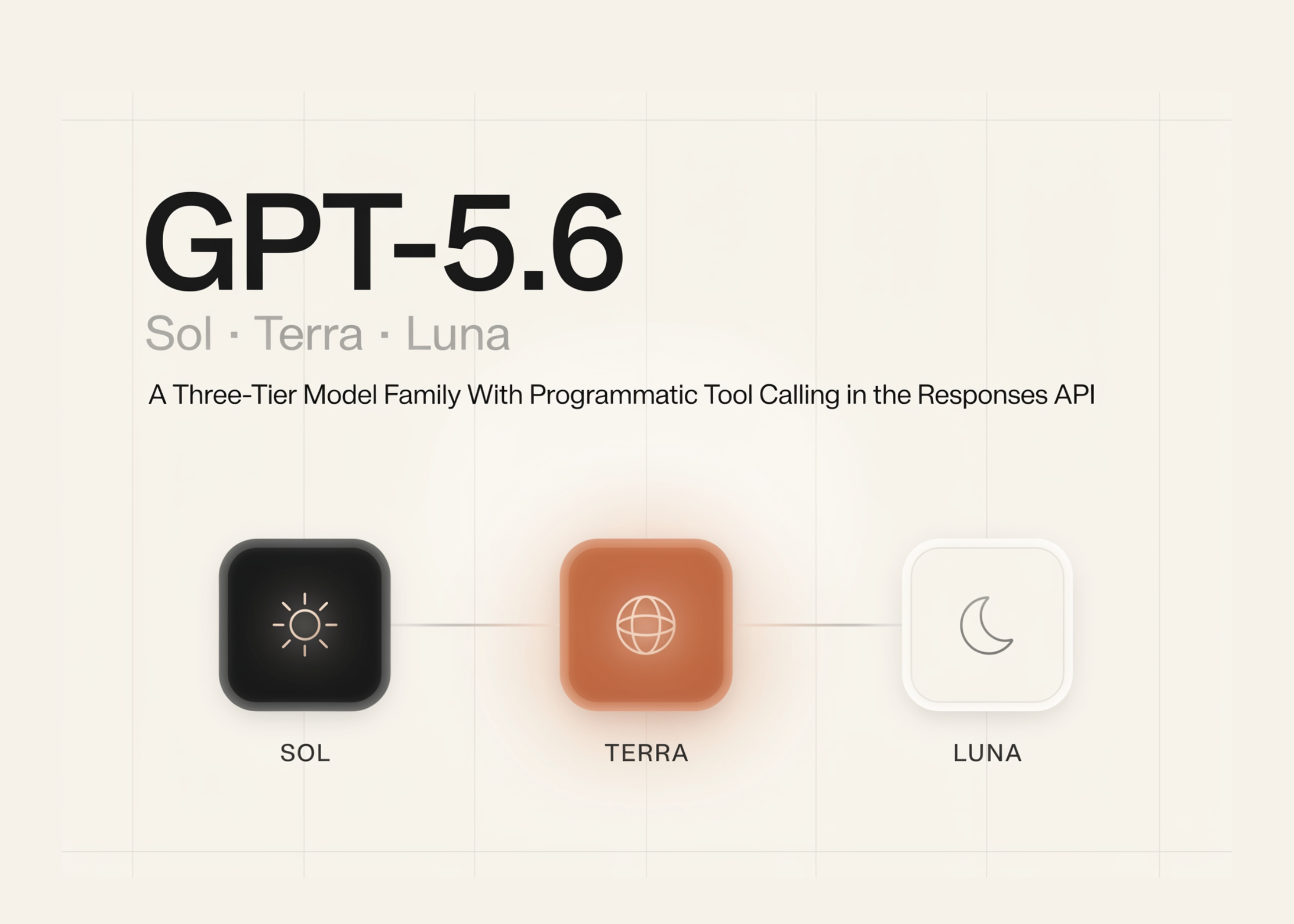
OpenAI Releases GPT-5.6 (Sol, Terra, Luna): A Three-Tier Model Family With Programmatic Tool Calling in the Responses API
The release of OpenAI's GPT-5.6 family, featuring new pricing tiers and capabilities, could reshape how businesses utilize advanced AI models for various applications.
- OpenAI announced the general availability of GPT-5.6, which includes three models: Sol, Terra, and Luna, each with different pricing tiers.
- Pricing for the models ranges from $1 to $30 per million tokens, depending on the model and usage level.
- The Sol model secured an 80 score on the Artificial Analysis Coding Agent Index, outperforming competitors by a notable margin.
- New features include Programmatic Tool Calling, which allows the AI to execute code in a secure, isolated environment.
- All three models support explicit caching and introduce multi-agent capabilities within the Responses API.
OpenAI, a leader in artificial intelligence research, has introduced the GPT-5.6 model family, building on previous iterations to enhance AI performance and functionality. This release follows a limited preview period and responds to ongoing advancements in AI capability and efficiency. Future updates may focus on addressing existing performance gaps with competitors in various evaluation benchmarks.
Read the original ↗
Anthropic Wants You to Pay Up for Claude Fable 5
This shift to usage-based fees for consumers signifies a major change in the pricing model of AI services, potentially impacting user access and industry standards.
- Starting July 12, Claude subscribers will incur extra usage-based fees to use the Claude Fable 5 model.
- Fees will be $10 for each million tokens sent to Claude and $50 for each million tokens generated by the model.
- This marks the first time a major AI lab has implemented usage-based billing for consumer access to an AI model.
- Anthropic aims to eventually return Fable 5 to subscription plans when computational capacity allows.
Anthropic is a leading AI company known for developing consumer AI models like Claude. This change follows an extended period of free access to Fable 5 and reflects trends in the industry moving towards usage-based pricing. Monitoring subscriber reactions will provide insight into market demand for premium AI services.
Read the original ↗
How did the government decide OpenAI’s frontier model was safe to release?
Understanding the government’s processes for evaluating AI models is crucial for public trust and accountability in AI technology and its regulations.
- OpenAI has launched its advanced language model, Sol, for wide public access, claiming it is comparable to Anthropic's model, Fable.
- The government's approval process for AI models like Sol remains unclear, raising concerns over oversight and evaluation criteria.
- Discussions between government officials and companies like OpenAI and Anthropic have occurred, but the specifics of these dialogues are not publicly known.
- The Department of Commerce’s Center for AI Standards and Innovation is currently leading the regulation process, as specified in a recently published executive order.
OpenAI is a prominent artificial intelligence research organization known for creating advanced language models and has engaged with the government to assess model safety. The uncertainty surrounding regulatory processes has persisted, with ongoing debates about who should evaluate these models and how. Observers are concerned that this lack of clarity may lead to significant implications for AI safety and governance in the future.
Read the original ↗
Paris-based AI voice startup Gradium raises $100M seed, backed by Nvidia
This investment enables Gradium to enhance its competitive position in the rapidly evolving voice AI market, crucial as it seeks talent in the heart of Silicon Valley.
- Gradium, a Paris-based startup specializing in voice AI models, has raised $100 million in a seed round backed by Nvidia.
- The company plans to use the funding to establish an office in the Bay Area to attract talent.
- Gradium aims to deliver voice at scale with ultra-low latency, minimizing delays in AI interaction.
- Since launching in December, Gradium has secured significant customers such as French automaker Renault.
Gradium was founded as a spinout from the French AI lab Kyutai, which is supported by telecommunications billionaire Xavier Niel. The startup's goal is to leverage the burgeoning AI ecosystem in Silicon Valley while maintaining its European roots.
Read the original ↗
Google will now disclose which ads are made with AI
This initiative enhances transparency in advertising, helping consumers understand when they are viewing AI-generated content, thereby addressing potential consumer deception.
- Google will disclose which ads are created or edited with AI technology globally through its 'My Ad Center' panel.
- Previously, only election ads were required to disclose AI involvement; now this requirement extends to all ads.
- Consumers can find out how an ad was made by selecting 'How this ad was made' in the ad's info panel.
- Advertisers must now indicate if AI was involved in creating ads outside Google's platform, as Google won't verify this independently.
Google, a leader in digital advertising, is expanding its transparency measures for ads made with AI. The new feature aims to inform consumers about the authenticity of the images they see in ads.
Read the original ↗
New York Times says OpenAI hid evidence in ChatGPT copyright trial
If OpenAI is found to have withheld evidence, it could significantly impact the ongoing copyright lawsuit and set precedents for how AI companies handle copyright claims in the future.
- The New York Times and The Daily News claim OpenAI concealed evidence relevant to their copyright lawsuit against the firm.
- OpenAI allegedly conducted internal searches of its training data for copyrighted journalism, contradicting its previous claims of inability to do so.
- The plaintiffs are requesting sanctions against OpenAI for allegedly tampering with the discovery process and for unreliable evidence submission in court.
OpenAI is facing a two-year lawsuit from news publishers for reportedly violating copyright law by utilizing their content to train ChatGPT. The case raises significant questions about copyright in AI and the handling of user-generated data. Continued developments are expected as the court assesses the new allegations and potential sanctions against OpenAI.
Read the original ↗
Meta enters the crowded AI coding battle with Muse Spark 1.1
Meta's introduction of Muse Spark 1.1 illustrates its commitment to AI coding amidst fierce competition, potentially impacting enterprise automation solutions across the industry.
- Meta has launched the Muse Spark 1.1, a multimodal AI model aimed at agentic coding.
- The model can engage in multistep reasoning, manage digital workflows, and assist with complex coding tasks.
- Muse Spark 1.1 is priced at $1.25 per million input tokens and $4.25 per million output tokens, aligning closely with competitors like Anthropic and OpenAI.
- CEO Mark Zuckerberg highlighted the model's strengths in agentic performance and tool use, revealing future updates may follow.
Meta is a leading technology company focusing on social media and AI advancements. The Muse Spark model is intended to offer capabilities similar to existing solutions from firms like OpenAI and Anthropic. The competitive landscape in AI coding is intensifying, with significant recent developments from multiple companies.
Read the original ↗
OpenAI may have made a fatal misstep in copyright fight with news orgs
OpenAI's alleged misconduct could significantly impact the outcome of a copyright lawsuit, ultimately affecting its defense strategy and the broader debate around the use of copyrighted material in AI training.
- OpenAI is facing a sanctions motion from news organizations, led by The New York Times, for allegedly concealing evidence in a copyright infringement case.
- The NYT claims that OpenAI misled the court for over two years about its ability to search ChatGPT logs for evidence related to user prompts.
- It is alleged that OpenAI deleted billions of logs that were required to be preserved under a court order, further complicating the case against them.
- The outcome of the sanctions could critically undermine OpenAI's defense as the court considers the implications of its alleged misconduct.
OpenAI has been under scrutiny for its use of copyrighted material in training its chatbot, ChatGPT. The ongoing litigation with news organizations focuses on whether such use constitutes fair use, and if OpenAI engaged in deceptive practices to protect its interests. The court's decision regarding sanctions may set significant legal precedents for future AI copyright disputes.
Read the original ↗
Meet Nemotron Labs 3 Puzzle 75B A9B: A Compressed Hybrid MoE LLM Delivering 2.03x Server Throughput
The release of Nemotron-Labs-3-Puzzle-75B-A9B signifies a notable improvement in server throughput efficiency for large AI models, potentially impacting various applications in machine learning and artificial intelligence.
- NVIDIA has launched Nemotron-Labs-3-Puzzle-75B-A9B, a compressed version of its Nemotron-3-Super model.
- The new model features 75.3 billion total parameters, compared to the original's 120.7 billion, achieving 2.03 times the server throughput.
- The compression allows for eight concurrent 1M-token requests on a single H100 GPU, increasing user capacity significantly.
Nemotron-3-Super is a hybrid Mamba-Transformer model known for its high accuracy and costly deployment. The new Puzzle-75B-A9B model uses an innovative iterative compression technique to boost efficiency while maintaining performance. Observers should monitor its adoption in real-world AI tasks post-release.
Read the original ↗
The 12-Week AI Transformation: What Changes When Agents Join Every Workflow
AI transformation can significantly enhance workflow efficiency and reduce communication overhead in organizations, shifting team dynamics and management roles in the process.
- AI transformation requires active participation from leaders to drive sustainable change among employees.
- Teams can cut internal meetings by at least 15% and reduce asynchronous communication by 50% through AI integration.
- After 12 weeks, employees independently develop skills and processes, transforming their roles to focus on quality and oversight rather than manual tasks.
The article discusses how AI can be effectively integrated into business workflows, highlighting that successful transformations depend on leader involvement and a supportive structure. As companies look to enhance efficiency through AI, understanding these dynamics is critical for future implementations and management strategies.
Read the original ↗
The 1X Neo Robot Has Freaky Fast Fingers
The development of advanced robotic hands like those on the 1X Neo could significantly enhance the capabilities of home robots, allowing them to perform complex tasks more effectively.
- The 1X Neo robot features five-finger hands designed to replicate human hand movement with 25 degrees of freedom.
- These hands can quickly grip various shapes, detect slipping items, and are waterproof with an IP68 rating.
- 1X aims to make Neo a helpful home companion, with early access pricing set at $20,000 or $500 per month.
1X is a Norwegian-American robotics company aiming to create soft, user-friendly robots for home chores. Previous robotic hands were less dexterous, and this innovation seeks to bridge that gap by enabling robots to perform complex tasks safely and effectively. Future developments will focus on enhancing automation while ensuring user privacy and security.
Read the original ↗
Meta’s new AI chips will begin production in September
Meta's new chips could significantly reduce its dependence on external GPU suppliers and lower production costs, impacting the competitive landscape in AI hardware.
- Meta plans to start production of its new AI chips in September to reduce GPU costs amid a component shortage.
- The chips were developed under the Meta Training and Inference Accelerator (MTIA) program and initially detailed in March.
- Meta is partnering with Broadcom for chip design, while manufacturing will be handled by Taiwan Semiconductor Manufacturing Company (TSMC).
- The company has budgeted between $125 billion and $145 billion in capital expenditures this year, primarily aimed at enhancing its AI capabilities.
- The new chips are intended for various AI tasks, including training models for ranking and recommendation systems.
Meta has been producing its own AI chips since 2023, as part of a strategy to mitigate dependency on suppliers like Nvidia and AMD. The company has massively invested in compute capacity to support its AI projects and aims to respond quicker to evolving AI workloads.
Read the original ↗
How to stop Meta’s AI image generator from using your Instagram photos
Understanding how Meta's new AI feature utilizes public Instagram photos raises important questions about user consent and privacy protections regarding personal data shared online.
- Meta launched a new AI image-generation feature called 'Muse Image' that uses photos from public Instagram accounts.
- Users can opt out of having their photos used in AI images by adjusting their Instagram settings.
- Public concern over user consent and the potential for misuse of personal images is growing amidst the rollout of new AI tools.
Muse Image allows users to create and edit images using public Instagram photos. This feature has drawn criticism over privacy issues, prompting users to seek ways to protect their content. Following previous privacy violations, there are increasing calls for clearer guidelines on how AI handles personal data.
Read the original ↗
Velocity Raises $27M to Build Monetization Infrastructure for AI-Native Software
The funding enables Velocity to create a monetization infrastructure that could enhance revenue models for AI-native software amid rising user adoption, addressing a critical market demand.
- Velocity raised $27 million in seed funding to develop monetization and distribution infrastructure for AI-native applications.
- The funding round was led by NFX and Red Dot Capital Partners, with several other venture firms participating.
- Velocity aims to bridge the gap between user growth and sustainable revenue in the fast-evolving AI software market.
Velocity is a startup focused on monetization and distribution for generative AI applications. The generative AI sector is currently experiencing rapid growth in user adoption, yet many companies struggle with profitable business models. Moving forward, Velocity's success may influence how AI products monetize engagement without degrading user experience.
Read the original ↗
Federal Investigators Say Certain DOGE Records Were Deleted
The deletion of records regarding DOGE's access to sensitive information raises serious concerns about accountability and transparency in federal agencies during ongoing investigations.
- On April 14, 2025, a whistleblower alleged that DOGE members accessed sensitive information from the NLRB.
- The GAO's report confirms that the NLRB deleted access records of DOGE members following the complaint, hindering investigations.
- The NLRB has a history of investigations involving companies linked to DOGE's leadership, raising questions of potential conflicts of interest.
The Department of Government Efficiency (DOGE) allegedly accessed sensitive NLRB systems amidst a whistleblower complaint. The NLRB is responsible for enforcing labor laws and has faced scrutiny from Congress and other watchdogs regarding its actions.
Read the original ↗
Anthropic, OpenAI, and SpaceX are bigger than the last 25 years of tech exits
The upcoming IPOs of Anthropic, OpenAI, and SpaceX could reshape the valuation landscape of the tech industry by surpassing total U.S. VC-backed exits in the past 25 years.
- SpaceX recently launched its IPO, achieving a valuation of $1.77 trillion.
- Pending IPOs for Anthropic and OpenAI are projected to push the combined value of these three companies beyond $4 trillion.
- In comparison, the SEC reported only $70 billion in total U.S. IPO proceeds for the previous year.
Anthropic and OpenAI are companies specializing in artificial intelligence, while SpaceX operates in aerospace and transportation. The promise of substantial valuations reflects a trend where tech companies are staying private longer before going public. Investors are keenly watching how these IPOs will impact the tech market and venture capital landscape.
Read the original ↗
Anthropic’s new Claude feature is quietly selling you on AI
The launch of Anthropic's Claude Reflect feature highlights the company's strategy to reinforce user reliance on AI amidst growing concerns about technology addiction and the impact of AI on daily workflows.
- Anthropic introduced the 'Reflect' dashboard to track AI usage and help users visualize their interactions with Claude.
- Reflect aims to shape user perceptions by illustrating Claude as an integral part of daily productivity and decision-making.
- The dashboard includes features that encourage critical thinking about AI usage and promotes more mindful interaction with technology.
Anthropic is a company focused on developing advanced AI technologies, such as the Claude chatbot. The Reflect feature is part of an ongoing effort to deepen user integration with AI tools and promote responsible usage. This development signals the company's approach to counter AI backlash by fostering user engagement and satisfaction with its products.
Read the original ↗
RoboDojo: A Unified Sim-and-Real Benchmark for Comprehensive Evaluation of Generalist Robot Manipulation Policies
The RoboDojo benchmark aims to enhance the assessment of robot manipulation capabilities, bridging gaps between simulation and real-world evaluations, which is crucial for developing effective robotic systems.
- RoboDojo is a new benchmark that integrates simulation and real-world evaluations for generalist robot manipulation policies.
- It features 42 simulation tasks and 18 real-world tasks, allowing comprehensive capability assessment.
- The benchmark evaluates across five dimensions, including generalization and precision, ensuring thorough testing of robot policies.
- RoboDojo supports scalable evaluation through the Isaac Sim and includes remote, standardized real-world testing with X Policy Lab.
- A public leaderboard will track the performance of 30 integrated policies, facilitating community engagement and systematic analysis.
RoboDojo introduces a standardized framework for evaluating robotic manipulation, addressing limitations of existing benchmarks that often focus solely on simulation or isolated skills. This initiative is expected to foster more effective and versatile robot training methods. Developers and researchers will closely monitor its adoption and impact on the robotics field.
Read the original ↗
Artificial Intelligence (472)
The development of AI technologies like OpenClaw and Ollama signifies ongoing advancements in artificial intelligence tools and their applications.
- The article discusses Artificial Intelligence enhancements linked to OpenClaw and Ollama.
- It provides insights into the functionalities and implications of these AI technologies.
Artificial Intelligence encompasses a range of technologies designed to simulate human intelligence, including machine learning and natural language processing. Ongoing advancements in AI tools continually reshape industries and everyday tasks. Upcoming developments in these technologies could further influence their applications and usability.
Based on the headline only — the full article could not be fetched.
Read the original ↗
Claude's new Reflect dashboard wants to help you log off of Claude
The introduction of the Claude Reflect dashboard emphasizes a goal to enhance user efficiency and awareness while using AI, potentially mitigating excessive engagement with the chatbot.
- Anthropic has launched the Claude Reflect dashboard to help users analyze their interactions with its AI chatbot, Claude.
- The dashboard includes summaries of recent conversations, usage statistics over different time frames, and topic breakdowns.
- Future updates will include the ability to track time spent on the platform and mobile availability.
- The feature is designed to help users be more efficient and potentially reduce time spent on Claude.
Claude is an AI chatbot developed by Anthropic that assists users with various inquiries. The Reflect dashboard is part of Anthropic's effort to address user feedback regarding the balance of AI utilization and user wellbeing.
Read the original ↗