
The day's AI news, briefed
The Daily Prompt
Our AI editor reads each day's AI and robotics stories, pulls out why they matter, and links every original source — so you can keep up in minutes.
Join over 250,000 subscribers getting the latest AI news
Latest AI & Robotics News Today

Popular open source AI developer tool Ollama raises $65M, grows to nearly 9M users
Ollama's significant funding and user growth indicate a strong demand for accessible AI tools among developers, reflecting broader trends in the AI landscape towards open-source solutions.
- Ollama has raised $65 million in a Series B funding round, bringing its total funding to $88 million.
- The company reports nearly 9 million monthly users and is utilized by 85% of Fortune 500 companies, demonstrating its widespread impact.
- Ollama simplifies running open-weight AI models on personal computers, allowing developers to set up quickly without complex configurations.
Ollama, launched in 2023, provides an open-source AI tool that enables developers to run and access AI models easily. It follows the success of Docker, which simplified cloud application management. The increasing reliance on open models by enterprises suggests future growth for Ollama's cloud services.
Read the original ↗
Character.AI enters the microdrama arena with its own productions, but there’s a twist
Character.AI's entry into microdramas represents a significant fusion of AI technology and interactive entertainment, allowing users to engage with content in innovative ways.
- Character.AI is producing its own microdramas featuring AI characters that users can chat with and roleplay with.
- Three initial dramas include a romance series called 'Last Summer,' a horror show named 'The Nighttime Game,' and a survival drama titled 'Eden Fall.'
- The company plans to eventually enable users to create their own characters and series based on the feedback from these productions.
- In the first half of 2026, users spent over 950 minutes per month on the Character.AI platform, indicating significant engagement.
Character.AI is known for allowing users to interact with customized AI avatars. Following a shift toward entertainment-focused features, the company now seeks to harness user engagement through interactive dramas. Future developments may include more creative tools for user-generated content.
Read the original ↗
Scaling Mixture-of-Experts Video Pretraining for Embodied Intelligence
The development of LingBot-Video could significantly enhance the efficiency of video pretraining for robots, improving their ability to perform physical tasks and interact in real-world environments.
- LingBot-Video is a DiT-based video pretraining framework using a Mixture-of-Experts architecture for embodied intelligence applications.
- The framework includes specialized data augmentation and a multi-dimensional reward system focusing on physical rationality and task completion.
- LingBot-Video aims to improve computational efficiency and physical realism, addressing limitations of traditional video generative models.
- The model is open-source and represents the first large-scale MoE video foundation model, contributing to the robotic learning community.
LingBot-Video is a new framework designed to optimize how robots learn from video data, addressing the gap between visual content generation and real-world application. This work builds on previous advancements in transformer-based architectures and aims to better equip robots for complex tasks. Future developments may focus on refining the training process and expanding the model's applicability across various robotics applications.
Read the original ↗
The Data Problem at the Heart of AI-Powered Drug Discovery
The future effectiveness of AI in drug discovery hinges on the quality of biological data, impacting clinical success rates and the development of effective medicines.
- AI's integration into drug discovery is advancing, with companies like Anthropic expanding into this field.
- The success of AI models in predicting drug efficacy relies heavily on the quality of the human biological data used in training.
- Historically, drug development has been hampered by reliance on animal studies and simplified systems that fail to replicate human physiology.
- Quality over quantity in biological data is critical, as large datasets from poor models may be less predictive than smaller, relevant human datasets.
- Regulatory bodies are emphasizing the need for human-relevant evidence in drug development, highlighting the importance of data quality.
AI is increasingly being utilized to enhance drug discovery processes, moving beyond general applications to targeted medical research. The transition from traditional biological data sources to high-fidelity human biological data infrastructure is essential for improving success rates in clinical trials. Future developments should focus on generating data that accurately represents human biology to optimize AI's potential in medicine.
Read the original ↗
World’s First Betavoltaic Nuclear Satellite Launches to Test a New Era of Space Power
The successful launch of the first betavoltaic nuclear satellite could revolutionize space power systems, enabling long-duration missions beyond the reach of sunlight.
- The City Labs BOHR satellite was launched aboard a SpaceX Falcon 9 rocket as part of the Transporter-17 mission.
- This satellite features a betavoltaic nuclear power system that converts beta radiation from tritium decay into electricity.
- The project aims to test the feasibility of using this compact nuclear power source for future deep-space missions, particularly in areas with limited sunlight.
- Tritium, the fuel used, is rare and costly, posing challenges for widespread adoption and scaling of this technology.
The BOHR satellite signifies a major advance in space technology with its innovative power system, potentially complementing traditional solar energy for spacecraft in dark environments. Historically, radioactive thermoelectric generators have powered missions like Voyager, but this system uses beta particles instead, providing a more compact alternative.
Read the original ↗
This Is the First Criss-Cross Office Chair I Didn’t Get Tired Of
The Amseatec Criss-Cross Office Chair addresses the need for more adaptable seating options for remote work, catering to diverse sitting preferences and enhancing comfort during long hours.
- The Amseatec Criss-Cross Office Chair features a wider, cushioned seat measuring 25 inches across, accommodating various sitting positions comfortably.
- The chair includes fold-down armrests with five locking positions, allowing users to shift easily between different postures.
- The memory foam seat retains its support over extended use and is designed for easy cleaning with a damp cloth.
The Amseatec Criss-Cross Office Chair is a new ergonomic seating option designed for users who prefer alternative sitting styles, such as cross-legged or sideways. Traditional office chairs often limit comfort and flexibility, leading to discomfort during long work sessions. The chair's design reflects a growing demand for more versatile and comfortable home office furniture.
Read the original ↗
Is an Air-Conditioning Revolution Coming to Europe?
The rising demand for air conditioning in Europe due to increasing heat is prompting a search for more efficient and environmentally friendly cooling technologies as conventional methods may exacerbate climate issues.
- Air conditioning demand in Europe is expected to increase significantly due to rising temperatures, with predictions that two-thirds of households could have AC by 2050.
- Only about 20% of Europeans currently own air conditioning, compared to nearly 90% in the United States, where electricity is cheaper.
- Innovations in solid-state cooling technologies, which do not rely on traditional refrigerants, are being developed in Europe to potentially revolutionize air conditioning.
- Researchers advocate for a "cooling hierarchy" to prioritize preventing overheating in buildings, using natural methods before resorting to air conditioning.
As Europe experiences more frequent heat waves, the need for effective cooling solutions is becoming urgent. Technologies such as solid-state cooling, which aim to improve energy efficiency and reduce environmental impact, are being explored. Future developments will likely involve collaboration between startups and major manufacturers to scale new innovations.
Read the original ↗
The $28 Million Mistake That Inspired Estonia's AI “Fuckup Finder”
Estonia is leveraging AI to improve legislation review processes, which could enhance governmental efficiency and reduce costly errors in legislation.
- A single wording mistake in Estonia's Gambling Tax Act resulted in a €24 million loss in government revenues due to a failure to tax online casinos for a year.
- The 'Fuckup Finder' tool was developed to catch legal errors in draft bills, identifying 102 out of 112 bills at high risk of issues.
- Estonia's Eesti.ai program aims to enhance AI use in government, targeting a significant increase in productivity by 2035.
- Future legislation may enable the use of AI for drafting and automating administrative processes in Estonia's government.
Estonia has established itself as a leader in digital governance, integrating various digital identities and services. The recent gambling tax error highlighted the need for solutions like the AI tool, prompting the government to explore AI's assistance in law-making and public services more broadly. Moving forward, Estonia plans to become the first country to create official digital identities for AI agents while emphasizing human oversight in decision-making processes.
Read the original ↗
SpaceXAI launches Grok 4.5, its first built with Cursor's help
Grok 4.5's advanced capabilities in coding and low cost challenge existing models, potentially reshaping AI coding agents and increasing competition in the sector.
- SpaceXAI has launched Grok 4.5, its first model trained in collaboration with Cursor.
- Grok 4.5 is now the default model for the Grok Build AI coding agent and is designed for coding and knowledge work.
- The model was trained using tens of thousands of NVIDIA GB300 GPUs and excels at engineering tasks, producing results at lower costs than its competitors.
- Grok 4.5 is priced at $2 per million input tokens and $6 per million output tokens, compared to OpenAI's pricing.
- The model is not currently accessible in the European Union, where it is expected to be available in mid-July.
SpaceXAI, originally known as xAI, is an AI company focused on developing advanced models for various applications. The Grok series is aimed at enhancing coding productivity. The partnership with Cursor, established in April, aims to drive advancements in AI technology.
Read the original ↗
Large Tabular Models Excel Where LLMs Fail
The development of large tabular models like NEXUS is crucial as it addresses the limitations of existing AI systems in processing structured data, leading to significant advancements in data analysis capabilities across industries.
- Startup Fundamental launched NEXUS, a large tabular model designed for analyzing structured data, on February 5, 2026, with $275 million in funding.
- Unlike large language models, NEXUS models the structure of tabular data directly and can handle diverse predictive tasks with minimal customization required.
- NEXUS has been integrated into Amazon SageMaker, allowing users to process sensitive data directly within the secure platform.
- Other companies, including Google and Feedzai, are developing their own foundational large tabular models to address similar challenges in data analysis.
NEXUS is a new type of AI foundation model focused on analyzing tabular data, which traditional large language models (LLMs) struggle with. Previous methods relied on older machine learning algorithms that require extensive data scientist input, while emerging large tabular models aim to automate and simplify these processes across various industries.
Read the original ↗
AI Changes How Engineers Develop
The integration of AI in engineering development reshapes learning pathways for junior engineers, allowing for quicker acquisition of skills and reducing dependency on senior oversight.
- AI can now assist junior engineers with immediate code reviews and feedback, fundamentally altering their learning process.
- Highly personalized AI feedback facilitates quicker judgment development, previously reliant on senior engineers' availability.
- AI review systems help prevent common coding errors, enabling juniors to operate more independently and safely.
- The roles of junior engineers are shifting towards creativity and product orientation as implementation becomes easier with AI assistance.
AI tools have revolutionized how engineers learn and develop, particularly at the junior level. Historically, mentoring and feedback were crucial for skill development. The current trend indicates a deeper integration of AI, altering the dynamics of engineer training and contribution.
Read the original ↗
Empower the Enterprise with an AI Platform
Implementing AI effectively is crucial for organizations aiming to solve operational inefficiencies and maximize business value amid prevalent high failure rates of AI projects.
- Many organizations struggle to derive business value from AI, with 80% of projects failing and 60% generating little to no value by late 2025.
- A successful AI strategy involves building a data platform while simultaneously enabling AI in areas with operational friction, rather than waiting for full readiness.
- Empowering employees with low-code/no-code AI tools can enhance workflows and address existing pain points, leading to better operational outcomes.
The article discusses the challenges organizations face in leveraging AI due to operational friction and data platform limitations. It stresses the importance of developing AI-ready data and deploying solutions in a parallel approach to increase effectiveness. Organizations should prioritize high-impact use cases to generate quick wins while building a robust data infrastructure.
Read the original ↗
China Flags Security Flaw In Anthropic’s Claude Code Tool
China's warning about a potential security flaw in Anthropic's coding tool raises concerns over data privacy and international tensions in AI technology.
- Chinese officials warn that Anthropic's Claude Code has a security flaw that could compromise user data.
- The vulnerability, described as a 'back-door', allows potential unauthorized data transmission to external servers.
- Affected versions of Claude Code, released between April 2 and June 29, could expose user location and identity without consent.
- Anthropic claims the feature was intentionally designed to protect its AI models from being copied by competitors.
- Despite Claude Code not being officially available in China, workarounds have allowed local users to access it.
Anthropic is a company that develops AI models, including a coding tool called Claude Code. The tool is embroiled in international rivalry as U.S. and Chinese firms compete for dominance in AI. Observers should monitor how this situation evolves, particularly regarding data privacy practices and international tech relations.
Read the original ↗
Meta’s New AI Tool to Use Your Images Without Consent
The launch of Meta’s Muse Image raises serious privacy concerns by allowing the use of individuals' public Instagram photos for AI-generated content without their consent, potentially leading to misuse.
- Meta has launched Muse Image, which allows users to create AI images using public Instagram photos without the owners' consent.
- The tool is currently accessible only in the US and can be used through the Meta AI app, web, WhatsApp, and within Instagram Stories.
- While the basic version of Muse Image is free, Meta offers subscription plans for users who require greater functionality.
Meta is a technology company focused on social media and artificial intelligence. The Muse Image tool integrates AI-generated imagery by scraping public profiles, which has raised privacy concerns among users and advocacy groups. Observers are watching for potential regulatory reactions to such privacy issues.
Read the original ↗
NHS AI blood test could reduce invasive womb cancer checks
The introduction of this AI blood test may significantly reduce the number of invasive procedures needed for women referred for possible womb cancer, improving patient experiences and healthcare efficiency.
- The NHS is set to use an AI-powered blood test developed by PinPoint Data Science to assess women referred for possible womb cancer.
- The test analyzes around 30 blood markers, classifying patients as low, elevated, or high risk for cancer.
- It costs approximately £30, aiming to decrease the need for invasive pelvic examinations in around 18,000 women annually.
- In a recent trial, the test identified 99.1% of cancers as elevated or high risk and demonstrated a 99.8% negative predictive value for low-risk patients.
AI in healthcare is gaining traction, particularly in diagnosing and triaging cancer. Previous methods involved invasive procedures that can be uncomfortable for patients. This innovation represents a significant shift towards utilizing AI to enhance patient care and streamline diagnostic processes.
Read the original ↗
IPOs, New Models, and Smarter Robots
The rapid advancement in humanoid robotics is significant as it highlights the disconnect between investment valuations and the actual technological capabilities of these machines.
- Agility Robotics filed for a SPAC IPO at a valuation of $2.5 billion, aiming to provide robots as a service to warehouses.
- Unitree received approval for its Shanghai IPO to raise approximately $618 million at a $5.9 billion valuation.
- Tesla is converting its Model S production line into an Optimus factory, but initial output will be slow due to a complex supply chain.
The humanoid robotics sector has seen increasing interest, with companies like Agility and Unitree moving towards public offerings. As robotics technology evolves, the focus remains on solving foundational issues, particularly in locomotion and real-world knowledge retention. The race for market dominance now involves not just the US and China, but also emerging European players.
Read the original ↗
NVIDIA Releases Nemotron-Labs-3-Puzzle-75B-A9B: A Compressed Hybrid MoE LLM Delivering 2.03x Server Throughput at Matched User Throughput
Optimizing AI model throughput is crucial for efficiently serving large-scale applications, enabling better performance and resource utilization as demand for AI capabilities increases.
- NVIDIA has released Nemotron-Labs-3-Puzzle-75B-A9B, a compressed variant of the larger Nemotron-3-Super model designed to improve server throughput.
- The new model offers 2.03 times the server throughput at a matched user throughput compared to its predecessor, thanks to a reduction in active parameters from 12.8B to 9.3B.
- The deployment enables the handling of eight concurrent 1M-token requests on a single H100 GPU, enhancing operational efficiency for developers.
NVIDIA specializes in AI and graphics processing technologies, with its MoE (mixture of experts) models optimizing performance for various applications. The release of this model follows ongoing efforts to improve the efficiency of large-scale AI models, critical for handling increasing user demands. Future developments may focus on further optimizations and scalability in AI architectures.
Read the original ↗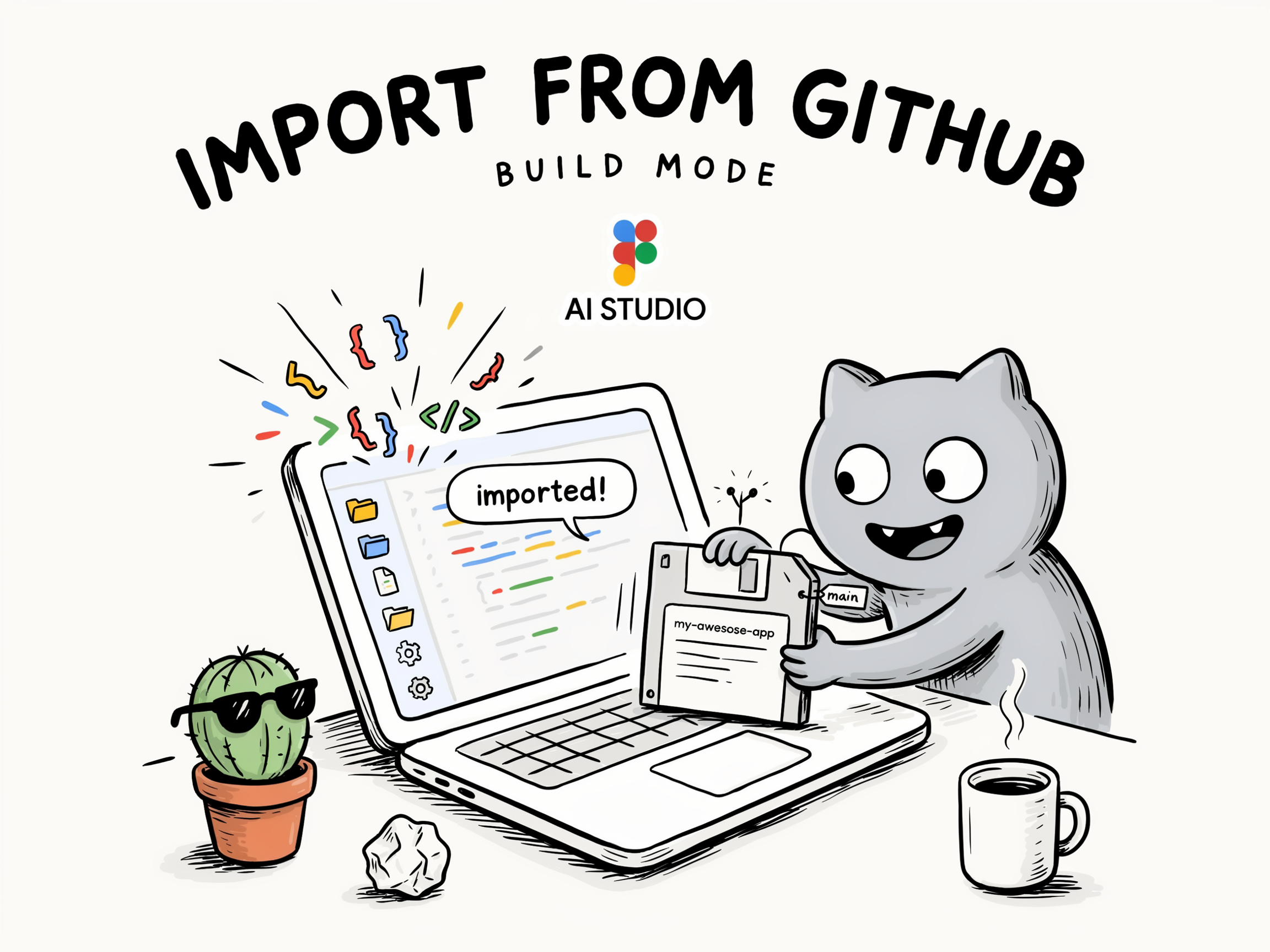
Google AI Studio Adds Import from GitHub to Build a Deployable App
The addition of the GitHub import feature in Google AI Studio enhances app development efficiency, allowing users to quickly build deployable applications from existing repositories.
- Google AI Studio has introduced an 'import from GitHub' feature in Build mode, facilitating the transformation of a repository into a runtime-compatible app.
- This feature allows users to iterate on their app and deploy directly from the GitHub import.
- AI Studio's Build mode features a 'vibe coding' interface where users can describe an app and generate a full-stack version with live previews.
Google AI Studio is a platform that allows users to build applications with the assistance of AI. The introduction of the GitHub import feature provides a new option for developers to leverage existing codebases. This update positions Google AI Studio to enhance collaborative development and streamline workflows for app builders.
Read the original ↗
Robbyant Releases LingBot-VLA 2.0: An Open-Source 6B Vision-Language-Action (VLA) Model for Cross-Embodiment Robot Manipulation
The release of LingBot-VLA 2.0 enhances cross-embodiment robot manipulation, potentially improving the deployment of versatile robots in real-world tasks.
- Robbyant has released LingBot-VLA 2.0, an open-source vision-language-action model for robots that unifies 20 robot embodiments in one action space.
- The new model features upgrades in generalization, expanded action space, and predictive dynamics modeling, with a focus on practical deployment.
- The model is trained on approximately 60,000 hours of curated data, including human videos and robot trajectories across various configurations.
Robbyant is a subsidiary of Ant Group, specializing in robotics and AI technologies. LingBot-VLA 2.0 is a successor to its previous VLA model, designed to improve robot performance in real-world applications. Future developments will likely focus on refining the model and expanding its use cases in automated tasks.
Read the original ↗
Netflix AI Team Cuts Wide-Partition Read Latency from Seconds to Milliseconds by Splitting Cassandra Partitions Per ID
This development significantly enhances data retrieval efficiency in Netflix's TimeSeries platform, crucial for maintaining seamless customer experiences in streaming services reliant on timely data access.
- Netflix's engineering team improved read latency from several seconds to low double-digit milliseconds for wide Cassandra partitions.
- The method uses dynamic partitioning to asynchronously split partitions by TimeSeries ID without requiring application changes.
- Bloom filters and cached metadata help route reads efficiently to smaller child partitions, ensuring system stability and performance.
Netflix's TimeSeries Abstraction manages petabytes of temporal event data using Apache Cassandra, chosen for its performance attributes. As datasets grow, partition sizes can become problematic, leading to slow read times and operational challenges.
Read the original ↗