
The day's AI news, briefed
The Daily Prompt
Our AI editor reads each day's AI and robotics stories, pulls out why they matter, and links every original source — so you can keep up in minutes.
Join over 250,000 subscribers getting the latest AI news
Latest AI & Robotics News Today

Apple Just Sued OpenAI. The Allegations Are Wild.
This lawsuit highlights significant concerns over trade secret theft in the tech industry, potentially impacting competitor dynamics and legal precedents in intellectual property disputes.
- Apple filed a federal lawsuit against OpenAI and its chief hardware officer, Tang Tan, for allegedly stealing trade secrets through former employees.
- The complaint details that job candidates were directed to bring Apple parts to interviews, raising security concerns.
- Apple claims that former engineer Chang Liu accessed confidential files while employed at OpenAI, maintaining links with current Apple employees.
- The lawsuit alleges a pattern of Apple employees transferring sensitive information to OpenAI prior to their departure, including details on unreleased products.
Apple is a major technology company known for its consumer electronics and software, while OpenAI is an AI research organization. This legal dispute follows Apple's concerns about its proprietary information after the departure of numerous employees to OpenAI, especially in light of OpenAI's impending hardware developments. The outcome could set important precedents for future intellectual property disputes in the tech sector.
Read the original ↗
OpenAI and Google Quietly Sell AI Tools To Chinese Firms
The sale of AI tools by OpenAI and Google to Chinese firms raises concerns about national security and the effectiveness of existing U.S. regulations regarding technology exports.
- OpenAI and Google confirmed supplying AI services to subsidiaries of Chinese companies Alibaba, Baidu, and Tencent, all on a Pentagon watch list.
- Current U.S. regulations allow Chinese firms to access American AI tools via subsidiaries located outside mainland China, such as in Singapore and Hong Kong.
- OpenAI has blocked direct access to its models from mainland China but permitted certain Chinese-owned businesses to use its tools abroad under monitored conditions.
OpenAI and Google are leading AI technology companies providing services worldwide. U.S. export controls currently allow specific forms of access for companies tied to military relations if they operate through subsidiary offices in certain countries. Critics argue that these regulations are insufficient to regulate technology transfers effectively.
Read the original ↗
Meta removes controversial AI feature on Instagram after backlash
Meta's removal of a controversial AI feature highlights the challenges tech companies face when balancing innovation with user control and ethical considerations regarding content use.
- Meta has removed an AI feature on Instagram that allowed users to modify photos from public accounts, following user backlash.
- The feature was intended to enhance creativity but faced criticism for lacking notifications to original content creators.
- Meta stated that they heard feedback indicating the feature 'missed the mark' and is now unavailable.
Meta is a leading technology company known for its social media platforms and AI developments. The removed feature was part of their recent AI tools rollout, specifically Muse Image, aimed at generating images through public Instagram account references. This incident raises questions about how AI integration on social media will evolve in the future.
Read the original ↗
Apple Is Suing OpenAI for Allegedly Stealing Hardware Secrets
This lawsuit highlights significant concerns regarding intellectual property protection in the tech industry and could set important legal precedents for trade secrets in AI hardware development.
- Apple has filed a lawsuit against OpenAI, alleging theft of trade secrets including unreleased parts and confidential designs.
- The lawsuit claims OpenAI's hardware chief, Tang Tan, coached departing Apple employees on how to evade data security protocols.
- Apple has accused OpenAI of encouraging employees to bring confidential Apple files and technology during job interviews.
- OpenAI has hired over 400 former Apple employees, with some involved in developing AI-powered consumer devices.
- Apple is seeking an injunction against OpenAI and monetary damages for the alleged theft of its proprietary information.
Apple and OpenAI have previously partnered to integrate ChatGPT into Apple devices. The lawsuit indicates a deteriorating relationship, as Apple has shifted towards Google's AI technology. The tech industry increasingly faces high-stakes battles over intellectual property rights.
Read the original ↗
OpenAI's browser isn't dead, it just moved to the ChatGPT app
OpenAI's shift from the Atlas browser to integrated features in the ChatGPT app highlights a new strategic approach in its product offerings amid competitive market pressures.
- OpenAI announced the deprecation of its Atlas browser, effective August 9, amid speculation about the company's commitment to the browser market.
- The updated ChatGPT desktop app combines ChatGPT, Codex, and new browsing features, moving towards a 'super app' concept.
- OpenAI's new Chrome extension directly competes with Google's Gemini, enabling users to interact with web content more effectively.
OpenAI is a leading AI research and deployment company known for developing advanced models like ChatGPT. The company has been transitioning to a more integrated platform, and the discontinuation of Atlas reflects a strategic refocusing on broader capabilities rather than standalone products. Future updates from OpenAI should clarify its ongoing product strategy and user engagement.
Read the original ↗
Apple calls OpenAI's hardware business 'rotten to its core' in trade secret theft lawsuit
This lawsuit highlights significant legal tensions between major tech companies, raising questions about trade secret protections and the competitive landscape in AI hardware development.
- Apple is suing OpenAI and two former employees for allegedly stealing trade secrets related to hardware technology.
- The lawsuit attributes misconduct to OpenAI's acquisition of io Products, a startup led by Jony Ive, for its involvement in the alleged theft.
- Apple claims that over 400 of its former employees have joined OpenAI and that OpenAI's hiring practices aim to elicit confidential information from them.
- OpenAI's Chief Hardware Officer Tang Yew Tan is accused of soliciting confidential Apple information during job interviews.
Apple alleges that OpenAI has been involved in a coordinated theft of trade secrets, which features both former employees and a startup acquired by OpenAI. This lawsuit comes amid an ongoing partnership between Apple and OpenAI for certain technology integrations.
Read the original ↗
Apple sues OpenAI over alleged trade secret theft
This lawsuit highlights the increasing tension in the tech industry over intellectual property and trade secrets, which could impact competition and innovation in AI hardware development.
- Apple has filed a lawsuit against OpenAI for alleged trade secret theft and breach of contract.
- The lawsuit claims OpenAI's Chief Hardware Officer, Tang Tan, directed misconduct to recruit Apple employees using confidential information.
- Apple alleges that departing employees were coached on how to evade security and share sensitive details about Apple's products.
- The complaint suggests that OpenAI may have used Apple's proprietary information in developing its own hardware, potentially a competitor to the iPhone.
Apple is a leading technology company known for its devices like the iPhone and iPad. This lawsuit follows reports that OpenAI is venturing into hardware development, believed to include a competitor to Apple's devices. Monitoring the legal case's outcomes may reveal more about industry practices regarding intellectual property.
Read the original ↗
Kyutai Releases MuScriptor: An Open-Weight Decoder-Only Transformer for Multi-Instrument Music Transcription...
The release of MuScriptor enhances the field of automatic music transcription, potentially transforming how musicians and researchers access and manipulate multi-instrument recordings.
- Kyutai and Mirelo have released MuScriptor, an open-weight decoder-only Transformer designed for transcribing multi-instrument music into MIDI format.
- The model utilizes a pipeline that synthesizes MIDI from audio, currently employing three weight variants: small, medium, and large.
- Training consists of pre-training on 1.45 million MIDI files, fine-tuning on 170,000 real recordings, and reinforcement learning on 300 verified tracks.
- MuScriptor features instrument conditioning, improving prediction accuracy and allowing customization for specific instruments during transcription.
MuScriptor is aimed at improving automatic music transcription (AMT), which converts audio recordings to symbolic music notation. Previous solutions have been more effective for single instruments. The ongoing advancements in AMT technology, such as MuScriptor, are likely to broaden applications in music production and education.
Read the original ↗
Claude Sonnet 5 Review: I Let It Research Its Rivals
AI models like Claude Sonnet 5 are crucial in advancing productivity and efficiency in professional tasks, promising significant economic contributions through improved performance in complex workflows.
- Claude Sonnet 5 is Anthropic's latest AI model, launched on June 30, 2026, designed to handle complex tasks independently.
- The model excels at coding, research, and multi-step tasks, positioning it as an all-around solution for professionals.
- Claude Sonnet 5 can use tools like browsers and terminals to aid in task execution, significantly enhancing its research capabilities.
Anthropic's Claude model series now includes Sonnet 5, which improves upon previous versions by offering better task handling and coding performance. Organizations are increasingly turning to advanced AI systems for complex work as generative AI technology evolves and becomes more integral to various workflows.
Read the original ↗
Hugging Face’s CEO on why companies are done renting their AI
The shift from renting to owning AI technology could reshape how companies approach AI development, promoting competition and innovation across the industry.
- Hugging Face CEO Clem Delangue noted that many companies are transitioning from expensive frontier APIs to open source AI models as they scale.
- The company has become a platform similar to GitHub for AI, facilitating the sharing and downloading of models and datasets among users, including half of the Fortune 500.
- Delangue expressed concerns that control of AI technology could fall into the hands of just a few large corporations.
- Discussions about the implications of open versus closed source AI are becoming critical, particularly following issues with Anthropic's plans.
Hugging Face is a hub for open source AI development, allowing users to share tools and resources. The trend toward open source has grown as companies seek more cost-effective options compared to proprietary APIs. Future developments in AI regulation and company strategies will be influenced by how these models evolve.
Read the original ↗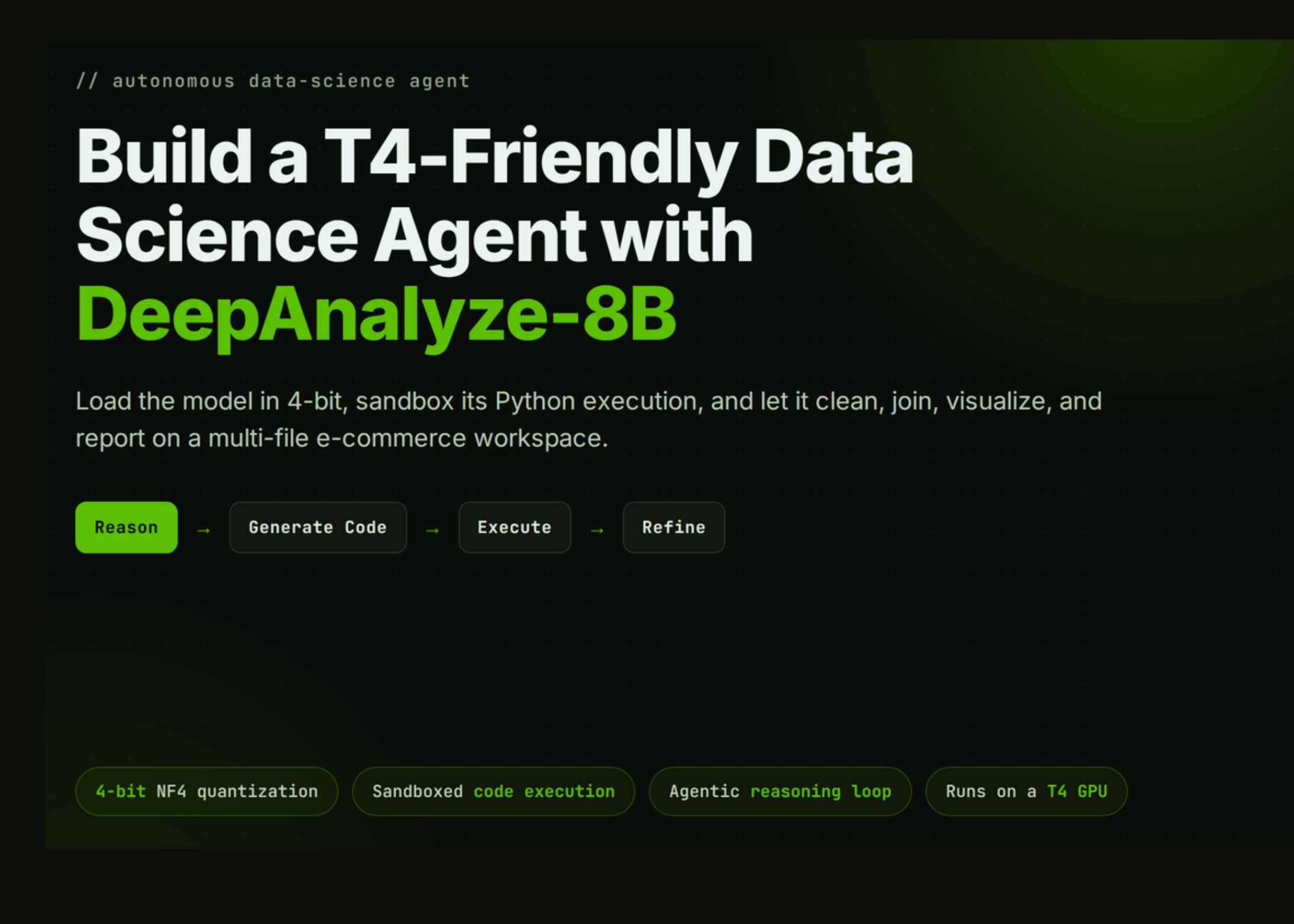
How to Build a T4-Friendly Autonomous Data Science Agent with DeepAnalyze-8B, Sandboxed Code Execution, and Iterative Analysis
The development of an autonomous data science agent using DeepAnalyze-8B marks a significant advancement in automating data analysis processes, enhancing efficiency in various applications such as e-commerce.
- The tutorial shows how to build an autonomous data science agent around DeepAnalyze-8B, which is designed for analyzing e-commerce data.
- The model is loaded in 4-bit mode to optimize usage on limited GPU memory, particularly for T4 GPUs.
- A sandboxed execution environment allows the agent to generate and run Python code safely, facilitating an iterative analysis loop.
- The agent processes multi-file e-commerce datasets by cleaning, joining, visualizing, and summarizing data into a structured report.
- Finally, the agent displays its analysis results alongside visual outputs generated during the workflow.
DeepAnalyze-8B is a machine learning model that enhances data analysis capabilities in autonomous agents. This tutorial provides detailed instructions on setting up such an agent within a controllable framework. Future developments may involve extending the capabilities and applications of autonomous data science agents in various domains.
Read the original ↗
Pentagon Releases New Batch of UAP Videos and Historical Files, But Clarity Remains Elusive
The Pentagon's release of new UAP materials highlights ongoing government efforts to address public interest in aerial phenomena, although it does not provide clear answers regarding their nature or origin.
- The U.S. Department of War released a collection of UAP materials, including previously unseen military videos, as a part of its Presidential Unsealing and Reporting System for UAP Encounters (PURSUE).
- The latest files include historical images from the 1996 STS-80 mission showing unidentified objects captured by Space Shuttle astronauts.
- Most new videos show blurry objects with limited details, leaving their true nature largely speculative, similar to prior releases.
- The DOW plans to continue releasing additional UAP files on a rolling basis, with expectations for future updates in the coming weeks.
Unidentified anomalous phenomena (UAP) refer to objects observed in the sky that cannot be easily identified. The Pentagon has made several prior releases of UAP-related materials to increase transparency and address public curiosity. Observers continue to seek clarity on these items' nature and implications for national security.
Read the original ↗
SK Hynix raises $26.5B in the biggest foreign IPO in US history, is urged to build new US fabs
The successful IPO of SK Hynix signifies increased global competition in the memory chip market, particularly as the U.S. government encourages domestic semiconductor manufacturing.
- SK Hynix raised $26.5 billion in its U.S. IPO, the largest ever by a non-American company, surpassing Alibaba’s record from 2014.
- The company sold 177.9 million American depositary shares at $149 each, generating significant demand with bids exceeding available shares sevenfold.
- Commerce Secretary Howard Lutnick is discussing with SK Hynix and Samsung about building new chip factories in the United States.
SK Hynix is a leading South Korean memory chip producer, particularly known for high-bandwidth memory crucial for AI applications. As global reliance on advanced chips grows, U.S. policy is increasingly focused on boosting domestic semiconductor production.
Read the original ↗
AI ‘Ghosts’ Offer New Opportunities for Conversations with Deceased Loved Ones, Study Reveals
The study reveals user interest in AI technologies that simulate conversations with deceased loved ones, highlighting the potential for emotional benefits and the need for careful design and support in their use.
- A study at the University of Colorado Boulder documented conversations between participants and AI models simulating deceased individuals, termed 'generative ghosts.'
- Sixteen participants reported that these simulated interactions provided a sense of closure, preferring first-person AI responses over third-person descriptions.
- Participants valued emotional tone and conversational style, prioritizing authenticity over factual accuracy in their interactions with the AI.
- Participants expressed a willingness to use the technology again but highlighted concerns about unregulated access for grieving individuals.
- The research team plans to collaborate with mental health professionals in future studies to assess the psychological impacts of using these AI grief tools.
Generative ghost technology involves AI systems that use data from deceased individuals to facilitate simulated conversations. The study underlines the importance of emotional resonance in these interactions. Future research aims to understand the mental health implications of prolonged use of such technologies.
Read the original ↗
For the Last Century, This Creature Was Thought to Only Exist in Hawaii—and Scientists Just Spotted One in the Himalayas
The discovery of the Himalayan Happy-Face spider suggests that biodiversity may be richer and more complex than previously understood, challenging existing assumptions about species distribution.
- The Himalayan Happy-Face spider, named Theridion himalayan, was discovered in Uttarakhand, India, where it was previously thought not to exist.
- This discovery was made accidentally by researchers initially studying ants, leading to the identification of 32 distinct color variations of the spider.
- DNA analysis shows that the Himalayan Happy-Face spider differs by about 8.5% from its Hawaiian counterpart, indicating independent evolution.
- The species has been found in three locations in Uttarakhand: Makku, Tala, and Mandal.
- The research raises questions about the functional role of the spider's color patterns and its evolutionary connection to Hawaiian species.
The Happy-Face spider is a species originally known only from the Hawaiian Islands. This latest discovery illustrates a significant finding in spider biodiversity and evolution, with researchers planning further studies to explore its ecological role.
Read the original ↗
A New Experiential Gallery Just Might Change Your Mind About AI Art
Dataland represents a significant shift in how AI is integrated into the art world, aiming to reshape perceptions of AI-generated creativity while addressing ethical concerns around data use.
- Dataland, opened on June 20 in Los Angeles, is the first museum dedicated to AI arts, attracting over 10,000 visitors in its first two weeks.
- The gallery features immersive installations that use visitors' biometric data to create interactive experiences like 'Machine Dreams: Rainforest.'
- Artist Refik Anadol highlights the importance of ethical data sourcing, contrasting Dataland's practices with those of larger tech companies.
- Dataland incorporates a unique environmental focus, showcasing AI's potential to enhance artistic engagement with nature rather than merely generate images.
- The exhibit aims to redefine AI art by emphasizing the emotional connection and interactive experiences it can foster among visitors.
Dataland is co-founded by artist Refik Anadol, known for exploring human-machine relationships through technology-based art. The gallery aims to counteract skepticism surrounding AI art by integrating ethical practices and interactive installations. Future developments may involve more exhibits that rethink the relationship between technology and emotional experiences in art.
Read the original ↗
Restoration of Claude Fable 5, Gemini's Video Dev Engine, DeepSeek Speeds Up Speculative Decoding
The return of Claude Fable 5 highlights ongoing regulatory challenges in AI development, while improvements in DeepSeek's text generation technology could significantly enhance efficiency in AI applications.
- Claude Fable 5 and Claude Mythos 5 were recently reinstated to the market after being suspended by the U.S. government.
- DeepSeek has released an open-source speculative decoding module that accelerates text generation by over 50% without loss of accuracy.
- Google's Gemini project now integrates a rapid image-to-video pipeline for developers, combining its latest image model with a multimodal video model.
Claude Fable 5 is a generative AI model developed by Anthropic, facing regulatory scrutiny that temporarily halted its use. DeepSeek specializes in high-efficiency text generation technologies, while Gemini is Google's multimedia AI initiative aimed at enhancing developer tools for media applications. Future developments include advancements in AI regulatory frameworks and continuing improvements in multimedia AI capabilities.
Read the original ↗
Artificial Intelligence (473)
Advancements in artificial intelligence are crucial as they continue to shape various industries and improve efficiencies in tasks ranging from data processing to automation.
- A new pipeline for local video summarization has been developed.
- The pipeline processes frames using a model named SmolVLM2-2.2B.
Artificial intelligence, or AI, refers to systems that can perform tasks typically requiring human intelligence, such as understanding natural language or recognizing patterns. The rise of AI technologies has led to innovations in automation, machine learning, and data analysis. Future developments in local video summarization could enhance media processing workflows significantly.
Based on the headline only — the full article could not be fetched.
Read the original ↗
GPT-5.6 Is Here: Sol, Terra, and Luna
The public release of GPT-5.6, featuring three distinct models, has significant implications for industries relying on AI, particularly in coding, security, and productivity tools.
- GPT-5.6 is launched today, making three models—Sol, Terra, and Luna—accessible to all users without a subscription.
- The models feature varying capabilities, with Sol designed for complex tasks, Terra for general-purpose use, and Luna as a low-cost option.
- New pricing structures include a Sol Fast tier offering increased speed at a premium, differentiating OpenAI's offerings for latency-sensitive applications.
- Advanced safety features in GPT-5.6 focus on preventing misuse in cyber and biological domains while enhancing user privacy and security measures.
OpenAI's GPT-5.6 is the latest version of their generative pre-trained transformer model, simplifying its naming convention and introducing advanced capabilities. This release follows the previous GPT-5.5 and aims to offer enhanced performance across various task types. As AI technologies evolve, interest will shift to their applications and integration into existing workflows.
Read the original ↗
MedSkillAudit: A Domain-Specific Audit Framework for Medical Research Agent Skills
The development of MedSkillAudit could enhance the reliability and governance of AI applications in healthcare, addressing the unique challenges of medical research agent skills.
- MedSkillAudit is a domain-specific audit framework assessing medical research agent skills for reliability prior to deployment.
- The study evaluated 75 skills across five medical research categories, focusing on quality and readiness for deployment.
- MedSkillAudit achieved a consistency rating of 0.449, surpassing the human inter-rater agreement score of 0.300, indicating effective assessment.
- The framework addresses critical elements like scientific integrity and methodological validity, which are vital for dependable healthcare applications.
MedSkillAudit provides a structured approach to evaluate the readiness and quality of AI skills used in medical research. This first version aims to complement existing quality checks tailored to scientific governance needs. Future developments may focus on refining its assessment processes and expanding its application across more medical research domains.
Read the original ↗