
The day's AI news, briefed
The Daily Prompt
Our AI editor reads each day's AI and robotics stories, pulls out why they matter, and links every original source — so you can keep up in minutes.
Join over 250,000 subscribers getting the latest AI news
Latest AI & Robotics News Today

LightNav-0: Eliciting VLM Spatial Intelligence for Generalist Embodied Navigation
The development of LightNav-0 enhances the capabilities of robots in navigating complex environments by utilizing advanced vision-language models, potentially improving automation across various applications.
- LightNav-0 is a generalist navigation model that utilizes a pretrained vision-language model's spatial reasoning for embodied navigation.
- It integrates a unified token interface to represent diverse navigation tasks without using task-specific components.
- The model supports instruction following, open-vocabulary object navigation, and visual tracking, achieving state-of-the-art performance in various simulations.
LightNav-0 improves upon existing navigation systems which often require specific adaptations for different tasks. This model demonstrates the potential of compact vision-language models to offer versatile navigation solutions. Future developments may focus on further real-world applications and enhancements in generalization capabilities.
Read the original ↗
Anthropic Announces Enterprise Frontier Safeguards, Customer-Held Data
Anthropic's new Enterprise Frontier Safeguards (EFS) will enable enterprises to enhance security while maintaining control over customer data, addressing significant concerns about AI misuse.
- Anthropic announced its Enterprise Frontier Safeguards (EFS) on September 1, 2026, designed to help enterprises manage data privacy and detect misuse of AI.
- EFS allows customers to store activity data in their own cloud infrastructure, maintaining control with zero data retention policies when desired.
- The rollout of EFS will begin later in fall 2026 and was developed in collaboration with over 100 enterprise customers across various industries and cloud partners.
Anthropic is an AI company focused on developing advanced AI technologies while addressing safety and regulatory concerns. EFS aims to balance data privacy with the need for ongoing monitoring to prevent misuse of AI systems. Future updates will likely include enhancements based on customer feedback and use cases across regulated industries.
Read the original ↗
Google Pics Rolls Out to Workspace Customers and AI Subscribers
Google Pics enables improved professional image creation and editing for businesses, responding to a growing need for efficient tools in marketing and design.
- Google has begun rolling out its AI image creation and editing tool, Google Pics, to Workspace business customers and AI subscribers on September 1, 2026.
- Pics integrates into Google Docs and Slides and will support Google Drive editing in the coming weeks.
- The tool allows users to generate images from text prompts, edit images at the object level, and collaborate with multiple users on the same project.
Google Pics is an AI tool that combines image generation with editing features, built on the company’s Nano Banana model. Initially announced at I/O 2026, it has moved beyond the testing phase to fulfill business demands for high-quality images. Future updates will enhance integration with Google Drive.
Read the original ↗
GoPro to be acquired for $285M, will remain a public company
The acquisition aims to capitalize on GoPro's intellectual property while addressing national security concerns by bringing manufacturing of critical components back to the U.S.
- GoPro is being acquired by Starman Optical for $285 million, with shareholders receiving $1.14 per share.
- The merger will erase GoPro's $92 million debt and allows existing shareholders to retain about 10% of the new company.
- Starman Optical plans to enhance GoPro's operations, expanding into consumer, commercial, and defense markets while maintaining support for current products.
GoPro, known for its action cameras, has faced financial hardships and previously hinted at shifting to defense technology. The merger with Starman Optical, a new player in photonics and optical technology, marks a strategic pivot for GoPro.
Read the original ↗
ChatGPT Health adds Epic integration for clinicians to import patient data
The integration of ChatGPT Health with Epic's EHR system enhances clinician efficiency by allowing direct access to patient data, which can improve care outcomes while maintaining data privacy.
- OpenAI's ChatGPT Health will integrate with Epic’s electronic health record system, allowing clinicians to import patient data from records of over 325 million patients.
- The integration provides read-only access, enabling clinicians to view appointment notes, lab results, and medications without modifying the records.
- Clinicians can use ChatGPT to prepare for appointments, review patient history, and identify changes, streamlining their workflow.
- OpenAI is introducing a Healthcare Public Data plug-in to access clinical trial data, medication identifiers, and provider records, assisting healthcare workers in synthesizing necessary information.
- Despite its deep integration, OpenAI reaffirms that AI should not be used for diagnosis or treatment.
OpenAI's ChatGPT Health is designed to assist clinicians by leveraging artificial intelligence to analyze patient data. The integration with Epic's EHR system means enhanced workflow efficiency for healthcare professionals. Future developments may focus on expanding this technology's capabilities while addressing safety concerns related to AI in healthcare.
Read the original ↗
Google’s answer to Canva is an AI tool where you prompt instead of design
Google's entry into the design market with an AI tool may challenge established services like Canva and Adobe, altering how users approach image creation and editing.
- Google has launched Google Pics, an AI-powered image-creation and editing tool, as part of its Google Workspace suite.
- This tool is designed for everyday design tasks, allowing users to create posters and social media visuals based on prompts instead of manual design.
- Unlike competitors like Canva, Google Pics does not support a marketplace for artists to sell templates and graphics.
- The app includes tools for object isolation, text modification, and collaborative editing, and will be integrated into Google Docs and Slides.
- Google Pics will progressively roll out to Workspace customers and premium Google AI subscribers over the coming weeks.
Google Pics is an AI-driven tool designed to streamline creative tasks, contrasting with current offerings from Canva and Adobe Express. As users increasingly demand efficiency in design, Google aims to address these needs through its Workspace platform. Future updates may expand its functionalities and accessibility.
Read the original ↗
DreamX-Creator: Democratizing Native Audio-Video Generation at 2K Resolution
DreamX-Creator 1.0 enhances the capabilities of audio-video generation by integrating audio and video streams in one system, thereby improving the quality and coherence of generated content.
- DreamX-Creator 1.0 is a 7B joint audio-video generator that produces high-resolution synchronized outputs at 2K resolution.
- The system utilizes advanced machine learning techniques such as cross-modal attention and reinforcement learning with multimodal feedback.
- A unique refinement pipeline allows for high-quality output with an autoregressive approach, increasing efficiency in generation processes.
DreamX-Creator represents a significant advancement in the field of multimedia generation by offering a combined audio-video generation model that operates natively together. Existing models usually treat audio and video separately, which can limit their effectiveness. Future developments may focus on further refining the technology or expanding its applications in various multimedia contexts.
Read the original ↗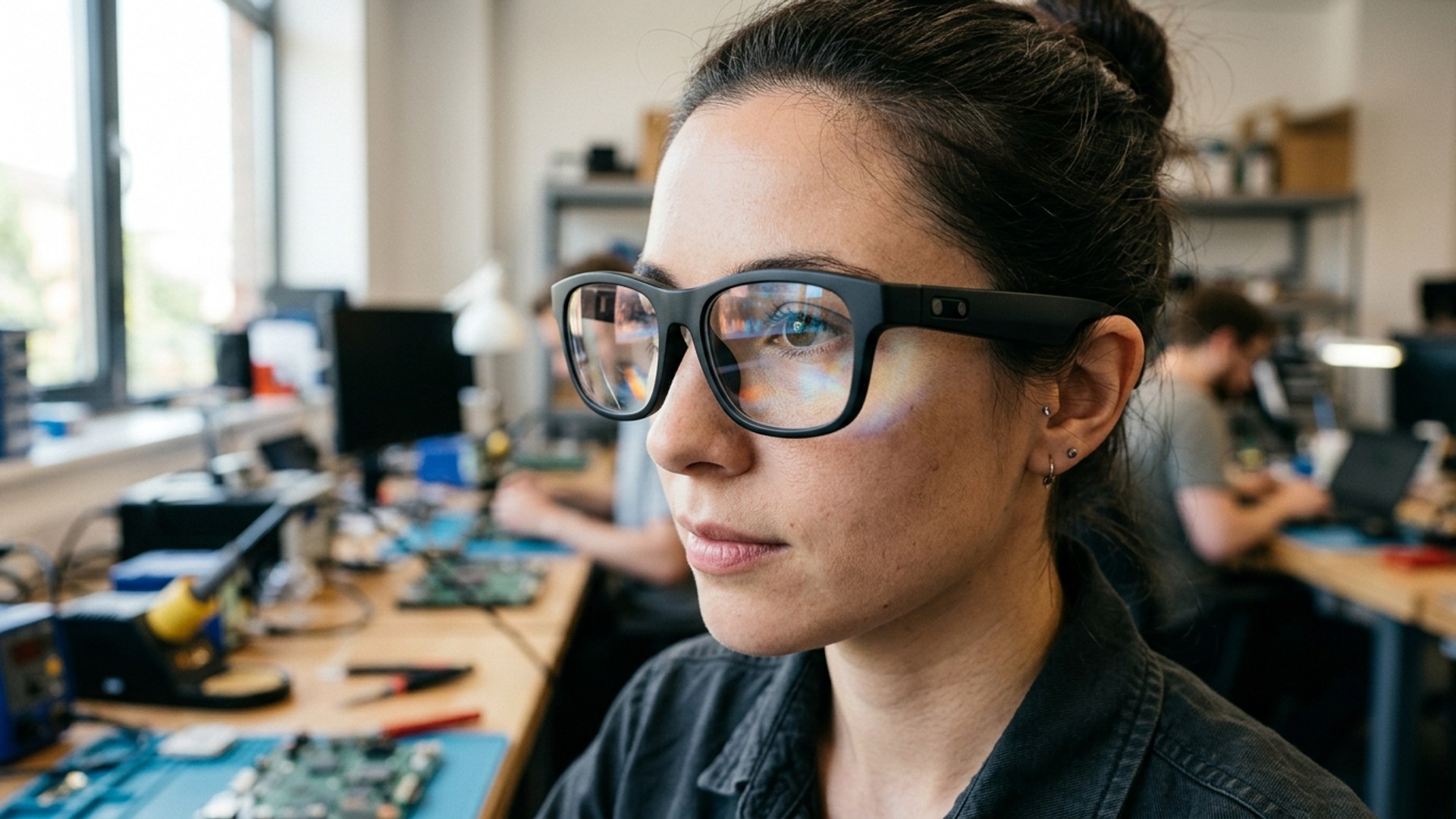
Lumus Licenses Waveguides to Quanta for AI Glasses Production
The partnership between Lumus and Quanta aims to advance augmented reality technology by producing lighter, cost-effective optical components, potentially enhancing consumer and enterprise applications.
- Lumus has licensed geometric waveguide technology to Quanta Computer for producing next-generation AR glasses optics.
- The agreement includes the Z-30 2.0 waveguide and A-Lens family, aimed at reducing size and manufacturing costs while maintaining quality.
- Quanta has been a partner of Lumus since 2016, with a history of achieving high production yields in waveguide manufacturing.
Lumus develops optical systems for augmented reality glasses, and its waveguides transfer projected images to the user's eyes. The new partnership with Quanta solidifies their ongoing collaboration to scale production effectively, reflecting a broader trend in AR technology development.
Read the original ↗
Salesforce Leads $166M HiBob Funding Round at $3.2B Valuation as AI Strategy Expands
This significant funding round indicates a larger trend of integrating advanced AI capabilities into workforce management systems, reflecting evolving needs in business operations.
- HiBob raised $166 million in a funding round led by Salesforce at a valuation exceeding $3.2 billion, marking its largest funding round to date.
- The new funding brings HiBob's total capital raised to over $700 million and is a substantial increase from its 2023 valuation of approximately $2.66 billion.
- HiBob is repositioning its platform to serve as an organizational intelligence layer that can enhance AI systems with data about company operations and workforce management.
- The investment aims to broaden HiBob's capabilities beyond traditional HR functions, integrating AI to manage both human and AI labor.
HiBob is known for its Bob platform, which provides a modern approach to human capital management such as HR and payroll services. As companies increasingly adopt AI, HiBob seeks to expand its functionalities and integrate AI technologies into workforce management. Future developments may focus on managing hybrid teams of humans and AI systems.
Read the original ↗
David Pinn, CEO of Brain Corp – Interview Series
Understanding the strategic insights of Brain Corp's CEO sheds light on the evolving role of robotics in enterprises and the shift towards software-driven solutions for operational efficiency.
- David Pinn became CEO of Brain Corp in 2022 after nearly nine years at the company, focusing on strategy and financial operations.
- Brain Corp develops BrainOS®, an autonomy platform for managing autonomous robots in various commercial environments.
- Pinn emphasizes that businesses seek measurable operational outcomes rather than just robotic technology itself.
- He critiques the industry's focus on humanoid robots, arguing that wheeled robots are more practical for commercial use cases.
- Effective autonomous systems must adapt to unexpected challenges in real-world environments, which requires complex engineering and operational learning.
Brain Corp is a robotics and AI company that provides an operating system for autonomous robots, primarily focusing on applications like floor cleaning and data capture. The company has transitioned from hardware to a software-centric model, powering over 50,000 robots globally. Following this, the sector is watching how Brain Corp's strategies impact robotics integration in various industries.
Read the original ↗
John Deere Puts JD AI Assistant Into Operations Center
John Deere's introduction of the JD AI assistant aims to enhance decision-making for farmers by providing tailored insights quickly, responding to a growing need for efficient data utilization in agriculture.
- John Deere launched JD, an AI assistant, within its Operations Center platform on September 1, 2026, during the Farm Progress Show in Iowa.
- JD enables farmers to ask natural-language questions and receive customized answers based on their operational data.
- The tool is part of an Early Access Program available to select U.S. agricultural customers, with universal availability planned for later in 2026.
- The JD assistant is designed to help farmers analyze data concerning fuel use, planting, and harvest timing without navigating complex dashboards.
- John Deere emphasizes its Farmer Data Commitment, ensuring farmers retain control over their data while using the assistant.
John Deere's Operations Center is a digital farm management system that helps farmers manage their resources effectively. The JD AI assistant aims to simplify the use of farm data for better decision-making. Upcoming features may extend the assistant's functionality beyond agricultural use to other sectors like construction and forestry.
Read the original ↗
Apple Says It Has New Shocking Proof Against OpenAI
The outcome of Apple's lawsuit could significantly impact both companies and the legal landscape around trade secrets in the tech industry.
- Apple filed new evidence in its lawsuit against OpenAI, alleging trade-secrets theft by former employees.
- Apple claims that OpenAI employee Chang Liu used confidential information from Apple to benefit OpenAI.
- The lawsuit includes allegations that Liu and a colleague attempted to destroy evidence following an investigation notice.
- Apple seeks a preliminary injunction to prevent OpenAI from using its technology while the case is ongoing.
Apple's lawsuit against OpenAI began in July 2026, focusing on allegations of trade-secret theft related to former employee access to sensitive materials. Attention will be on the court's response to Apple's demands for an injunction and expedited discovery, as details of the evidence remain largely redacted.
Read the original ↗
Scientists Discover Ancient Pottery Contains a Magnetic “Clock” That Can Reveal Its Past
This discovery may enhance the authentication of ancient pottery, helping to combat the forgery of artifacts and protect cultural heritage.
- Researchers at the University of California, San Diego have identified a magnetic 'clock' in ancient pottery that helps determine the age of ceramic artifacts.
- The method distinguishes genuine ancient clay artifacts from modern forgeries using thermal remnant magnetization, a property established during firing.
- Experiments showed that modern pottery lost its magnetic signature below 234°F, while ancient pottery retained it until higher temperatures.
- The technique has been tested on disputed artifacts tied to illegal antiquities trafficking, confirming their authenticity.
- Researchers plan to apply this magnetic testing method to artifacts held in museums worldwide for further validation.
Ancient pottery can hold clues to its age through magnetic properties acquired during firing. This research offers a new tool for archaeologists and curators amid ongoing challenges with fakes and forgeries in the antiquities market.
Read the original ↗
Artificial Intelligence (509)
The exploration of artificial intelligence is critical as it influences various sectors including technology, healthcare, and finance.
- The article discusses artificial intelligence developments.
- It encompasses various aspects related to AI technology.
Artificial intelligence refers to the simulation of human intelligence in machines, which can perform tasks that typically require human cognition. Companies and researchers are rapidly advancing AI technologies for applications across numerous industries. Future developments in AI may lead to significant changes in how tasks are automated and decisions are made.
Based on the headline only — the full article could not be fetched.
Read the original ↗
Perplexity's Hybrid Compute splits sensitive tasks between cloud and local AI
Hybrid Compute enhances data privacy and reduces costs for users by allowing them to manage sensitive tasks between local and cloud-based AI models.
- Perplexity's new Hybrid Compute tool enables task distribution between local AI models on computers and cloud-based models like Opus 5 or GPT-5.6 Sol.
- The approach allows users to keep sensitive data secure on their machines, which is important in fields such as law.
- Hybrid Compute is designed to lower inference costs by offloading some processing to local models, making it cost-effective for users.
- Currently, the feature is only available on Apple Silicon Macs running macOS 15 for Pro and Max subscribers and enterprise customers.
- Users can oversee which files remain local and can choose which models to use for specific tasks without needing to access terminal commands.
Perplexity is a developer of AI tools that enable autonomous task completion using AI agents. The Hybrid Compute system is built on the need for improved privacy and cost-effectiveness in AI processing. Future developments may include additional local models and broader access beyond current hardware limitations.
Read the original ↗
Fambot introduces an ‘AI chief of staff’ for families
The development of Fambot's AI chief of staff could significantly alleviate the organizational burdens many families face, helping parents manage their children's activities and schedules more effectively.
- Fambot is an AI platform designed to assist families with managing logistics such as emails, school updates, and sports schedules.
- The startup was founded by Greg Karlin and David Reich, who both have backgrounds in tech and parenting.
- Fambot connects with users' emails and calendars to provide daily checklists and proactive task management.
- The service is currently free for beta users and is expected to charge a fee similar to that of a Netflix subscription after launch.
- Fambot has already been tested by over 1,000 families and aims to cater to various family structures beyond just traditional households.
Fambot is positioning itself as an AI chief of staff for families, acknowledging the challenges parents face in managing numerous daily obligations. The service differentiates itself by not only providing updates via text but also through web and mobile applications. With significant interest in AI solutions for everyday tasks, Fambot aims to become a central hub for family communication.
Read the original ↗
AIR raises $50M to help companies vet the skills and add-ons AI agents use
The $50 million funding for AIR highlights the growing importance of monitoring and securing AI agent ecosystems as companies integrate these technologies into their operations.
- AIR has raised $50 million across two seed funding rounds to develop a platform for monitoring AI agents' skills and add-ons.
- The company can discover active agents, continuously vet their skills, and block unwanted behaviors using a whitelist approach.
- Currently, AIR claims to have more than 20 customers, predominantly from regulated industries such as financial services and pharmaceuticals.
AIR, co-founded by veterans of Israel's intelligence corps, aims to address security gaps in AI systems as they increasingly become integrated into corporate environments. The company competes in a growing space that includes players like Noma Security and Zenity, both focused on securing AI tools and agents. Upcoming developments to watch include AIR's scaling efforts in the U.S. and Europe using its newly acquired funding.
Read the original ↗
PaperGym: Rubric-Centered Evolution for Research-Plan Generation
PaperGym offers a new framework for enhancing research planning in AI by effectively converting scientific papers into training environments, which could significantly improve the capabilities of AI scientists.
- PaperGym separates research questions from evaluation criteria, enabling improved reinforcement learning for research planning.
- The framework uses structured scientific papers to create training environments that enhance methodological and experimental evaluation.
- Models trained using PaperGym outperform existing methods and receive higher scores on benchmarks, demonstrating its effectiveness.
PaperGym is designed to optimize AI training by utilizing the structure of scientific papers, distinguishing research goals from evaluation methods. Its introduction addresses the limitations of traditional reinforcement learning in research planning. Future developments may focus on its application across various AI models and research domains.
Read the original ↗
Enovis Makes Binding Offer to Acquire eCential Robotics
The acquisition will enhance Enovis's surgical capabilities by integrating advanced robotic technologies, potentially improving surgical outcomes and operational efficiency in healthcare.
- Enovis Corporation has made a binding offer to acquire eCential Robotics for an upfront enterprise value of €155 million.
- The transaction is expected to close by the end of 2026, pending regulatory approvals and consultation with eCential Robotics' works council.
- The acquisition will allow Enovis to expand its ASTRA enabling technology platform with robotic automation capabilities, complementing its existing offerings.
Enovis is a company focused on developing advanced surgical technologies, while eCential Robotics specializes in surgical navigation and robotic assistance systems. Founded in 2009, eCential is known for its Op.n platform, which integrates various surgical technologies. Following this acquisition, attention will be on how the combined companies will innovate and support surgical procedures.
Read the original ↗
I Tried $5,000 Worth of Tennis Gear to Play Better. Here’s What Happened
This story highlights the effectiveness and value of high-end technology tools designed to enhance athletic performance, an area gaining increased investment and interest.
- An expert tests over $5,000 worth of smart tennis gadgets to evaluate their impact on performance.
- The featured technologies include a $2,000 ball machine, a $400 radar gun, and training tools costing between $200 to $2,000.
- The article aims to determine which tennis tech products are worth the investment based on performance outcomes.
The article focuses on smart tennis gadgets designed to improve player skills using technology. Prior trends show a rise in sports tech aimed at enhancing training efficacy. Future developments in this area may include more affordable and accessible options for amateur players.
Read the original ↗