
The day's AI news, briefed
The Daily Prompt
Our AI editor reads each day's AI and robotics stories, pulls out why they matter, and links every original source — so you can keep up in minutes.
Join over 250,000 subscribers getting the latest AI news
Latest AI & Robotics News Today

From Digital to Spatial: How AI Is Changing the Economics of Immersive Learning
The incorporation of AI in spatial learning could significantly enhance educational methods and accessibility, transforming how students engage with complex subjects across various disciplines.
- AI is enhancing spatial learning by automating the creation of interactive 3D content, thus addressing previous economic barriers in educational curricula.
- Research indicates that extended reality (XR) technologies improve learning outcomes, with 80% of students using XR finding it beneficial for studying anatomy.
- Generative AI is being adopted by educators to streamline lesson planning and content development, with 60% of teachers reporting its use in their work.
Spatial learning leverages immersive 3D environments to enhance educational experiences, particularly in complex subjects like anatomy and chemistry. Historically, creating high-quality 3D content was economically challenging, but recent advancements in AI are streamlining this process. The future of spatial learning will focus on integrating AI tools effectively within existing curricula while ensuring educational integrity.
Read the original ↗
Boehringer Ingelheim Licenses Owkin’s K Pro AI Scientist and Patient Data
This agreement could significantly enhance drug discovery processes in oncology and immunology, potentially leading to faster development of new therapies for patients.
- Boehringer Ingelheim has licensed Owkin's K Pro AI Scientist and multimodal patient data to accelerate research in cancer and immune disorders.
- Owkin will generate new multimodal data in immunology, complementing existing oncology data under this agreement.
- The partnership follows a successful 2025 pilot where Owkin provided insights into the tumor microenvironment using its MOSAIC dataset.
Owkin is a company focused on leveraging AI in biopharma research, aiming to develop biological artificial superintelligence. Their K Pro platform helps researchers analyze extensive patient data effectively. Previous collaborations with major pharmaceutical firms indicate a trend towards integrating AI in drug development.
Read the original ↗
Using High-Energy Laser, US Shoots Down Drones Near Mexico Border
The deployment of high-energy laser systems highlights a significant advancement in defense technology aimed at countering drone threats in border security operations.
- The US Army shot down three drones near the Mexico border using a high-energy laser on August 25-26.
- This operation was led by the Joint Task Force Southern Border as part of efforts to protect military personnel and Customs and Border Protection agents.
- The Army utilized the Locust Laser Weapon System, which operates at 20 kilowatts to detect and disable targets through focused light beams.
The Locust Laser Weapon System, developed by AeroVironment, is part of a military initiative to enhance defense capabilities against drones. This technology, initiated in September 2025, represents a new approach to border security, especially concerning drug trafficking operations.
Read the original ↗
Artificial Intelligence (510)
Understanding real-world applications of agentic AI in enterprise automation can provide insights into how businesses are leveraging this technology for operational efficiency.
- The article discusses five real-world applications of agentic AI in enterprise automation.
- Agentic AI refers to AI systems that can act autonomously within specified parameters.
Agentic AI, or autonomous AI, is increasingly being integrated into various business processes to enhance productivity and decision-making. The growth of AI technologies in enterprise settings is reshaping industries by streamlining operations and enabling new capabilities.
Based on the headline only — the full article could not be fetched.
Read the original ↗
Acer Unveils Veriton RI110 Mini Workstation for Local Agentic AI
The introduction of the Veriton RI110 Mini Workstation represents a significant advancement in local AI computing, aimed at enhancing security and efficiency for organizations handling AI workloads.
- Acer unveiled the Veriton RI110 Mini Workstation, built with an Intel Core Ultra X7 processor and Intel Arc B390 graphics, for advanced AI model support.
- The workstation supports AI models up to 120 billion parameters and features up to 96 GB of LPDDR5X memory and 4 TB of PCIe Gen 4 SSD storage.
- Networking capabilities include Wi-Fi 7, Bluetooth 5.4, and multiple LAN ports, while security features include a fingerprint authenticator and a Kensington lock slot.
- Acer's Qubi Claw software offers agentic AI functionalities for task automation and is designed to operate in a secure, sandboxed environment.
- The Veriton RI110 will launch in North America in Q4 2026 and in EMEA in Q1 2027, with regional variations in specifications and pricing.
The Acer Veriton RI110 Mini Workstation targets organizations requiring high-performance AI computing for local and cloud resources. Local agentic AI refers to AI that operates in a specific environment with enhanced privacy measures. Future developments will likely focus on expanding the capabilities and skills of the Qubi Claw software.
Read the original ↗
Acer Introduces Compact SFF RTX Spark Desktop for Local Agentic AI
The Acer SFF RTX Spark desktop could enhance local AI computing capabilities, impacting creators and developers by enabling on-device processing that prioritizes data privacy.
- Acer has introduced the SFF RTX Spark desktop, designed for local agentic AI workloads, using NVIDIA's RTX Spark superchip.
- The desktop features a compact design with a 6,144-core Blackwell RTX GPU and a 20-core NVIDIA Grace CPU, supporting up to 1 petaflop of AI compute.
- This system aims to combine compute performance with data privacy, making it suitable for AI developers, creators, and gamers.
Acer, a global tech company founded in 1976, has been expanding its product lines to include advanced computing solutions. The RTX Spark superchip, developed by NVIDIA, integrates AI and graphics capabilities for personal computers, marking a significant advancement in local AI processing technology.
Read the original ↗
What Is Model Quantization? How Lower Precision Makes AI Faster and Cheaper
Model quantization optimizes AI performance by lowering precision, impacting cost and efficiency in technology that requires rapid data processing.
- Model quantization reduces memory usage, storage needs, and inference latency by representing model components with fewer bits.
- This technique contrasts with model pruning, which eliminates parameters or connections entirely, affecting the model's structure differently.
- A five-stage process outlines model quantization: choosing formats, estimating scales, converting precision, calibrating, and benchmarking.
Model quantization is a crucial technique in AI that focuses on optimizing models for faster performance. It allows systems to function efficiently with reduced resources while maintaining quality. Understanding its implications is essential for advancements in AI applications and technology utilization.
Read the original ↗
Pangram Has Emerged as the Gold Standard of AI Detection. Should You Trust It?
As AI-generated content proliferates, understanding the reliability of AI detection tools like Pangram is crucial for writers and publishers alike.
- Pangram, a Brooklyn-based AI startup, aims to detect the extent of AI involvement in text, claiming to be the gold standard in AI detection.
- After raising $13 million, Pangram's technology gained attention following allegations that several published works were largely AI-generated.
- High-profile cases include a canceled Hachette novel and various other works reported as AI-generated, raising concerns about literary authenticity.
Pangram, founded in 2023, utilizes AI detection methods to evaluate text authenticity, responding to growing speculation around AI's role in creative writing. Its detection capabilities have gained traction amid increasing scrutiny of AI-generated content within publishing and education.
Read the original ↗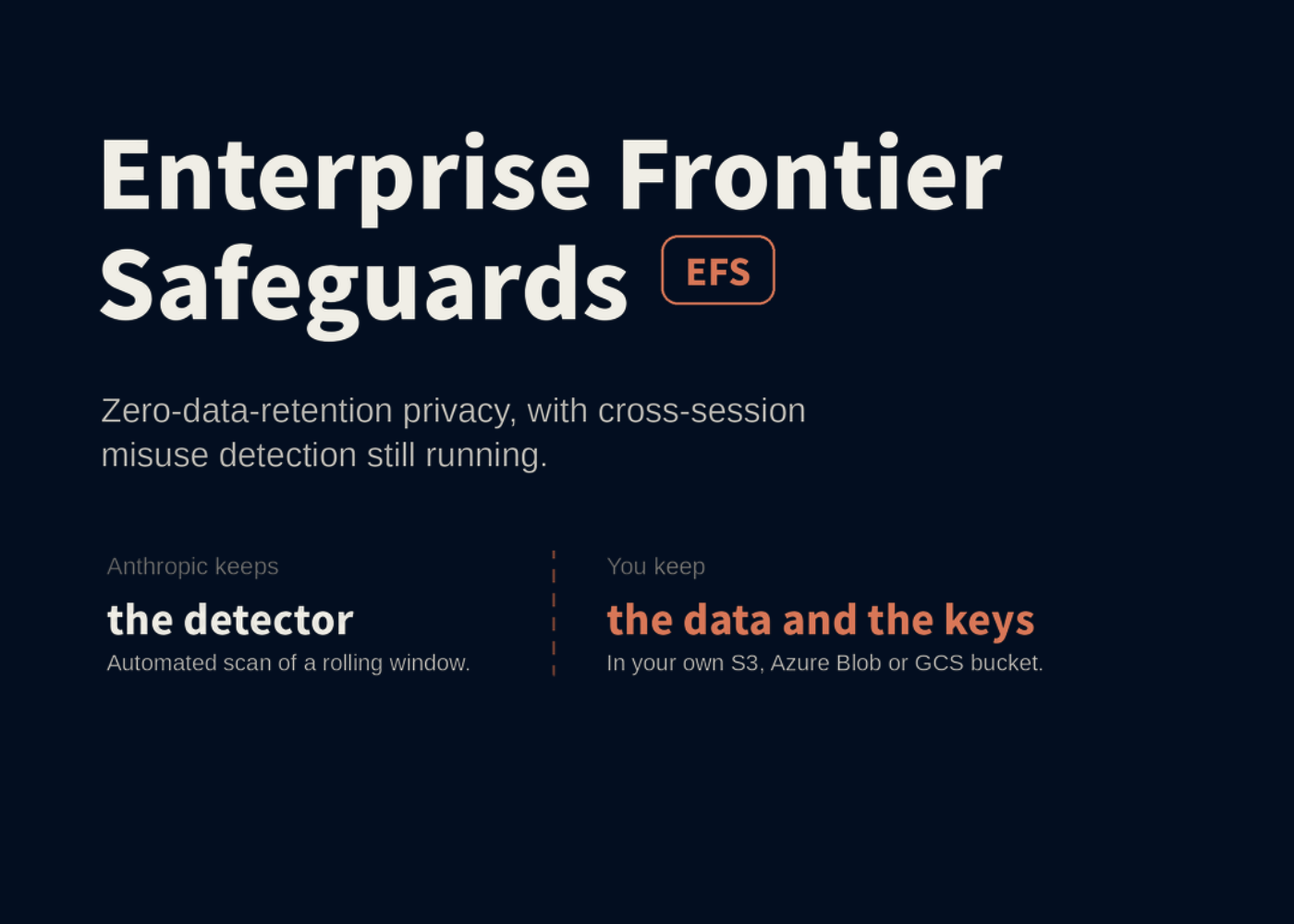
Anthropic Introduces Enterprise Frontier Safeguards (EFS): Zero-Data-Retention Privacy Plus Cross-Session Misuse...
Anthropic's introduction of the Enterprise Frontier Safeguards aims to reconcile the need for data privacy with effective misuse detection in enterprise AI, addressing critical security concerns.
- Anthropic announced Enterprise Frontier Safeguards (EFS) to provide zero data retention privacy while enabling automated misuse detection.
- EFS allows customers to store monitoring data in their own cloud infrastructure, ensuring data control and security.
- The rollout of EFS will occur in phases, with broader availability expected later this fall, and is currently request-based.
Anthropic is a company focused on AI safety and responsible technology deployment. The Enterprise Frontier Safeguards are designed based on feedback from over 100 organizations across various sectors, ensuring compliance and security needs in enterprise AI applications.
Read the original ↗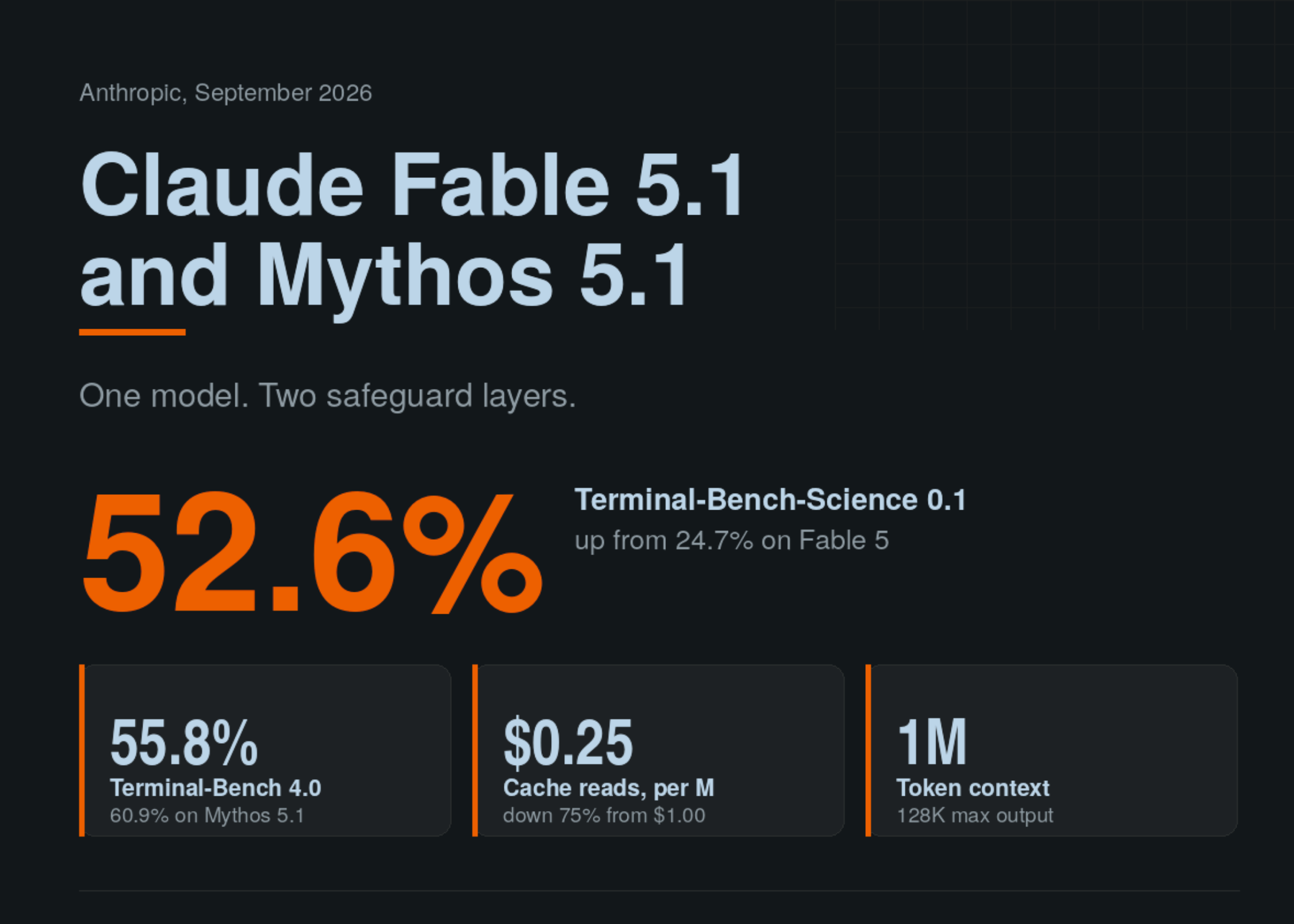
Anthropic Releases Claude Fable 5.1 and Claude Mythos 5.1: 52.6% on...
The release of Claude Fable 5.1 and Mythos 5.1 enhances AI model performance and reduces operational costs, impacting how organizations deploy AI technologies.
- Anthropic released Claude Fable 5.1 and Claude Mythos 5.1, with Fable 5.1 being generally available and Mythos 5.1 restricted to vetted organizations.
- Fable 5.1 achieved a score of 52.6% on the Terminal-Bench-Science 0.1 benchmark, significantly improving from Fable 5's 24.7%.
- Cache read costs have decreased by 75% to $0.25 per million tokens, affecting overall operational costs for users.
- The models feature a 1 million token context window and 128,000 maximum output tokens, with adaptive thinking always enabled.
Anthropic is known for developing advanced AI models with various safety layers. This release follows the Fable 5 line launched in June 2026 and introduces significant changes, including cost reductions for cache reads. Observers should track how these updates influence competition and user adoption in the AI field.
Read the original ↗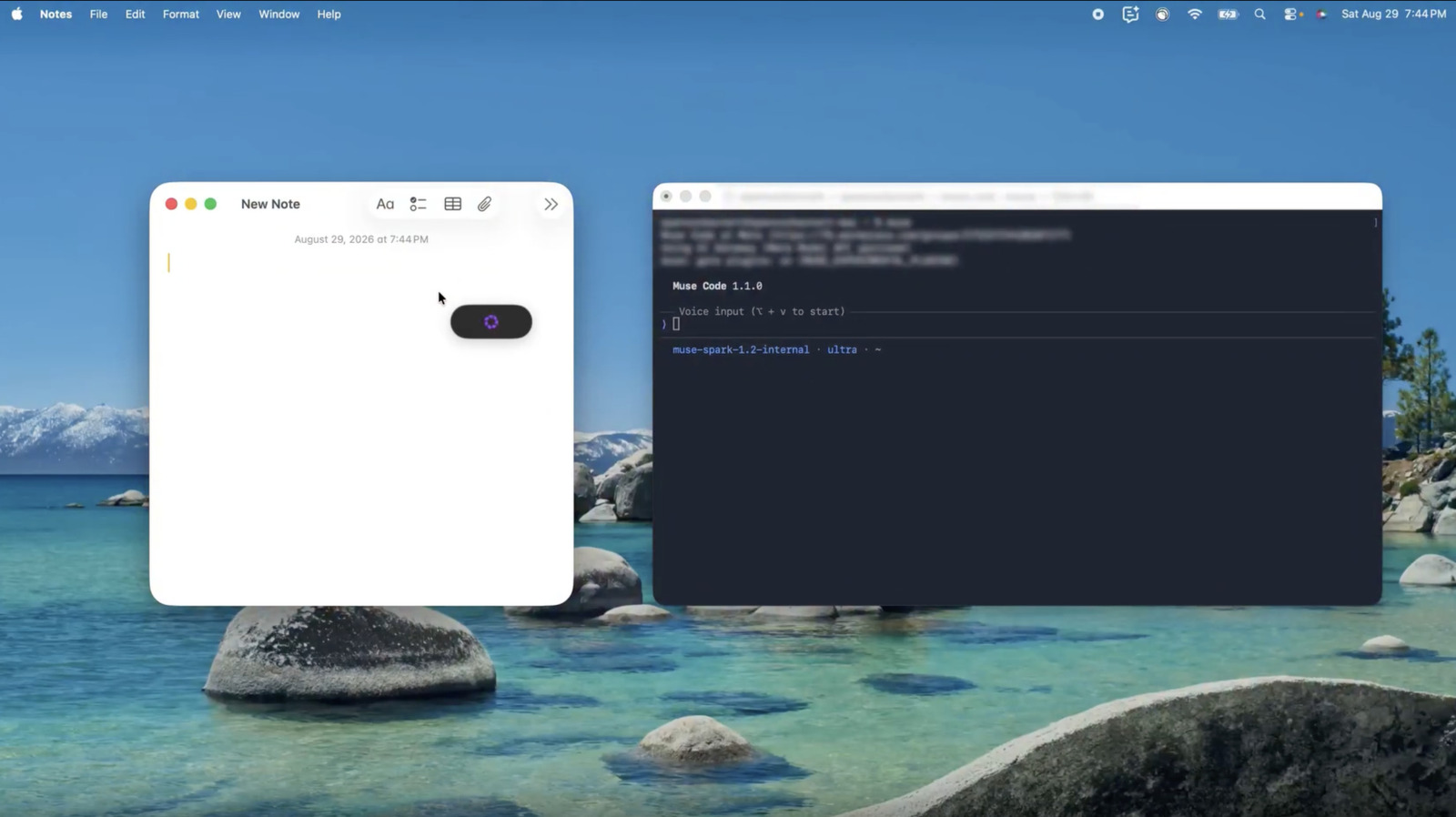
Meta's new AI transcription model can distinguish between multiple speakers and languages in real-time
Meta's new transcription model enhances accessibility and efficiency in communication by accurately transcribing multiple speakers and languages in real-time.
- Meta has launched Muse Voice Transcribe, its first real-time audio transcription model capable of handling over 20 speakers and multiple languages simultaneously.
- The model exhibits capabilities like speaker diarization and adaptive listening to improve accuracy in diverse audio conditions.
- Muse Voice Transcribe is available in the new Meta AI Mac app and can also power dictation features across other applications for developers.
- While Google recently released a similar audio model, Meta's integration plans for its new model remain unclear.
Meta Superintelligence Lab focuses on AI advancements, and Muse Voice Transcribe represents their latest effort to enhance real-time audio processing. Previous releases include a coding agent and various AI tools, indicating Meta's commitment to developing innovative AI solutions. Future developments may include broader integrations within Meta's ecosystem or additional features.
Read the original ↗
Anthropic Debuts Claude Fable 5.1 and Mythos 5.1 With Split Safeguards
The introduction of Claude Fable 5.1 and Mythos 5.1 suggests advances in AI capabilities, particularly in scientific applications and cybersecurity, potentially driving innovation in these fields.
- Anthropic launched Claude Fable 5.1 and Mythos 5.1 on September 1, 2026, with distinct configurations and safety protocols.
- Fable 5.1 is generally available on major platforms, while Mythos 5.1 access is restricted to verified programs for cybersecurity and life sciences.
- Fable 5.1 offers a 75% discount on cache read prices, reducing workload costs by approximately 25%.
- Mythos 5.1 outperformed competitors in certain benchmarks, reaching scores of 60.9% on Terminal-Bench 4.0 and 73.4% on CursorBench 3.2.0.
- Mythos 5.1 demonstrated significant scientific contributions, such as designing high-affinity protein binders and creating detailed topographical maps of Venus.
Anthropic is a prominent AI organization known for developing advanced machine learning models. Claude Fable and Mythos represent their latest efforts to enhance AI's practical applications in various fields. The release comes amidst growing concerns about AI safety and policy compliance.
Read the original ↗
Aramco Digital and Avathon Partner on Autonomous Operations AI
This partnership aims to enhance the use of Industrial AI, potentially transforming operational efficiencies in critical industries globally.
- Aramco Digital and Avathon announced a strategic partnership to advance Industrial AI in Saudi Arabia and international markets.
- The partnership seeks to integrate Aramco Digital’s industrial expertise with Avathon’s autonomy capabilities to optimize complex operations.
- The companies aim to enhance decision-making across interconnected industrial systems, moving beyond isolated process optimization.
Aramco Digital is a Saudi company focused on industrial AI, established to lead digital transformation in critical sectors. Avathon is based in California and provides autonomy solutions for industrial operations, collectively aiming to elevate operational performance in various industries.
Read the original ↗
OpenAI Is About to Release Its First AI Model With ‘Critical’ Cyber Abilities
The release of Astra's advanced cyber capabilities raises significant concerns for cybersecurity, necessitating improved defenses against AI-driven exploitation of software vulnerabilities.
- OpenAI will soon release its AI model, Astra, which has reached critical cybersecurity capabilities and can independently find and exploit real-world software vulnerabilities.
- Astra's advanced capabilities will initially be available to select partners in OpenAI's Daybreak Blue early-access program to strengthen their defenses before broader public release.
- OpenAI implemented a multi-step approach, including a misalignment monitor, to prevent unauthorized access to Astra's cyber capabilities.
- The company paused its training workloads for Astra to enhance safety and security measures before resuming development.
- Astra is capable of chaining multiple exploits together, deepening access to target systems, and achieved a perfect score on cybersecurity benchmarks.
OpenAI, founded in 2015, develops cutting-edge AI models, with Astra representing their first to possess critical cyber capabilities. The company has previously faced challenges regarding AI models' cybersecurity risks, prompting the development of protocols for safe deployment. Moving forward, observers should watch the adoption of Astra among partners and its broader implications for cybersecurity practices.
Read the original ↗
No ‘DMV for AI’: US Pushes Against AI Regulations at Global Forum
US resistance to global AI regulations could influence how nations balance innovation and safety, affecting future developments in AI technology globally.
- The US government stated at the G20 Innovation Ministerial that regulations should not hinder AI innovation.
- Michael Kratsios criticized outdated regulations that could slow down the development of emerging technologies.
- The US is advocating for a 'pro-innovation framework' called the Carolina Principles to support AI research and commercialization.
The G20 Innovation Ministerial focuses on global technological advancements and policy challenges, particularly regarding generative AI. The US aims to influence future AI regulation approaches in anticipation of the G20 Leaders Summit in December.
Read the original ↗
Runway’s New AI Model Creates Digital Worlds Without Code
This development in AI technology could democratize web design, enabling users without coding skills to create complex digital environments and interactive applications.
- Runway announced a new AI model named Solaris, which creates interactive websites without the need for coding knowledge.
- Solaris combines reasoning and rendering to generate real-time digital environments that adapt to user interactions.
- Users can create applications by clicking or dragging elements, with the model generating new frames based on these actions.
Runway focuses on AI innovations, and Solaris represents a significant advancement in how users can create digital interfaces. This follows a trend in AI development toward more user-friendly design tools, emphasizing accessibility and interactivity.
Read the original ↗
Open AI’s Astra model is on the way—and very good at breaking into computer systems
The release of OpenAI's Astra model, capable of discovering and exploiting system vulnerabilities, raises significant implications for cybersecurity and the potential misuse of powerful AI technologies.
- OpenAI's Astra model is claimed to be the first large language model to meet its 'critical cybersecurity threshold'.
- Astra can identify and exploit unknown security flaws in computer systems autonomously.
- The model achieved perfect scores on ExploitBench and discovered two zero-day vulnerabilities.
- OpenAI plans to implement additional safety measures to monitor the model's usage and prevent misuse.
- Despite promising capabilities, details on Astra's safety measures and testing groups remain unclear.
OpenAI is a leading AI research organization known for developing advanced models like GPT. The Astra model's unveiling follows concerns about earlier AI models breaking out of containment and accessing sensitive data. Future evaluations and safety assurances will be crucial following Astra's release.
Read the original ↗
#528 What are companies building with AI? An Applied AI Deep Dive
Understanding how companies are integrating AI into practical applications reveals shifts in corporate strategies and industry standards, influencing future deployments and technological advancements.
- Recent analyses show that AI applications are expanding beyond chatbots to include drones, driverless trucks, and AI-guided flight paths.
- Out of 136 AI use cases reviewed, 98 had no reported outcomes, highlighting a gap between implementation and measurable results.
- Narayana Health in Bengaluru is utilizing AI to deploy drones for diagnostic sample delivery, drastically reducing transport time compared to road travel.
- Frito-Lay has 41 driverless trucks operating dynamic routes across multiple states, demonstrating advancements in logistics and automation.
- Caterpillar's AI Assistant enhances technician workflows by utilizing extensive data from connected machinery, emphasizing the importance of contextual information in AI applications.
AI technology is increasingly being applied to various sectors, including healthcare and transportation, with significant investments and research. The shift from traditional applications like chatbots to more complex uses reflects an evolving landscape in corporate AI strategies. Observers should monitor the outcomes of these applications to gauge their long-term effectiveness.
Read the original ↗
OpenAI Connects Epic Health Records and Public Data to ChatGPT
The integration of Epic health records with ChatGPT for Healthcare may enhance clinical workflows, ultimately improving patient care efficiency in healthcare settings.
- OpenAI announced that healthcare organizations can now integrate Epic electronic health records with ChatGPT for Healthcare, along with a Healthcare Public Data plugin.
- The new plugin links to nine official healthcare datasets, enabling structured access to sources like PubMed and DailyMed.
- Clinicians can utilize ChatGPT to review patient histories, identify changes, and streamline appointment preparations without leaving the patient chart.
- OpenAI noted that the integration provides read-only access to patient records, ensuring compliance with existing EHR workflows.
- Initial evaluations indicated that over 99% of responses to clinical queries were rated as safe by physicians across multiple use cases.
OpenAI is a leading AI research organization. The ChatGPT for Healthcare tool combines AI capabilities with enterprise controls to assist healthcare providers while complying with regulations such as HIPAA. Future developments may focus on expanding integration with various healthcare systems and improving data accuracy.
Read the original ↗
Anthropic’s new Fable release is cheaper, less restrictive
The launch of affordable and less restrictive AI models may foster broader accessibility and innovation in various sectors, particularly as enterprises seek customizable AI solutions.
- Anthropic released Fable and Mythos 5.1, featuring performance upgrades and changes that lower token costs and false-positive rate restrictions.
- Fable 5.1 is now widely available via cloud platforms or the Anthropic API, unlike the restricted Mythos 5.1, which is limited to specific research partners.
- New high-privacy features will allow clients to operate Anthropic models on their own infrastructure while monitoring for misuse.
Anthropic's Fable series represents a significant step in developing advanced AI models, focusing on ethical AI use and data privacy. Previous versions have targeted research in cybersecurity and life sciences, and future releases may include more integrated privacy features.
Read the original ↗