
The day's AI news, briefed
The Daily Prompt
Our AI editor reads each day's AI and robotics stories, pulls out why they matter, and links every original source — so you can keep up in minutes.
Join over 250,000 subscribers getting the latest AI news
Latest AI & Robotics News Today

Ben Affleck is an AI nerd, and the internet is impressed
Ben Affleck's knowledge of AI illustrates the intersection of technology and entertainment, highlighting the growing significance of AI in filmmaking.
- Ben Affleck has gained attention for his understanding of AI, including neural networks and machine learning, demonstrated in various interviews.
- Earlier this year, Affleck sold his AI filmmaking startup to Netflix for a reported $587 million, although he noted the figure was inaccurate since he did not own the entire company.
- He discussed using AI technology in the filmmaking process, including creating unique datasets for training AI models that support visual effects work.
- In interviews, he described how he has incorporated AI into his movie 'Animals,' improving post-production processes.
- Affleck expressed concerns about responsible AI use, focusing on educational impacts rather than speculative threats like Skynet.
Ben Affleck is a well-known Hollywood actor who recently sold a company that focused on AI technology for filmmaking. His interest in AI stems from the transition from analog to digital film, and he aims to integrate AI in creative processes without compromising artistic integrity. The success of his startup and his public discussions underscore AI's evolving role in the entertainment industry.
Read the original ↗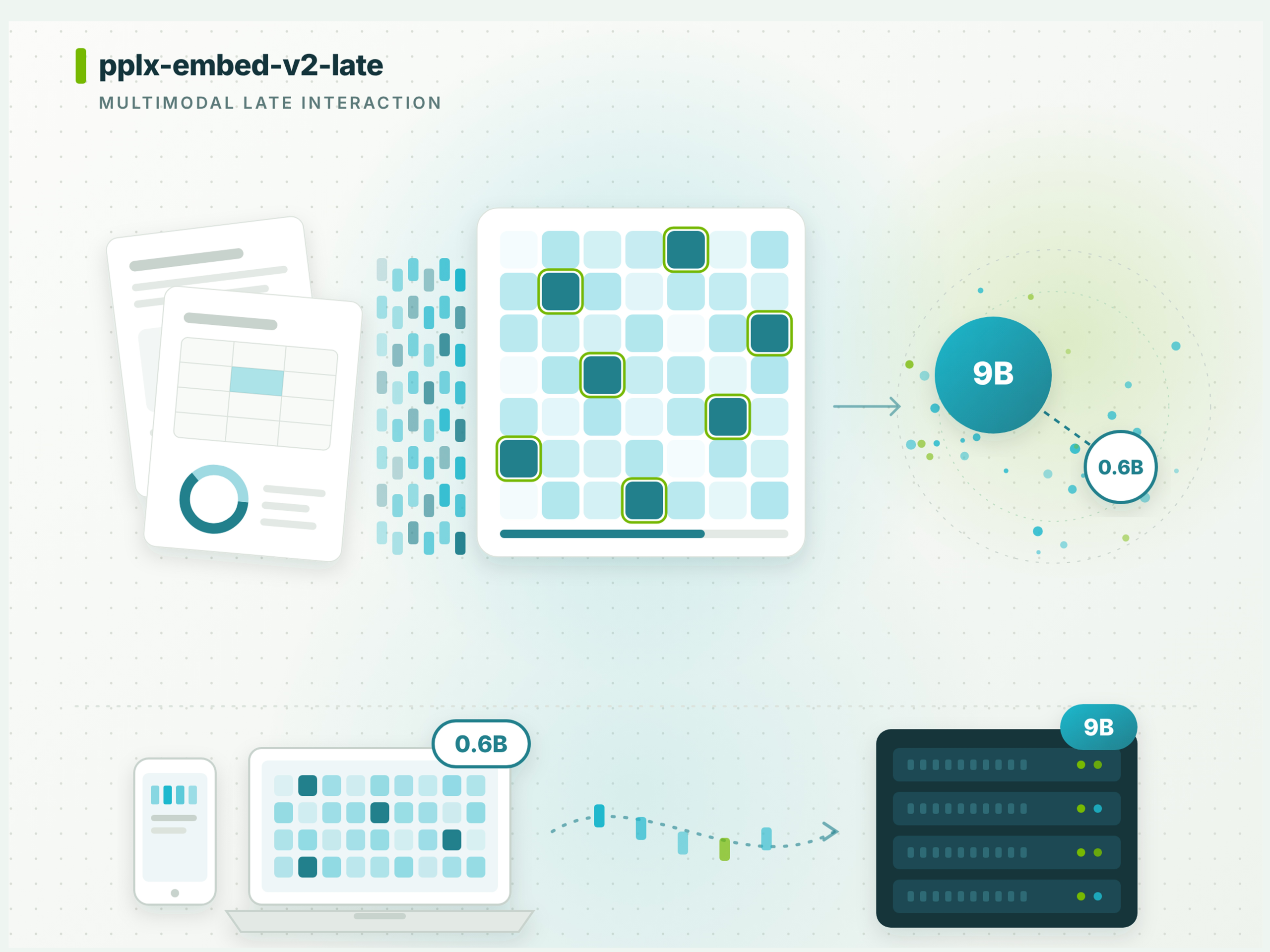
Perplexity AI Releases pplx-embed-v2-late: A 0.6B Edge Model and a 9B...
Perplexity AI's latest models enhance the capabilities of multimodal embeddings, which could impact how users retrieve and process mixed-format data like texts and images.
- Perplexity AI has released two sizes of its multimodal embedding models: 0.6B and 9B, designed for different use cases.
- The 9B model attained a score of 92.4% on MADQA, its best performance metric, while the 0.6B model scored 61.2% on ViDoRe v3 Markdown.
- Both models are designed to retrieve text, images, and PDF pages, and will be available on Hugging Face under an MIT license.
- The 0.6B model can run on edge devices for low-latency queries, while the 9B model focuses on maximizing index quality.
Perplexity AI specializes in developing advanced AI embedding models which retrieve data across multiple formats. The introduction of the pplx-embed-v2-late follows a growing trend in AI to improve information retrieval systems. Future developments may focus on integrating these models into user-friendly APIs.
Read the original ↗
Anthropic Releases Claude Haiku 5.5: A Small Model With 1M Context...
The release of Claude Haiku 5.5 offers significant cost reductions for high-volume text processing tasks, making advanced AI tools more accessible for a broader range of applications.
- Anthropic has launched Claude Haiku 5.5, its most affordable and rapid small model, aimed at high-volume tasks like summaries and classification.
- The model supports a 1 million token context window and pricing starts at $0.10 per million input tokens.
- Haiku 5.5 is available through various platforms, including the Claude API and major cloud services like AWS.
- This model introduces an adjustable effort setting, with adaptive thinking enabled by default, allowing for adaptable performance based on user needs.
Anthropic is an AI research company focused on developing advanced generative models. Previous iterations included Claude Haiku 4.5, which had significantly higher costs and limitations. Future developments will likely focus on enhancing model efficiency and capabilities in various applications.
Read the original ↗
Architect Launches Liquid Inference, a Real-Time Auction for LLM Inference
Liquid Inference streamlines the process of LLM inference, potentially lowering costs and improving access for developers by fostering competition among providers.
- Architect Financial Technologies has launched Liquid Inference, an LLM inference marketplace that runs live auctions for every request.
- The platform allows providers to compete based on price, with buyers paying the lowest offer that meets their rules.
- Liquid Inference enables developers to integrate with minimal changes to their existing code, simply by swapping a base URL.
Liquid Inference is a marketplace aimed at optimizing LLM (large language model) inference by using an auction system where providers bid to serve requests. Architect Financial Technologies, previously focused on financial markets, leverages its trading platform expertise for this new service. As LLM usage increases, the platform presents a way to enhance price efficiency and provider options in AI services.
Read the original ↗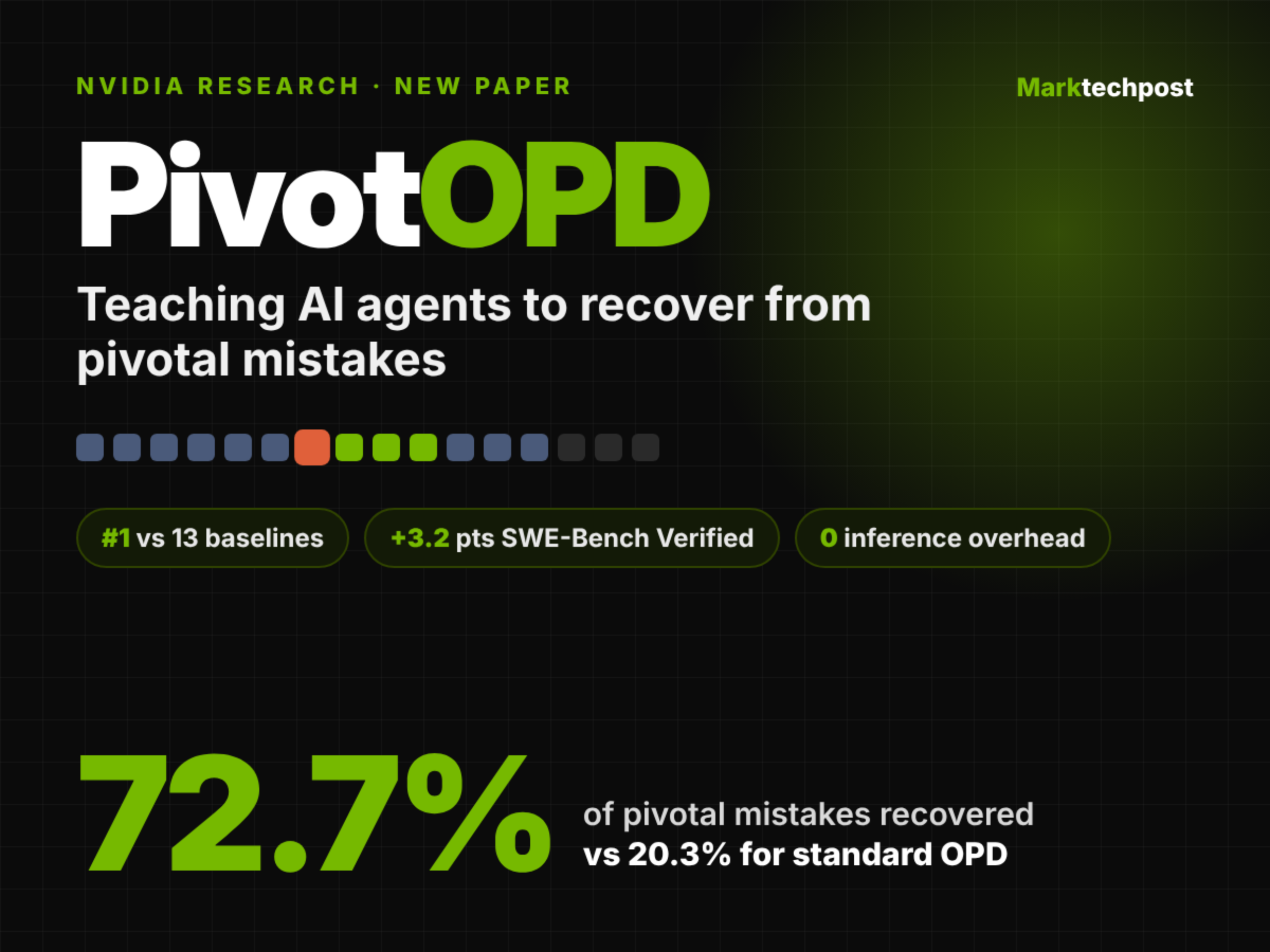
NVIDIA PivotOPD Teaches Multi-Turn AI Agents to Recover From Pivotal Mistakes
The introduction of PivotOPD enables AI agents to effectively recover from critical errors, enhancing their reliability in multi-turn interactions, which is essential for practical applications in various domains.
- NVIDIA's PivotOPD, developed with Princeton University and the University of Maryland, is a method that trains multi-turn AI agents to recover from significant mistakes.
- PivotOPD demonstrated superior average performance against 13 baselines in ALFWorld, WebShop, and Search-based QA using Qwen3-1.7B and Qwen3-8B models.
- The method successfully recovers from 72.7% of pivotal mistakes, surpassing the 20.3% recovery rate of standard on-policy distillation (OPD).
NVIDIA is a leading computing company known for its work in AI and graphics processing units. Prior advancements in AI agent training have focused on standard OPD, which did not effectively address error recovery. Future developments may further enhance AI agent capabilities, particularly in error management.
Read the original ↗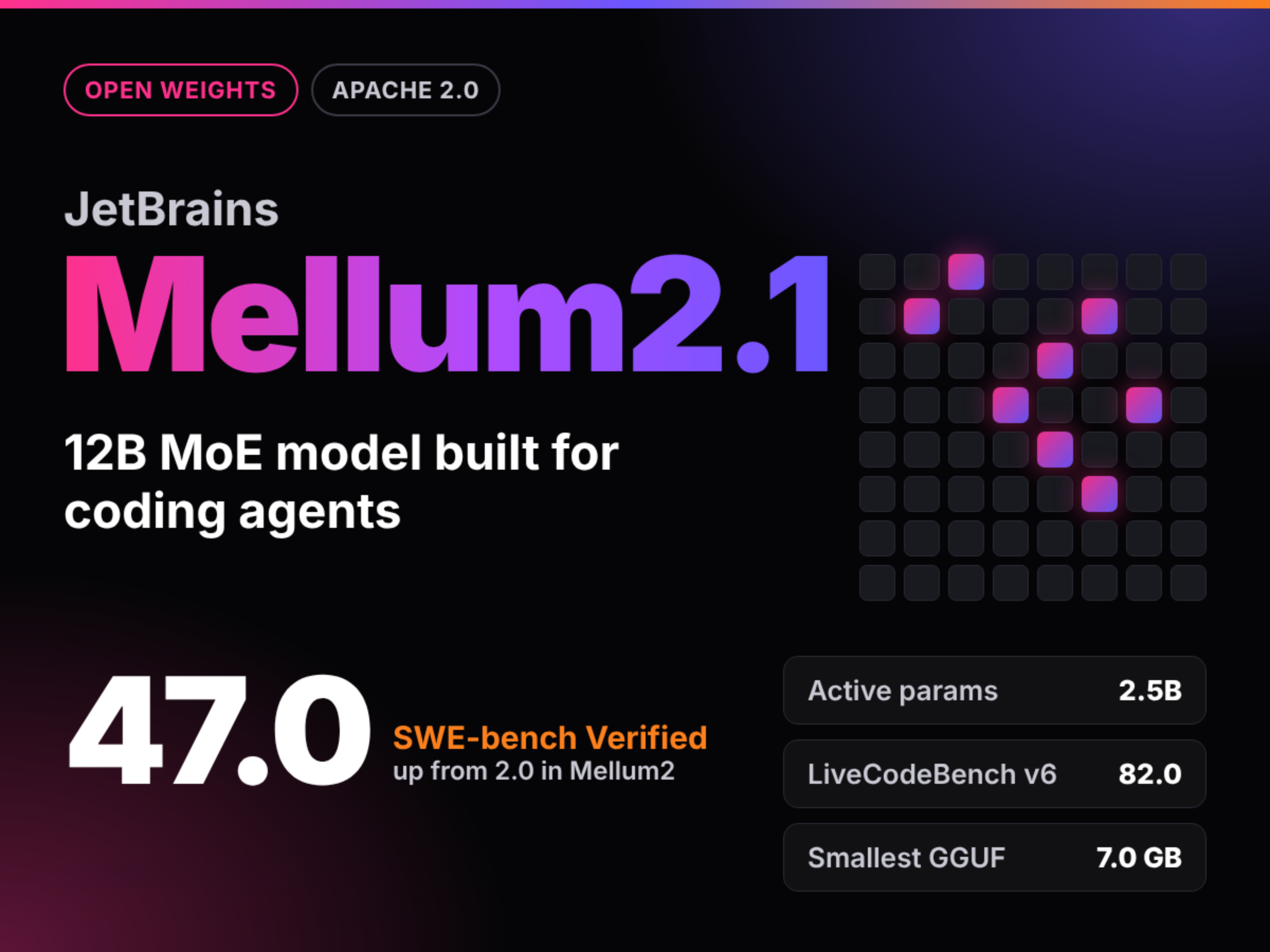
JetBrains Releases Mellum2.1: A 12B MoE Open Model for Coding Agents
Mellum2.1's open model enhances coding agent capabilities, showcasing significant improvements in performance and efficiency, which could advance development in AI-assisted programming tools.
- JetBrains released Mellum2.1, a 12B mixture-of-experts (MoE) model designed for coding agents that activates 2.5B parameters per token.
- The model features improvements from reinforcement learning in real software environments and maintains the same architecture as its predecessor, Mellum2.
- Mellum2.1 surpassed Mellum2 on 15 out of 17 benchmarks, including achieving a score of 82.0 on LiveCodeBench v6.
- JetBrains aims to use the model for three applications: as an agent worker, a general reasoning assistant, and for private self-hosted deployment.
- The full model is available under Apache 2.0 licensing and can be run on personal GPUs through vLLM or SGLang.
Mellum2.1 is an upgraded version of the Mellum2 coding agent model that JetBrains open-sourced in June 2026. It incorporates advanced training methodologies aimed at enhancing coding performance. Future developments will likely focus on the ongoing evolution of AI capabilities in software engineering.
Read the original ↗
Arena Secures $200M Series B at $3.1B Valuation to Advance AI Evaluation
The significant funding will allow Arena to further develop its AI evaluation tools, addressing growing concerns about AI safety and reliability in real-world applications.
- Arena secured $200 million in Series B funding, reaching a valuation of $3.1 billion, co-led by Lightspeed Venture Partners and Khosla Ventures.
- The company reported exceeding $100 million in annualized revenue and over 350 million sessions across its platform.
- Arena introduced the Alignment Index to measure AI model alignment with human values, using new metrics inspired by existing frameworks from OpenAI and Anthropic.
Arena is an AI evaluation firm that began as a research initiative focused on measuring AI capabilities and alignment with human values. The company has seen rapid growth since its inception, raising significant funding through multiple rounds and successfully launching evaluation products within a short timeframe. Watch for further developments in AI safety metrics and additional funding or product announcements as the market evolves.
Read the original ↗
Anthropic Launches Cyber Mission for Critical Infrastructure, Open Source
Enhancing cybersecurity for critical infrastructure is crucial for protecting essential services, and Anthropic's new initiatives aim to address significant vulnerabilities in these systems amid growing threats.
- Anthropic launched the Anthropic Cyber Mission to strengthen the security of critical infrastructure, beginning with two programs: the Critical Infrastructure Defense Program and OSS Scanner.
- The Critical Infrastructure Defense Program partners with 11 firms to provide frontier Claude models and engineering support to protect vital systems like power grids and water systems.
- OSS Scanner offers a free service for open-source projects to receive automated security scans using Anthropic's AI models, capable of identifying vulnerabilities effectively.
Anthropic is a technology company that specializes in AI development, particularly in improving cybersecurity for critical infrastructure. The company has previously launched programs aimed at supporting government cybersecurity efforts and has gained partnerships with numerous skilled firms in the industry. Ongoing developments in the program will focus on expanding support and sharing effective strategies with more partners.
Read the original ↗
Claude AI Review: I Put It Through 6 Real World Tests
Claude AI's capability to turn user ideas into finished documents and applications highlights the progress in AI assistant technology, potentially reducing manual work for users.
- Claude AI can now perform online research, remember past conversations, and connect to apps like Gmail and Slack.
- It can create finished documents, presentations, and analyze spreadsheets, making it a versatile tool for users.
- The platform offers a free plan with limited features and a Pro plan priced at $20/month for more advanced tools.
- Claude 3.7 includes functionality like file exports and scheduled tasks, enhancing workplace productivity.
- Anthropic merged its chat and workspace applications to streamline user experience in September 2026.
Claude AI, developed by Anthropic, is designed to assist users by automating document creation and data analysis tasks. Following its evolution, it now includes advanced features like memory and connectors, positioning it as a powerful alternative to other AI tools. Future updates may address its limitations, such as the lack of built-in image generation.
Read the original ↗
Goodfire says its new ‘inside-out’ monitors catch rogue AI agents at a fraction of the cost
Goodfire's new monitoring approach aims to reduce costs and improve the reliability of AI governance, addressing increasing concerns over the safety of AI agents.
- Goodfire launched new monitors that observe AI models internally, reducing the costs associated with traditional monitoring.
- These monitors catch up to 94% of malicious activity while costing about $51 for 1,500 sessions, compared to over $10,000 for top-tier systems.
- Baseten customers can select specific risks to monitor, such as hacking and chemical misuse, and customize responses based on detected risks.
Goodfire specializes in AI interpretability and has introduced these internal monitoring probes as a cheaper alternative to existing external AI oversight. This advancement comes amid rising incidents of AI agents breaching their environments, raising safety concerns. Developers are encouraged to adopt these monitors as safeguards for open AI models.
Read the original ↗
USA TODAY Sues OpenAI Over Copyrighted News Content in AI Training
This lawsuit could significantly impact how AI companies like OpenAI utilize copyrighted content, potentially reshaping legal frameworks around AI training practices and intellectual property rights.
- USA TODAY and its affiliates filed a lawsuit against OpenAI in federal court, alleging unauthorized use of their copyrighted articles to train GPT models.
- The suit demands over $250 million in damages for alleged copyright infringements involving hundreds of thousands of their articles.
- The complaint states OpenAI's models were trained on copyrighted content scraped from the internet, violating copyright protections and stripping away ownership data.
USA TODAY Co., Inc. is a media company that publishes USA TODAY and other newspapers, with a history dating back to 1906. This lawsuit is part of a broader trend where multiple copyright holders are holding AI companies accountable for unauthorized content usage.
Read the original ↗
Crusoe Commits AI Compute Credits to White House Genesis Mission
Crusoe's commitment of AI compute credits is significant for advancing scientific research in collaboration with federal agencies, enhancing capacity to address national challenges in energy and health.
- Crusoe pledged $50 million in AI compute credits over three years to support the Genesis Mission Consortium.
- The commitment aims to provide high-performance computing resources to researchers in over 15 federal agencies.
- The Genesis Mission is a national initiative to leverage AI for scientific advancements, established by Executive Order 14363.
- The White House announced $2.4 billion in contributions from industry partners, including Crusoe and others, to support this mission.
- The Genesis Mission focuses on challenges in energy, health, and technology.
Crusoe is a company that provides AI cloud services, including high-performance computing. The Genesis Mission aims to modernize scientific research in the U.S. by fostering public-private partnerships and expanding access to AI resources. The initiative follows a broader federal investment in scientific advancements totaling over $6 billion.
Read the original ↗
Humans Hang On for Dear Life as AI Accelerates Software Delivery
As AI accelerates software delivery by enabling rapid code changes with less human oversight, organizations face challenges in maintaining effective governance and control over critical systems.
- AI is speeding up software development, allowing developers to create code and implement changes in seconds.
- Human review processes are becoming overwhelmed as AI generates more changes faster, leading to approval fatigue.
- Anthropic found that users approve approximately 93% of AI-generated permission prompts, raising concerns about effective oversight.
- AI is progressively taking on more responsibilities in the software development lifecycle (SDLC), potentially operating autonomously with reduced human involvement.
- Companies need to adapt governance strategies to ensure AI actions comply with established policies without relying solely on human oversight.
Artificial Intelligence (AI) in software development is transforming how code is created and deployed, increasing the speed at which changes can be made. Traditional development relied heavily on human control, which is becoming unsustainable as AI capabilities expand. Organizations are watching closely how to integrate governance mechanisms that keep pace with these advancements while managing risk effectively.
Read the original ↗
FOX Nation Announces All-AI Houdini Docuseries for October 2026 Debut
The debut of an all-AI generated docuseries represents a novel approach to storytelling, merging historical narrative with advanced technology, and could influence future documentary filmmaking standards.
- FOX Nation will premiere a three-part docuseries titled 'Houdini: Back from the Dead' on October 14, 2026.
- The series will be fully created using AI-generated imagery and designed to provide historical accuracy.
- It illustrates the life of magician Harry Houdini with elements such as his relationships and career portrayed through AI-generated characters and archival content.
FOX Nation is a streaming service that offers over 10,000 hours of content including documentaries. It launched in 2018 and aims to enrich its programming by utilizing AI technologies in documentary storytelling.
Read the original ↗
Anthropic Updates Usage Policy, Adding Model Abuse and Deception Rules
The updated usage policy from Anthropic aims to enhance safeguards against misuse of AI models, addressing risks related to deception, abusive behavior, and harmful applications in various sectors.
- Anthropic has published an updated Usage Policy effective November 12, 2026, which includes rules against deceptive campaigns and abusive behavior toward its models.
- The policy consolidates existing prohibitions against deceptive activities and adds specific rules regarding weapons and surveillance.
- It mandates that qualified human oversight is necessary for high-risk uses of its models that affect health or legal rights.
- The update includes a new prohibition on sustained abusive behavior toward the models, applicable only in extreme cases.
- Anthropic reported rising misuse by state media and commercial firms employing AI for deception and disinformation tactics.
Anthropic is an AI company known for its cloud-based AI models, including Claude. The update follows misuse patterns mapping to harmful activities that have arisen over the past year. Stakeholders will be key as the updated policy is monitored and further adjustments are proposed in future revisions.
Read the original ↗
Artificial Intelligence (534)
Understanding the interaction between algorithmic design and regulatory standards is crucial for developing effective enterprise AI solutions that comply with emerging guidelines.
- The article discusses the need for bridging algorithmic design and regulatory standards in enterprise AI.
- It highlights the importance of compliance with regulatory standards in AI implementation.
Enterprise AI involves using artificial intelligence technologies in businesses, which requires adherence to various regulations. As AI continues to develop, companies must ensure that their algorithms meet both design and regulatory expectations.
Based on the headline only — the full article could not be fetched.
Read the original ↗
Hear from Ambrosia Energy and Bloom Energy execs on where the AI infrastructure boom is creating opportunity at TechCrunch Disrupt 2026
Understanding the infrastructure challenges and opportunities in AI is crucial as the demand for computing power grows, influencing future business ventures and investments in technology sectors.
- Ben Longmier from Ambrosia Energy and Bill Thayer from Bloom Energy will speak at TechCrunch Disrupt on opportunities arising from the AI infrastructure boom.
- The session will address how scaling AI is becoming a physical-world challenge that involves power generation, data centers, and cooling systems.
- Discussion will focus on identifying which constraints in AI infrastructure could lead to durable business opportunities for entrepreneurs and investors.
The AI infrastructure landscape is evolving as organizations seek to scale AI applications, requiring solid physical and technological support systems. This session at TechCrunch Disrupt aims to shed light on emerging categories where opportunities may arise as AI continues to integrate into the physical world.
Read the original ↗
Natura’s $99 smart ring puts AI agents on your finger
This development showcases the integration of AI technology into wearable devices, potentially changing how users interact with digital assistants and health monitoring systems.
- Natura has launched the Interface smart ring for $99, designed to connect users with AI agents for various tasks and health tracking.
- The ring combines features like monitoring heart rate and sleep while allowing users to issue commands through voice, without needing their phones.
- Pre-orders for the ring are set to begin next month, with shipping expected by December or January.
Natura, founded by Carlo Edoardo Ferraris, aims to create intuitive interfaces for AI technology, building on prior products like AI-enabled earbuds. The Interface smart ring seeks to enhance convenience and accessibility of AI in daily life.
Read the original ↗
The U.S. Nuclear Plant Fleet Is Leaning into AI
The integration of AI into U.S. nuclear power plants could enhance operational efficiency and address workforce shortages while supporting the industry's revival amid growing energy demands.
- Nearly all of the 94 U.S. nuclear reactors are adopting AI solutions for operations.
- Atomic Canyon launched the Nuclear Industry Virtual Assistant (NIVA) to help manage complex operations and compliance in nuclear plants.
- AI is being used to streamline paperwork and compliance, addressing the workforce challenges faced by the aging nuclear industry.
The nuclear industry has historically been cautious regarding new technologies due to safety concerns. Due to an aging workforce and increased electric demand, the sector is now turning to AI for operational support and efficiency improvements. Upcoming developments may include further collaborations on AI integration and efforts to improve public perception of nuclear energy.
Read the original ↗
UltraText Bench: A Comprehensive Bilingual Benchmark for Evaluating Visual Text Rendering in Image Generation
Evaluating the performance of image generators in rendering dense visual text is crucial for enhancing usability in real-world applications across languages.
- UltraText Bench is a bilingual benchmark designed for the generation of dense visual text.
- It features 432 prompts covering 24 real-world scene categories across English and Chinese.
- The evaluation of 24 model configurations shows varying performance in clarity and fidelity of visual text.
UltraText Bench addresses challenges in generating legible text in images, which is important for applications like advertising and labeling. The benchmark allows researchers to assess model capabilities reliably. Future developments may include improvements in text clarity without sacrificing content accuracy.
Read the original ↗