
The day's AI news, briefed
The Daily Prompt
Our AI editor reads each day's AI and robotics stories, pulls out why they matter, and links every original source — so you can keep up in minutes.
Join over 250,000 subscribers getting the latest AI news
Latest AI & Robotics News Today

Google wants to host your personal vibe-coded apps in the Play Store
Google's plan to host personal vibe-coded apps on the Play Store reflects a significant shift towards user-generated content and AI integration in app distribution.
- Google will allow users to privately host and share AI-generated apps directly from AI Studio without a developer account.
- The Ask Play feature in the Play Store will expand, enhancing AI-driven discovery options for users.
- Game Finder, which uses usage data from 1.2 billion Android gamers, will personalize game recommendations based on a profile called Gamer DNA.
Google's Play Store is evolving to incorporate more AI features, including app discovery through the Ask Play interface and a new gaming recommendation system. This shift towards user-generated content positions Google to tap into the growing trend of personalized digital applications.
Read the original ↗
Gemini 4 Argon for Robotics
The advancements in Gemini 4 Argon for robotics demonstrate significant progress in physical reasoning and control, potentially leading to improved robotics capabilities and human-robot collaboration.
- Gemini 4 Argon achieved an 87% score on the Embodied Reasoning (ERQA) benchmark, surpassing other models in physical reasoning and spatial problem-solving.
- The model is versatile across the robotics lifecycle, enabling tasks from control of mobile robots to physical understanding and researching improvements.
- Argon uses simulation, self-improvement, and visual reasoning to enhance physical manipulation skills, significantly improving success rates in real-world scenarios.
Gemini 4 Argon is a general-purpose model developed by DeepMind that integrates reasoning in various aspects of robotics including control and manipulation. This model signifies a major leap towards achieving physical artificial general intelligence (AGI). Future developments in robotics may focus on further improving capabilities for complex tasks and human interaction.
Read the original ↗
Liquid AI Releases Open-Weight LFM2.5-24B-A2B for On-Device Agents
The release of the LFM2.5-24B-A2B model by Liquid AI enhances on-device artificial intelligence capabilities, which could lead to more efficient and responsive applications across various sectors.
- Liquid AI launched the LFM2.5-24B-A2B model on October 13, 2026, featuring 24 billion total parameters and 2 billion active parameters for on-device agents.
- This model boasts improvements such as a context window enlarged to 131,072 tokens and a vocabulary expanded to 128,000 tokens to enhance reasoning and tokenization.
- LFM2.5-24B-A2B outperformed or matched benchmarks against other models in various areas, particularly tool use, instruction following, and agentic workflows.
- The model is designed for efficient operation on edge hardware, reportedly achieving up to 184 tokens per second on an Apple M5 Max and over 21,000 tokens per second on GPU.
- Liquid AI recommends pairing the LFM2.5-24B-A2B model with retrieval or web search for optimal performance in knowledge-heavy tasks.
Liquid AI specializes in artificial intelligence and has developed a series of reasoning models under the LFM2.5 family. The new LFM2.5-24B-A2B model represents the largest in this series, offering advancements in on-device agent capabilities. Future developments may focus on further optimizing AI models for real-world applications in various industries.
Read the original ↗
Artificial Intelligence (536)
Mastering agentic AI systems could reshape various industries and daily life, prompting discussions on ethics and use cases.
- The article discusses a roadmap for mastering agentic AI systems by 2026.
- Agentic AI systems refer to artificial intelligence that can take autonomous actions to accomplish specific tasks.
Agentic AI systems are an emerging area in artificial intelligence focusing on autonomy and decision-making. Understanding and mastering these systems is crucial for their integration into society and industry applications.
Based on the headline only — the full article could not be fetched.
Read the original ↗
GroundingPI: A Grounding Foundation Model towards Physical Intelligence with Visual Primitives
The development of GroundingPI represents a significant advancement in foundation models for physical intelligence, enhancing robot capabilities in complex real-world environments.
- GroundingPI is a new grounding foundation model with 4 billion parameters that improves object localization in cluttered settings.
- It achieves an average performance of 73.68% across 34 grounding benchmarks, outperforming the previous leading model, GPT-6 Astra, by approximately 2.14%.
- GroundingPI effectively enhances robotic manipulation and autonomous driving, outperforming all mainstream backbones evaluated on the RoboTwin 2.0 platform.
- The model reduces the required training data, achieving comparable performance with only 50% of the demonstrations in certain scenarios.
Grounding models are critical for enabling robots to understand and interact with their environments. Previous models struggled in cluttered settings, prompting the need for improved systems like GroundingPI, which combines multimodal training and reinforcement learning. Future developments may focus on expanding these foundational models to other aspects of artificial intelligence and robotics applications.
Read the original ↗
AutoStore Unveils Fall 2026 Fulfillment Hardware and Software Lineup
The new hardware and software from AutoStore aims to enhance automation in fulfillment operations, which could significantly streamline logistics processes and reduce reliance on manual workflows in the industry.
- AutoStore announced a new lineup of hardware and software products for Fall 2026 aimed at increasing autonomy in fulfillment operations.
- The company seeks to address manual workflows in automated systems, improving efficiency and reducing operational effort.
- New products include FlexBinsPort for mixed-bin operations, AutoCase for integrated picking, and Robotic-as-a-Service model Pio Pal for smaller businesses.
- CubeExplore and CubeFleet are introduced as tools to model ROI and streamline maintenance across warehouse networks, potentially reducing downtime by 35–45%.
AutoStore is a logistics automation company specializing in robots and software for warehouse fulfillment. This announcement builds on previous product developments from 2026 and reflects ongoing trends toward increased automation in the industry. Future updates will likely focus on further reducing manual processes and expanding system capabilities.
Read the original ↗
Apple Introduces HomeView, a Smart Display Built Around Siri AI
The introduction of Apple HomeView highlights the growing integration of AI in consumer technology, emphasizing personalization and smart home capabilities.
- Apple launched HomeView, a smart display featuring a 7-inch Liquid Retina screen powered by Siri AI, on October 13, 2026, with pre-orders starting at $299.
- The device will be available in Australia, Canada, India, New Zealand, the UK, and the U.S. on November 13, 2026, with options for tabletop and wall-mounted models.
- HomeView includes a 12MP camera, four microphones, and the A18 chip, supporting personalized user profiles and smart home control.
- Siri AI enhances HomeView's functionality by integrating personal context from Apple devices, while maintaining user privacy by processing data locally.
Apple HomeView is a new smart display designed to enhance home interactivity with AI. It builds on Apple's existing AI technology, Siri, and is part of a broader launch including smart home accessories. Future developments to watch include updates on Siri AI and additional smart home features anticipated in future releases.
Read the original ↗
IFS Launches IFS Intelligence, Governed by New Industrial AI Harness
The launch of IFS Intelligence could significantly streamline industrial operations by enabling real-time decision-making and reducing inefficiencies in data handling.
- IFS launched IFS Intelligence on October 13, 2026, at the IFS Unleashed event in Orlando, Florida.
- The product gathers real-time data from industrial operations and executes actions within defined business rules.
- IFS Intelligence features a conversational interface where users can ask questions and receive actionable insights based on live operational data.
- The accompanying Industrial AI Harness ensures that AI actions comply with company governance and policies, reinforcing safety and control in industrial settings.
- IFS reports that 43% of frontline teams integrated digital workers into operations over the last year, indicating a growing reliance on AI in industry.
IFS is a global enterprise software company specializing in industrial management solutions. The introduction of IFS Intelligence comes amid rising interest in AI applications across industries, focusing on efficiency and operational excellence. Future developments may include broader adoption and further enhancements as companies increasingly integrate AI into their workflows.
Read the original ↗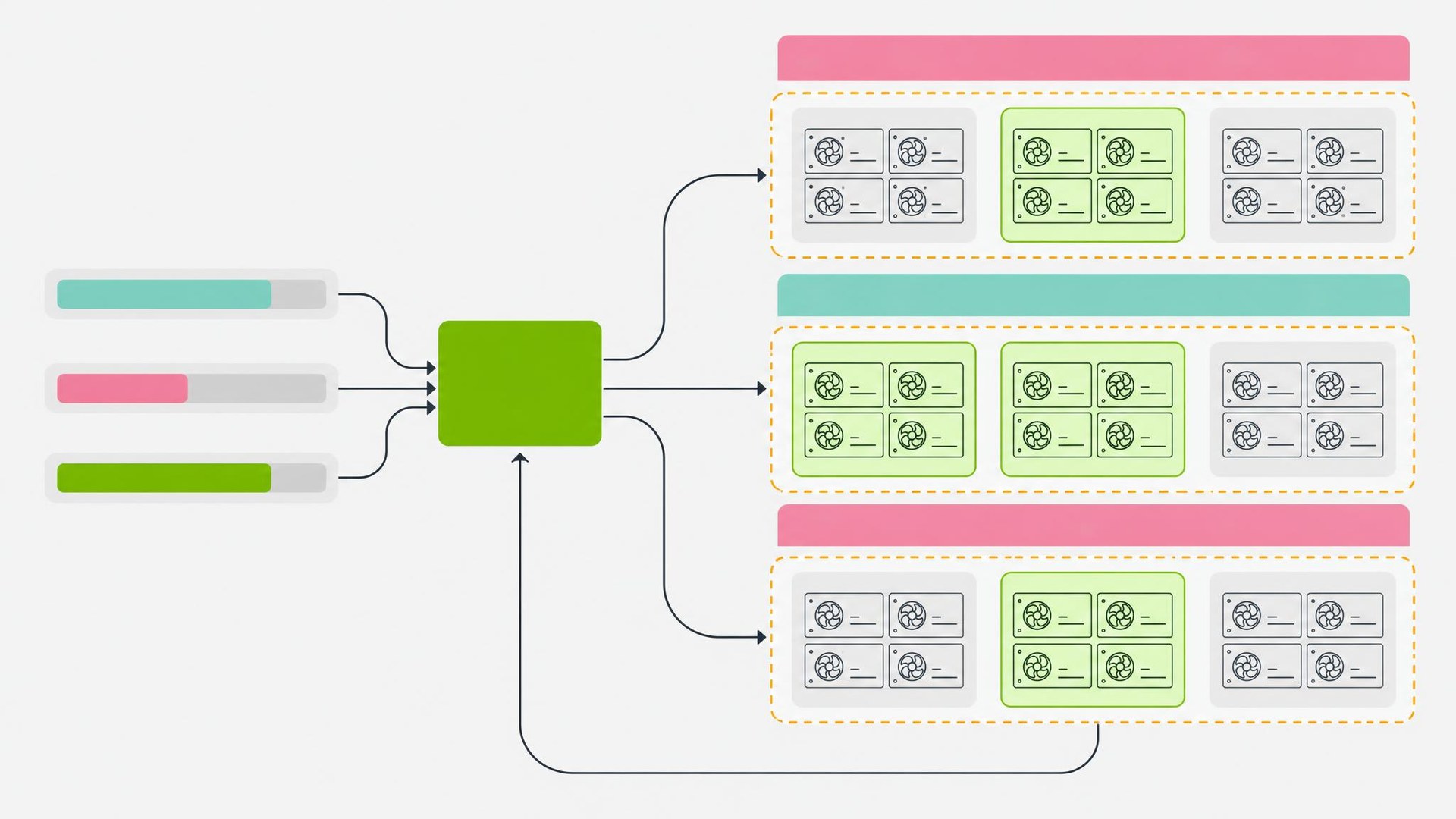
Lambda Readies Open-Source Run:ai Scheduler for Kubernetes Service
The integration of the open-source Run:ai GPU scheduler into Lambda's Kubernetes Service may enhance GPU utilization and resource allocation for AI development teams, improving efficiency in workload management.
- Lambda is collaborating with NVIDIA to make the open-sourced Run:ai GPU scheduler a managed option in its Kubernetes Service.
- Run:ai, originally part of the NVIDIA platform, was open-sourced in 2025 and allows multiple workloads to share a single GPU.
- The GPU scheduler features quota-based scheduling and fair-share allocation methods to optimize resource distribution among teams.
Lambda is enhancing its Kubernetes Service by incorporating advanced scheduling capabilities for AI workloads. Historically, GPU scheduling has aimed to manage the varying demands for GPU resources more effectively. Future developments may involve a library of schedulers to streamline integration for users.
Read the original ↗
Agentic AI Needs More Testers, Not Fewer
As Agentic AI transforms software development, the demand for skilled testers increases to ensure code quality and security, highlighting a critical shift in quality assurance practices.
- Agentic AI automates many coding tasks, but human verification of AI-generated code remains essential.
- 84% of developers are using or planning to use AI tools, but 46% distrust AI accuracy.
- AI-generated code can produce significantly more issues than human-written code, prompting a need for increased testing resources.
Agentic AI refers to AI systems that operate autonomously in software development. With rising adoption of AI tools, quality assurance practices are evolving to address new challenges. Current trends suggest an increased focus on ensuring the reliability of AI-generated code.
Read the original ↗
How to use a ChatGPT Dot when it rolls out to you
OpenAI's Dots agents enhance productivity by automating tasks, promising significant operational efficiency for users willing to pay a premium for advanced AI capabilities.
- OpenAI introduced Dots, always-on AI agents designed to automate tasks and assist with complex projects at its recent developer conference.
- Dots require a paid Pro plan starting at $100 per month for access, with wider rollout plans for Business and Enterprise customers.
- European Union and certain other regions currently lack access to Dots, with gradual rollout expected for paid Pro subscribers.
- Users can create Dots using the ChatGPT desktop app or website, but mobile app support is not yet available for setup.
- Dots utilize plugins to operate over 4,000 apps and will incur usage charges after the initial month of free extended limits.
OpenAI is a leading AI research organization known for developing advanced models like ChatGPT. Dots are part of its latest offerings to enhance user productivity through AI-driven automation. Future updates may broaden Dots' availability and features based on user demand.
Read the original ↗
Character.AI just filed for bankruptcy, and former foe Disney may buy it for parts
Character.AI's bankruptcy highlights the precarious nature of the generative AI startup landscape, with established companies showing interest in acquiring its assets amidst ongoing legal controversies.
- Character.AI has filed for Chapter 11 bankruptcy to facilitate the sale of its assets, with liabilities estimated between $50 million and $100 million.
- Disney has made the first offer of $20 million for Character.AI's assets, with plans to provide transition support using staff it previously hired from the startup.
- Character.AI allows users to create and publish customizable chatbot characters, but has faced legal issues, including lawsuits and brand damage accusations from Disney.
Character.AI is a generative AI startup founded in 2022, enabling users to create personalized chatbot characters. The company has struggled with employee turnover and legal challenges involving its chatbots. The outcome of the proposed sale to Disney and the legal ramifications surrounding the company will be pivotal in the months ahead.
Read the original ↗
Apple HomeView hands-on: Siri AI is your new roommate
The introduction of the Apple HomeView could significantly enhance how users interact with their smart home devices, leveraging Siri AI for personalized assistance and control.
- Apple has launched the HomeView display, a smart screen and speaker designed to streamline in-home experiences with smart home gadgets.
- The device integrates seamlessly with Apple’s Home app, providing access to live camera feeds and controls for devices such as thermostats and lights.
- Siri AI plays a crucial role, utilizing information from the user's iPhone to deliver personalized responses and functionality, such as managing music requests and recipes.
- HomeView features a recipe integration mode that formats ingredients and directions for easier cooking, including inline timer shortcuts.
- Users can transfer recipes from their iPhone to the HomeView simply by bringing the two devices close together.
Apple's HomeView is part of its broader initiative to enhance smart home technology, serving as a hub for various smart devices. This follows the trend of integrating AI and smart technology in home environments to provide cohesive control and convenience. Future developments may focus on expanding compatibility and enhancing user experience through updates.
Read the original ↗
Just 5 years in, interactive chatbot platform Character.AI files for bankruptcy
The bankruptcy of Character.AI highlights the challenges of scaling consumer-facing AI products, particularly in maintaining user engagement while managing operational costs.
- Character.AI has filed for Chapter 11 bankruptcy, with assets and liabilities between $50 million and $100 million.
- The company plans to sell some assets to Disney for $20 million, including a non-exclusive license for its technology.
- Founded in 2021 by former Google engineers, Character.AI allowed users to create and converse with AI characters, gaining rapid user traction but facing legal and operational challenges.
- Despite reaching 20 million monthly active users, the platform struggled with monetization and legal issues after a tragic incident involving a minor.
- The company appointed a new CEO in June 2024, aiming to innovate with products like AI video generation and storytelling formats.
Character.AI is an interactive chatbot platform launched in late 2021 that lets users create custom chatbots. Despite initial success and high user engagement, legal issues and operational struggles led to its bankruptcy filing. The company is now pursuing a court-supervised sale process, with hopes to find a viable path forward for its operations.
Read the original ↗
Amex introduces a framework to prevent AI agents from making unauthorized purchases
American Express's new framework aims to mitigate the risk of unauthorized purchases by AI agents, enhancing secure transactions in the rapidly growing field of AI commerce.
- American Express is launching the Intent Intelligence Framework to prevent AI agents from making unauthorized purchases.
- The framework captures and authenticates customer purchase intent before transactions are completed, aiming to create a standardized process for AI-powered transactions.
- Amex's new technology includes an API that collects customer instructions and generates secure digital payment credentials for transactions.
American Express is a financial services company introducing technology to ensure AI agents act within authorized parameters as consumer usage of AI shopping tools increases. The growth of AI in commerce necessitates proactive measures to prevent costly errors. The new framework is part of a broader push by Amex to develop secure options for agentic commerce as it evolves.
Read the original ↗
Google Deepmind’s New Resident Philosopher Tackles AI Ethics
The appointment of a resident philosopher at Google DeepMind highlights the increasing importance of ethical considerations in the rapidly evolving field of artificial intelligence.
- Henry Shevlin has become Google DeepMind's resident philosopher, dedicating 80 percent of his time to AI ethics.
- His work includes exploring human-AI relations, the potential consciousness of AI, and moral rights for artificial intelligence.
- Shevlin emphasizes the need for philosophers in AI labs to address ethical questions and their rapid developments.
Google DeepMind is a leader in AI research and development, known for innovations like AlphaGo. The integration of philosophy into AI work seeks to address ethical implications of AI technology as it evolves. Future focus includes human-AI interactions and developing responsible AI systems.
Read the original ↗
SpatialASM: Internalizing Active Mentalization for Spatial Reasoning
This advancement in spatial reasoning for large vision-language models may enhance their problem-solving capabilities, leading to more effective and human-like interactions in various AI applications.
- Researchers introduce a new framework called Active Spatial Mentalization (ASM) to improve spatial reasoning in large vision-language models (LVLMs).
- SpatialASM employs a novel-view generator for training that synthesizes planning, imagining, and reasoning tasks.
- The framework resulted in performance improvements across seven spatial benchmarks, enhancing LVLM's reasoning without losing visual capabilities.
Active Spatial Mentalization (ASM) aims to allow LVLMs to think proactively when solving spatial tasks, mimicking human-like mental reconstruction of environments. This research addresses current limitations in LVLM capabilities regarding spatial reasoning and aims to fill gaps in spatial supervision. Future developments will likely focus on refining these models for broader applications.
Read the original ↗
Multi-Stream Attention Residuals
The introduction of Multi-Stream Attention Residuals (MSAR) could lead to significant performance improvements in machine learning models, enhancing efficiency in large-scale pre-training tasks.
- Multi-Stream Attention Residuals (MSAR) is an extension of Attention Residuals (AttnRes) that improves depth attention with multi-head mechanisms.
- MSAR achieves substantial performance gains with minimal additional overhead by employing lightweight adaptive mixing for stream combination.
- In benchmarking, MSAR outperforms prior residual variants like standard connections and manifold-constrained Hyper-Connections (mHC).
- Scaling-law experiments demonstrate that MSAR offers a compute speedup of 1.58 times over the standard residual baseline, compared to 1.35 times for AttnRes and 1.30 times for mHC.
Multi-Stream Attention Residuals (MSAR) enhances the retrieval mechanisms in neural networks, expanding capabilities in managing depth and context. This follows the advancements brought about by multi-head attention in sequence processing. The results from MSAR suggest potential new directions for optimizing large-scale machine learning architectures.
Read the original ↗
Z.ai GLM-Legal Beats Claude Fable 5 and Kimi K3 on Harvey...
The introduction of Z.ai's GLM-Legal demonstrates significant advancements in AI capabilities for the legal field, leading to more efficient processes in legal work at a lower cost.
- Z.ai's new GLM-Legal model achieved a 19.2% pass rate on Harvey's Legal Agent Benchmark, significantly improving its base model's score of 6.7%.
- GLM-Legal is application-only via a hosted API, limiting access for potential users such as law firms and compliance teams.
- The model provides legal AI services such as contract review, evidence analysis, and compliance research, displaying potential to enhance legal operations.
Z.ai specializes in AI technologies, and GLM-Legal is designed specifically for legal applications. This release follows a trend of increasing sophistication in AI for specialized tasks, with users anticipating further enhancements and wider availability in the future.
Read the original ↗
Top 12 AI Live Translation Tools in 2026: Latency, Languages, Pricing
Understanding the capabilities and costs of top AI live translation tools is crucial for businesses and individuals seeking effective communication in multilingual settings.
- The article compares 12 AI live translation tools by factors such as languages, latency, and pricing.
- Palabra.ai claims under 1 second latency for its speech-to-speech translations, with a starting price of $60 per month.
- Google’s Gemini 3.5 Live Translate supports over 70 languages and works with any headphones, maintaining near real-time performance.
- DeepL Voice translates 40+ languages in meetings, costing $10 per month for its Pro plan.
AI live translation tools convert spoken language into translated text or speech with minimal delay. These tools are increasingly used in various settings such as consumer apps and meetings, allowing for real-time communication across language barriers.
Read the original ↗