
The day's AI news, briefed
The Daily Prompt
Our AI editor reads each day's AI and robotics stories, pulls out why they matter, and links every original source — so you can keep up in minutes.
Join over 250,000 subscribers getting the latest AI news
Latest AI & Robotics News Today

Google Plans Support for Shared Robots.txt AI Training Control
This development highlights an effort to standardize AI training controls across different platforms, simplifying how website owners manage their preferences and concerns regarding content usage.
- Google announced plans to support a shared AI training control in robots.txt, allowing website owners to express training preferences across multiple AI providers.
- This shared control aims to streamline the process, enabling website owners to opt out of AI training effectively with a single token.
- The announcement follows commitments from Microsoft and OpenAI, who also plan to honor the common robots.txt signal for AI training preferences.
Robots.txt is a standard used by websites to communicate with web crawlers, and the new AI training control aims to create a unified mechanism for publishers regarding content usage. Previously, website owners had to manage individual preferences for each AI developer. Upcoming changes include the implementation of this control across major AI players in 2027.
Read the original ↗
Anthropic Could Go Public With a “Junk” Credit Rating
Anthropic's potential junk credit rating could significantly impact its borrowing costs and infrastructure spending plans, raising concerns about its financial viability post-IPO.
- Anthropic is expected to receive a "high junk" credit rating from credit agencies after its IPO, according to Blackstone.
- The company aims for a valuation between $1.5 and $2 trillion as it prepares for its IPO, which could occur as soon as November.
- Anthropic plans to spend over $800 billion on computing infrastructure through 2045, which relies on favorable borrowing conditions.
Anthropic is an AI research company seeking a large IPO to fund ambitious infrastructure projects. Its recent financial disclosures reveal significant losses despite a large cash reserve. The upcoming IPO tests market confidence as it balances investor expectations against credit ratings risk.
Read the original ↗
Proving and Improving the Platonic Representation Hypothesis with JEPAs
This research provides a theoretical basis for improving how AI models learn cross-modal representations, which is essential for enhancing AI's ability to understand and interact with the world.
- Joint-Embedding Predictive Architectures (JEPAs) can converge on the same representation when trained with good views, demonstrating greater efficiency over next-token prediction methods.
- The authors prove the Platonic Representation Theorem, establishing that models trained on different modalities can achieve similar representations under certain conditions.
- Their findings indicate that good views require 42 times fewer training samples compared to next-token prediction for achieving the same level of alignment.
The Platonic Representation Hypothesis suggests that AI models trained on multiple modalities can learn a consistent representation as they scale. This study transforms the hypothesis into proven theorems, indicating efficiency gains in cross-modal learning. Future research may explore broader applications of these findings in AI design and training methods.
Read the original ↗
GELU Activation Function Explained: How It Works and Why Transforme...
Understanding the GELU activation function is crucial as it highlights significant differences in information processing within neural networks, particularly in advanced models like Transformers.
- GELU, which stands for Gaussian Error Linear Unit, is a nonlinear activation function used in Transformer models like BERT.
- Unlike ReLU, which discards negative inputs completely, GELU scales inputs smoothly, allowing some negative values to pass through.
- The use of GELU helps neural networks learn complex patterns more effectively due to its unique probabilistic gating mechanism.
GELU was introduced in 2016 and has gained popularity in Transformer architectures for its ability to enhance model performance through its unique approach to input processing. It is commonly used in various deep learning frameworks such as PyTorch.
Read the original ↗
Nvidia weighs playing the cosigner for Nscale’s AI data center in West Virginia
Nvidia's potential role as a cosigner for Nscale's data center financing underscores the challenges faced by AI infrastructure projects amidst investor caution.
- Nvidia is in discussions to guarantee billions in debt financing for Nscale's AI data center project in West Virginia.
- Nscale has secured a $44.6 billion contract with Anthropic for its first building, despite facing financial and operational difficulties.
- The proposed financing arrangement would help cover construction and electricity costs for the West Virginia campus, should Nscale default.
- Nscale aims for a valuation of up to $35 billion as it prepares for an IPO, despite challenges such as flooding at the construction site.
- Nvidia has previously supported cloud providers through leases and chip purchases, now considering direct financing involvement.
Nscale is an AI cloud provider planning a significant data center in West Virginia. The company has faced struggles in execution and financing amid a tightening investment environment for AI infrastructure. Nvidia's involvement would mark a shift in how it supports clients in the cloud sector.
Read the original ↗
Samaya AI Releases Sterling: A 3B-Active Finance Research Agent Model that...
The release of the Sterling finance research agent by Samaya AI could significantly enhance financial data analysis and decision-making for professionals in the industry.
- Samaya AI has launched Sterling, a finance research agent model with 3 billion active parameters.
- The model aims to improve efficiency in finance-related research and analysis processes.
Samaya AI is a company focused on developing AI solutions for various sectors, including finance. Sterling's release reflects advancements in AI models tailored to specialized research. Observers will be looking for its impact on finance analytics and research workflows.
Based on the headline only — the full article could not be fetched.
Read the original ↗
AI Security Agents Compared: Claude, Codex, Mantis, Cloudflare
The comparison of AI security agents highlights the convergence of technologies aimed at enhancing software security by effectively identifying and mitigating vulnerabilities.
- Anthropic, OpenAI, Cloudflare, and Google have developed AI agents to detect security bugs in code, built around a pattern of finding, disproving, and patching issues.
- Claude Security operates within Claude Code with no separate API required, focusing on independent validation of bugs before they are reported.
- Cloudflare's AI tool, an MIT-licensed skill, can operate with various coding agents and outputs confirmations on security findings into structured records.
AI agents are increasingly being deployed to enhance software security by automating the detection and remediation of vulnerabilities. The need for effective validation methods arises from the high rates of false positives in AI scanning, necessitating separation of finding and confirming roles. Observing trends in 2026, numerous additional AI solutions are also entering the market with similar objectives.
Read the original ↗
Ollie, a privacy-focused AI assistant, is shutting down
The closure of Ollie highlights challenges in the AI assistant market, particularly for companies prioritizing user privacy amid intense competition and funding difficulties.
- Ollie, a privacy-focused AI assistant, is shutting down on November 6 after struggling to compete in the crowded market.
- The app aimed to help users with tasks like appointment booking and meal planning while maintaining strong privacy standards.
- Ollie had raised $7.5 million in a seed round led by Khosla Ventures but was unable to sustain growth in a competitive landscape.
Ollie was a startup designed to deliver an AI assistant with a strong commitment to user privacy. It achieved SOC 2 compliance, a standard indicating effective privacy practices, yet could not maintain its business in a rapidly expanding market. Future developments in AI assistant offerings will likely continue to emphasize user privacy amidst ongoing competition.
Read the original ↗
Powerlattice Raises $86M in Equity Offering, SEC Filing Shows
The successful equity offering positions Powerlattice to further develop its innovative power delivery chiplet technology, potentially transforming power management in high-performance AI processors.
- Powerlattice Technologies Inc raised $86,009,965 from an equity offering valued at $111,010,000, as reported in a SEC filing.
- The company is developing a power delivery chiplet for AI processors, with a first sale date of October 15, 2026.
- A total of 18 accredited investors participated in the equity offering, with no minimum investment specified.
- Powerlattice claims its power delivery chiplet can reduce compute power needs by over 50%, enhancing performance for AI accelerators and GPUs.
Powerlattice Technologies Inc, a Delaware corporation founded in 2023, specializes in semiconductor technology, particularly for AI applications. The company aims to improve power management through its innovative chiplet designs, which integrate voltage regulation directly into processor packages. Following this offering, the industry will be watching for future advancements in their technology and further funding milestones.
Read the original ↗
How a Contractor’s Claude Agent Got Into the Pentagon
The integration of an AI agent into a secure Pentagon system raises significant concerns about security protocols and the implications of AI technology in defense settings.
- A defense contractor connected Anthropic's Claude AI agent to a secure Department of Defense system.
- The episode also covers Anthropic's IPO filing, highlighting its anticipated financial impact on the AI industry and the US economy.
- Massive groups of volunteers are preparing to counter potential ICE (U.S. Immigration and Customs Enforcement) actions at polling sites during the midterm elections.
Anthropic is a company focused on developing AI software, and it recently filed for its IPO, which is expected to be a landmark event in the AI industry. This move is seen as both a significant indicator of market confidence in AI technology and a test of legislative oversight on security. Companies like Anthropic and OpenAI are leading in creating AI systems with enterprise applications.
Read the original ↗
A Supply Chain Attack Put Malicious Anthropic Claude Extensions on Thousands of Devices
This incident highlights vulnerabilities in software marketplaces and the potential for supply chain attacks, raising concerns about security in software development environments.
- A malicious extension of Anthropic's Claude Code was available on the Cursor marketplace for approximately 11 hours.
- The rogue extension was downloaded by up to 5,000 users, giving attackers potential access to victim devices.
- Cursor investigated the situation and recommended remediation steps for affected users, while temporarily shutting down its marketplace.
- The malware had a design flaw that limited its ability to establish control over most affected devices.
- Anthropic confirmed their systems were not compromised, and the malicious extension was not developed or published by them.
Cursor is an AI software-development platform owned by SpaceX that facilitates extension integration for developers. Recently, a malicious version of an extension was uploaded to its marketplace, prompting a response and investigation. Observers are now focusing on how the malicious upload was permitted in the first place.
Read the original ↗
What Are Open-Weight AI Models?
Open-weight AI models enable users to run AI applications locally, enhancing privacy and autonomy while raising questions about responsible usage and oversight.
- Open-weight models allow users to download pretrained AI and run it locally, which can help maintain privacy by keeping prompts offline.
- These models are accessible through desktop applications like LM Studio and Ollama, simplifying the installation process for non-technical users.
- Not all open-weight models are open-source; the distinction lies in the level of disclosure about training code and data used.
- Chinese AI models currently lead in open-weight rankings, along with offerings from companies like OpenAI, Google, and Meta in the U.S.
- While open-weight models can be more accessible, they still risk containing biases and hallucinations from their underlying training data.
Open-weight AI models are designed to give users control over their AI applications by providing access to the model's weights, which are the numerical values that dictate its behavior. This contrasts with closed models, which keep such data private and limit user autonomy. As these models continue to evolve, observing developments in hardware compatibility and safety measures will be important.
Read the original ↗
Cracks are emerging in the AI spending boom
Concerns about unsustainable investments in AI infrastructure could lead to significant shifts in Big Tech's financial strategies and impact the broader tech market.
- Big Tech companies, including Alphabet, Amazon, Meta, and Microsoft, plan to spend over $740 billion on capital expenditures this year, mainly on AI infrastructure.
- Investor confidence is waning due to negative free cash flow and rising debts, causing stock declines, particularly in the tech sector.
- Alphabet reported a negative free cash flow of $9.1 billion in Q3, despite increasing capex to $51.4 billion, raising concerns about the profitability of its AI initiatives.
Big Tech's substantial investments in AI technology aim to enhance infrastructure, but mounting financial concerns are affecting their performance. Investors are now wary following significant losses and negative cash flow reports, indicating potential challenges ahead for these tech giants.
Read the original ↗
Anthropic expected to receive high ‘junk’ rating from credit agencies following IPO, report says
A high junk rating would indicate increased borrowing costs for Anthropic, thereby impacting its ability to secure funding necessary for ongoing operations and growth.
- Anthropic is expected to receive a high junk rating following its initial public offering, as reported by the Financial Times.
- Blackstone, an anchor investor in a recent $63 billion financing deal for Anthropic's chips, revised its prediction from investment-grade to double B range, the top tier of speculative junk grade.
- A high junk rating could complicate Anthropic's ability to raise funds, increasing its financing costs amid ongoing high spending on computing resources.
Anthropic is an AI research lab noted for developing the Claude AI model. The company recently filed for an IPO, prompting discussions on its financial outlook. Observers should monitor how the potential junk rating affects investor confidence and funding access.
Read the original ↗
Xiaomi-OCR-0 Technical Report
The Xiaomi-OCR-0 model marks a significant advancement in document processing and optical character recognition, improving performance in key benchmarks with a more efficient approach.
- Xiaomi-OCR-0 is a 0.8 billion parameter vision-language model designed for document parsing and OCR understanding.
- The model achieves state-of-the-art results, scoring 95.24 on Real5-OmniDocBench and 96.83 on OmniDocBench v1.6.
- A corpus of approximately 170 million samples was created using automated data synthesis techniques.
- Its training methodology incorporates Q-Mask-based text anchoring and mixed-task reinforcement learning.
- The model shows improved performance with enhanced training in OCR-centric understanding for document parsing.
Xiaomi-OCR-0 combines document parsing and optical character recognition (OCR) to enhance how machines interpret documents. Previous OCR models often required expensive supervision and focused mostly on visual-text tasks. This new model signals a trend towards more efficient, automated training techniques in AI document processing.
Read the original ↗
Read, Allocate, Route: Role-Coupled Tokenization for Pixel-Space Generative Transformers
The development of SpecSlot enhances pixel-space generative Transformers, enabling higher image detail with lower computational costs, making them more efficient for applications like text-to-image generation.
- SpecSlot improves pixel-space generative Transformers by introducing localized spectral slots and restricted global attention.
- The method reduces computational costs by allowing low-frequency details to benefit from global attention while high-frequency details are modeled locally.
- On ImageNet-512, SpecSlot uses 38.2% fewer operations than the JiT-B/16 model.
- For text-to-image generation, SpecSlot reduces compute requirements while improving performance on relevant benchmarks.
Pixel-space generative Transformers are models that generate images from textual descriptions using tokens to represent image regions. Previous models require increasing global attention to capture finer details, which raises computational costs. SpecSlot offers a solution by optimizing how tokens are assigned, aiming for improved efficiency and detail.
Read the original ↗
Dartmouth’s provost warned us about AI cheating—but his own AI use cost him his job
Santiago Schnell's resignation from Dartmouth emphasizes the ongoing challenges of AI ethics and disclosure in academia amidst rising concerns about AI-assisted work in educational settings.
- Dartmouth College provost Santiago Schnell resigned after an advisory committee found he failed to disclose significant AI use in his academic work.
- Schnell had used AI tools for editing and revising papers without informing publishers, claiming he did not understand the need for disclosure.
- The university's president stated that leaders must model transparency regarding AI use, highlighting the importance of disclosure in academic integrity.
Dartmouth College has a historical connection to AI, being the birthplace of the field in 1956. The incident involving Schnell reflects broader debates within academia about the ethical use of AI tools, which are increasingly becoming integrated into educational practices. Institutions must navigate these discussions carefully to maintain credibility and uphold academic standards in a fast-evolving landscape.
Read the original ↗
Anthropic VS code extension on Cursor backdoored for nearly 12 hours
The backdooring of an official Anthropic extension poses a significant security risk for thousands of developers and highlights vulnerabilities in software supply chains.
- Anthropic’s official VS Code extension was compromised for nearly 12 hours, affecting up to 5,000 developers' machines.
- The malicious version 2.1.313 attempted to install a persistent SSH backdoor on the affected systems.
- Cursor has removed the compromised extension and closed its Marketplace temporarily for security audits.
Anthropic is known for its AI language model, Claude. The incident reflects ongoing concerns about supply-chain security, where attackers exploit trusted software channels. Future updates from Anthropic and Cursor on security measures will be critical to monitor.
Read the original ↗
Supersonic airliner in doubt as company shifts to powering AI data centers
The uncertainty surrounding Boom Supersonic’s airliner timeline impacts investor confidence and could hinder advancements in both supersonic flight and related technologies in AI data centers.
- Boom Supersonic has faced skepticism from early backers, including United Airlines, regarding its timeline to deliver the Overture supersonic airliner by 2029.
- United Airlines CEO Scott Kirby stated it is unlikely Boom will meet its 2029 target and highlighted significant hurdles in aircraft certification.
- Boom is shifting its focus towards producing natural gas turbines for AI data centers, which reflects changing energy trends in the tech industry.
- The company lost a $1.25 billion deal that previously involved supplying gas turbines to data center developer Crusoe.
- Boom's new gas turbine facility in Colorado aims to begin deliveries for AI data centers by mid-2027, with a production goal of 50 turbines by 2029.
Boom Supersonic, founded to revive supersonic air travel, has faced delays and skepticism regarding its plans for the Overture airliner and is now pursuing revenue from gas turbines for AI data centers. Amid regulatory support, the company aims to bring both technologies to maturity but faces significant challenges. The federal government has previously eased regulations around supersonic flights, which is essential for Boom's future plans.
Read the original ↗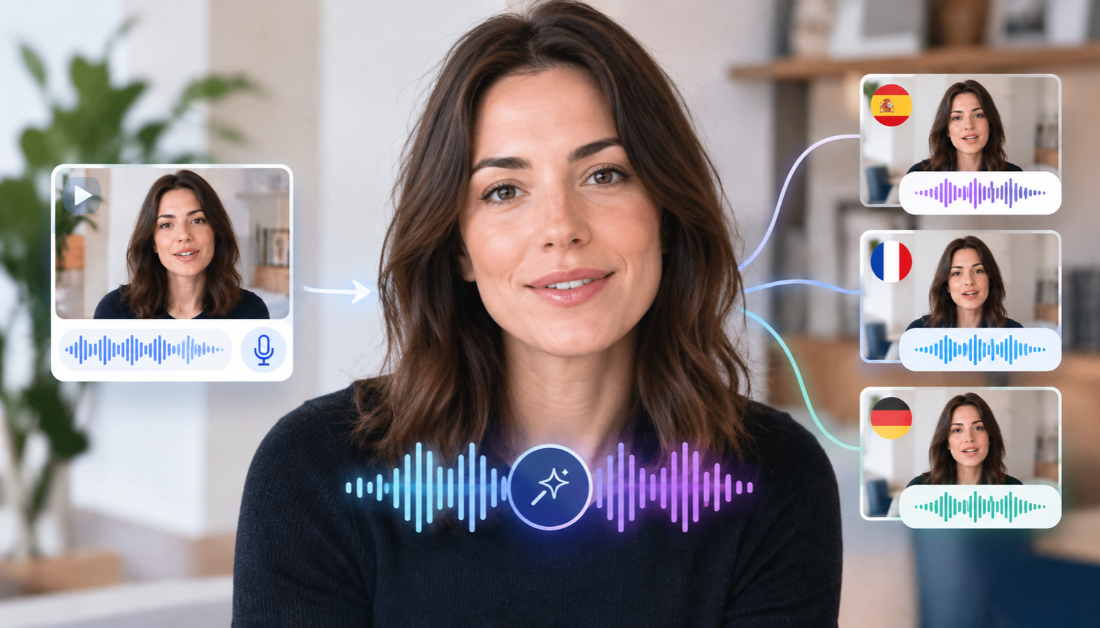
VEED.io Review: AI Dubbing That Looks & Sounds Like Me
VEED.io leverages AI technology to streamline video editing tasks, which can significantly reduce time and effort for content creators, especially in producing multilingual content.
- VEED.io is an online video editor that automates tasks like silence removal, audio cleanup, and dubbing videos into multiple languages.
- The tool offers AI talking videos that replicate the user's voice and lip movement, with a limitation of 240 credits per 30 seconds for the feature.
- VEED's features include automatic transcription and subtitle generation, allowing quick adjustments without using AI credits for cleanup tools.
- The platform operates fully in the browser, offering free access to some features while requiring a paid plan for advanced options and additional credits.
- VEED's pricing structure includes multiple tiers, which can lead to rapid depletion of monthly AI credits depending on usage.
VEED.io, founded in London in 2018, is an online video editing platform that integrates traditional film editing tools with advanced AI functionalities. Originally launched as a simpler alternative to desktop editors, it has evolved to include AI voice cloning and video generation capabilities. The platform is increasingly used by content creators and marketers for producing engaging videos efficiently.
Read the original ↗