
The day's AI news, briefed
The Daily Prompt
Our AI editor reads each day's AI and robotics stories, pulls out why they matter, and links every original source — so you can keep up in minutes.
Join over 250,000 subscribers getting the latest AI news
Latest AI & Robotics News Today

Wikimedia Foundation Seeks to File Amicus Brief in OpenAI Copyright Case
The Wikimedia Foundation’s involvement in OpenAI's copyright case could shape future regulations around the use of copyrighted content for artificial intelligence, impacting both innovation and knowledge sharing.
- The Wikimedia Foundation has requested permission to file an amicus brief in the OpenAI copyright infringement case in the U.S. District Court for the Southern District of New York.
- The court will decide if AI companies can fairly use copyrighted content for developing large language models, with significant implications for technological innovation and public access to information.
- Wikimedia argues that restrictive fair use could hinder open-source projects and knowledge accessibility, while unchecked fair use may lead to greater information barriers.
The Wikimedia Foundation advocates for free access to knowledge and relies on millions of volunteer contributions to maintain Wikipedia and its other projects. The case centers on claims against OpenAI regarding copyright use in AI model training, a critical legal question as technology advances.
Read the original ↗
&Truth Raises $70M Seed to Build Universal Verification Machine for Code
The emergence of &Truth aims to revolutionize software safety by enabling rapid, universally verifiable proofs for code integrity, addressing increasing vulnerabilities in AI-generated software.
- &Truth raised $70 million in seed funding to develop a universal verification machine for code.
- The verification machine will use AI to mathematically prove that software is safe, secure, and correct across any programming language.
- The company aims to reduce formal proof generation time from years or months to hours or minutes, making it accessible for broader use.
&Truth is a public benefit corporation specializing in software verification using advanced mathematical principles. Formal verification is essential for ensuring software reliability, especially as AI-generated code becomes more prevalent. The company utilizes tools like Lean and Mathlib to create a standardized verification framework.
Read the original ↗
Google Loses $500 Billion in One Day
Alphabet's significant loss of market value highlights the financial risks associated with heavy investments in AI technology, raising concerns about the sustainability of its business model.
- Alphabet, Google's parent company, lost over $500 billion in market value after reporting a decline in ad revenue linked to AI deployment.
- Despite a 25% increase in total revenue to $127.6 billion, Alphabet's profits fell by 25% and reported negative free cash flow exceeding $9 billion.
- Google's shift to AI-generated search summaries has reduced ad space, directly impacting its primary source of revenue from search ads.
Alphabet is the parent company of Google, which primarily generates revenue from advertising through its search engine. Recent trends show that investment in AI technologies is affecting traditional revenue streams, particularly in search advertising. Stakeholders are concerned about how effectively these companies can balance their AI spending with the profitability of their core businesses.
Read the original ↗
ChatGPT-4 vs. Llama 3: A Head-to-Head Comparison
Comparing ChatGPT-4 and Llama 3 reveals key distinctions that can influence choices for businesses seeking AI-driven natural language processing solutions.
- ChatGPT-4 and Llama 3 are large language models that excel in natural language processing tasks.
- ChatGPT-4 can analyze complex data, answer questions, and assist with coding, making it versatile for various domains.
- Llama 3 is recognized for its efficiency and accuracy in multilingual tasks, making it suitable for cost-effective applications.
Large language models (LLMs) like ChatGPT-4 from OpenAI and Llama 3 from Meta are crucial in AI's rapid evolution, enabling advanced text understanding and generation. As companies increasingly adopt LLMs, understanding their strengths and limitations is essential. Future trends indicate ongoing advancements in AI architecture and a rise in open-source models.
Read the original ↗
Manual Pricing vs. AI Pricing: Why AI is the Future of Retail Success
As retail becomes increasingly competitive, the transition from manual to AI-driven pricing strategies is essential for maximizing profits and enhancing customer satisfaction.
- Retailers relying on manual pricing strategies may face profit losses of up to 30% annually due to pricing errors.
- AI pricing utilizes machine learning algorithms to adjust prices in real-time based on market conditions.
- AI pricing provides precise insights that help retailers adapt to consumer demand and seasonal trends.
AI pricing represents a shift from traditional manual methods, which are often slow and prone to errors. The evolution towards AI is crucial as consumers expect competitive pricing and transparent practices in retail. Companies must adapt to these technological advancements to stay relevant in a rapidly changing market.
Read the original ↗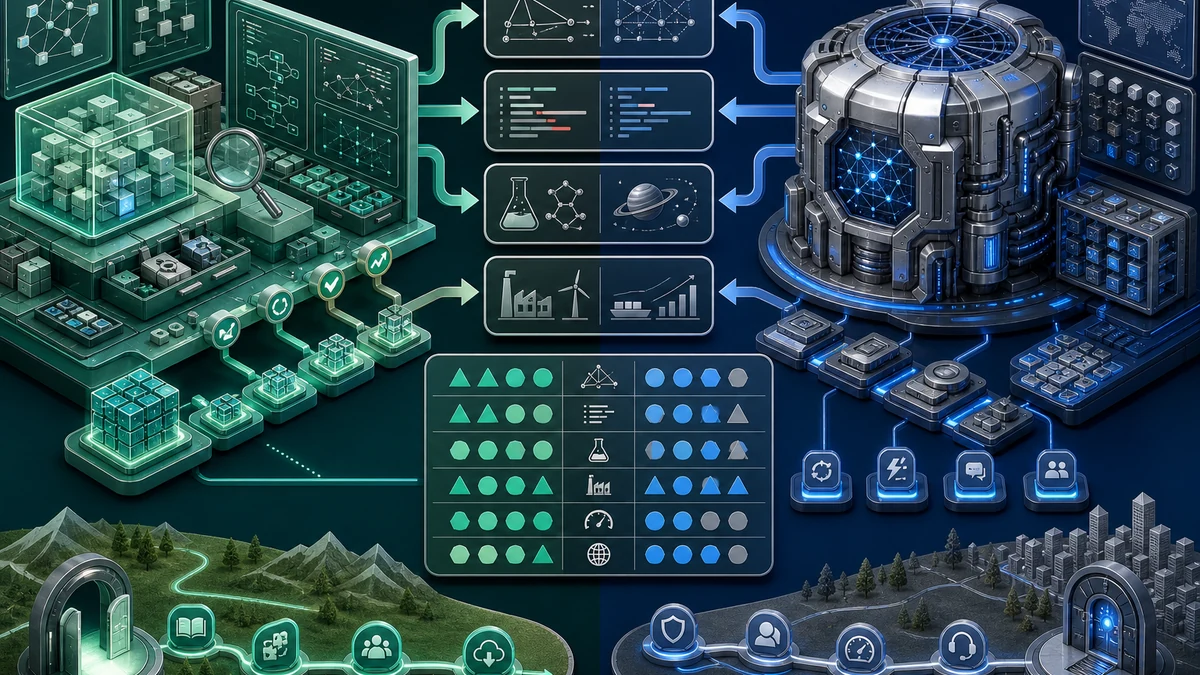
DeepSeek vs. OpenAI: The Battle of Open Reasoning Models
The competition between OpenAI and DeepSeek could accelerate advancements in AI reasoning models, significantly impacting various industries from healthcare to finance by enhancing decision-making capabilities.
- DeepSeek and OpenAI are leading innovators in AI reasoning models, with DeepSeek focusing on modular solutions for healthcare and finance, and OpenAI offering versatile models like GPT-4.
- DeepSeek R1 scored higher than OpenAI o1 in reasoning-specific tests like AIME 2024 and MATH-500, but OpenAI o1 excelled in general knowledge benchmarks and natural language processing.
- DeepSeek R1's open-source model is significantly more cost-effective, priced at $2.19 per million tokens, compared to OpenAI's $60 for the same volume.
DeepSeek and OpenAI represent two approaches to AI reasoning models, with DeepSeek prioritizing modular and explainable AI for specialized industries and OpenAI providing general-purpose capabilities across various applications. As AI continues to evolve, monitoring their developments will be crucial for understanding the future of technology in these fields.
Read the original ↗
Google’s AI Co-Scientist vs. OpenAI’s Deep Research vs. Perplexity’s Deep Research: A Comparison of AI Research Agents
The development of AI research agents like Google’s AI Co-Scientist, OpenAI’s Deep Research, and Perplexity’s Deep Research is transforming the landscape of scientific research, streamlining data handling and insight generation.
- Google’s AI Co-Scientist assists researchers by automating tasks such as literature reviews and experimental design while relying on Google’s extensive ecosystem.
- OpenAI’s Deep Research employs advanced reasoning capabilities to synthesize scientific knowledge and generate hypotheses, though it depends on the quality of its training data.
- Perplexity’s Deep Research serves as a search engine that enhances scientific discovery by delivering precise, relevant information based on complex queries.
AI research agents are increasingly utilized to aid researchers by managing data and automating repetitive tasks. Each agent, including those from Google, OpenAI, and Perplexity, offers unique features that cater to specific research needs. Ongoing advancements are likely to further refine their capabilities and applications in the research field.
Read the original ↗
AI Agents vs Large Models: Why Team-Based Approach Works Better Than Bigger Systems
The shift from large language models to team-based AI systems represents a significant change in AI design, promising improved efficiency and adaptability for complex tasks while addressing environmental and operational concerns.
- Researchers are increasingly focusing on teams of smaller, specialized AI agents instead of single large language models (LLMs) for enhanced performance.
- Large models require substantial computing power and financial resources, making them impractical for certain applications and raising environmental concerns due to high electricity consumption.
- Team-based AI can efficiently handle complex problems by combining the strengths of individual agents, improving resilience and adaptability compared to monolithic systems.
Traditionally, AI development prioritized the creation of larger language models, believed to enhance performance through increased data and parameters. However, this approach has proven unsustainable, prompting interest in collaborative systems of specialized AI agents. Future developments will likely explore enhancing coordination and resource management within these team-based frameworks.
Read the original ↗
Context Engineering vs Prompt Engineering: A Guide to AI Interaction
The shift from prompt engineering to context engineering represents a significant advancement in AI systems' ability to understand and utilize complex information, enhancing their effectiveness in critical applications.
- Prompt engineering focuses on how questions are phrased to yield better responses from AI language models, gaining prominence in early 2024.
- Context engineering addresses limitations of prompt engineering by optimizing the information AI knows when inquiries are made, leading to improved outcomes.
- Effective context engineering involves managing multiple layers of information including historical, environmental, and domain context to enhance AI interactions.
Prompt engineering emerged as a technique to improve AI responses by refining question formulation. However, as the complexity of AI applications grew, context engineering became necessary to provide AI with relevant information for improved performance. Organizations are now prioritizing context engineering to meet user expectations and manage the risks associated with AI applications.
Read the original ↗
Gemini 3 vs. GPT-5: Why Google’s New Model Is Redefining AI for Business Operations
The differences between Gemini 3 and GPT-5 illustrate the evolving landscape of AI, impacting how businesses optimize operations for efficiency and effectiveness.
- Gemini 3 emphasizes multimodal processing, integrating text, images, audio, and video for comprehensive data analysis.
- GPT-5 specializes in deep textual reasoning, making it suited for complex written tasks requiring logical consistency.
- Both models present unique strengths in enterprise applications, influencing customer support, analytics, and strategic planning efforts.
Gemini 3 is Google's advanced AI model designed for multimodal tasks, while GPT-5 from OpenAI focuses on deep textual reasoning. As companies increasingly adopt AI for various operational needs, understanding these models' capabilities is crucial for informed decision-making in technology integration.
Read the original ↗
AI SDR vs Human SDR: What the Future of Sales Development Looks Like in a Saturated, Multi-Channel World
The evolving dynamics between AI and human sales development representatives (SDRs) could significantly impact how sales teams operate and engage with potential clients in a saturated market.
- AI is reshaping the sales development representative (SDR) landscape, prompting businesses to choose between scaling automation or prioritizing human interaction.
- Email is becoming a saturated communication channel, with new sender requirements being enforced by major providers like Google and Microsoft.
- Human-led engagement remains critical in social and phone channels, where trust and compliance are paramount, as AI cannot fully replicate these aspects.
- AI can assist SDRs by enhancing research, targeting, and handling administrative tasks, allowing humans to focus on higher-value interactions.
- Future sales strategies must integrate AI and human efforts, optimizing each's strengths in different communication channels.
Sales development involves connecting with business contacts to encourage meetings with potential vendors. Recent saturation in email channels has driven a need for a hybrid approach, leveraging both AI and human skills to effectively engage prospects. The upcoming regulations on email marketing and AI's limitations in cold calling highlight the importance of balancing automation with strong human connections in sales processes.
Read the original ↗
Flexible Automation vs Agentic Augmentation in Coding
The evolution of coding practices through agentic automation and flexible automation could significantly impact developer productivity and skill development, shaping the future of the software industry.
- Agentic automation, also known as 'vibe coding', has gained popularity in software development, with Microsoft reporting that up to 30% of its code is AI-generated.
- Flexible automation emphasizes keeping developers in control by integrating AI selectively into repetitive tasks without disrupting their workflow.
- 42% of developers using AI state that at least half of their codebase is AI-generated, raising questions about the implications for junior developers' skill development.
Agentic automation leverages generative AI to produce code from conversational prompts, while flexible automation focuses on human oversight in repetitive coding tasks. As AI becomes more prevalent, it is essential for developers to find the right balance between automated and hands-on coding to support learning and productivity. The ongoing integration of AI tools suggests a strategic approach toward automation in software development is critical for the industry's future.
Read the original ↗
OpenClaw vs Claude Code: Remote Control Agents
The development of Remote Control for Claude Code and the growth of OpenClaw highlight a significant shift toward continuous and cross-device AI agent functionality that can enhance productivity and interaction.
- Anthropic released Remote Control for Claude Code on February 25, enabling coding session continuity across devices while maintaining local execution.
- OpenClaw is a free, open-source AI agent that allows task automation across various messaging platforms and executes commands locally on users' machines.
- Claude Code is specifically designed for coding tasks, while OpenClaw serves as a general-purpose agent across different digital activities.
Remote Control for Claude Code allows developers to continue coding tasks remotely from any device, marking a shift toward persistent AI functionality. OpenClaw, built to operate across various platforms, offers a more integrated AI experience but presents security challenges in its open-source model. Both developments reflect a broader trend in AI toward continuous availability and interaction across devices.
Read the original ↗
China-Nexus VAPOR PANDA Breached Nine of 200-Plus Targets With AI Agents
The breach by VAPOR PANDA highlights the growing sophistication of cyber threats leveraging AI, posing significant risks to a wide array of industries globally, including government and defense sectors.
- VAPOR PANDA used the AI-driven ARTEX framework to target over 200 organizations in 14 countries from October 17, 2026.
- CrowdStrike confirmed post-exploitation activity at nine organizations, where adversaries deployed the BLOODALCHEMY backdoor and conducted reconnaissance.
- Significant breaches included foreign ministries in Latin America and a Middle Eastern interior ministry, as well as numerous U.S.-based organizations.
- The operation suggests a strategic shift towards using AI for multiple concurrent intrusions rather than individual attacks, raising concerns about increased threat capabilities.
VAPOR PANDA is a China-based cyber adversary known for targeting government and industrial sectors. The ARTEX intrusion framework is powered by AI models, including the Chinese-developed DeepSeek. The attack's unprecedented scale and use of AI signal an evolving threat landscape in cybersecurity.
Read the original ↗
Inside the US Probe Into an Alleged Spy Near Nvidia CEO
The ongoing investigation into Alice Huang highlights concerns over national security and the potential diversion of advanced AI technologies to foreign entities.
- U.S. intelligence is investigating Alice Huang, an executive at Megaspeed, for potential ties to Chinese espionage related to Nvidia's technology.
- Jensen Huang, Nvidia's CEO, has met with Alice Huang at various business dinners, raising concerns about information sharing.
- Nvidia denies any sensitive information was leaked and asserts that its interactions were standard business practices.
Nvidia, a leading AI chip manufacturer, is facing scrutiny over potential illegal exports to China through its customer Megaspeed, which has been accused of reselling restricted chips. The U.S. has imposed strict export controls on advanced AI technologies to prevent their use in enhancing China's military capabilities.
Read the original ↗
Here’s Why You’re About to See More Ads in Google’s AI Overviews
The expansion of ads in Google's AI Overviews may reduce organic traffic to online publishers, challenging their business models and impacting how content is accessed online.
- Google is expanding advertising in its AI Mode to 10 new countries, including Australia and India.
- AI Mode now features 'multiturn ads' that appear within follow-up queries with commercial relevance.
- Nearly half of Google search queries now generate AI Overviews, leading to a 61% drop in traffic for other pages.
Google's AI Overviews provide summarized answers at the top of search results, potentially diminishing the visibility of traditional content links. This shift affects online publishers significantly, prompting adaptations in search behaviors to access preferred content. The overall trend indicates increasing reliance on ads over organic search results.
Read the original ↗
You don’t need to believe in a god to get a religious exemption from using AI at work
This story highlights a growing trend where individuals seek legal religious exemptions from the use of AI in the workplace, raising questions about technology's role and impact on personal beliefs.
- David Durman, a University of Kentucky administrator, received a religious exemption to abstain from using AI at work due to his Humanist beliefs.
- Durman argues that AI undermines human dignity and critical thinking essential for personal and societal flourishing.
- He is the first Humanist to obtain such an exemption, inspired by another individual who secured similar protections.
- The University of Kentucky assesses religious accommodation requests based on individual circumstances and essential job functions.
Humanism is a non-religious worldview that emphasizes human well-being and ethical decision-making. The American Humanist Association assists individuals seeking protections based on these beliefs. Legal frameworks are evolving to recognize diverse belief systems, prompting more individuals to seek exemptions from AI usage.
Read the original ↗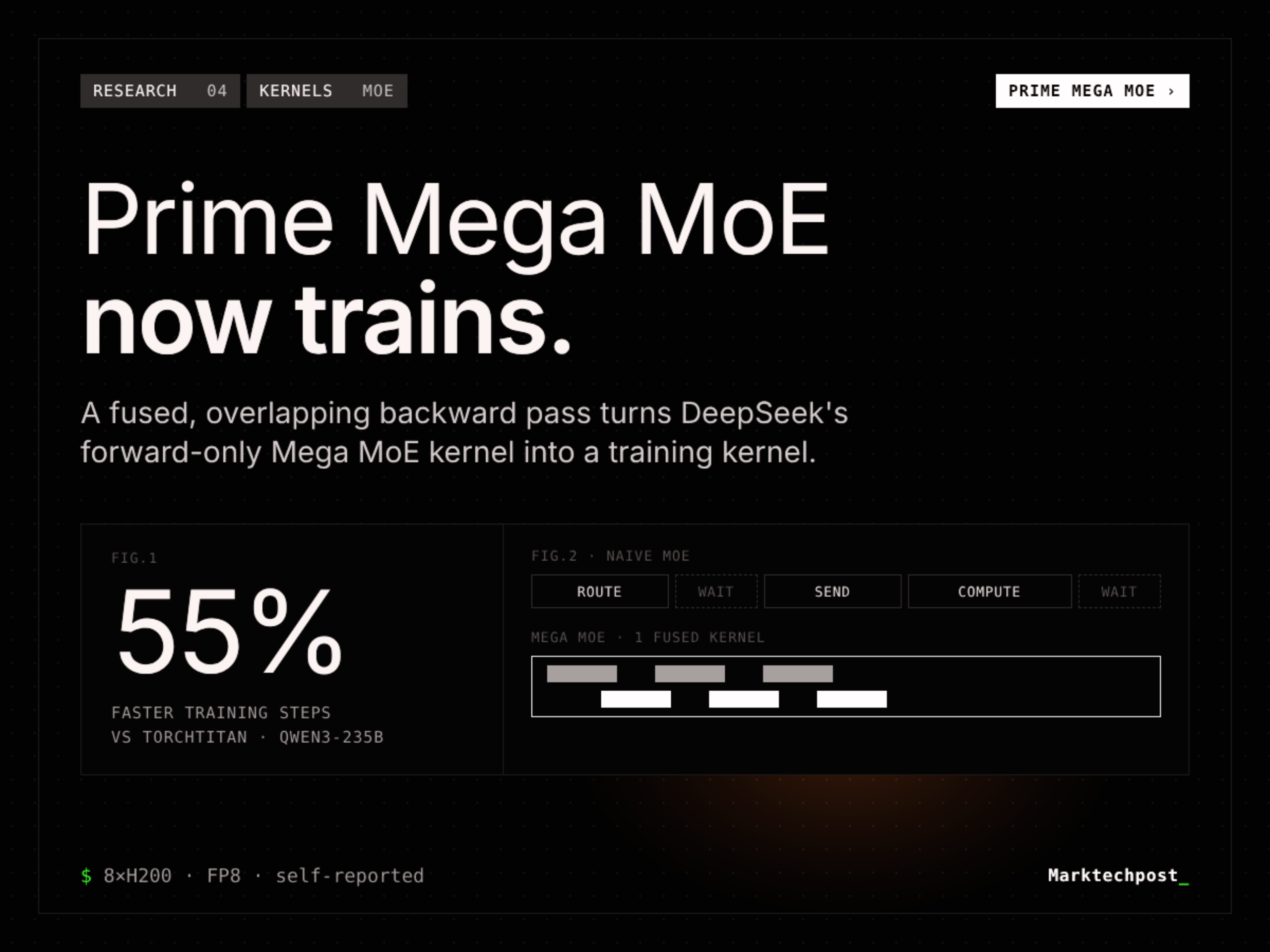
Prime Intellect Releases Prime Mega MoE: Trainable Fused MoE Kernel, 3.11x...
The introduction of Prime Mega MoE enhances the efficiency of training mixture-of-experts models, potentially reducing the computational resources required for AI model development.
- Prime Intellect has released Prime Mega MoE, a training extension of DeepSeek's fused Mega MoE kernel, making it trainable instead of just usable for inference.
- The new kernel incorporates a faster, overlapping backward pass, resulting in training steps running 32% to 34% faster than its baseline and up to 55% faster against TorchTitan.
- Performance improvements include a 3.11x faster forward pass for the Qwen3-30B-A3B model, while the backward pass shows a gain of 1.24x on a larger model.
Prime Mega MoE builds on DeepSeek’s open-source DeepGEMM library, which introduced the original Mega MoE kernel in April 2026. This upgrade is significant for teams training MoE models, as it optimizes both training time and GPU usage.
Read the original ↗
ConnectWise Launches AI Agent That Investigates IT Tickets Before Fixes
The introduction of ConnectWise's AI agents aims to streamline IT ticket resolution, enhancing efficiency in service-desk operations and potentially reducing operational delays caused by incomplete requests.
- ConnectWise launched the RMM Agent, which investigates IT tickets by examining linked devices and testing possible causes before recommending fixes.
- Every device change executed through the RMM Agent requires explicit technician approval, ensuring control over system modifications.
- Alongside RMM Agent, ConnectWise introduced Voice, Teams, and Email Agents to gather customer information and reduce service-desk delays.
- The platform is designed to connect service requests with device conditions, allowing technicians to make informed decisions based on diagnostic evidence.
ConnectWise specializes in IT management solutions, including remote monitoring and management (RMM) tools that assist technicians in servicing client systems. The new AI agents build on previous capabilities, aiming to reduce time and improve outcomes in troubleshooting and service request handling.
Read the original ↗
Epoch AI Reports Open-Weight GLM 5.3 Exploits Firefox Patch Gap
The ability of an AI model to exploit security vulnerabilities in widely-used software like Firefox underscores the evolving cyber threat landscape, highlighting the need for robust security practices.
- Epoch AI reported that GLM 5.3 can exploit a patch gap in six Firefox versions, compromising them at a cost of approximately $1,000 per version.
- The exploit allowed for file access from a user's computer without interaction, posing serious risks to user data and credentials.
- Mozilla released Firefox 159.0 on October 27, 2026, to address the disclosed vulnerabilities after being informed by Epoch.
- Epoch invested over $100,000 in research and demonstrated that the model could autonomously identify and exploit vulnerabilities without human input.
Epoch AI's research focuses on exploiting security vulnerabilities using AI models. Prior to this report, the company provided evidence of potential exploits against various software platforms, emphasizing the accessibility of advanced cyber capabilities. Future efforts will likely involve testing more sophisticated models against diverse software challenges.
Read the original ↗