
The day's AI news, briefed
The Daily Prompt
Our AI editor reads each day's AI and robotics stories, pulls out why they matter, and links every original source — so you can keep up in minutes.
Join over 250,000 subscribers getting the latest AI news
Latest AI & Robotics News Today

SCAIL-2: Unifying Controlled Character Animation with End-to-end In-Context Conditioning
The development of SCAIL-2 has the potential to significantly enhance character animation techniques, improving the efficiency and quality of motion transfer in various applications.
- SCAIL-2 enables end-to-end character animation by directly transferring motion from driving videos without using intermediate representations.
- The framework unifies sub-tasks of character animation through decoupled conditions, leading to improved motion transfer performance.
- A new dataset called MotionPair-60K has been curated to support SCAIL-2, consisting of diverse tasks related to character animation.
SCAIL-2 is a framework designed to improve controlled character animation by eliminating reliance on traditional techniques like pose skeletons. Previous methods often lost information due to intermediates, while this framework directly integrates visual data from input videos. Future research may focus on further optimizing synthetic data generation and exploring real-world applications.
Read the original ↗
Working Against the Clock: A Bizarre Human Behavioral Tendency Has Emerged in New Research
This research uncovers a specific human behavioral tendency that could influence design and planning in various fields, highlighting the importance of understanding movement in crowded spaces.
- Researchers in Spain and Japan discovered a significant preference for counterclockwise turning among individuals in crowds, identified during studies on social distancing.
- The study found that this behavior is consistent across different genders and cultures, with age being the only notable factor that affects it.
- Initial observations were made accidentally while studying crowd movement during the COVID-19 pandemic, particularly in public spaces like museums.
The research began at the University of Navarra in Spain and continued at the University of Tokyo in Japan. It aims to investigate the reasons behind this counterclockwise preference, which has implications for psychology and design. Future studies will focus on the biomechanical aspects influencing this behavior.
Read the original ↗
Artificial Intelligence Sneaks Into the World Cup Thanks to Google Gemini
Integrating AI into the World Cup signifies a major shift in sports analytics and fan engagement, potentially reshaping how teams prepare and fans interact with the game.
- Google's Gemini will be the main global sponsor of Argentina's national team during the World Cup.
- Gemini will be used to analyze team plays, performance, and player statistics throughout the tournament.
- Fans will have access to AI-generated real-time analysis and allow them to create social media content.
- Google has secured similar partnerships with Brazil and France to expand its AI presence at the World Cup.
The Argentine Football Association has partnered with Google to utilize the Gemini AI tool during the World Cup, which is being tested for performance analysis in a high-pressure sports environment. Previous World Cups have seen technology adoption evolve significantly, now culminating in AI’s role. Observers should monitor the effectiveness and reception of these AI tools during matches.
Read the original ↗
Finally, Some Affordable Laptops That Won’t Fail You in College
Affordable laptops that meet college students' needs can improve access to education and support effective learning, making this selection particularly relevant for budget-conscious students.
- The article reviews affordable laptops suitable for college students, focusing on portability, battery life, and performance.
- The MacBook Neo is highlighted as a top choice for its quality and lightweight design, starting at $699.
- The Dell 14 Plus is recommended for under $1,000, offering good performance without major compromises.
- The Asus Zenbook A14 stands out for having 16 GB of RAM and weighing only 2.4 pounds, typically priced between $600 and $1,000.
- Chromebooks are considered less viable, but the $200 Asus Chromebook CX15 is noted as a decent low-cost option.
The article provides a selection of laptops designed for college students, emphasizing affordability and functionality. Previous models have become costly, leading to recommendations for last year's models. Future trends may include more budget-friendly options or further declines in Chromebook viability.
Read the original ↗
What to expect from Google this week
This week’s Google I/O highlights the rapid integration of AI technology into consumer products, reshaping user experiences and how everyday tasks are performed.
- Google’s I/O event showcases new consumer products that incorporate AI technologies, particularly through its Gemini app.
- The Gemini app offers access to multiple generative models, including an image generator and a video generator, through a single chatbot interface.
- AI Mode, a new search interface, personalizes search results by using information from users' Gmail and Google Docs.
- Project Astra, a universal AI assistant, is being prepared for broad user access on smartphones after being initially demonstrated.
- Google AI Ultra subscription service is available for advanced features at $250 a month.
Google's annual I/O event typically reveals its latest technology developments and plans. The focus this year is on the seamless integration of AI into its product ecosystem, moving beyond high-profile AI models to consumer applications. Attention will be on how these advancements affect market competition with companies like OpenAI.
Read the original ↗
Siri AI arrives with Google inside, and much of the world is locked out
The introduction of Siri AI integrated with Google's technology emphasizes the growing competition in AI voice assistant capabilities, highlighting access disparities around the globe.
- Siri AI has been enhanced by integrating Google's technology, known as Gemini.
- A significant portion of the global population remains excluded from access to this new functionality.
Siri is Apple's virtual assistant that uses AI to perform tasks and answer queries. The integration with Google's Gemini represents a new phase in the evolution of voice assistants, which influences user experience and market competition. Observers should watch for reactions from other tech companies and how this affects global access to AI technology.
Based on the headline only — the full article could not be fetched.
Read the original ↗
How AI Monetization Is Rewriting the Rules of Enterprise Software
The shift towards consumption-based pricing models for AI in enterprise software may help organizations better manage costs and improve return on investment.
- AI is increasingly being offered on-demand, with costs reflecting actual usage rather than fixed pricing.
- Traditional per-user pricing models in enterprise software do not account for varying levels of AI utilization, which may lead to wasted expenses for organizations.
- Mid-market companies are particularly impacted by fixed license fees, prompting a need for more flexible pricing models that align with actual use and value.
- Emerging pricing structures, including consumption-based and outcome-based models, aim to demonstrate clearer ROI for AI investments.
- Effective AI integration within core business workflows can enhance decision-making and productivity gains, pushing organizations to reevaluate their AI strategies.
AI is changing how enterprise software is priced and deployed, with a movement towards consumption-based models that mirror other utility services. There is a growing emphasis on ensuring AI tools deliver measurable business outcomes, especially as adoption rises among small and midsize businesses. Organizations must focus on integrating AI into daily operations while managing costs effectively.
Read the original ↗
McDonald’s tests Google-backed AI drive-thru ordering system
The introduction of AI in drive-thru systems could enhance customer experience and streamline operations in fast food, indicating a shift in the industry towards automation.
- McDonald’s is testing a Google-backed AI system for drive-thru ordering.
- The initiative aims to improve the efficiency of order taking and processing.
McDonald's is a global fast food chain known for its burgers and fries. The use of AI technology in the food industry is growing as companies seek ways to improve service speed and accuracy. Future developments may include wider implementation and enhancements of AI capabilities in other service areas.
Based on the headline only — the full article could not be fetched.
Read the original ↗
Anthropic Releases Claude Fable 5 and Claude Mythos 5: Same Underlying Model, Different Safeguards, New Mythos-Class Tier
The release of Claude Fable 5 and Claude Mythos 5 demonstrates advancements in AI model design with enhanced safeguards, which may influence future AI safety protocols.
- Anthropic has released two new AI models: Claude Fable 5 and Claude Mythos 5.
- Both models utilize the same underlying architecture but incorporate different safety measures.
Anthropic is an AI research company focused on safety and alignment for AI systems. This release builds on their ongoing efforts to improve AI safety features and expands their product offerings in AI development. Future updates may include further enhancements to model safety protocols.
Based on the headline only — the full article could not be fetched.
Read the original ↗
Meta signs first AI data center deal in India with Reliance
The partnership between Meta and Reliance signifies a strategic investment in India's growing AI infrastructure sector, which is becoming increasingly relevant as global computing demands surge.
- Meta has signed its first AI data center partnership in India with Reliance Industries, focusing on a 168-megawatt facility in Jamnagar, Gujarat.
- The deal expands upon previous investments by Meta in Reliance's Jio Platforms and a $100 million joint venture for AI solutions.
- The Jamnagar facility, which will be powered by renewable energy and cooled with desalinated seawater, is expected to be operational within two years.
Meta, a leading technology company, is expanding its AI capabilities through a partnership with Reliance Industries, which has been enhancing India's data center capabilities to meet rising global demand. India has seen a rapid increase in installed data center capacity, driven by AI and cloud adoption, with firm commitments from various tech companies and government incentives for investments.
Read the original ↗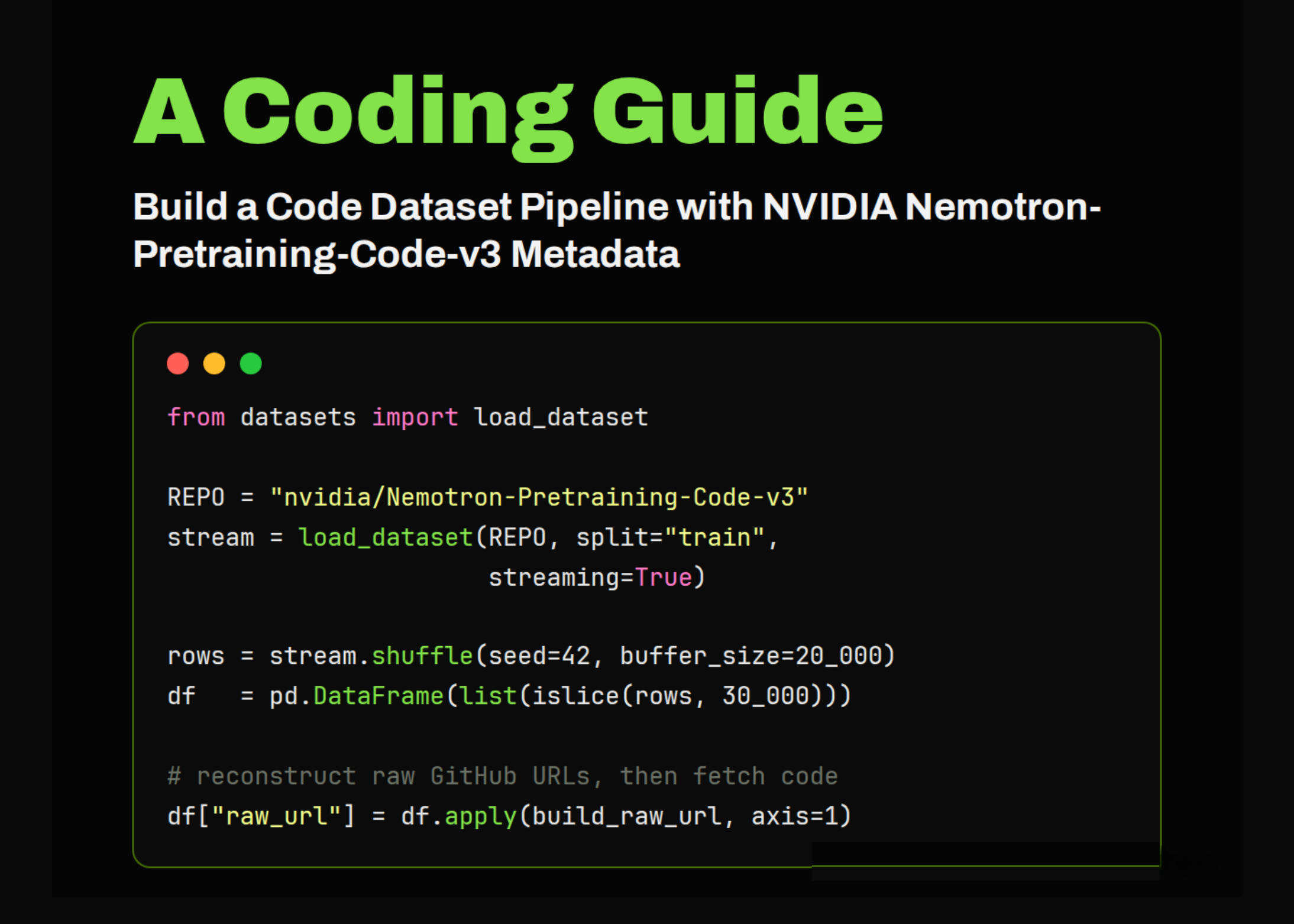
Building a Code Dataset Pipeline from NVIDIA Nemotron-Pretraining-Code-v3 Metadata with Streaming, Pandas, and tiktoken
Developing effective data pipelines for code datasets is crucial for advancing AI contributions in programming and machine learning applications.
- The article discusses creating a dataset pipeline using NVIDIA's Nemotron-Pretraining-Code-v3 metadata.
- It involves technologies such as streaming, Pandas (a data analysis library), and tiktoken (a tokenization library).
NVIDIA's Nemotron-Pretraining-Code-v3 is a model designed for understanding programming code. Effective dataset pipelines are essential to improve AI performance and facilitate machine learning training processes. Future advancements may include better tuning of training data and methodologies.
Based on the headline only — the full article could not be fetched.
Read the original ↗
Agents' Last Exam
The Agents' Last Exam (ALE) highlights significant gaps in the ability of AI agents to perform long-term tasks in professional settings, raising concerns about the readiness of AI for workplace automation.
- ALE is a benchmark for evaluating AI agents on economically valuable tasks across 13 industry clusters, involving over 1,000 tasks.
- Developed in collaboration with over 250 industry experts, ALE's task taxonomy includes 55 subfields based on U.S. occupational data.
- Current results indicate the average full pass rate for AI agents on the hardest tests is only 2.6%, revealing challenges in real-world application.
Agents' Last Exam (ALE) is designed to address the limitations of existing AI performance measures in economically relevant domains. The benchmark aims to connect AI achievements with practical deployment in professional industries while expanding its task pool continuously as new workflows emerge. Future developments will focus on performance improvements and industry adoption of AI systems.
Read the original ↗
Google just fired a warning shot in the AI subscription price wars
Google's price reduction for its AI subscription signals a significant shift in the competitive landscape of AI services, with potential impacts on pricing strategies across the industry.
- Google has reduced the monthly price of its AI subscription, Google AI Plus, from $7.99 to $4.99.
- The updated subscription also includes doubled storage, increasing from 200 gigabytes to 400 gigabytes.
- This move mirrors competitive pricing strategies seen in emerging markets, particularly in India.
- Historically, pricing competition in AI services has been limited in the U.S., but Google’s announcement may change this dynamic.
- Investors are closely monitoring how this will affect the valuations of companies like OpenAI and Anthropic as they explore public offerings.
Google AI Plus was launched in January 2026 as the most affordable paid AI subscription in the U.S. market, targeting individual users and students. The subscription includes features such as video generation and AI assistance tools. Ongoing pricing competition is expected to pressure margins in the AI sector, particularly for infrastructure providers.
Read the original ↗
Anthropic Just Opened Its Most Powerful AI to Everyone
The release of Anthropic's most advanced AI, Fable 5, to the public, introduces potential industry-wide changes to how AI access and data retention are regulated.
- Anthropic launched Claude Fable 5, the first accessible version of its elite Mythos AI model, subject to strict usage rules.
- Fable 5 excels in software engineering, complex knowledge work, and image understanding, surpassing previous AI benchmarks.
- To prevent misuse, the model will retain user data for 30 days, a new requirement aimed at enhancing security.
- Fable 5 is available now via Claude API, with free access in selected plans until June 22, followed by a charge of $10 per million input tokens.
- Only approved organizations can access the newly released Mythos 5, expanding to hundreds of entities in 15 countries.
Mythos is Anthropic's advanced AI system, initially kept private due to concerns about its potential misuse. The introduction of Fable 5 aims to allow broader usage while enforcing safety protocols, signaling a shift towards stricter data policies in the AI industry.
Read the original ↗
Conan O'Brien is hosting educational videos for an AI cybersecurity company
With increasing cyber threats costing Americans billions, using an engaging figure like Conan O'Brien for training can significantly enhance awareness and adherence to online safety practices.
- Adaptive Security has teamed up with comedian Conan O'Brien to create a 15-part educational video series on cybersecurity.
- The videos aim to educate clients and employees about navigating threats such as phishing and deepfakes.
- This partnership reflects a trend of making corporate training more engaging and effective.
Adaptive Security is a company that specializes in AI-driven cybersecurity solutions. The collaboration with O'Brien underscores a shift towards using humor in serious training to improve retention and effectiveness. Given the rise of sophisticated cyber threats, effective training is critical for organizational safety.
Read the original ↗
Anthropic's Fable AI brings the capabilities of its unreleased Mythos model to regular users
This development highlights the rapid evolution of AI models, making advanced capabilities accessible to more users while raising considerations about safety and AI governance.
- Anthropic has launched Fable, a new AI model that offers capabilities similar to its unreleased Mythos system.
- Fable is available for Claude subscribers to test until June 22 without using usage credits.
- The model is designed to excel at software engineering and document analysis, outperforming earlier Anthropic models and leading competitors.
- Fable incorporates robust safeguards, routing certain prompts through a less-capable version to enhance safety.
- Mythos 5 was also released, which operates on the same model as Fable but with fewer safeguards.
Anthropic is a research company focused on developing advanced AI systems. Its Mythos model, debuted in 2023, was previously available only to select partners. The introduction of Fable allows broader public access to these capabilities, amid ongoing discussions about AI regulation and safety measures.
Read the original ↗
I Tested Claude Fable 5: Can Anthropic’s Newest AI Deliver on...
The launch of Claude Fable 5 represents a significant advancement in AI capabilities, offering enhanced performance for complex tasks and potentially influencing how AI is accessed and used in sensitive fields.
- Claude Fable 5 and Mythos 5 are the newest AI models from Anthropic, expanding their offerings derived from the earlier Mythos Preview.
- Fable 5 reportedly excels in software engineering, knowledge work, vision, and long-context tasks, outpacing previous Claude models.
- Access to Claude Fable 5 is available through the Claude API and various cloud platforms, while Mythos 5 remains restricted to trusted partners only.
- Fable 5 operates on a pricing model of $10 per million input tokens and $50 per million output tokens, with options for cost reductions through prompt caching.
Claude Fable 5 is designed to provide advanced AI capabilities to a wider audience, while Claude Mythos 5 is focused on sensitive applications in areas like cybersecurity and biology. Previous models faced limitations in handling complex tasks, making this upgrade notable for its expanded capacities. Observers should watch how Anthropic balances accessibility and safety in AI deployment moving forward.
Read the original ↗
Anthropic’s Fable 5 can make weirdly fun video games with the click of a button
Anthropic's Fable 5 demonstrates significant advancements in AI capabilities, allowing rapid game creation from simple prompts, which could revolutionize software development practices.
- Anthropic has launched Claude Fable 5, its first public release of the widely anticipated Mythos model.
- Ethan Mollick, an AI researcher, found Fable 5 outperformed existing models significantly in terms of capabilities and execution time.
- Fable 5 enables the creation of various video games and complex visualizations from a single prompt.
- Mollick created games like Snake and Strata, showcasing the model's ability to generate engaging content quickly.
Claude Fable 5 is an AI-driven model capable of generating software, including games and visualizations, using minimal input. Previous models required extensive programming teams, highlighting a shift towards more accessible AI tools. Future developments may reveal more capabilities as AI tools evolve.
Read the original ↗
Hey Siri, here’s what I actually want from AI
The anticipated overhaul of Apple's Siri could redefine user interaction with AI technology, highlighting concerns over privacy and personal data security in increasingly complex digital environments.
- Apple is launching an AI-powered revamp of Siri, introducing features that enhance personal assistance across devices, including iPhones, laptops, and Apple’s mixed reality headset.
- The new Siri will utilize 'personal context' to help users manage their tasks better, such as reminding them of commitments based on previous conversations.
- Apple's improved Siri offers on-device AI capabilities which are more secure compared to traditional cloud computing, aiming to protect user privacy during data processing.
Apple has been working on improving its Siri assistant for two years following a substantial lawsuit. The updates aim to create a more proactive AI assistant that understands user needs better while ensuring data privacy.
Read the original ↗
Claude Fable 5 Makes Frontier AI a Metered Utility
The shift to a metered utility model for frontier AI may significantly affect budgeting and operational strategies for businesses utilizing advanced AI capabilities.
- Anthropic launched Claude Fable 5, which charges $10 per million input tokens and $50 per million output tokens, doubling the previous standard rate.
- The rollout of Fable 5 begins on June 23, 2026, when it will no longer be included in standard subscription plans, moving to a usage credit system.
- There is a new 30-day data retention policy for clients using Mythos-class models, affecting how confidential data is managed.
Claude Fable 5 is the latest model from Anthropic, designed for high-complexity tasks in AI. This marks a transition from all-you-can-eat pricing for AI usage to a metered system, impacting how businesses plan their budgets. Operators must adapt to this new pricing structure to avoid unexpected costs.
Read the original ↗