
The day's AI news, briefed
The Daily Prompt
Our AI editor reads each day's AI and robotics stories, pulls out why they matter, and links every original source — so you can keep up in minutes.
Join over 250,000 subscribers getting the latest AI news
Latest AI & Robotics News Today

New SPHEREx Space Telescope Images Confirm a Major Problem That Many Astronomers Were Afraid Of
The contamination of astronomical images by satellite trails poses a significant challenge for space research, potentially hampering scientific discoveries in astrophysics and related fields.
- NASA's SPHEREx space telescope found that 73.3% of its images showed trails from artificial satellites.
- The telescope was designed to limit satellite streaks from its low Earth orbit position, yet detected an average of two trails per exposure.
- Some satellites were bright enough to trigger SPHEREx's protection system, inadvertently shutting down data collection against cosmic rays.
SPHEREx, designed to map the night sky in near-infrared light, faces challenges from increased satellite activity which can distort astronomical observations. Previous studies indicated growing concerns about satellite light pollution affecting data quality in space research.
Read the original ↗
Robust-U1: Can MLLMs Self-Recover Corrupted Visual Content for Robust Understanding?
The development of Robust-U1 addresses a significant gap in the reliability of multimodal large language models, improving their performance in real-world applications affected by visual distortions.
- Robust-U1 enhances the robustness of multimodal large language models by enabling them to self-recover from visual corruptions.
- The framework uses supervised fine-tuning and reinforcement learning to improve visual quality and reasoning performance.
- Extensive experiments show that Robust-U1 achieves state-of-the-art robustness on visual corruption benchmarks and performs well under adversarial conditions.
Multimodal large language models (MLLMs) process and understand visual and textual data but often struggle with real-world visual corruptions. Prior methods have shown limited success due to their inherent interpretability issues. Researchers seek to improve MLLM resilience and functionality in practical scenarios through advancements like Robust-U1.
Read the original ↗
How Frontier AI Models Are Fundamentally Shaping Cyber Risk
This story highlights how frontier AI technologies are altering the dynamics of cyber risk management, suggesting organizations must adapt to new vulnerabilities and attack methods.
- Frontier AI models like Mythos and Daybreak can quickly analyze vulnerabilities and simulate attack paths in ways not previously achievable.
- Despite advanced capabilities, many breaches still stem from unaddressed basic vulnerabilities, emphasizing the need for timely actions.
- The tempo of cyber operations is shifting with frontier AI, compressing the timeframe between exploit discovery and development for both attackers and defenders.
Frontier AI refers to advanced artificial intelligence models that enhance cybersecurity capabilities by identifying vulnerabilities and attack patterns. As organizations increasingly rely on interconnected systems, understanding how to mitigate risks associated with these technologies becomes crucial for effective security operations.
Read the original ↗
The AI Visibility Crisis: Why Security Teams Are Flying Blind and Why they Don’t Have to
Addressing the visibility crisis in AI security is crucial for preventing vulnerabilities that could lead to significant data breaches or system failures in enterprise environments.
- The integration of AI agents into production environments is increasing, but security measures are not keeping pace.
- Security teams currently lack adequate observability and visibility of AI agent activities, making them vulnerable to attacks.
- Existing log analysis techniques can detect AI activity without requiring new security appliances or tools.
AI agents are increasingly deployed in workplace environments, but their integration raises security concerns due to insufficient protective frameworks. As AI tools prove to have lapses in security, organizations must adapt by enhancing their existing monitoring strategies.
Read the original ↗
How to Address Upcoming Regulatory Compliance Requirements for GenAI Security
Upcoming regulatory compliance requirements for Generative AI (GenAI) could significantly impact how organizations manage data security and operational risks, particularly for multinational companies.
- Regulatory demands for GenAI security are increasing, requiring organizations to demonstrate risk management strategies.
- The EU's Artificial Intelligence Act designates high-risk AI applications and imposes strict transparency and accountability requirements, with penalties based on global revenue.
- The FTC is scrutinizing AI practices to prevent unfair or deceptive practices, holding companies accountable for misleading claims regarding data management and AI risks.
- State laws in California and New York are shaping AI governance and privacy expectations, enhancing compliance frameworks firms must adhere to.
- Organizations must adapt to the complexities of GenAI risks, as traditional compliance tools may be inadequate for emerging challenges.
Generative AI is a technology that can produce text, images, and other content based on input data. Regulatory frameworks like the EU AI Act and the FTC guidelines aim to ensure ethical use and data protection in AI applications. Organizations are encouraged to proactively develop compliance strategies as regulatory landscapes evolve rapidly.
Read the original ↗
EurekAgent: Agent Environment Engineering is All You Need For Autonomous Scientific Discovery
Environment engineering is essential for enhancing the effectiveness and reliability of autonomous agents in scientific discovery, crucial for advancing research across diverse fields.
- EurekAgent optimizes autonomous scientific discovery by enhancing agent environments to improve exploration and collaboration while reducing harmful behaviors.
- The system achieves state-of-the-art results on various tasks, including mathematics and machine learning, at a low cost of less than $11 in total API expenditure.
- EurekAgent incorporates four dimensions of environment engineering: permissions, artifact, budget, and human-in-the-loop engineering.
EurekAgent is a novel agent-based system aimed at boosting autonomous scientific discovery through structured environments. Traditionally, the challenge was designing agent workflows, but now the focus is on optimizing the environments that define agent capabilities. Future developments will likely explore further applications of environment engineering in research automation.
Read the original ↗
SpatialClaw: Rethinking Action Interface for Agentic Spatial Reasoning
The introduction of SpatialClaw highlights a significant advancement in spatial reasoning capabilities of vision-language models, which may improve applications requiring complex spatial understanding.
- SpatialClaw is a training-free framework that uses code as an action interface for flexible spatial reasoning in vision-language models.
- The framework enables an agent to write executable Python cells, adapting its analysis based on prior outputs across various tasks.
- SpatialClaw achieved an average accuracy of 59.9% across 20 spatial reasoning benchmarks, outperforming previous models by 11.2 points.
Spatial reasoning is crucial for understanding object locations and movements in 3D spaces, presenting challenges for vision-language models. Prior spatial agents were limited by their inflexible action interfaces. Future efforts should monitor the impact of SpatialClaw on related tasks in AI development.
Read the original ↗
The Rise of ‘AI Slop!’ Accusations Is Becoming a New Form of Gatekeeping
The rise of 'AI slop' accusations could undermine trust in online discourse, complicating the ability to discern between human and AI-generated content.
- Accusations of 'AI slop' on Reddit and Hacker News have increased sharply between 2023 and 2026, often lacking evidence.
- A study analyzed 25 million comments, revealing 'AI slop' accusations became a novel form of social gatekeeping.
- The phenomenon emerged first in technically-oriented communities before spreading, indicating a shift in online social dynamics.
The study examines how the term 'AI slop' is used as an accusation of AI-generated content, impacting discussions about authenticity online. It highlights a growing concern with differentiating human-written and machine-generated text, complicating trust in digital communication.
Read the original ↗
Pastigio AI Calendar Review: Why a Solo Remote Worker Might Love It
The Pastigio AI Calendar delivers user-friendly scheduling tools for remote workers, enhancing productivity through constant visibility and voice-command capabilities without subscription fees.
- The Pastigio Smart Digital Calendar features a 15.6-inch touchscreen and syncs with Google Calendar and Apple iCloud.
- It allows users to create events using voice commands, photo scanning, or manual touch input and costs $299.99 on Amazon.
- The device provides a gamified task tracker and an always-visible display, which has been found to improve punctuality and time management for users.
- Pastigio is positioned as a budget-friendly alternative to similar products without subscription fees.
- It currently lacks Microsoft 365 support, limiting its use for businesses running that platform.
Pastigio is a digital calendar device designed primarily for remote workers, enhancing scheduling and task management without ongoing costs. This review highlights its benefits and limitations, including features that cater to individual users. Future updates may expand compatibility with other calendar systems.
Read the original ↗
Matchmakers Are Being Paid $25K to Find Trad Wives for Rich Men
The rising demand for traditional wives among wealthy men highlights shifting social dynamics and the complex interplay of gender roles in modern relationships, raising important questions about cultural values.
- High-end matchmakers report wealthy men seeking traditional and conservative women, often requesting characteristics like a focus on family and femininity.
- Matchmaker Blaine Anderson charges between $30,000 and $50,000 for her services, reflecting the high stakes and specific demands of her clients.
- This trend is not confined to conservative areas, with men in places like New York expressing similar desires for partners with traditional values.
The rise of the "trad wife" phenomenon reflects a cultural shift towards valuing traditional gender roles and domesticity. Matchmakers are increasingly catering to clients who desire conservative partners despite their own modern lifestyles, emphasizing a growing societal interest in traditional family structures.
Read the original ↗
RepWAM: World Action Modeling with Representation Visual-Action Tokenizers
The development of RepWAM advances robot manipulation by enhancing the connection between language instructions and autonomous actions, potentially improving the efficiency of robots in various tasks.
- RepWAM is a representation-centric world action model that utilizes semantic visual-action tokenization to enhance robot manipulation performance.
- It address the limitations of existing world action models, which often rely on reconstruction-oriented video tokenizers that do not facilitate effective instruction-following dynamics.
- The model is pretrained to jointly predict future visual states and latent actions based on language instructions, enabling it to adapt to real robot trajectories for manipulation tasks.
- Experiments show that RepWAM outperforms traditional models across diverse manipulation settings, reinforcing the advantages of semantic over reconstruction-oriented tokenization.
RepWAM introduces an innovative approach in robotic manipulation by integrating language cues with visual data through tokenization. Traditional world action models have primarily focused on visual fidelity without adequately connecting visual input with actionable instructions. Future developments in this area may lead to more generalist robot policies capable of performing a wider range of tasks.
Read the original ↗
Pokémon Go players unwittingly contributed to tech with military drone uses
The use of data from Pokémon Go for military technologies raises ethical concerns about user consent and privacy in the evolving landscape of AI and robotics.
- AI company Niantic Spatial is using billions of images from Pokémon Go players to develop navigation technologies for delivery robots and possibly military drones.
- Niantic Spatial trained its model on 30 billion images captured by players, facilitating the creation of a visual positioning system that aids navigation in GPS-denied environments.
- The company has partnered with Vantor to integrate its system with terrain data for drone and vehicle navigation, which has military applications.
- Concerns have emerged about consent, as players did not foresee their data contributing to military technology.
- Niantic Spatial currently has no access to data from active Pokémon Go players, as the game is now managed by a different publisher.
Niantic Spatial, formed in May 2025 from the Pokémon Go developer Niantic, utilizes user-generated data to enhance navigation technology. This development follows a long-standing trend of using crowdsourced data in tech innovations, raising ethical questions about privacy and military applications. Stakeholders, including users and ethicists, are increasingly scrutinizing the implications of such data use.
Read the original ↗
The Everywhere Problem: Why “Data Anywhere” Is Becoming the Defining Infrastructure Challenge of the AI Era
The evolution of AI infrastructure is crucial as it determines how effectively AI can operate across various sectors while adhering to regulatory constraints and data sovereignty.
- The AI industry is facing the 'data anywhere' problem due to distributed data constrained by jurisdictional regulations.
- Inference workloads are projected to account for two-thirds of all AI compute as early as 2026, drastically reshaping data architecture needs.
- Inference costs significantly exceed training expenses, with cumulative costs expected to reach $7 trillion by 2030.
- AI systems must increasingly process data locally to ensure low-latency performance and compliance with regulations such as GDPR.
The article discusses the challenges faced by the AI industry as it transitions from centralizing data to adapting AI systems that respect data sovereignty. With rising demand for inference, companies must develop infrastructures that allow AI to operate effectively at the edge, close to data sources. Future developments will focus on ensuring compliant and efficient data handling in diverse regulatory environments.
Read the original ↗
Five things you need to know about AI
The evolution of AI technologies carries significant implications for privacy, security, and societal decision-making, as both industry and military applications continue to grow and integrate into daily life.
- AI technologies are progressing rapidly, with a focus on understanding the external world and overcoming limitations of current systems.
- Generative AI's incorporation into military decision-making alters traditional intelligence sharing practices.
- The rise of AI agents capable of complex teamwork represents a new frontier in automated research and industry collaboration.
- AI is enhancing the ability of scammers and hackers by making digital infiltration faster and more accessible.
- A backlash against unrestricted AI development is emerging globally, as activists seek to address resulting societal issues.
AI encompasses a range of technologies designed to simulate human intelligence. Recent advancements include large language models and generative AI, which have transformed industries and warfare. Future developments may focus on ethical use and regulatory measures as public concerns grow.
Read the original ↗
Gemini Omni: AI Video Generation Inside Gemini
The introduction of Gemini Omni signifies a significant advancement in AI video generation, blending various media forms to enhance creative possibilities and streamline video creation processes.
- Gemini Omni is a multimodal AI model developed by Google, able to generate and edit videos based on text and image inputs.
- It can create videos from prompts or static images, transforming them into dynamic video sequences with motion and transitions.
- Users must subscribe to a paid Google AI plan for access, with strict usage limits that can be quickly exhausted due to high computational requirements.
Gemini is an AI model that has evolved from text-centric functionalities in 2023 to include video generation capabilities. It offers innovative features for creating videos, but it also faces limitations such as watermarking and usage restrictions that need to be addressed in future developments.
Read the original ↗
Zyphra Release Zamba2-VL: Hybrid Mamba2–Transformer Vision-Language Models That Cut Time-to-First-Token by...
The introduction of Zamba2-VL models potentially enhances efficiency in AI applications involving both vision and language processing, which could accelerate development in various tech fields.
- Zyphra has released Zamba2-VL, a hybrid model combining Mamba2 and Transformer architectures.
- These vision-language models significantly reduce the time-to-first-token by about an order of magnitude.
Zyphra specializes in developing advanced AI models that integrate visual and linguistic understanding. The release of Zamba2-VL builds upon previous innovations in hybrid model architectures, signaling a trend towards improved efficiency in AI processing.
Based on the headline only — the full article could not be fetched.
Read the original ↗
Moonshot AI Launches Kimi Work, a Local Desktop Agent Reportedly Running...
The release of Kimi Work by Moonshot AI highlights advancements in local desktop AI agents, which could enhance productivity and efficiency for individual users.
- Moonshot AI has launched Kimi Work, a local desktop agent designed to assist users with various tasks.
- The agent reportedly operates on the Kimi K2-6 model and is capable of managing a swarm of 300 sub-agent agents.
Moonshot AI is focused on developing innovative AI solutions aimed at improving user experience and productivity. This launch marks a significant step in the evolution of desktop AI technology, which is becoming increasingly capable and accessible. Looking ahead, the performance and reception of Kimi Work will be crucial for Moonshot AI's future offerings.
Based on the headline only — the full article could not be fetched.
Read the original ↗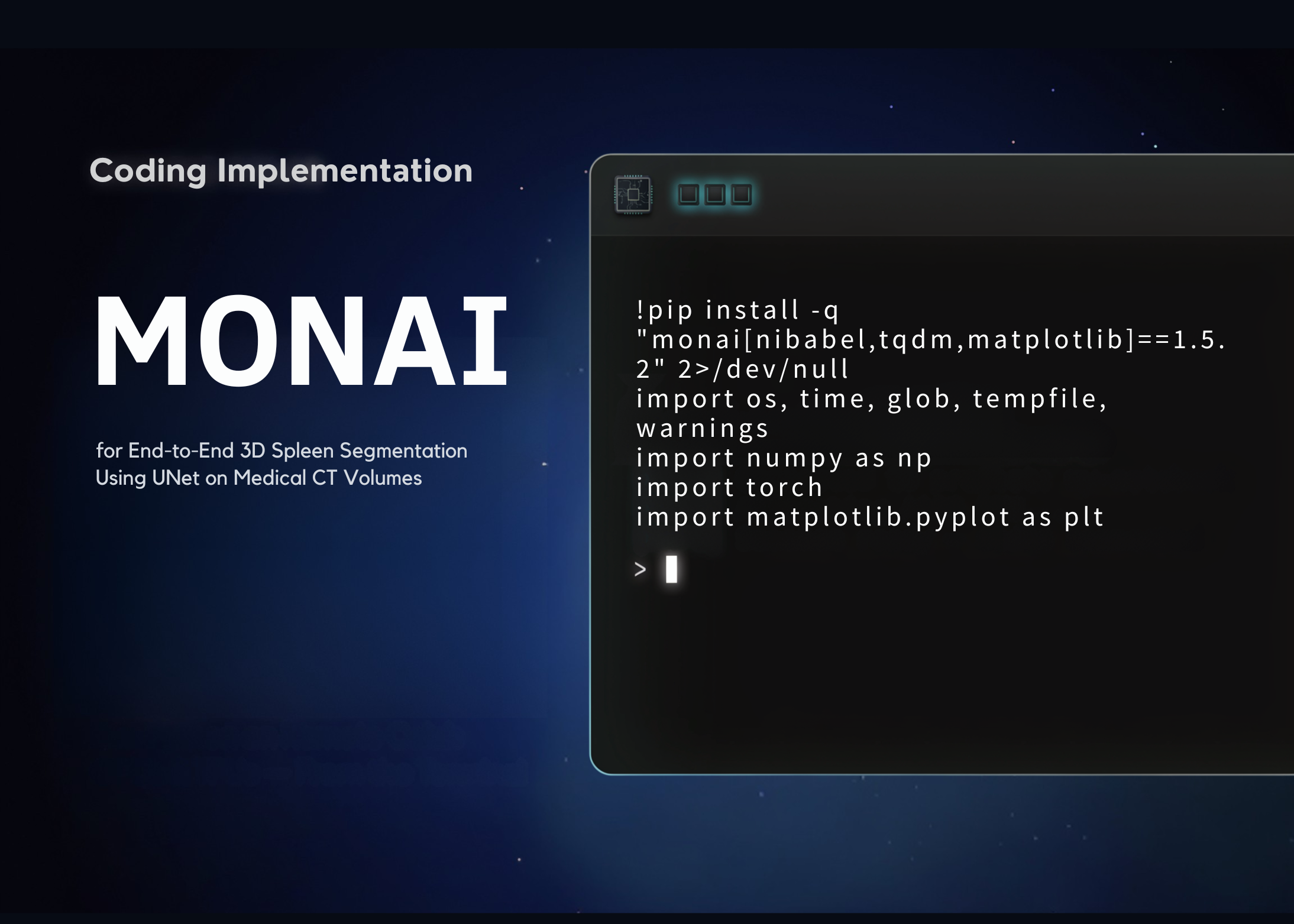
A Coding Implementation on MONAI for End-to-End 3D Spleen Segmentation Using UNet on Medical CT Volumes
The development of an end-to-end 3D spleen segmentation method using UNet could significantly enhance diagnostic accuracy in medical imaging.
- The article discusses a coding implementation using MONAI, a framework for AI in medical imaging.
- The focus is on achieving end-to-end 3D spleen segmentation from medical CT volumes using the UNet architecture.
MONAI (Medical Open Network for AI) is an open-source framework designed for deep learning in medical imaging. Spleen segmentation is critical for diagnosing and monitoring various medical conditions. This implementation reflects ongoing advancements in applying AI to healthcare diagnostics.
Based on the headline only — the full article could not be fetched.
Read the original ↗
Cheaper, faster, and culturally aware, Avataar’s video AI is built for India’s scale
Avataar AI's Varya model promises to significantly reduce costs and production times for video generation in India, potentially transforming the accessibility of AI technologies across various sectors.
- Avataar AI launched Varya, a video generation model optimized for India's cultural context, which runs 10 times faster than previous models.
- Varya is priced at ₹0.48 ($0.005) per second of video, significantly cheaper than competitors which charge $0.10 or more per second.
- The model was developed using a distillation technique on Alibaba's Wan 2.2, allowing faster output with fewer processing steps.
Avataar AI is part of the India AI Mission, a $1.2 billion initiative aimed at fostering AI development in India. The initiative provides startups with subsidized compute resources to support the public release of AI models. Varya is available on the AIKosh portal, promoting open access for developers.
Read the original ↗
Apple’s Camera Chief Thinks AI Can Give You Superpowers
Apple's new AI-driven features in its Photos app could significantly alter how users edit images, impacting personal photography practices and digital media consumption.
- Apple is introducing generative AI features to the Photos app in iOS 27, enhancing tools like Clean Up, Extend, and Spatial Reframe to improve photo editing.
- These features enable users to adjust the composition of images by expanding space or changing perspectives while still preserving the integrity of the main subject.
- Unlike competitors, Apple emphasizes caution in its AI application, generating fake pixels only in backgrounds while avoiding significant alterations to primary subjects.
Apple's Photos app is evolving with new AI capabilities aimed at enhancing user experience without compromising the authenticity of captured moments. The company is integrating features from services like Google DeepMind's SynthID for watermarking AI-altered images and aims to maintain the sanctity of personal memories in photography.
Read the original ↗