
The day's AI news, briefed
The Daily Prompt
Our AI editor reads each day's AI and robotics stories, pulls out why they matter, and links every original source — so you can keep up in minutes.
Join over 250,000 subscribers getting the latest AI news
Latest AI & Robotics News Today

Morgan Stanley Selects MDOTM Sphere to Scale AI-Powered Model Portfolios
This story highlights Morgan Stanley's strategic partnership with MDOTM to enhance investment management through AI, which could reshape portfolio management in wealth management practices.
- Morgan Stanley's Portfolio Solutions team has selected MDOTM's Sphere to improve its model portfolio offerings using AI technology.
- Sphere will facilitate the management of hundreds of portfolios, enabling consistency across varying investment strategies.
- The platform aims to automate coordination among different portfolio variations, helping investment teams address market changes more efficiently.
Morgan Stanley is a major financial services firm that offers investment products and planning solutions. The implementation of MDOTM's Sphere signifies a move towards more sophisticated AI tools in managing portfolios. Observers should anticipate how this technology adoption will affect investment choices and operational efficiency in wealth management.
Read the original ↗
Changshin Taps Palantir AI to Link Development and Factory Feedback
This partnership aims to enhance operational efficiency in footwear manufacturing by linking product development with factory feedback, potentially improving decision-making and production outcomes.
- Changshin and Palantir Technologies announced their partnership on November 4, 2026, to implement Palantir Foundry and the Artificial Intelligence Platform in Changshin's operations.
- The system will provide end-to-end visibility by connecting footwear development, sample planning, and factory production.
- The collaboration aims to enable teams to respond to issues earlier and enhance coordination between development and manufacturing processes.
Changshin, a South Korean footwear manufacturer founded in 1981, has expanded globally and employs around 80,000 people. Palantir Technologies specializes in big data analytics and AI, supplying software solutions that connect data and improve operational workflows.
Read the original ↗
Parloa Forms Deloitte Canada Alliance for AI Customer Service
The alliance between Parloa and Deloitte Canada could enhance customer service operations by combining advanced AI technology with expert consulting, potentially transforming how companies manage customer interactions.
- Parloa formed an alliance and reseller agreement with Deloitte Canada to expand its AI Agent Management Platform services.
- Deloitte Canada will assist in deploying Parloa's platform to modernize customer service operations across various channels.
- The agreement builds on a previous strategic partnership dated October 20, 2025, enhancing collaboration towards AI implementation in Canada.
Parloa specializes in AI-driven solutions to optimize customer interactions, while Deloitte provides consulting and system integration services. This new alliance aims to effectively utilize AI technology for improving customer service efficiency and responsiveness.
Read the original ↗
Anthropic Develops FlashProve to ID AI Models
The development of FlashProve addresses concerns about the integrity and trustworthiness of AI models, potentially enhancing accountability in AI model usage and evaluations.
- Anthropic has developed an open-source system called FlashProve designed to verify which AI model produced a specific output.
- FlashProve employs a method known as 'provable inference' to create cryptographic proofs, acting as a mathematical receipt for model outputs.
- The system aims to prevent model swaps by AI labs, ensuring users know exactly which model is generating results for them.
- Anthropic's research indicates that checking a proof can be performed on a standard computer processor, though generating proofs requires significant computational resources.
- FlashProve is currently in the research phase, with limitations including proof coverage for outputs up to 1,024 tokens and no rollout plans yet.
Anthropic is known for its AI models, including Claude. FlashProve seeks to increase transparency in AI outputs, addressing fears that companies might use cheaper or more powerful models covertly. Future developments will focus on improving the system's capabilities and reliability.
Read the original ↗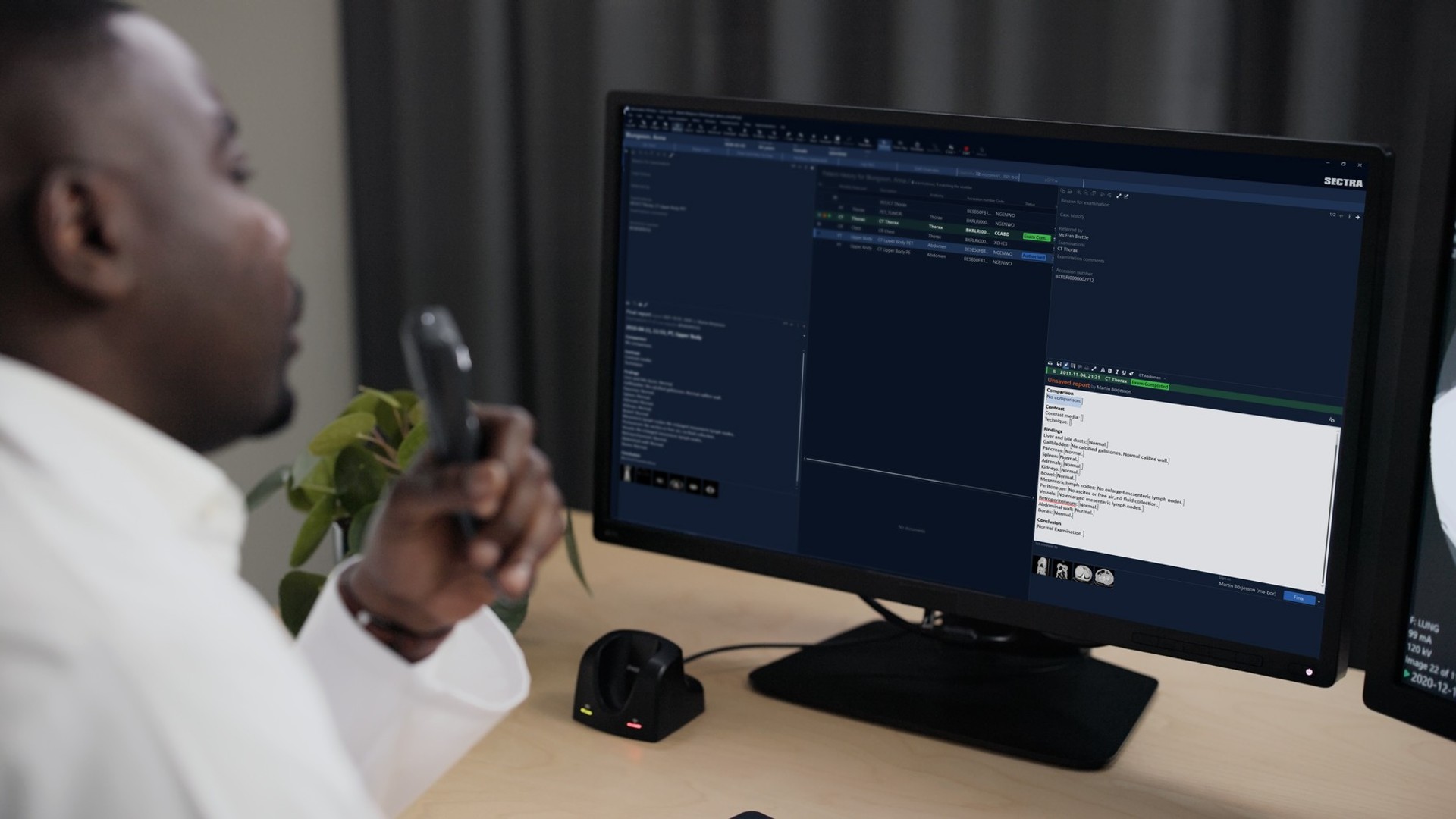
Mount Sinai Chooses Sectra’s AI-Assisted Radiology Reporting
This partnership signals a significant advancement in radiology by integrating AI to streamline reporting and improve efficiency in a large health system.
- Mount Sinai has signed a seven-year agreement with Sectra to implement its AI-assisted radiology reporting module across all its services.
- The AI tool will enable radiologists to create structured reports while dictating findings, reducing the need to switch systems.
- Go-live for the new system is slated for spring 2027, aiming to improve turnaround times for radiology reports.
Sectra is a company that provides medical imaging solutions, including radiology reporting software. Mount Sinai, a major health system with seven hospitals, aims to enhance its existing imaging infrastructure with this integration. This agreement is part of a trend toward unifying diagnostic workflows in healthcare.
Read the original ↗
Cerillion 26.2 Extends AI From Customer Care to Churn Prediction
The introduction of AI capabilities in Cerillion's latest release can enhance operational efficiency for communications service providers and improve customer retention strategies.
- Cerillion 26.2, launched on November 4, 2026, enhances its BSS/OSS Suite with AI for customer care and churn prediction.
- The new Customer Care Agent aims to streamline customer support by quickly retrieving relevant details during inquiries.
- Churn prediction utilizes machine-learning models to identify at-risk customers and support targeted marketing campaigns.
- Competitor-aware Package Creation allows for rapid adaptation to market changes by integrating competitor offer insights into product design.
- Cerillion's AI architecture is designed to allow integration with external AI systems, enhancing its operational capabilities across user-defined permissions.
Cerillion provides business support systems (BSS) and operational support systems (OSS) for communications service providers. The latest update builds on previous versions that introduced coordination between AI agents, focusing on enhancing customer support and product development. Future developments may include wider integrations with external AI technologies and enhanced functionalities.
Read the original ↗
Data Center Policy Fears Hit AI Stocks After Hinojosa’s Texas Win
Investor anxiety surrounding proposed data center policies in Texas, represented by Gina Hinojosa's victory, may delay critical infrastructure developments and impact AI stock performance.
- AI-linked stocks and Nasdaq-100 futures fell after Gina Hinojosa's projected victory in the Texas governor's race, indicating investor concern about new data center policies.
- Citing data, Texas is responsible for 27% of planned U.S. data center capacity, making it a critical state for infrastructure development.
- Hinojosa's campaign included a proposal for a moratorium on data centers pending legislative protections, influencing market reactions and project timelines.
Gina Hinojosa's election as Texas governor has raised concerns among investors about potential restrictions on data center developments in the state. This follows a broader market trend of declining AI infrastructure investment amidst worries about growth in data-center spending. Observers are now focused on how Hinojosa's proposals will affect future project approvals and tax regulations.
Read the original ↗
Turn Off AI, Lose Search- Google’s New School AI Rule
This policy's all-or-nothing stance on AI access affects students' ability to use essential educational tools, placing educators in a difficult position regarding technology usage.
- Google will disable its AI tools for K-12 students by default unless turned on by school administrators, starting next year.
- If schools opt-out of AI, students will also lose access to Google Search, affecting their research capabilities.
- The decision follows discussions with educators and policymakers, emphasizing the link between Google Search and its AI features.
Google's updated policy requires schools to decide on AI usage, which affects how students can access educational resources. Earlier reports cited concerns about AI's impact on learning, leading to greater scrutiny of Google’s tools. Upcoming feedback from educators will guide Google's future initiatives in education.
Read the original ↗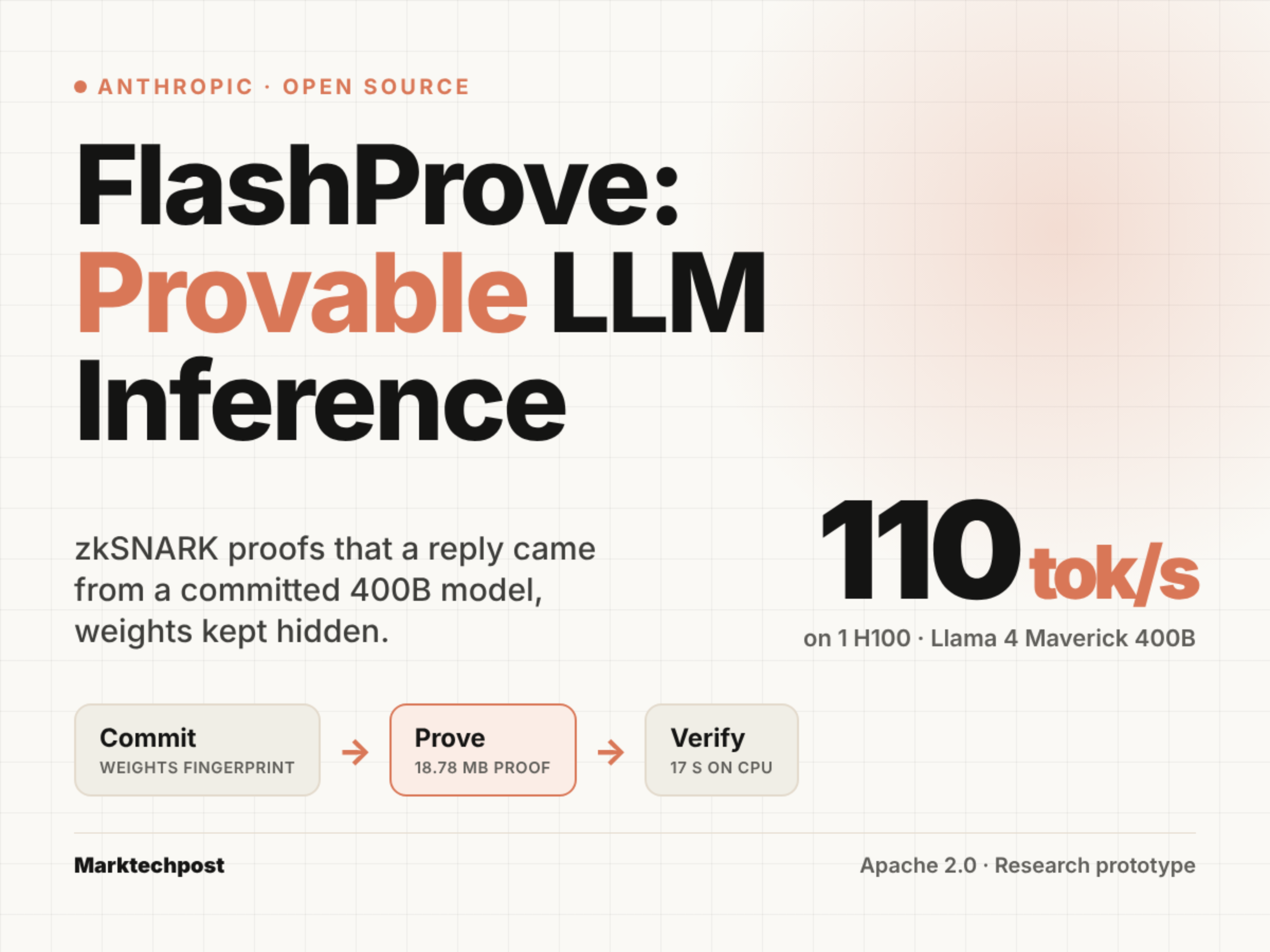
Anthropic Releases FlashProve: Cryptographic Proofs That a Reply Came From Committed...
Anthropic's FlashProve introduces provable inference, enhancing trust in AI systems by confirming which model generated a response, crucial for maintaining integrity and security in AI applications.
- Anthropic has released FlashProve, an open-source prototype for generating cryptographic proofs of model responses.
- FlashProve can prove responses from a 400B Llama 4 Maverick model at 110 tokens/second using 1 H100 GPU.
- The system supports verification that protects against tampering and model swapping, ensuring reliable output quality.
- Proofs generated are 18.78 MB in size and require about 17 seconds to verify on a CPU.
- Proving costs are significantly higher, at 70 to 95 times the GPU time compared to standard inference.
FlashProve is a zero-knowledge succinct non-interactive argument of knowledge (zkSNARK) system that ensures a model's response can be trusted without revealing its internal weights. This technology addresses existing gaps in accountability for AI models, especially in cases susceptible to attacks or rerouting. Future developments will focus on improving performance and expanding compatibility with different models and hardware configurations.
Read the original ↗
STMicroelectronics Unifies STM32 for Physical AI and Automotive
This unified STM32 platform can simplify development in high-safety and automotive applications, potentially accelerating innovation across multiple sectors by enabling code reuse and reducing fragmentation.
- STMicroelectronics introduced a unified STM32 microcontroller platform featuring three STM32A product lines for high-safety and automotive systems.
- The new strategy emphasizes code reuse across industrial, automotive, and robotics applications.
- Each STM32A tier offers varying levels of memory and safety support, targeting specific use cases from local sensors to real-time control systems.
STMicroelectronics is a global semiconductor manufacturer known for microcontrollers like the STM32. The company aims to reduce fragmentation by offering a shared architecture across different industries, which is crucial for the increasing integration of AI and safety features.
Read the original ↗
Maine’s data center revolt will decide who controls the Senate
The Senate race in Maine could significantly influence national data center and AI policy, affecting local economies and environmental standards beyond the state.
- Tech billionaires are investing heavily in Maine's Senate race, with Democrats projected to spend $81 million and Republicans $114 million.
- Residents harbor growing concerns over data centers' effects on utility costs and the environment, leading many towns to enact temporary moratoriums.
- A recent poll showed that 76% of Mainers oppose building a data center in their community, highlighting local resistance.
- Sen. Susan Collins supports data centers and has received substantial campaign contributions from tech donors, affecting her reelection bid.
Maine's Senate race has become a focal point for national debate on data centers and AI, particularly after the state legislature's veto of a proposed statewide moratorium on large data centers. As rural areas become targets for these resource-intensive facilities, ongoing voter sentiment against them could shape both state and federal policies.
Read the original ↗
AI Data Centers Have a PR Problem. OpenAI Is Proposing a Rebrand
OpenAI's proposed rebranding of data centers as 'AI compute campuses' highlights the growing backlash against AI infrastructure and the company's strategy to shape public perception and policy.
- OpenAI plans to rebrand its data centers as 'AI compute campuses' following the US midterm elections.
- The initiative is part of a broader PR campaign to improve the public image of AI data centers amid growing opposition.
- About 70% of US adults, across political lines, oppose local data center construction due to environmental concerns.
OpenAI, the creator of ChatGPT, is responding to heightened criticism of AI data centers, which are controversial for their environmental impact and limited job creation. The company aims to influence AI policy and public perception, especially in light of potential shifts in Congressional power and voter concerns regarding AI's role in society.
Read the original ↗
Google Is Forcing Schools to Choose Between Its Search Engine and AI
Schools face a dilemma as Google's new policy forces them to choose between its search engine and AI tools, limiting students' access to educational resources based on administrative decisions.
- Google announced that K-12 student accounts will have AI products turned off by default and require manual activation by school administrators.
- If schools opt out of using AI tools, students will lose access to Google Search, limiting their ability to gather information online.
- The company had previously enabled AI products in Google Classroom but reversed this decision following concerns from child-safety organizations.
- The new Guided Learning feature, launching as a pilot later this month, is designed to help students with homework through step-by-step assistance.
Google's policy alters how K-12 schools can utilize its products, creating potential barriers to accessing its widely used search engine. Schools have previously relied on tools like Google Classroom and Chromebooks, which incorporate a variety of Google services. Moving forward, schools must navigate the implications of integrating AI technology into their educational framework, with potential challenges for resource allocation among districts.
Read the original ↗
Docusign Buys Suplari to Add AI Procurement Intelligence
This acquisition allows DocuSign to enhance its procurement intelligence capabilities, potentially improving decision-making and cost management for businesses dealing with fragmented supplier data.
- DocuSign acquired Suplari to integrate its AI procurement intelligence into its Intelligent Agreement Management (IAM) platform.
- The aim is to link contract terms with spending and supplier activity, addressing challenges in fragmented information.
- DocuSign plans to enhance its existing AI engine, Iris, to identify savings opportunities and manage supplier commitments effectively.
DocuSign is a company known for its e-signature solutions that has expanded towards automating agreement workflows. Suplari specializes in procurement intelligence, helping teams manage supplier contracts and spending data effectively. The integration of Suplari's technology is part of DocuSign's strategy to enhance purchasing decision-making and supplier relationship management.
Read the original ↗
Cat Wu Steps Down as Claude Code Product Chief After Two Years
The departure of Cat Wu as head of product for Claude Code highlights a significant leadership change at Anthropic during a key period of product development and innovation.
- Cat Wu announced her resignation from Anthropic as head of product for Claude Code on November 3, 2026.
- She led Claude Code's transition from an internal experiment to a more autonomous software development tool over two years.
- Wu previously worked in product management, joining Anthropic in August 2024 after roles in product engineering and venture capital.
Claude Code is a coding tool developed by Anthropic, designed to facilitate software development with AI-assisted automation. Under Wu's leadership, the product incorporated innovative features and evolved its operational methods. The company now faces the challenge of maintaining momentum in product development after her departure.
Read the original ↗
Expedia, Hotels.com and Vrbo Bring More AI to the Travel Booking Experience
The integration of AI in travel booking platforms aims to enhance user experience by streamlining trip planning and personalizing services for travelers.
- Expedia Group has launched over 30 new AI-driven features across its brands to improve trip planning and execution.
- Expedia's new AI products include an Activity Planner for booking based on itineraries and a Property Expert for inquiries about properties.
- Hotels.com is adapting its homepage to personalize content based on the type of trip booked, while Vrbo introduces natural language search for rental properties.
Expedia Group owns Expedia, Hotels.com, and Vrbo, major players in the travel industry. The company is focusing on practical AI to simplify the user experience during peak travel seasons. Future developments may enhance AI capabilities further to improve travel personalization and planning.
Read the original ↗Apple Is Putting an Age Limit on Falling in Love With AI
Apple's new age restriction for dating apps and AI companions highlights concerns about the emotional risks of digital relationships among minors, addressing potential safety issues.
- Apple will require dating and AI companion apps offering romantic interactions to have an age rating of at least 18, effective Nov. 16.
- Developers must disclose whether their apps feature dating elements or location-sharing capabilities, with compliance due by Jan. 12, 2027.
- Major dating apps like Tinder and Hinge already require users to be 18 or older, while AI companions are increasingly popular among younger users.
- Concerns have risen regarding the emotional attachment between minors and AI, prompting a shift in how these apps classify their content.
Apple is tightening App Store rules to regulate dating and AI companion apps aimed at young users due to growing concerns about emotional risks. This change reflects broader trends in technology concerning youth engagement with AI. Future developments may include further enhancements to parental controls and content rating systems.
Read the original ↗
Data centers are turning to old jet engines as the wait for power grows
The shift towards converting old jet engines into power sources highlights the growing energy crisis faced by data centers, impacting their ability to operate efficiently and meet demand.
- Some data centers are using converted jet engines from retired aircraft to generate electricity due to long waits for traditional power sources.
- Conversion allows for rapid deployment, with data centers potentially operational within 24 months compared to seven years for grid connections in some areas.
- Companies like xAI and OpenAI have installed jet-engine turbines to power their facilities, responding to urgent power supply challenges.
Data centers require substantial energy, and delays in securing grid connections have prompted some operators to seek alternative power solutions. The long-term implications of using jet engines include efficiency concerns and environmental impacts, which may lead to reconsideration of this approach in the future.
Read the original ↗
Anthropic is working on a system to prove AI models’ identity
The ability to verify which AI model produced specific outputs could enhance trust and accountability in AI deployment across various sectors.
- Anthropic is developing an open-source system called FlashProve to verify AI model outputs.
- FlashProve provides cryptographic proofs that confirm the source of a given response from an AI.
- The system protects against misrepresentation of AI models and can verify claims made by third parties about model use.
- AI labs must publish a 'fingerprint' for each model to facilitate verification without disclosing proprietary details.
Anthropic is a research company focused on AI safety and alignment. The FlashProve system aims to address trust concerns by ensuring that outputs from AI systems can be accurately attributed to their respective models. Ongoing research and public sharing of technical specifications may invite improvements from the wider community.
Read the original ↗
PhotoGuider: Composition-Aware Cropping and 360^{circ} View Framing with Explainable Photographic Assessments
PhotoGuider represents a significant advancement in photographic composition by enabling informed framing of 360° panoramas, which enhances the quality and relevance of visual content.
- PhotoGuider selects viewing directions and frames 360° panoramas using composition-aware tokens and outputs camera parameters with explanations.
- It combines direction selection and framing for 360° scenes, which traditional cropping methods struggle with due to lack of predetermined composition.
- PhotoGuider achieves the highest average mean Intersection over Union (mIoU) performance on two standard image cropping benchmarks.
- In a blind ranking study, participants preferred PhotoGuider's framings in 53.2% of cases over two other cropping methods tested.
PhotoGuider is an innovative approach to crop and frame 360° panoramic images, integrating learned composition-aware features and explanation mechanisms. Traditional cropping assumes existing compositional integrity, while PhotoGuider addresses the unique challenges of panoramic framing. Continued advancements are expected in machine learning and computer vision for improved photographic tools.
Read the original ↗