
The day's AI news, briefed
The Daily Prompt
Our AI editor reads each day's AI and robotics stories, pulls out why they matter, and links every original source — so you can keep up in minutes.
Join over 250,000 subscribers getting the latest AI news
Latest AI & Robotics News Today

AI Alliance Drafts Confidential Incident Reporting Rules With Public Deadlines
The development of these confidential incident reporting rules is crucial for establishing a more secure AI environment by improving transparency and accountability in reporting AI security incidents.
- The Linux Foundation published a Request for Comments for the Shared AI Findings Exchange (SAFE) draft framework to regulate AI security incident reporting.
- Members of the Open Secure AI Alliance are required to report AI security incidents confidentially at first, then publicly within 30 days.
- The framework specifies reportable events and a notification schedule, requiring rapid communication to affected organizations and thorough analysis of incidents.
The Open Secure AI Alliance, launched on July 27, 2026, aims to enhance AI security by requiring members to share information about incidents. The SAFE draft follows a recent security disclosure by Hugging Face, highlighting vulnerabilities associated with AI systems.
Read the original ↗
Your Best AI Pilots Are Cementing the Process You Meant to Kill
Companies using AI pilots without governance risk solidifying outdated processes into their operations, complicating future redesign efforts and potentially incurring significant costs.
- McKinsey discusses the 'pilot trap,' where ungoverned AI agents entrench old processes instead of improving them.
- With low-code tools, specialists can now deploy AI agents quickly, bypassing traditional cautious approaches to implementation.
- About 20% of human resources functions may be dedicated to managing AI agents by 2030, which adds to operational costs.
- Countless organizations might overlook the hidden dependencies created by successful AI pilots, complicating future changes.
McKinsey emphasizes the need for structured governance in AI deployments, warning against the temptation to deploy agents without assessing existing workflows. The challenge lies in managing these AI pilots to avoid unintentionally locking in old operational methods that diminish effectiveness. Companies should identify all active agents to understand their impact and risks better.
Read the original ↗
Runware Ships Containerized AI Data Centers for Cheaper Inference
Runware's Sonic Inference Pod aims to transform AI inference infrastructure by reducing costs and deployment times, potentially reshaping the industry dynamics dominated by large data centers.
- Runware launched its Sonic Inference Pod, a modular data center combining up to 1,200 GPUs in a 20-foot container, on August 4, 2026.
- The new data center design promises inference prices that are 30-80% lower than traditional data centers, with European deployment already live.
- Each pod can be deployed in about three weeks and operates with a closed-loop cooling system that significantly reduces water and electricity usage.
- Runware currently has 10 pods in operation across the US, Europe, and Asia-Pacific and plans to scale to 1 GW of inference capacity by 2027.
- The company aims to serve growing demand for AI inference with relocatable facilities, contrasting with the fixed mega-campuses being built by major players.
Runware is an AI inference provider that has shifted from reselling cloud capacity to offering its own hardware. The Sonic Inference Pod initiative is part of a broader strategy to make AI infrastructure more efficient and accessible. The company is competing against major industry players who invest heavily in traditional data centers.
Read the original ↗
Convex Raises $57M Series B to Build the Backend for Agent-Written Software
The $57 million funding round will enhance Convex's platform, which aims to support the development of software written alongside AI agents, reflecting growing demand in the tech industry.
- Convex has raised $57 million in a Series B funding round led by Insight Partners.
- The company claims millions of Convex instances are now running in production, with many enterprise customers onboard.
- Convex's platform is designed for compatibility with AI coding agents, enhancing the reliability of generated code.
- The company plans to hire across multiple functions and expand its product capabilities, focusing on agent infrastructure.
- A one-day conference called Abstract will be held by Convex on September 2, 2026, in San Francisco.
Convex is an application backend startup founded by former Dropbox engineers, specializing in infrastructure for agent-written software. The company previously raised $26 million in Series A funding, indicating strong backing and investor interest. Future developments to watch include the expansion of its platform and the impact of its new funding on product offerings.
Read the original ↗
From Prediction to Accountable Action: Designing Uncertainty in Femtech AI
Enhancing decision integrity in femtech AI can improve user trust and safety in women's health technologies, which rely on accurate predictions for critical health decisions.
- Femtech AI requires better uncertainty design to enhance decision integrity and trust in women's health products.
- Current fertility and cycle-tracking apps often present inaccurate predictions based on various biological proxies and subjective user inputs.
- A six-layer method has been proposed to govern the conversion of uncertain health signals into accountable actions in femtech products.
Femtech refers to technology designed to support women's health, particularly in reproductive health. Building on previous shortcomings in prediction accuracy, innovators are now focusing on how to better handle uncertainty in health data inputs.
Read the original ↗
NVIDIA’s Alpamayo 2 Super Opens Robotaxi Development to Commercial Use
The release of Alpamayo 2 Super marks a significant advancement in robotic taxi technology, enabling developers and manufacturers to deploy AI models commercially, enhancing the potential for autonomous driving solutions.
- NVIDIA has launched Alpamayo 2 Super, a 34-billion-parameter model for commercial autonomous driving use, as of August 4, 2026.
- The model's weights are available under the OpenMDW-1.1 license, allowing developers to create derivative models without additional permissions.
- Built on the Cosmos 3 Super Reasoner, Alpamayo 2 Super focuses on rare traffic situations that traditional systems struggle to handle.
- NVIDIA validated the model's performance using a single H100 GPU and it generated outputs crucial for understanding driving decisions.
- The Alpamayo family, first introduced for research, has now transitioned to a commercial-ready product, reflecting rapid development in AI for autonomous vehicles.
NVIDIA's Alpamayo series includes advanced models aimed at improving autonomous vehicle technology, specifically针对特殊交通情景 that conventional AI models find challenging. The Alpamayo 2 Super iteration, which supports commercial use, enhances access for developers in the autonomous vehicle sector.
Read the original ↗
Fotor AI Features: Every AI Tool Inside Fotor Reviewed (Image Generator, Video, Face Swap, and More)
Fotor offers a comprehensive suite of AI tools that streamlines creative content production, appealing to users seeking an all-in-one solution for various image and video projects.
- Fotor is a multi-model AI creative platform that integrates six distinct tools: image generation, video creation, face swap, hairstyle changing, baby generation, and avatar generation.
- The AI image generator is highlighted as Fotor’s flagship feature, allowing users to test multiple models with the same prompt to compare results.
- Fotor's video generator creates short animated clips from images or text prompts, but is limited to short-form content suitable for social media.
- The face swap tool effectively replaces faces in photos and videos, working best with front-facing images in good lighting conditions.
- The AI hairstyle changer offers realistic previews of different hairstyles based on user photo analysis.
Fotor began as a browser-based photo editor but has evolved into a robust platform combining various AI tools for media creation. This shift signifies the growing market demand for integrated solutions in creative software. Users can expect advancements in these AI features as competition increases among creative AI platforms.
Read the original ↗
AI Is Not the Transformation. Decision Velocity Is.
Understanding how decision velocity affects organizational effectiveness can guide businesses in implementing analytics that drive actionable results, rather than just increased insights.
- Many organizations believe they are analytically mature, having invested in data platforms and generative AI.
- Despite improved insights, decision-making processes often remain slow due to structural bottlenecks.
- Companies like Amazon and Google demonstrate the integration of analytics into real-time decision execution, achieving faster impacts.
Decision velocity refers to the speed and efficiency of turning analytical insights into actionable decisions. Previously, organizations focused on improving analytical capabilities without addressing execution bottlenecks. Future transformations will depend on aligning insights with operational workflows to enhance decision-making speed.
Read the original ↗
The First Workflow: From AI Blueprint to Build
This information is crucial as it outlines practical steps for businesses to effectively build and implement AI workflows, helping them achieve operational efficiency and reduce error costs.
- Companies should begin AI projects with a single workflow that has real volume and error costs rather than larger, more complex transformations.
- The description of the work must accurately reflect actual processes, including exceptions, and should be drafted with the help of AI tools for efficiency.
- The supervised launch phase ensures that human oversight is maintained while gradually transitioning to automation.
- As AI processes prove reliable, consistent decisions can be automated, streamlining operations while keeping humans in crucial decision-making roles.
The article is part of a series on building effective AI workflows, emphasizing a step-by-step approach to integrating AI into operational processes. Previous installments discussed the structural groundwork needed before actual implementation. Moving forward, businesses should focus on continuous improvement and adaptability of AI systems in response to operational changes.
Read the original ↗
Obsidian Security Raises $85 Million Series D at Unicorn Valuation
This funding round highlights the growing importance of security measures as enterprises increasingly rely on AI agents within their software environments.
- Obsidian Security raised $85 million in a Series D funding round at a valuation of $1.1 billion, marking its entry into unicorn status.
- The funding was led by Crescent Cove Advisors and included existing investors such as Greylock Partners and Menlo Ventures.
- Obsidian has over 100 customers spending more than $100,000 annually, including 60 from the Fortune 500.
- The company plans to use the new capital to enhance research and development and expand its customer base among Fortune 500 and Global 2000 companies.
- Obsidian's platform focuses on governing AI agents' actions in third-party applications, where non-human identities vastly outnumber human ones.
Obsidian Security, founded in 2017, has shifted its focus from SaaS security posture management to the governance of autonomous AI agents. The company previously raised $90 million in a Series C funding round in April 2022, which focused on threats from misconfigurations and insider risks.
Read the original ↗
‘Everyone Is Doing It’: The Truth About AI in Hollywood
The integration of AI in Hollywood affects not only production processes but also raises critical issues around copyright, job security, and creative control within the industry.
- Hollywood is increasingly using AI, with varied opinions among industry professionals regarding its role in creative processes and production efficiency.
- Generative AI is creating content, particularly in animation, but many studios struggle with its quality and public acceptance.
- Netflix's acquisition of Ben Affleck's AI company for $587 million highlights the industry's growing reliance on AI technology.
- AI's impact on Hollywood raises significant concerns about control, workforce displacement, and creative originality in film and television.
AI technology is transforming Hollywood by enhancing filmmaking processes and generating content, particularly in animation. Current debates focus on the balance between utilizing AI and protecting traditional creative roles, an issue already affecting writers and actors. Upcoming developments include more integration of AI in production and potential regulatory discussions about its use.
Read the original ↗
Is This Poker Player Bluffing? The AI Thinks So
The introduction of an AI tells detection tool by ESPN could change how poker players strategize and perceive the game, raising questions about the balance between technology and traditional skills.
- ESPN launched an AI tells detection tool during the 2026 World Series of Poker to analyze player movements and predict hand types.
- The tool gathers data on players' eye movements, posture, and gestures from live broadcasts to create a tells database.
- Many poker experts doubt the tool's effectiveness due to its training on a limited dataset from only a few recorded tables.
- The AI tool will not be used during the final table of the tournament, according to an Omaha Productions representative.
Artificial intelligence (AI) is increasingly being used in various fields, including sports and gaming. The tool, engineered by Luke Geel, culminates a trend of using technology to enhance understanding in competitive environments. As AI methods improve, their potential impact on poker and similar games may expand significantly.
Read the original ↗
How One Startup Built a (Mostly) China-Free Robot
Ati Robotics' strategy to minimize reliance on Chinese parts may enhance its competitiveness as US regulations restrict imports from China, reshaping the robotics supply landscape.
- Ati Robotics assembles its robots in India, using minimal Chinese components, which may position it well amid US regulatory crackdowns on Chinese-made robots.
- The Federal Communications Commission recently banned imports of humanoid robots from China due to national security concerns, impacting many smaller US robotics firms.
- Founded in 2017, Ati Robotics began by developing motors for self-driving cars and now produces industrial robots like tuggers and pallet movers with hundreds currently operational.
Ati Robotics focuses on developing hardware for robotics, claiming to limit Chinese parts to enhance supply chain resilience. The company began with a vision of robust functionality and sees competitive potential weakened amid increased scrutiny of international suppliers.
Read the original ↗
I Was Anti-Siri Until I Tried Siri AI on iOS 27
The improvements to Siri in iOS 27 could enhance user interaction with Apple's virtual assistant, potentially setting a new standard for voice-activated technology.
- Siri has shown significant improvements with the release of iOS 27, aligning with Apple's promises since 2011.
- Users report that Siri is more efficient in completing tasks compared to previous versions.
- The upgrade marks a notable shift in how Siri is perceived by some users.
- The advancements may impact future updates and competition among virtual assistants.
Siri is Apple's virtual assistant, originally launched in 2011, designed to assist users with voice commands. The latest major update, iOS 27, introduces various enhancements aimed at improving Siri's functionality. Observing user response to this update will be crucial for Apple's strategy moving forward.
Read the original ↗
Building an Advanced AI Skill Security Auditing Pipeline with NVIDIA SkillSpector,...
Implementing a robust security auditing pipeline for AI skills minimizes risks associated with deploying third-party tools, thus enhancing overall AI system integrity.
- A workflow was built to evaluate the security of AI skills using NVIDIA SkillSpector, LangGraph, and other tools.
- The pipeline scans skills for risks and categories findings, allowing organizations to assess security posture effectively.
- SARIF and Markdown reports are generated to support CI systems and human reviews of the scan results.
NVIDIA SkillSpector is a tool designed to analyze the security of AI skills by inspecting code and identifying vulnerabilities. Previous security audits may have been less comprehensive, lacking structured reporting. This new framework establishes procedures for ongoing oversight and risk management in the deployment of AI skills.
Read the original ↗
Decompile-Bench: Million-Scale Binary-Source Function Pairs for Real-World Binary Decompilation
The introduction of Decompile-Bench promises to significantly enhance the accuracy of language model-based decompilers, aiding in the understanding of binary code by providing a vast dataset for evaluation.
- Decompile-Bench is an open-source dataset containing two million binary-source function pairs for improved decompilation accuracy.
- This dataset was created from 100 million collected function pairs, totaling 450GB of binaries from licensed GitHub projects.
- The benchmark Decompile-Bench-Eval includes manually crafted binaries to ensure effective evaluation without data leakage.
- Fine-tuning decompilers with Decompile-Bench showed a 20% improvement in re-executability rates compared to previous benchmarks.
Decompile-Bench develops a critical resource for binary decompilation, addressing the need for large, accurate mappings between low-level binaries and high-level source code. Prior datasets were often insufficient or unreliable due to their reliance on synthetic examples. This advancement may lead to better applications in software analysis and security.
Read the original ↗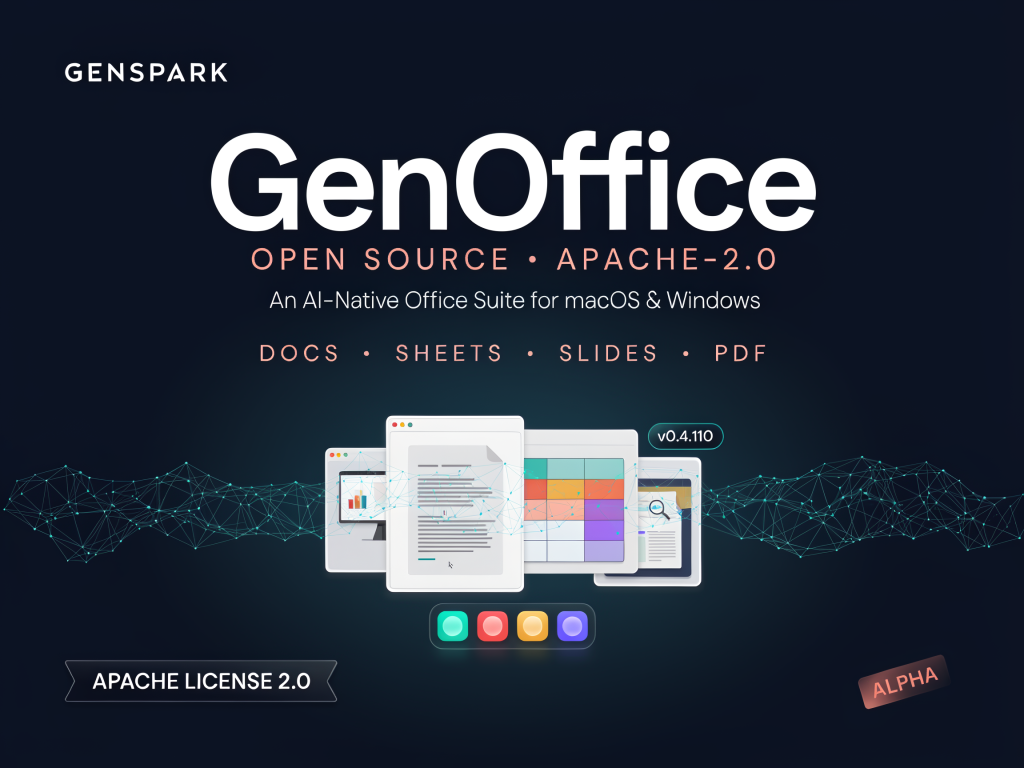
Genspark Open Sources GenOffice: A Free, Ad-Free AI Office Suite for...
The release of an open-source AI office suite like GenOffice provides a competitive, ad-free alternative for organizations seeking cost-effective productivity tools without licensing fees or restrictions.
- Genspark has made GenOffice available as an open-source project under the Apache License 2.0.
- GenOffice includes applications for document editing, spreadsheets, presentations, and PDF handling optimized for macOS and Windows.
- The implementation consists of five Electron applications built around a shared AI editing engine and is currently in Alpha status.
- GenOffice is free and ad-free, designed for startups and small to medium-sized businesses (SMBs) with no license fees or watermarks.
- AI features in GenOffice require a Genspark account, as model calls are managed server-side.
Genspark is introducing GenOffice to provide a free competitive alternative to existing office software suites. This initiative aligns with a trend toward open-source solutions in productivity software. Future developments may include additional features and the expansion of the GenOffice Enterprise License for commercial modifications.
Read the original ↗
ChatGPT is Winning the Battle for Congress’s Wallet
The increasing reliance on ChatGPT in Congress reflects a significant trend in how lawmakers leverage AI technology, potentially shaping future policies around AI use and regulation.
- OpenAI's ChatGPT has garnered $100,580 in spending on AI technology by House offices between April 1, 2025, and March 31, 2026, dominating funding for AI tools.
- Anthropic's Claude, the second-ranked AI tool, received only $13,160 during the same timeframe, indicating ChatGPT's substantial lead in congressional preferences.
- Approximately 88% of AI spending and 96% of AI transactions in House offices were attributed to ChatGPT, illustrating its widespread adoption.
- Democratic offices accounted for over three times the spending on AI tools compared to Republican offices, highlighting partisan differences in tech investment.
- Many AI applications used by Congress remain untracked, as free accounts and certain bundled services are not included in spending records.
ChatGPT, developed by OpenAI, is a generative AI chatbot that has become the preferred AI tool for congressional offices, significantly outpacing its competitors. The data suggests that AI technologies are increasingly integrated into the legislative process to support various administrative tasks. The trends in AI spending may influence future congressional decisions on technology policy and regulation.
Read the original ↗
Did an AI Music App Just Snitch on the Song of the Summer?
Concerns about AI influence in music are growing as accusations regarding potential AI-generated content spark debates over authenticity in the industry, reflecting broader societal questions about AI's role in creative fields.
- Fenix Flexin's song "Rubberz" has recently reached No. 58 on the Billboard Hot 100 and has received over 7 million views on its music video.
- The song has ignited controversy as claims suggest it may have been partially generated by an AI music app called Treblo.
- An independent music producer, Medasin, asserted he could replicate "Rubberz" using Treblo, raising questions about the authenticity of the track.
- Treblo has released a detector that indicates songs made with its technology, suggesting "Rubberz" is likely AI-generated.
- These developments are part of a larger trend of heightened scrutiny regarding AI-generated content in creative industries.
Fenix Flexin is a rapper known for his distinct voice and style, who evolved from the group Shoreline Mafia. The emergence of AI music generation tools, like Treblo, raises concerns about authenticity and creativity in music. Ongoing debates and further scrutiny in the industry are expected as these issues progress.
Read the original ↗
After killer quarter, Palantir CEO Alex Karp calls AI industry ‘Marxist’
Karp's assertions highlight concerns over the trustworthiness and ethical implications of the AI industry's current trajectory, which may influence perceptions and business decisions within the tech sector.
- Palantir CEO Alex Karp criticized the AI industry in a shareholder letter, claiming it contains Marxist overtones.
- The company reported $1.9 billion in revenue and $1.1 billion in profit for its second quarter, marking significant growth year-over-year.
- Karp's remarks suggest that AI frontier labs could potentially undermine enterprise partners by capturing their intellectual property.
Palantir Technologies is a software company that builds AI and data analysis tools primarily for government and enterprise clients. The company has seen rapid growth, driven by increased AI utilization, prompting Karp's critique of AI labs. Future discussions may focus on the ethical implications of AI partnerships in the industry.
Read the original ↗