
The day's AI news, briefed
The Daily Prompt
Our AI editor reads each day's AI and robotics stories, pulls out why they matter, and links every original source — so you can keep up in minutes.
Join over 250,000 subscribers getting the latest AI news
Latest AI & Robotics News Today

OpenAI Hits Back at Apple, Calls Lawsuit ‘Careless, Aggressive and Oddly Personal’
The outcome of the lawsuit between OpenAI and Apple could significantly impact OpenAI's operations and reputation in the tech industry.
- Apple has filed a lawsuit against OpenAI, accusing it of stealing trade secrets from two former Apple employees who joined OpenAI.
- OpenAI claims the lawsuit is based on false allegations and points to Apple's own security lapses as the source of the issue.
- Texts and emails released by OpenAI suggest miscommunication and mistakes on Apple's part prior to the lawsuit being filed.
- Apple seeks a court order for OpenAI to return all proprietary information it may have accessed.
- The case raises questions about the responsibilities of former employees regarding legitimate access to company information after leaving.
OpenAI is a prominent AI research organization known for developing technologies like ChatGPT. The lawsuit stems from allegations about improper access to Apple’s proprietary technology by former employees who transitioned to OpenAI. This case highlights ongoing tensions in the tech industry regarding intellectual property protection.
Read the original ↗
Nvidia doesn’t mess around: A week after open AI industry group formed, it’s already showing progress
The formation of the Open Secure AI Alliance signals a collective industry effort to establish standards and safeguard against AI-related cybersecurity threats, crucial for maintaining trust in AI technologies.
- The Open Secure AI Alliance (OSAA), led by Nvidia, has grown to over 120 member companies in just one week.
- The group has introduced the Shared AI Findings Exchange (SAFE) working group to develop proposals for reporting AI cybersecurity incidents.
- Guidelines produced by OSAA cover incident reporting, alerting affected parties, and conducting blame-free analyses for learning purposes.
- Notable members include Adobe, BlackRock, Cisco, and Intel, while Anthropic, OpenAI, and Google have not yet joined despite signing an initial support letter.
The Open Secure AI Alliance is a collaborative initiative aimed at enhancing cybersecurity for artificial intelligence. The group formed in response to concerns over AI threats, particularly from foreign entities. As the alliance gains momentum, its proposals could lead to increased security protocols in the AI industry.
Read the original ↗
Anthropic signs $10 billion deal with AI cloud startup Volta
This deal highlights the increasing competition in AI cloud computing and the need for robust compute infrastructure among leading AI firms.
- Anthropic has signed a six-year, $10 billion deal with AI cloud startup Volta for cloud computing services.
- Volta, which was founded earlier this year, will develop a data center in Norway with a capacity of 133 megawatts, supported by Bitdeer.
- The facility will utilize Nvidia’s Vera Rubin systems, which are advanced AI chip architectures.
- Anthropic aims to enhance its compute capacity as it competes with other tech giants, having recently announced additional agreements with SpaceX and Amazon.
Anthropic is a leading AI company known for developing advanced AI models, notably Claude. The partnership with Volta follows previous collaborations with other companies and enhances Anthropic's efforts to expand its technological capabilities.
Read the original ↗
Relax Within, Balance Across: Geometry-Guided Load Balancing for Vision-Language Mixture-of-Experts
The development of ReBA allows for improved efficiency in vision-language models, which may enhance their performance while reducing resource consumption.
- ReBA, or Relax Within, Balance Across, improves load balancing in vision-language mixture-of-experts (MoE) by separately optimizing image and text processing.
- The method reduces load imbalance over image resolutions and tiling without negatively impacting task accuracy when compared to standard practices.
- ReBA maintains consistent average loads across varying conditions, outperforming prior models in resource efficiency during diverse token mixes.
ReBA addresses limitations in existing routing methods for vision-language systems, where imbalances between image and text token loads can adversely affect performance. By focusing on separately optimizing these loads, ReBA aims to create more efficient models that are less sensitive to variations in input conditions. Further exploration may reveal new strategies for performance enhancement in multimodal systems.
Read the original ↗
Orchard: An Open-Source Agentic Modeling Framework
Orchard's open-source framework for agentic modeling could significantly enhance the development and scalability of autonomous agents across various applications, reducing reliance on proprietary systems.
- Orchard is an open-source framework that facilitates scalable agentic modeling for training autonomous agents.
- The framework includes Orchard Env, which provides reusable primitives for managing tasks, agent harnesses, and training pipelines.
- Orchard-SWE, designed for coding agents, sets a new performance benchmark for open-source models with a score of 67.5% after fine-tuning and reinforcement learning.
- Orchard-GUI trains a vision-language agent, achieving competitive success rates on various computer-use tasks with minimal training data.
- Orchard-Claw focuses on personal assistant agents, demonstrating effective training with only 0.2K synthetic tasks.
Orchard represents a significant advancement in the field of agentic modeling, which aims to enable large language models (LLMs) to perform complex tasks autonomously. Prior research faced limitations due to reliance on proprietary systems and inadequate open-source infrastructure. Future developments may focus on further enhancing agent capabilities and expanding open-source contributions.
Read the original ↗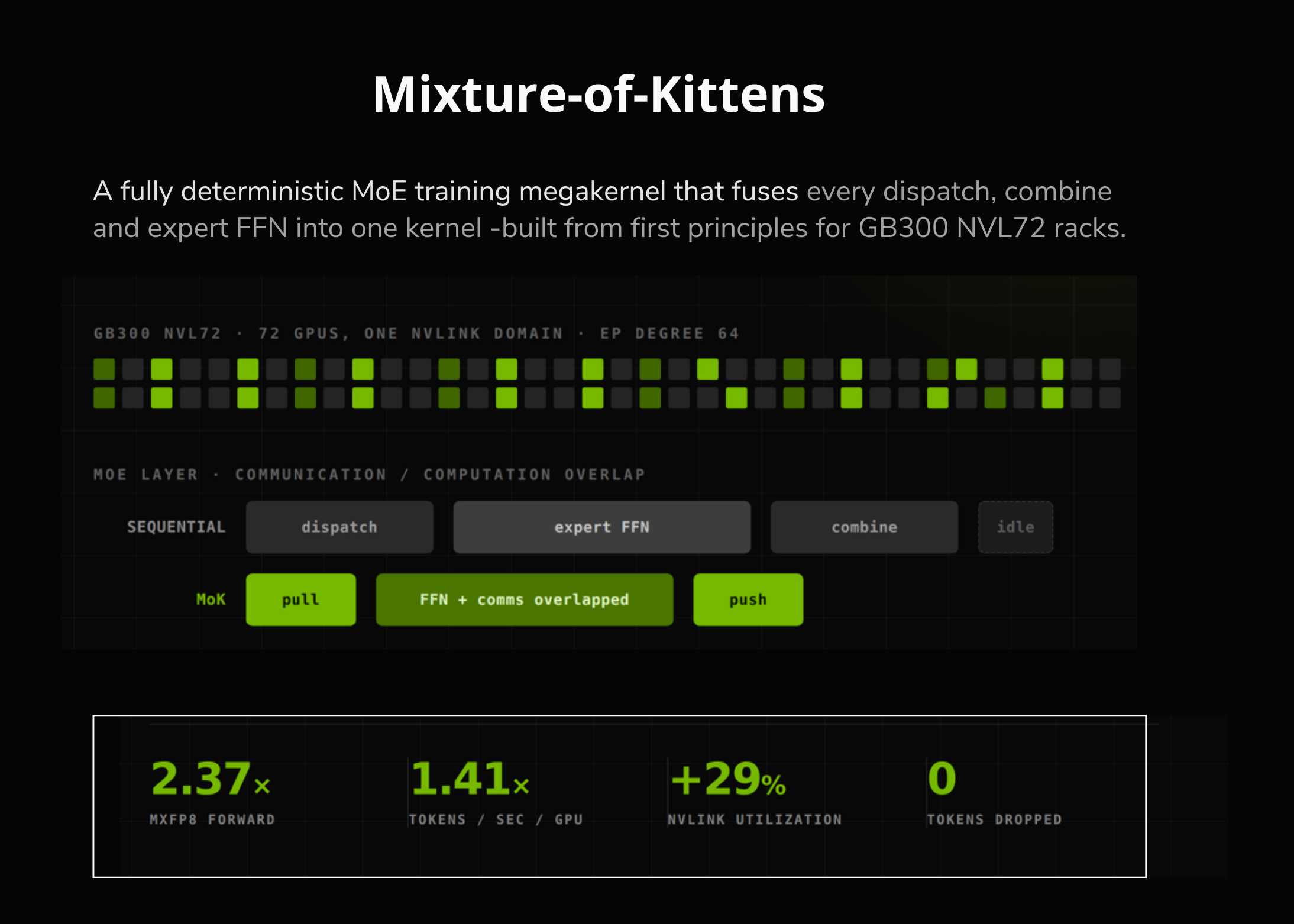
Cursor Open-Sources Mixture-of-Kittens (MoK): A Deterministic MoE Training Megakernel for GB300 NVL72 Racks
The release of MoK may significantly improve training efficiency for advanced AI models, potentially accelerating development across various sectors reliant on GPU infrastructure.
- Cursor Research has open-sourced Mixture-of-Kittens (MoK), a deterministic training megakernel for MoE models optimized for NVIDIA NVL72 racks.
- MoK achieves up to 2.37x higher throughput compared to existing public benchmarks and is designed for organizations with specific GPU infrastructure.
- The megakernel requires advanced hardware, including NVIDIA Blackwell GPUs and software dependencies such as Python 3.12+ and PyTorch 2.10+.
- MoK integrates communication and computation processes, utilizing a ring token buffer to enhance performance by minimizing CPU-GPU synchronization.
MoK is part of Cursor Research's efforts to improve mixture-of-experts (MoE) model training. Prior developments focused on training kernels for various precision modes and performance enhancements. Future developments may further refine model training methods and reduce operational costs for GPU infrastructures.
Read the original ↗
Buzz Solutions Raises $20 Million Series A to Expand AI-Powered Grid Intelligence
This funding round will enable Buzz Solutions to enhance its AI technology, which is crucial for utilities looking to improve the safety and efficiency of energy infrastructure amid rising electricity demand.
- Buzz Solutions raised $20 million in a Series A funding round led by S3 Ventures to develop its AI-powered grid intelligence software.
- The capital will support product development and customer deployments as utilities seek faster inspection and maintenance solutions.
- Buzz Solutions' platform analyzes visual inspection data from power lines and substations using over 50 AI models, processing images at a rate of 5.8 per second.
Buzz Solutions, based in Palo Alto, develops software that leverages artificial intelligence to analyze infrastructure inspection data for utilities. This funding will help address growing electricity demands and the need for efficient infrastructure management as utilities increasingly adopt technological solutions.
Read the original ↗
This AI Agent Can Negotiate Bills for You – if It Doesn’t Reject the Lower Offers
The implications of AI-assisted negotiation for bills could reshape consumer interactions with service providers, potentially leading to savings for users, but technical limitations remain a significant obstacle.
- Kudos is an AI agent that attempts to negotiate lower bills with various service providers, connecting with 60 companies including AT&T and Verizon.
- Users must provide explicit permissions and frequently enter one-time codes, which can complicate the negotiation process.
- In trials, the AI agent sometimes rejected lower offers due to a lack of explicit user permissions, limiting potential savings.
- Kudos plans to expand its services to include negotiations for credit card annual fees in the near future.
Kudos operates as an AI voice assistant designed to negotiate lower rates for services like phone and internet bills. Previous attempts to automate negotiation processes have faced technical challenges and user frustrations. Observers should monitor Kudos' developments, especially regarding its credit card negotiation capabilities.
Read the original ↗
Progressive Agent Skill Generation via Reinforcement Learning
Advancements in agent skill generation could enhance the efficiency and effectiveness of AI systems in various applications, impacting performance in complex tasks.
- Skill-α is a reinforcement learning method designed to progressively generate high-quality skills for agents.
- It uses a novel rollback reward system that evaluates each skill edit based on its impact on downstream tasks.
- Skill-α outperforms traditional heuristic or pipeline-based skill generation methods, showing significant improvement in success rates on benchmark tests.
Skill generation in AI involves creating capabilities for agents to perform tasks effectively. Prior techniques often relied on manual heuristics, while Skill-α introduces a learning-based approach. Future developments may focus on refining these methods and expanding their applications across diverse AI tasks.
Read the original ↗
MetaChain: A Fully-Automated and Zero-Code Framework for LLM Agents
MetaChain's framework could democratize the development of Large Language Model (LLM) agents, making it accessible to users without programming skills and expanding the potential user base significantly.
- MetaChain allows non-technical users to create and deploy LLM agents using only natural language, eliminating coding requirements.
- It features four main components: an Agentic System, an LLM-powered Actionable Engine, a Self-Managing File System, and Self-Play Agent Customization.
- MetaChain has achieved top performance on the GAIA benchmark, surpassing existing frameworks in multi-agent tasks and retrieval-augmented generation capabilities.
- It integrates with a wide range of LLMs and supports both function-calling and ReAct interaction modes.
MetaChain is an automated framework designed to produce LLM agents without requiring programming knowledge. Traditional frameworks like LangChain cater to developers, which limits accessibility. The introduction of MetaChain provides a solution to this issue by enabling easier agent development for all users.
Read the original ↗
LongHorizon-Harness: Advancing Long-Horizon Agents for Real-World Tasks
Improving long-horizon agent performance can enhance the capabilities of AI systems in executing complex, multi-step tasks, broadening their practical applications in various fields.
- LongHorizon-Harness optimizes long-horizon agent performance by managing task states outside of the execution context using a manage-execute-audit loop.
- The new method improves the performance of the Qwen~3.7-Plus model on WeaveBench from 51.8% to 80.7%, demonstrating significant progress in long-horizon task handling.
- The system also raises Claude Opus~4.7's accuracy on an OSWorld 2.0 subset from 20.0% to 34.3%, indicating consistent performance gains across various models.
- It uses an AgentAdapter to allow seamless integration of different models and harness backends without altering their native agent loops.
LongHorizon-Harness represents a new approach in managing long-horizon tasks for AI agents, which involve multi-step reasoning and decision-making. Traditional methods face challenges in tracking task states, leading to errors in judgment. This innovation aims to streamline agent interactions by enhancing reliability and reducing incorrect assessments through independent verification of task states.
Read the original ↗
NSF Puts $100 Million Into Regional AI Infrastructure Hubs
The NSF's funding for regional AI infrastructure hubs will enhance access to crucial computational resources for research and education, potentially driving innovation across multiple disciplines in the U.S.
- The U.S. National Science Foundation has announced a $100 million program to create state and regional AI infrastructure hubs across the country.
- The program aims to fund up to 10 regional consortia to enhance compute, data, and expertise access for researchers and educators in AI.
- Private-sector partners like NVIDIA, AMD, Intel, and Dell Technologies will support the consortia through resource contributions and technical guidance.
The NSF's initiative is built on a 2020 partnership with the University of Florida aimed at enhancing AI education and research resources. This program is part of the broader national AI-for-science effort and addresses past challenges in AI resource accessibility among universities.
Read the original ↗
Chugai Deploys Phylo’s Biomni Lab AI Agents Across Drug Discovery
The deployment of Phylo's Biomni Lab at Chugai aims to streamline drug discovery processes, potentially accelerating the development of innovative medicines and addressing inefficiencies in data usage.
- Chugai Pharmaceutical will implement Phylo's Biomni Lab AI platform in its drug discovery workflows across four areas: single-cell analysis, human genetics, disease biology, and target evaluation.
- Biomni Lab connects with Chugai’s proprietary research data within a secure environment, aiming to reduce inefficiencies in the drug discovery process.
- The platform integrates over 300 databases and tools, allowing agents to handle complex biomedical research tasks more efficiently than traditional methods.
Phylo, Inc. specializes in AI technology for biomedical research, initially launching a general-purpose AI agent called Biomni in open-source form. Chugai joins a growing list of pharmaceutical companies adopting this technology to enhance their research capabilities.
Read the original ↗
Flock’s AI Cameras May Have Misread Over 70% of License Plates, Creating New Headaches for Cities
The high failure rate of Flock's AI cameras in reading license plates could undermine public trust in surveillance technology and complicate law enforcement efforts.
- An analysis by the Roseville, California police department revealed a 71% failure rate in Flock's camera system for reading license plates.
- Incorrect readings resulted in innocent vehicles being incorrectly flagged as stolen, causing significant concern.
- Flock claims a 96% accuracy in vehicle counting and 92% in vehicle type categorization, but lacks transparency on license plate recognition accuracy.
Flock Safety provides surveillance cameras aimed at reducing crime, but recent criticisms have focused on the technology's reliability. Prior issues included false alerts from gunshot detection systems. Current scrutiny follows a growing trend of cities reconsidering contracts with the company due to public and operational concerns.
Read the original ↗
Why R&D Waste Persists Despite Widespread AI Adoption
Understanding the persistent waste in R&D spending despite AI adoption may help organizations improve budget allocation and project outcomes significantly.
- Many organizations lose 25–40% of their R&D budgets on projects that do not reach commercialization.
- Nearly half of surveyed R&D professionals report losses exceeding $1 million when late-stage projects are canceled.
- AI is primarily utilized for execution rather than for making strategic investment decisions in R&D projects.
The report highlights the challenges organizations face in effectively utilizing AI for strategic decisions in R&D. It suggests that better access to market and competitive intelligence can enhance decision-making early in the development process. Organizations are under pressure to innovate rapidly while managing resources effectively, as highlighted by responses from over 200 R&D leaders across different industries.
Read the original ↗
Elon Musk spends half his time talking robots and AI on Tesla earnings calls
Musk's increasing focus on AI and robotics during Tesla earnings calls signals a significant strategic shift that could redefine the company's future direction and investor expectations.
- Elon Musk now discusses AI and robotics nearly 50% of the time during Tesla earnings calls, a significant increase from 15-20% in 2022.
- Musk's emphasis on robotics, particularly the Optimus humanoid robot, has grown from less than 2% to at least 10% of his remarks over the past year.
- Tesla executives outside of Musk still spend about 30% of their time discussing the automotive business, indicating a slower shift in focus.
Tesla, known for its electric vehicles, is increasingly positioning itself as an AI and robotics company. Historically, Musk's comments were focused more on car sales, but as competition grows, he is pivoting to futurist innovations like robotaxis.
Read the original ↗
Apple says more ex-employees may have taken confidential data to OpenAI
The outcome of Apple's investigation could significantly impact OpenAI's operations and raise concerns about intellectual property protection in the tech industry.
- Apple is seeking a preliminary injunction to prevent OpenAI from developing products based on its technology.
- The investigation alleges that more former Apple employees may have taken confidential data to OpenAI.
- Apple claims 11 additional former employees beyond the initially named are potentially involved in the case.
- OpenAI has publicly denied Apple's accusations and argues the injunction request is unnecessary.
Apple continues its legal battle with OpenAI over alleged trade secrets theft, claiming new evidence implicates more former employees. This case enhances scrutiny on how tech companies safeguard intellectual property, a crucial factor in competitive market dynamics.
Read the original ↗
Spotify expands AI remix and covers project with Merlin partnership
The partnership with Merlin broadens Spotify's reach in the AI music space and could revolutionize how fans and artists interact through AI-generated content.
- Spotify has announced a partnership with Merlin, which represents over 30,000 independent labels, to enhance its AI remix and covers project.
- The new AI tool will enable fans to create remixes and covers of music with the artists' consent, credit, and compensation.
- The product is set to be a paid add-on, providing an additional revenue stream for participating artists.
- A preview of the AI remix and covers feature will initially be available to a select group of users, although a launch date has not been disclosed.
Spotify's AI music initiative aims to allow fans to create music while ensuring that artists are recognized and compensated. Previously, concerns about AI-generated music primarily revolved around unauthorized use of artists' works. Going forward, the music industry will watch how this initiative affects artists' engagement with AI technology.
Read the original ↗
VAD: Attributing Visual Evidence for Target Reconstruction in Multimodal On-Policy Distillation
The introduction of Visual Attribution Distillation (VAD) provides a novel method for improving multimodal on-policy distillation, potentially leading to advancements in fine-grained visual knowledge transfer in AI models.
- Visual Attribution Distillation (VAD) uses counterfactual reconstruction to determine visually supported corrections in multimodal on-policy distillation.
- VAD evaluates teacher corrections by comparing outputs with relevant visual evidence both present and removed.
- In experiments across fine-grained visual benchmarks, VAD surpasses existing methods like direct privileged-view distillation.
- The method produces stronger target shifts, particularly when evidence contradicts an incorrect answer.
Multimodal on-policy distillation (OPD) aims to enhance AI's understanding by effectively transferring knowledge from a teacher model to a student model. Prior approaches faced challenges in isolating effective corrections due to mixed signals from various sources. Future developments will likely focus on refining methods for clearer attribution of visual support in AI learning processes.
Read the original ↗
#518 The White House finished its AI safety framework. It's secret.
The lack of a public AI safety framework and the absence of legal accountability for AI intrusions raises significant concerns for businesses relying on AI technologies.
- The White House completed its AI safety framework but has not disclosed its contents or details about its implementation.
- Existing US law does not address liability for autonomous AI agents that commit unauthorized intrusions.
- CrowdStrike reported an 89% increase in AI-enabled attacks, highlighting the rising security threats related to AI.
- Anthropic disclosed that its models inadvertently breached three organizations during testing due to misconfigurations.
- Palantir reported a 93% revenue increase, driven by demand for solutions addressing the risks associated with AI model dependence.
The framework aims to provide voluntary guidelines for evaluating advanced AI models, following an executive order issued in June. However, its lack of transparency has resulted in uncertainty for businesses using AI technologies. Future developments will likely focus on establishing clearer regulations and accountability measures for AI usage.
Read the original ↗