
The day's AI news, briefed
The Daily Prompt
Our AI editor reads each day's AI and robotics stories, pulls out why they matter, and links every original source — so you can keep up in minutes.
Join over 250,000 subscribers getting the latest AI news
Latest AI & Robotics News Today

Booksellers suspect AI firms are buying and then destroying rare books
Concerns grow over the preservation of rare books as AI firms reportedly buy and may destroy these texts to train their models, potentially impacting literary heritage.
- Booksellers are increasingly suspicious of AI firms making large bulk orders of rare books, which they fear may be linked to destruction for training purposes.
- Following a lawsuit revealing that Anthropic destroyed millions of print books for AI training, critics worry about the preservation of rare literary works.
- Some AI companies, such as OpenAI and Microsoft, are working on initiatives to digitize public-domain texts without destroying rare books.
- Booksellers, like those at Kennys Bookshop in Ireland, report red flags when buyers order large, varied selections without negotiating prices, suggesting possible AI involvement.
- Not all AI firms are intent on destruction; some, including xAI, have publicly committed to preserving rare books.
AI firms are increasingly reliant on vast datasets, often sourcing texts from physical books for model training. The Internet Archive uses careful, non-destructive scanning processes for preserving rare works, while recent controversies highlight the potential risks of indiscriminate book destruction by AI developers. Observers expect ongoing scrutiny and potential shifts in industry practices as public awareness grows.
Read the original ↗
Putting sign language AI into users’ hands
The development of sign-language-to-text AI aims to enhance communication accessibility for the 70 million Deaf and hard of hearing individuals globally, fostering greater inclusivity within digital spaces.
- Google has introduced a multilingual sign-language-to-text model called SL2T for Deaf users, beginning with American Sign Language to English translations.
- SL2T is designed to enable Deaf users to sign to their phones for various tasks, similar to how hearing users use voice dictation.
- The model processes sign language by interpreting physical movement rather than merely translating words, thus addressing the challenges inherent in sign languages.
- SL2T was trained on over 100,000 hours of data from over 50 sign languages, enhancing its translation accuracy and performance.
- Privacy protection is integrated into SL2T, as it uses pose landmark locations instead of raw video feeds, discarding original video data immediately.
Sign languages are essential forms of communication for Deaf communities, yet technology development in this area has lagged behind spoken languages. Previous attempts at sign language technology faced significant limitations, making SL2T a notable advancement. Future efforts will focus on expanding to more sign languages and enhancing overall usability in digital interactions.
Read the original ↗
Runable AI Review: One AI Tool to Replace All Others
Runable AI centralizes various content creation tasks, potentially streamlining workflows for users who juggle multiple AI tools, thus improving efficiency and project management.
- Runable AI serves over 1.5 million customers, helping them create and manage diverse content from a single platform.
- The tool allows users to specify an outcome and then builds the necessary components, handling research, planning, and delivery.
- While Runable improves workflow efficiency, users may sacrifice precision and may still need specialized tools for advanced tasks.
- Features like Plan Mode streamline project execution by allowing users to review plans before production begins.
Runable AI is an all-purpose AI tool designed to simplify content creation across multiple formats, from websites to reports. It aims to reduce the need for multiple subscriptions by consolidating various functions into a single platform. The tool represents a growing trend in AI toward multifunctional applications, while users are advised to consider their specific requirements when choosing between specialized tools.
Read the original ↗
Voice Is Currently the Worst Way to Communicate With AI
Understanding the limitations of voice communication with AI suggests that users may achieve better results through text input, impacting how AI interfaces are developed and utilized.
- New research indicates that voice communication with AI leads to worse results than typed prompts, even with ordinary typing mistakes.
- The study evaluates various input methods, discovering that transcription errors from speech significantly hinder accuracy in AI responses.
- Experiments showed that voice inputs could reduce the accuracy of AI responses by three times more than keyboard errors.
Recent advancements in AI have prioritized voice-controlled interfaces, as seen with systems like Siri and Alexa. However, this study challenges the efficacy of voice communication, emphasizing the need to reconsider user interaction approaches with AI technologies.
Read the original ↗
Liquid AI Ships LFM2.5-VL-3B for Faster Vision-Language AI on the Edge
The release of the LFM2.5-VL-3B model enhances capabilities for on-device vision-language tasks, potentially improving performance in applications like object detection and document processing across various devices.
- Liquid AI launched the LFM2.5-VL-3B model on August 12, 2026, a 3.1-billion-parameter vision-language model designed for mobile and low-power hardware.
- The model demonstrates significant improvements in screen understanding and object grounding scores compared to its predecessor, with an average of 80.7 on a benchmark for screen understanding.
- It features new function calling capabilities and improved multi-image reasoning, averaging 69.4 across 28 vision benchmarks, a significant upgrade from 57.2 in the last model.
Liquid AI specializes in developing advanced AI models, and the LFM2.5-VL-3B is part of its ongoing evolution in vision-language processing technology. Previous releases include the LFM2.5-2.6B text model and earlier vision models, signaling the company's focus on enhancing operational efficiency on consumer devices. The company has made its model weights available for immediate download under an open-weight license, facilitating broad adoption and experimentation.
Read the original ↗
Google's Pixel 11 phones offer more proactive AI notifications and help
The introduction of proactive AI features in Google's Pixel 11 phones aims to enhance user experience and streamline daily tasks through contextual assistance.
- Google is upgrading its Gemini Intelligence for the Pixel 11 family, focusing on enhanced software capabilities due to rising memory costs.
- The Pixel 11 devices will provide proactive notifications and assistance with glance-able cards related to app usage and daily activities.
- A new sign-language-to-text model, SL2T, will allow users to sign at their phone for communication and web searches.
- The cameras will feature 'Magic Capture', which processes multiple frames to automatically capture high-quality photos of fast-moving subjects.
Google's Pixel smartphones are known for integrating innovative software features with their hardware. The Pixel 11 emphasizes proactive AI assistance and new interaction methods, addressing user needs in real-time. Future developments may focus on expanding these AI capabilities and incorporating user feedback to improve functionality.
Read the original ↗
AI Watermarks Coming to Claude, New Robot Vacuum Ban and Disney Plus Updates | Tech Today
The introduction of AI watermarks and the FCC's ban on foreign-made robot vacuums reflect growing regulatory efforts to ensure safety and authenticity in emerging technologies.
- Claude, an AI platform, will implement watermarks to distinguish AI-generated content.
- The FCC has banned foreign-made robot vacuums due to safety concerns.
- Disney Plus plans to introduce vertical videos and a free membership tier.
Claude is a rapidly developing AI platform focusing on generating text and content. The FCC's ban on foreign robot vacuums follows increasing scrutiny of product safety and reliability in consumer electronics. Upcoming developments to watch include regulatory changes and enhancements in AI-generated content features.
Read the original ↗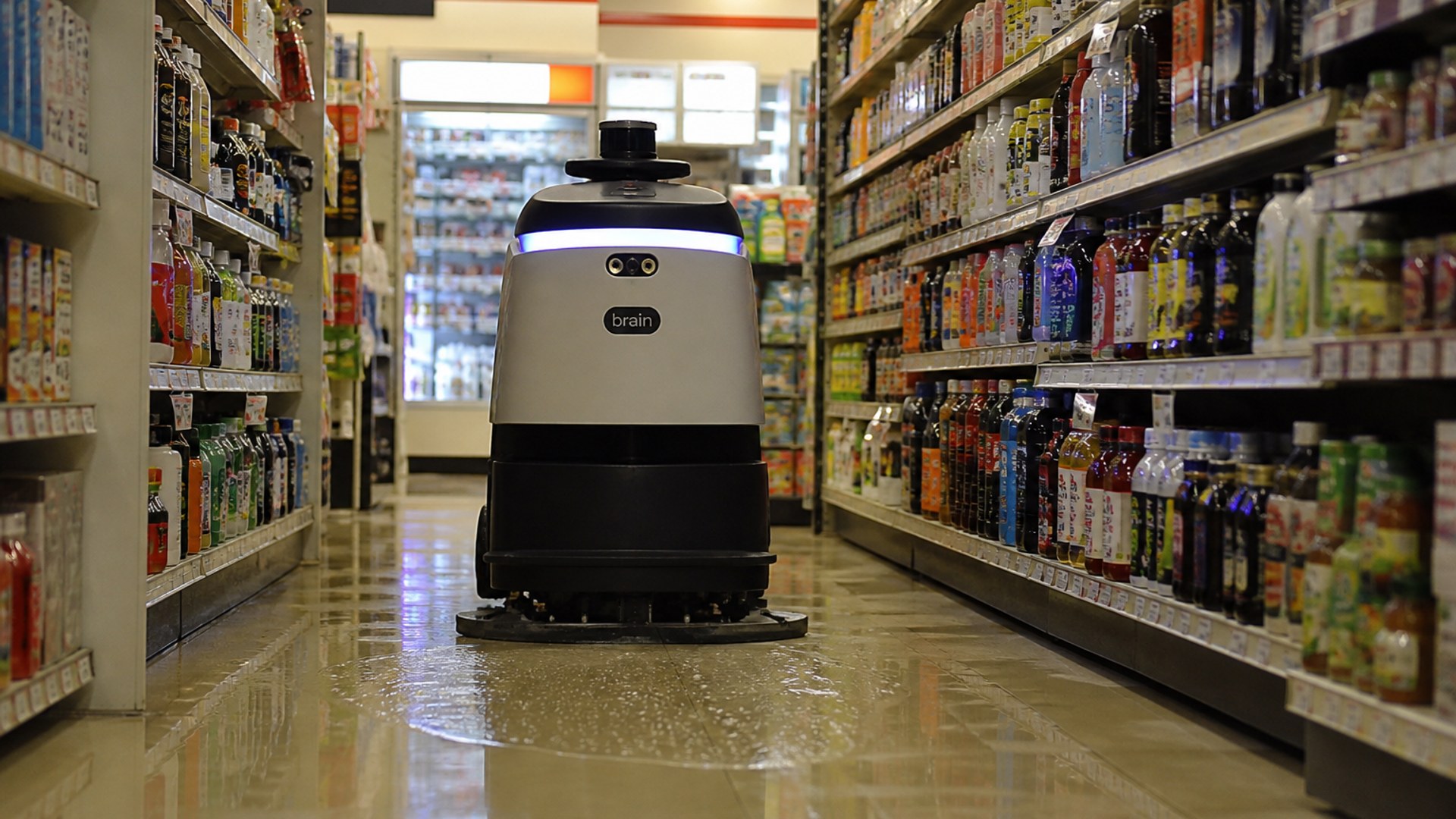
Pudu ET1 Scrubber-Dryer Robot Targets Small Commercial Spaces
The introduction of the PUDU ET1 robot may enhance cleaning efficiency in small commercial spaces, addressing a significant gap where larger robots are impractical due to size constraints.
- Pudu Robotics launched the PUDU ET1, a compact AI-powered scrubber-dryer robot, designed for commercial spaces of 100 to 800 square meters.
- Target environments include convenience stores, drugstores, and chain restaurants—areas where larger cleaning machines are difficult to navigate.
- The ET1 features an 8-in-1 docking station that automates various maintenance tasks, minimizing operator intervention after cleaning runs.
- It uses 'AI Magic Cleaning' for efficient operation, adapting scrubbing modes based on surface type and detected stains.
Pudu Robotics is known for its advanced cleaning solutions, holding a leading 29% market share in commercial cleaning robotics. The ET1 expands its product line to include smaller, more agile robots for tighter retail environments, complementing larger models already in use. Future updates may focus on enhancing AI capabilities and expanding deployment options.
Read the original ↗
The First AI IPO Won’t Decide Who Wins AI
The upcoming first AI IPO will shift investor focus from model development to how effectively AI can be integrated into industries, influencing future market dynamics and the importance of operational success.
- OpenAI and Anthropic are competing to be the first AI company to go public, marking a significant moment in the industry.
- An IPO will provide investors insight into the economics of frontier AI, including revenue quality and cost structures.
- The shift from technical capability to practical integration in industries may redefine how success in AI is measured.
- As AI technology matures and becomes cheaper, organizations will prioritize practical outcomes over mere technical superiority.
AI represents a significant technological advancement with implications for various industries. The first phase emphasized building powerful models, while the next phase will focus on their practical applications in business environments. The outcome of the IPO race could influence how companies are valued and how AI's long-term benefits are realized.
Read the original ↗
What the EU AI Act Doesn’t Tell Founders About Training Data
This article highlights significant gaps in the EU AI Act regarding data privacy for founders, underscoring the risks of user data handling without transparency in AI systems.
- Article 50 of the EU AI Act mandates AI systems to inform users they are interacting with a machine but lacks clarity on data handling afterward.
- As of August 2, 2026, noncompliant companies could face fines up to €15 million or 3% of global turnover, emphasizing the importance of understanding vendor data practices.
- Research indicates major AI developers typically use customer chat data for training by default, often retaining such data indefinitely, creating privacy concerns.
- Founders integrating AI must proactively investigate vendor data handling policies, contract terms, and opt-out provisions to avoid unintended data exposure.
- The article suggests founders should establish clear opt-in consent for user data training ahead of future regulations and to build user trust.
The EU AI Act introduces guidelines for artificial intelligence usage in Europe, specifically requiring transparency regarding AI interactions. However, it leaves unresolved issues about data privacy practices by AI vendors, raising concerns for companies utilizing third-party AI models. Founders are advised to adopt proactive privacy measures as regulatory frameworks evolve.
Read the original ↗
Skan AI’s Series C Bets Enterprise AI Needs a Map of Real Work
Skan AI's funding and product development highlight the increasing recognition of context-based analysis in optimizing enterprise operations, which could significantly enhance efficiency and cost-effectiveness for various industries.
- Skan AI has raised $63 million in Series C funding led by Cathay Innovation and Dell Technologies Capital, totaling approximately $120 million in funding to date.
- The startup's software tracks how employees interact with enterprise applications, creating a model that reflects actual business operations instead of relying on documentation.
- Skan claims to have generated over $500 million in customer value by identifying operational inefficiencies, with notable savings and efficiency improvements reported at a major U.S. bank.
- The company has experienced revenue growth exceeding 300% year over year and boasts clients including seven of the ten largest U.S. banks.
Skan AI, founded in 2018, focuses on enterprise process intelligence by observing work patterns via software to enhance operational efficiency. The recent funding will help expand its product offerings and support growth in the enterprise AI sector, particularly applications in banking and insurance.
Read the original ↗
Hidden Charcoal Inside a Famous French Cave Just Rewrote the Timeline of Its Ice Age Paintings
The discovery of charcoal in Ice Age cave paintings allows for precise dating, reshaping the understanding of artistic activity and continuity in prehistoric societies.
- Charcoal found in the cave paintings at Font-de-Gaume enables direct radiocarbon dating, overturning previous assumptions.
- A new study published in PNAS confirms that the black pigment contained charcoal, allowing accurate age estimation of the artwork.
- The bison painting's radiocarbon date ranges from 13,461 to 13,162 years ago, while the mask-like painting shows multiple artistic phases with varying dates.
- This research could facilitate dating of previously indeterminable artwork across the Dordogne region.
Font-de-Gaume, located in southwest France's Dordogne region, is renowned for its prehistoric cave art, previously believed not to contain carbon for dating. The recent findings indicate that these artworks may have been revisited and modified over time by different generations. Future research may uncover additional paintings containing charcoal, prompting a reevaluation of their ages.
Read the original ↗
FEMA's ‘Shadow Administrator’ Was Paid by a DOGE Member's Startup for Months
The relationship between a FEMA contractor and a DOGE member's startup raises significant concerns regarding potential conflicts of interest and the integrity of government contracting processes.
- Kara Voorhies, identified as FEMA's 'shadow administrator', worked for a company owned by DOGE operative Kyle Schutt while serving in government.
- Court filings reveal that Voorhies subcontracted with Schutt's company, AnchorCode Technologies, from October 2025 until mid-March 2026.
- Federal law forbids contractors from performing inherently governmental functions, yet Voorhies allegedly influenced FEMA's contract awards and grant approvals.
The Federal Emergency Management Agency (FEMA) is responsible for coordinating the federal government's response to disasters, and recent events have exposed possible corruption linked to DOGE members within the Department of Homeland Security (DHS). The situation raises questions about ethics and government oversight, especially in light of recent staffing changes at DHS.
Read the original ↗
Oh Lord, AI Reporters Are Actually Breaking Big News
The emergence of AI-generated newsrooms like RuntimeWire poses significant implications for the future of journalism, raising questions about quality, ethics, and the role of human reporters.
- RuntimeWire, an AI newsroom, outpaced WIRED in breaking a story about OpenAI and a hacking incident during the Black Hat security conference.
- RuntimeWire operates without human reporters, using AI to draft and publish stories quickly from online sources, achieving publication in about six minutes.
- Since its launch in May, RuntimeWire has published nearly 2,000 stories, primarily focusing on technology news, but often lacking depth and quality.
RuntimeWire is a synthetic newsroom run by Ryan Merket, utilizing AI to generate news content quickly. This model contrasts with traditional journalism practices, leading to a debate on the quality and ethics of AI-generated news. Observers suggest that while AI newsrooms can enhance speed, they may compromise the integrity and context essential to quality reporting.
Read the original ↗
The Job Interview Tattoo Guy Everyone Got Mad at Finally Explains Himself
This story highlights the controversial tactics some startups employ in recruitment, raising questions about ethics and power dynamics in the job market.
- Jordan Zietz, co-founder of AI startup LemonLime, faced backlash for offering job interviews in exchange for tattoos of the company's logo.
- Seven attendees at a party hosted by LemonLime got tattoos, although Zietz insists that this was not a job requirement.
- Zietz acknowledged the discomfort caused by the original job offer, stating that it was a test for cultural fit rather than a requirement for employment.
LemonLime is an AI-for-small-business startup co-founded by Jordan Zietz, who aims to cultivate a unique company culture. Previous instances of unconventional hiring practices include an interview while skydiving. Future reactions from job seekers and companies in similar sectors will be worth monitoring.
Read the original ↗
‘The Worst I’ve Ever Seen’: Cargo Thefts Have Turned Violent in Pursuit of AI Hardware
The rise in violent cargo thefts targeting AI hardware poses significant risks to the freight industry and could disrupt operations for companies relying on data center technology.
- Two recent violent thefts in California involved high-value AI equipment and the use of coordinated tactics against escort vehicles meant to protect shipments.
- Investigators suspect truck drivers may have colluded with the thieves, as the stolen trucks have not been found and millions worth of gear is missing.
- Cargo thefts have surged alongside the growth of the AI data center industry, prompting concerns that these incidents represent a worrying trend in freight crime.
AI hardware thefts have increased dramatically, coinciding with the expanding AI data center market. Cargo theft overall has been on the rise since the pandemic, with criminals increasingly targeting high-value technology.
Read the original ↗
Pakistani Judges Give Their Verdict on JudgeGPT
The trial of JudgeGPT in Pakistan demonstrates the potential for AI tools to improve judicial efficiency, which could help address the significant backlog in legal cases.
- A large-scale trial of an AI tool for judges in Pakistan showed a 6.3 percent increase in cases resolved without decreasing judgment quality.
- The custom AI tool, called JudgeGPT, was introduced to help judges with legal research and drafting judgments in 2024.
- 1,559 judges participated in the trial, which included training about how to use the tool effectively and safely.
- The study indicated a slight decrease in appeal rates, suggesting that faster resolutions did not compromise decision quality.
- Judges trained to use JudgeGPT logged in significantly more times and used the tool more effectively than those without specific training.
JudgeGPT is based on OpenAI's GPT-4 and designed to assist judges in Pakistan with legal tasks using a large database of local laws and judgments. The trial highlights the judiciary's interest in adopting AI despite previously reported illicit uses and aims to reduce a substantial backlog in cases. Future developments will focus on expanding AI integration in legal systems.
Read the original ↗
AI code-testing startup Blacksmith’s valuation jumps almost 10x in less than a year
Blacksmith's rapid growth and increased valuation highlight the significant demand for tools that ensure the quality of AI-generated code, a growing concern in software development.
- Blacksmith has raised $45 million in a Series B funding round, now valuing the company at $550 million.
- The valuation increased from $60 million in less than a year, following a previous $10 million Series A funding round.
- The startup serves over 5,000 customers, growing from just 700 within a year, indicating strong market demand.
- Blacksmith aims to compete by improving the speed and affordability of code testing in a crowded market.
- The company plans to expand its offerings to help developers write, validate, and merge software faster.
Founded in 2024, Blacksmith provides solutions for testing and validating software to ensure quality before production. It is expanding amid a competitive landscape that includes major players like GitHub and Amazon. Future developments are expected to enhance its toolset for coding workflows.
Read the original ↗
Blacksmith Raises Funding for AI Code Validation Layer
The funding enables Blacksmith to enhance its infrastructure for validating AI-generated code, which is crucial as software development evolves rapidly with more automated coding tools.
- Blacksmith raised $45 million in Series B funding led by Peak XV Partners at a $550 million valuation.
- The company reports a significant increase in weekly CI (continuous integration) jobs and customer count since the beginning of 2026.
- Blacksmith's platform operates faster and cheaper than general-purpose cloud solutions, specifically targeting GitHub Actions users.
Blacksmith, founded in 2024, specializes in continuous integration workloads on Custom hardware to manage software validation processes. The startup initially gained traction with a $3.5 million seed round and a $10 million Series A, and it is now positioned to expand its validation services for AI-driven coding tasks.
Read the original ↗
FIFA Picks Globant to Run a Year-Round AI Fan Ecosystem on Glob.AI
FIFA's partnership with Globant to create a unified AI fan ecosystem could transform how fans interact with the organization, leveraging data for enhanced experiences and monetization strategies.
- FIFA selected Globant to develop a year-round AI fan ecosystem on Glob.AI, expanding an ongoing collaboration.
- Key components include FIFA ID for unified fan identity, a personalized FIFA.com website, and a consolidated tournament app.
- This initiative aims to transition from anonymous fan interactions to a data-driven approach for better content and commercial opportunities.
Globant is a technology services firm specializing in AI solutions, and FIFA is the international governing body for football. This collaboration focuses on enhancing fan engagement through improved digital platforms while ensuring data ownership crucial for FIFA's future innovations. The outcome of this new economic model will be closely observed by other enterprises considering similar strategies.
Read the original ↗