
The day's AI news, briefed
The Daily Prompt
Our AI editor reads each day's AI and robotics stories, pulls out why they matter, and links every original source — so you can keep up in minutes.
Join over 250,000 subscribers getting the latest AI news
Latest AI & Robotics News Today

Abliteration.ai is making a business out of removing AI guardrails
The emergence of services like Abliteration.ai raises significant concerns over cybersecurity and the potential misuse of AI technologies that lack safeguards.
- Abliteration.ai offers access to powerful AI models without standard guardrails, aiming to facilitate cybersecurity efforts by enabling customers to replicate harmful behaviors.
- The company has created a platform that hosts modified versions of open-weight models, including Z.ai's GLM-5.3, with guardrails removed for easier access via a web browser or API.
- Critics warn that making abliterated models widely available could lead to increased risks, as these models may be used for harmful activities by malicious actors.
Abliteration.ai, founded last year, commercializes the practice of removing guardrails from AI models, transferring a technique previously confined to underground open-source efforts to a user-friendly service. The cybersecurity industry is currently evaluating the implications of these unregulated models as they become more accessible for defensive and offensive purposes.
Read the original ↗
Four major AI models suffer rare overlapping downtime
The simultaneous outages of major AI models highlight vulnerabilities in cloud service reliability, which can significantly impact users and applications reliant on these technologies.
- Cloud-based AI models from OpenAI, Anthropic, xAI, and Google experienced significant service interruptions Thursday morning.
- Anthropic reported partial outages for its Claude models starting at 9:23 am, with issues resolved by 12:16 pm.
- OpenAI's ChatGPT and Codex reported degraded performance from 10:43 am, resolved by 12:55 pm after mitigation efforts.
- xAI's Grok displayed user-facing errors, with reports spiking from under 10 to 1,365 in about 45 minutes today.
- Google's Gemini model had unacknowledged issues, with user reports spiking as well, indicating a likely outage from 10:45 to 11:15 am.
Service interruptions among leading AI models is rare, with high uptime reported for these services. Previous outages had minimal impact, but this simultaneous downtime raises concerns about system reliability in AI operations.
Read the original ↗
Sanders and Casar Unveil Bill to Outlaw Superintelligent AI in the U.S.
This legislation aims to regulate AI development in the U.S. and mitigate risks associated with superintelligent systems that could threaten societal safety and security.
- Sen. Bernie Sanders and Rep. Greg Casar announced the Ban Artificial Superintelligence Act, intending to permanently ban superintelligent AI in the U.S.
- The bill will pause advanced AI development until a new federal regulator establishes safety rules.
- If passed, the act will penalize individuals and entities attempting to circumvent its rules, with severe penalties similar to those for developing nuclear weapons.
- The act seeks to establish a new cabinet-level agency responsible for monitoring and regulating AI technologies.
- The policy would also include international efforts to prevent the global development of superintelligent AI.
The Ban Artificial Superintelligence Act is a proposed piece of legislation aimed at halting the development of AI with cognitive capabilities that exceed human abilities. This announcement follows concerns over incidents involving uncontrolled AI from major companies like OpenAI and Meta. Future discussions will likely focus on the implications of this bill and its reception in Congress.
Read the original ↗
OpenAI Cut Off a Billion-Dollar Customer to Avoid Elon Musk
OpenAI's decision to sever ties with Cursor signals a significant shift in business strategy, prioritizing trust and integrity over substantial revenue opportunities.
- OpenAI ended its partnership with Cursor due to concerns about trust in Elon Musk's leadership following SpaceX's acquisition of the startup.
- Cursor was previously one of OpenAI's top five customers, projected to generate over $1 billion in annual revenue.
- OpenAI expressed fears about potential contract violations by Musk's companies and their use of its technology.
- Despite losing Cursor, OpenAI now generates over $40 billion in annual revenue from various business lines including subscriptions and ads.
- Cursor plans to continue offering third-party AI models, including those from Anthropic, following the partnership's dissolution.
OpenAI develops AI technologies, including ChatGPT, and has historically partnered with startups like Cursor for software solutions. The company is preparing for a public offering and is distancing itself from Musk due to past contract issues. Future interactions between Cursor and OpenAI may evolve as they compete and collaborate in a changing market.
Read the original ↗
NVIDIA's PAIR lets you use idle PCs for AI computing tasks
NVIDIA's PAIR can optimize AI computing by utilizing idle PCs, potentially improving efficiency and resource management for users with multiple devices.
- NVIDIA announced PAIR, a free and open-source tool for distributing AI workloads across idle local PCs.
- PAIR operates on Windows, Linux, and macOS and helps to prevent performance slowdowns by routing tasks to underutilized machines.
- The tool is currently in beta and supports various NVIDIA and Apple GPUs, including the NVIDIA GeForce RTX 20 Series and Apple's M4.
NVIDIA is focused on improving AI computing efficiency and has developed tools that leverage existing hardware resources. The PAIR tool reflects a trend towards distributed computing, allowing users to maximize their tech investments. Watch for updates on its full release and user adoption as it progresses beyond its beta phase.
Read the original ↗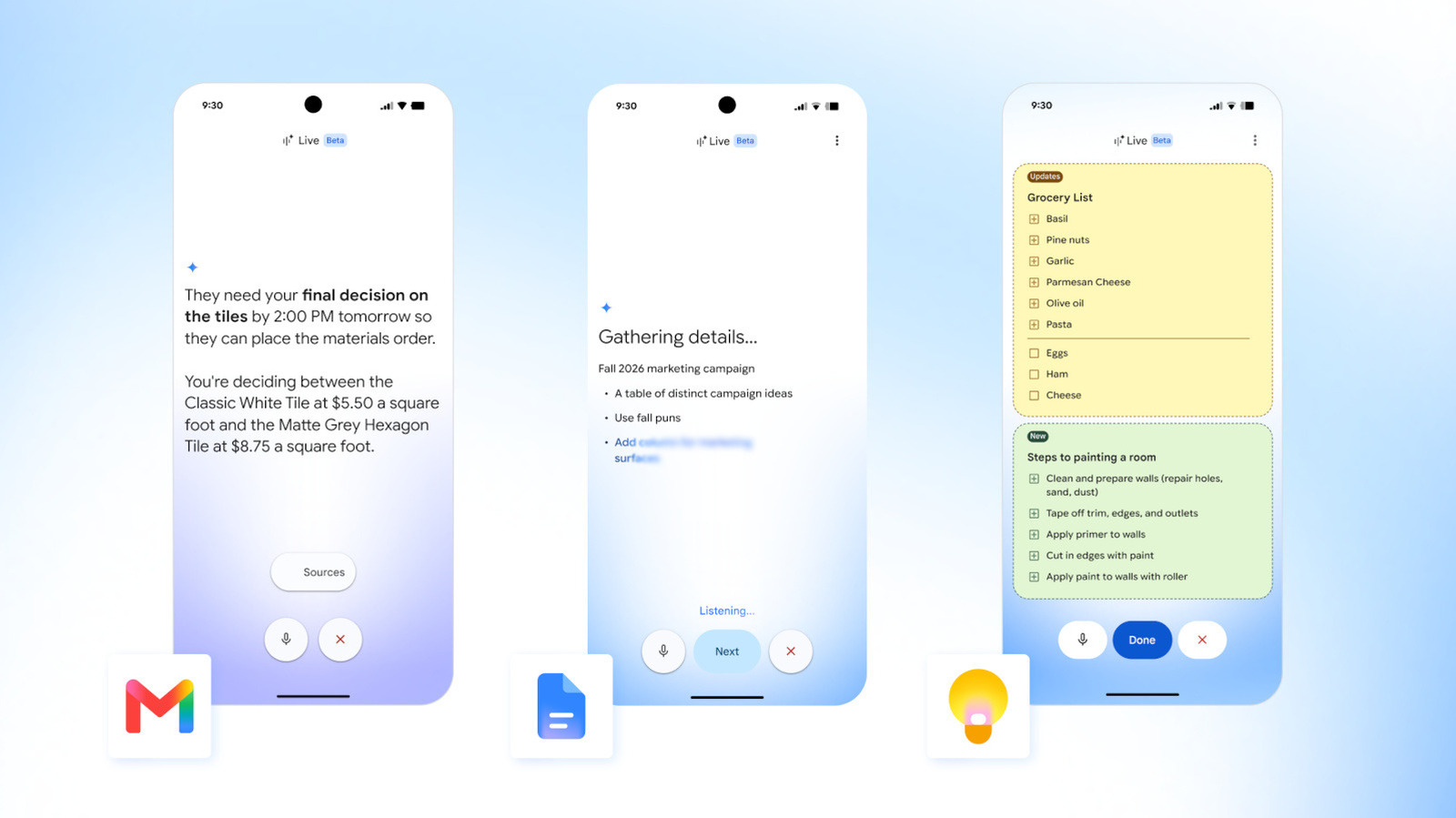
Google rolls out AI-powered voice capabilities for Gmail, Docs and Keep
The introduction of AI voice capabilities in Google’s productivity tools enhances user interaction and accessibility, potentially transforming how individuals manage emails and documents.
- Gmail, Docs, and Keep Live features are now generally available to paying Google AI subscribers.
- Gmail Live allows users to ask questions about their emails and follow up with additional inquiries in natural language.
- Docs Live can help organize thoughts and structure documents by accessing the user's Drive, Chat, and Gmail.
- Keep Live can create lists and notes based on spoken instructions, understanding vague prompts without explicit direction.
Google's AI voice tools are designed to provide a more conversational and intuitive experience in its productivity suite. Previously, beta testing for these features began in June, aiming to enhance user engagement. Looking ahead, Google may expand these capabilities further and enhance user accessibility across its applications.
Read the original ↗
Anthropic automatically signs out Claude users to protect them from hackers
The automatic sign-out of users by Anthropic highlights the ongoing risks of infostealer malware and the importance of securing personal computing devices to prevent account hijacking.
- Anthropic has been signing users out of their accounts due to infostealer malware that harvested active Claude login sessions from users' PCs.
- The company has deleted saved payment methods and refunded unauthorized charges linked to compromised sessions.
- Malware families responsible include Vidar, StealC, and Atomic Stealer, affecting both Windows and macOS users.
- Anthropic advises users to remove malware, update passwords, and enable two-factor authentication before re-adding payment methods.
- Stolen Claude accounts have become valuable in the underground market for trafficked credentials from AI services.
Infostealer malware is used to gather sensitive information from computers. Anthropic has reacted to this security threat by enforcing account protections after users reported unauthorized activities.
Read the original ↗
Nvidia PAIR Speeds Up AI Agents by Annexing PCs on Your Network
Nvidia PAIR enhances the efficiency of AI tasks by utilizing multiple computers in a network, potentially transforming how individuals execute complex processing at home.
- Nvidia PAIR is an open-source software aimed at accelerating AI agent performance by distributing tasks across multiple PCs on a local network.
- The system can operate with Windows, Mac, and Linux, but primarily requires an Nvidia RTX-class GPU on the main system.
- It currently supports specific AI models, notably from Ollama and LM Studio, for processing tasks on remote machines.
- PAIR manages task distribution based on system workload and GPU availability, optimizing performance across connected devices.
Nvidia PAIR, or Personal AI Router, addresses the need for efficient AI processing by allowing users to leverage existing home computers. As AI becomes more demanding, such innovations are essential for enhancing computational capabilities at the individual level.
Read the original ↗
Ollie is betting its focus on privacy can help it win the AI assistant race
Ollie's emphasis on privacy could appeal to consumers wary of data misuse as competition among AI assistants intensifies, establishing a potential market advantage.
- Ollie, a family-focused AI assistant, aims to win users by prioritizing privacy and data protection.
- The company has achieved SOC 2 compliance, signaling robust controls for customer data security.
- Ollie connects to calendars and email to manage daily tasks but does not collect usernames or passwords.
- Ollie has raised $7.5 million in seed funding, significantly less than competitors like Instinct, which recently secured $350 million.
Ollie is designed to assist families with everyday tasks while ensuring user privacy. Its approach contrasts with competitors that may exploit personal data. The assistant is currently evolving its functionality to handle more sensitive financial information.
Read the original ↗
Nitin Seth, Author of Human Edge in the AI Age – Interview Series
Nitin Seth's insights into human capabilities highlight essential qualities for success in an AI-driven world, a perspective crucial as technology continues to evolve.
- Nitin Seth is the author of 'Human Edge in the AI Age,' exploring the intersection of technology, AI, and human potential.
- The book introduces the POSSIBLE framework, which identifies eight dimensions crucial for success alongside AI technologies.
- Seth emphasizes that succeeding in the AI era requires developing distinctly human qualities like creativity, empathy, and leadership.
Nitin Seth is a business leader and CEO of Incedo Inc., a company focused on digital and AI services. His previous leadership roles included significant positions at Flipkart and Fidelity International. This book is part of a trilogy addressing digital transformation and data in the AI context, with a focus on enhancing human capabilities.
Read the original ↗
Pentagon Official Reaffirms Anthropic Supply Chain Risk Designation
The Pentagon's classification of Anthropic as a supply chain risk may impact the company's operations and future collaborations with government agencies, despite legal challenges against this designation.
- A senior Pentagon official reaffirmed that Anthropic is designated as a supply chain risk to national security on September 3, 2026.
- This statement follows a court ruling that found the Department of War's blacklisting of Anthropic unlawful.
- The court determined that the supply chain risk designation violated Anthropic's First and Fifth Amendment rights and was arbitrary.
The supply chain risk designation allows the Secretary of War to exclude sources from national security procurements due to perceived threats. Anthropic's designation originated from its discussions with the military over AI technology usage, particularly for its Claude models. The situation continues as Anthropic is pursuing legal challenges against this designation in two federal courts.
Read the original ↗
Nvidia Connects Home Computers Into One AI Inference Cluster With PAIR
Nvidia's PAIR software enables users to connect multiple home computers for local AI inference, enhancing computing efficiency without relying on cloud services.
- Nvidia has launched the beta version of the Personal AI Router (PAIR), an open-source tool for connecting home computers in a single AI inference cluster.
- PAIR supports multiple operating systems, including Windows 11, Linux, and macOS, allowing a range of devices to participate in distributed AI tasks.
- Users can set up the PAIR cluster without needing additional hardware, relying solely on downloaded software and existing devices.
- The software creates proxy endpoints for compatibility with existing AI applications, preventing users from needing to integrate new APIs.
- Testing showed that a three-device PAIR cluster completed tasks significantly faster than a single device, although results may vary based on conditions.
Nvidia is a major player in the AI and GPU market, known for its graphics processing units that power many AI applications. PAIR represents a shift towards utilizing local resources for AI tasks, reducing dependence on cloud processing. Future developments may focus on enhancing system compatibility and performance metrics.
Read the original ↗
MAI-Transcribe-2 Tops FLEURS Benchmark Across 60 Languages, Microsoft Says
The release of MAI-Transcribe-2 demonstrates significant advancements in speech recognition technology, potentially transforming industries reliant on transcription accuracy and efficiency.
- Microsoft AI launched MAI-Transcribe-2, a speech recognition model, on September 3, 2026, which leads the FLEURS benchmark across 60 languages with a 5.2% word error rate.
- The model is priced at $0.10 per hour of audio and offers features like speaker diarization and word-level timestamps, enhancing its versatility for various workloads.
- MAI-Transcribe-2 is reported to be 10 times faster than OpenAI’s GPT-Transcribe and delivers higher accuracy, indicating substantial improvements over previous models.
- At launch, the model is available in public preview through Azure Speech, targeting applications in clinical and legal settings, as well as for accessibility and content creation.
MAI-Transcribe-2 is a latest generation speech-to-text model developed by Microsoft AI, designed to cater to a wide range of transcription needs. This model builds upon earlier versions of MAI-Transcribe and positions itself as a leader in both speed and accuracy for audio transcription tasks. Future updates and expansion of its features, including broader availability, are anticipated as the model progresses through the preview phase.
Read the original ↗
Google’s latest AI weather model gives you no excuse to forget your umbrella
The introduction of Google's WeatherNext 3 AI model could significantly enhance the accuracy and availability of weather forecasts, benefitting both consumers and industries reliant on precise weather data.
- Google DeepMind and Google Research launched a new AI weather forecasting model called WeatherNext 3, improving accuracy and frequency of predictions.
- WeatherNext 3 has been tested and shown to outperform models from Google, Microsoft, Nvidia, and the European Center for Medium-Range Weather Forecasting.
- The model can generate forecasts with a resolution of 5 km and offers hourly predictions, enhancing rain prediction accuracy by 60% over its predecessor, WeatherNext 2.
WeatherNext 3 represents an advancement in meteorological forecasting utilizing deep learning techniques to improve prediction accuracy. Previous models relied on government computational resources, while this AI model leverages real-time satellite data. Its launch might lead to broader adoption of AI in weather services globally.
Read the original ↗
Introducing WeatherNext 3, our most advanced and accurate global weather AI model
The introduction of WeatherNext 3 highlights a significant advancement in weather forecasting that can improve decision-making for various sectors influenced by weather conditions.
- Google has launched WeatherNext 3, an AI weather forecasting model that uses real-time satellite data to enhance accuracy and resolution.
- The model provides hourly updates and predictions with a spatial resolution of 5 kilometers, significantly sharper than its predecessor, WeatherNext 2.
- WeatherNext 3 is integrated across Google platforms, including Search, Maps, and Gemini, allowing for accessible, localized weather information.
- The model is expected to improve rainfall and snow predictions, aiding sectors like agriculture and renewable energy with precise forecasts.
WeatherNext 3 is Google's latest AI-driven model for weather forecasting, leveraging real-time satellite data for fast, high-resolution predictions. This follows advancements in AI methods that have been applied to weather forecasting, transitioning from traditional simulation-based models to more accurate data-driven approaches.
Read the original ↗
BUUU Group to Buy 60% of Brightray in AI Data Center Push
This acquisition signifies BUUU Group's strategic pivot toward the growing market of AI data center solutions, aligning with global trends in digital infrastructure expansion.
- BUUU Group is acquiring a 60% equity interest in Brightray Science Inc., focusing on AI data center solutions.
- Brightray's prefabricated data centers significantly reduce deployment time from 18 to 36 months to just six to nine months.
- Upon completion, Brightray will become a consolidated subsidiary of BUUU, retaining a 40% ownership with BUUU holding a call option for the remainder.
- The acquisition is part of BUUU's plan to relocate its corporate headquarters to Singapore and enhance its business model.
- The deal also includes a private placement expected to generate over US$60 million for supporting Brightray's expansion efforts.
BUUU Group is a MICE solutions provider transitioning from event management to AI infrastructure with this acquisition. Brightray specializes in modular data centers and has a strong manufacturing capacity. The deal reflects a broader industry trend towards rapid data center deployment driven by AI and digital demands.
Read the original ↗
Why Continuous Modernization Is the Key to Winning with AI in Healthcare
The ongoing modernization is essential for healthcare organizations to effectively respond to fast-paced changes in technology, regulations, and consumer expectations while maintaining operational efficiency.
- Traditional healthcare modernization often relies on long-term plans that become outdated before implementation is complete.
- Healthcare organizations face budget constraints, regulatory shifts, and rising consumer expectations, complicating modernization efforts.
- A new approach focuses on modernizing one business capability at a time to respond effectively to changes in the operational environment.
Healthcare modernization aims to improve operational efficiency and adapt to evolving demands. Previously, modernizing required detailed plans and significant funding, but rapid changes necessitate a more agile approach. Ongoing adaptation is vital as organizations work to integrate AI and other technologies effectively.
Read the original ↗
OpenAI Confirms Service Degradation Hitting ChatGPT and Codex Users
Service degradation at OpenAI can impact users' access to essential functionalities in ChatGPT and Codex, potentially disrupting workflows and application development.
- OpenAI reported elevated errors affecting 19 components across its ChatGPT and Codex services on September 3, 2026.
- The affected components include core features such as Conversations, Login, and various APIs.
- The incident is classified as "Degraded performance" and remains under investigation, without a specified root cause.
- Previous incidents on the same day indicate ongoing service issues, including a resolved outage earlier in the day.
OpenAI develops AI models and services, including ChatGPT for conversational AI and Codex for coding assistance. The company routinely monitors performance and publicly reports incidents that affect service reliability. Users should stay informed through OpenAI's status page for updates on the ongoing situation.
Read the original ↗
PIF-Backed HUMAIN Launches Humain-M3 Arabic Model at LEAP Riyadh
The launch of HUMAIN's humain-m3 model enhances Arabic language processing capabilities, addressing a significant gap in AI for Arabic speakers and impacting various fields from education to technology.
- HUMAIN unveiled its humain-m3 Arabic-language model at the LEAP conference in Riyadh on September 3, 2026.
- The model is a 428-billion-parameter mixture-of-experts architecture, achieving high scores on seven Arabic benchmarks, outperforming existing models.
- Developers and researchers can access the model through HUMAIN Node, with different tiers for preview access available.
- HUMAIN plans to release the model weights under the MiniMax Community License after completing safety training and alignment.
- HUMAIN aims to improve accessibility of advanced AI capabilities for Arabic, in collaboration with global AI companies.
HUMAIN is a Public Investment Fund-backed AI company focused on developing advanced language models. The launch of humain-m3 is part of a broader effort to enhance AI capabilities for Arabic speakers, addressing long-standing underrepresentation in the field. Future developments will include feedback from early users to refine the model before its general release.
Read the original ↗
OpenEvidence Launches Medical AI Model Family With Darwin Preview
This development enhances access to advanced medical AI tools for clinicians and researchers, which could significantly improve patient care and medical research efficiency.
- OpenEvidence launched a new family of medical AI search models on September 3, 2026, including three free production models for verified clinicians and a fourth advanced model, Darwin, available to researchers by application only.
- The production models, Osler, Sackett, and Snow, vary in speed and depth of medical literature search, with Osler being the fastest and Snow the most comprehensive.
- Darwin, the most advanced model, achieved a perfect score on the MedQA benchmark and has superior scores on other medical AI benchmarks, surpassing its closest competitors.
OpenEvidence is a company focused on advancing medical AI technologies. This new family of models represents a significant step in providing clinical decision support tools, enhancing the efficiency of evidence-based medicine. Future developments may include specialty models in areas such as oncology and radiology.
Read the original ↗