
The day's AI news, briefed
The Daily Prompt
Our AI editor reads each day's AI and robotics stories, pulls out why they matter, and links every original source — so you can keep up in minutes.
Join over 250,000 subscribers getting the latest AI news
Latest AI & Robotics News Today

Google DeepMind’s WeatherNext 3 Trains on Weather Station Observations to Deliver...
WeatherNext 3 represents a significant advance in weather forecasting by providing improved accuracy and timely updates, addressing limitations of previous models that impacted various sectors relying on precise weather data.
- Google DeepMind released WeatherNext 3, a global weather model offering forecasts at 5 km resolution refreshed hourly.
- The model uses real-time satellite data as input, significantly improving the initialization speed compared to previous models that used outdated data.
- Independent evaluations have ranked WeatherNext 3 as the most accurate global weather model available to date.
- Forecast data can be accessed through BigQuery, Earth Engine, and Cloud Storage, but the model weights remain proprietary and are not open source.
- WeatherNext 3 outputs include detailed atmospheric variables, improving accuracy in predicting precipitation and renewable energy generation.
WeatherNext 3 is the latest evolution of Google DeepMind's AI-driven weather forecasting models, which aim to refine predictions by training directly on weather station data. Previous iterations, like WeatherNext 2, relied more heavily on reanalysis data, which can obscure local variances. Moving forward, this release could enhance operational forecasting for energy management and weather-sensitive industries.
Read the original ↗
Synthesia vs. Creatify: Which AI Video Tool is Better?
This comparison highlights the differences between two AI video tools, providing insights for businesses deciding which platform meets their specific needs for training or marketing.
- Synthesia is designed for corporate training, offering over 240 stock avatars, while Creatify targets marketers with URL-based ad creation features.
- Both platforms have different pricing structures; Synthesia uses a video-minute meter, whereas Creatify uses a credit system with varying costs depending on video length and quality.
- Synthesia’s user base largely consists of enterprises, while Creatify is primarily used by small businesses, emphasizing their distinct target markets.
Synthesia, founded in 2017, specializes in creating AI-generated videos for corporate environments, whereas Creatify focuses on generating marketing videos quickly from product listings. Users should consider their specific applications before choosing a platform as they cater to different organizational needs in video production.
Read the original ↗
Crusoe reportedly raises $3B at a $30B valuation
The funding reflects significant investor confidence in AI infrastructure, highlighting the growing demand for data centers that support advanced technologies like artificial intelligence.
- Crusoe has raised $3 billion at a $30 billion valuation, as reported by Bloomberg.
- The fundraising round was co-led by Atreides Management and Valor Equity Partners with participation from Mubadala Capital.
- Crusoe recently secured a $13 billion, five-year contract with Jane Street for GPUs and AI infrastructure.
- The company initially launched in 2018 as a crypto mining operation using flared natural gas before pivoting to AI infrastructure.
- Crusoe is considering a potential near-term IPO, having recently met with investment bankers including Goldman Sachs.
Crusoe is a data center developer known for creating hyperscale data center campuses for major clients like Meta and Microsoft. The company transitioned from a crypto mining focus to AI infrastructure amid rising demand for cloud services. Its substantial new funding may indicate continued growth and future public offerings.
Read the original ↗
OpenAI says GPT-6 Astra is 'the most intelligent and aligned model in the world'
The release of GPT-6 Astra, touted as the most advanced and aligned AI model, raises significant implications for various professional fields, including software engineering and cybersecurity.
- OpenAI has launched GPT-6 Astra, claiming it is the most intelligent and aligned AI model to date.
- Astra excels in computer-use tasks, particularly in software engineering and cybersecurity, demonstrating strong multi-tasking abilities.
- The model achieved a 98.6% score on the ARC-AGI-3 benchmark, indicating its problem-solving capabilities, though comparisons with other models may vary due to configuration differences.
- Astra scored a perfect 100% on the ExploitBench benchmark, significantly improving over its predecessor, GPT-5.6 Sol.
- The model will be rolled out to a limited number of organizations before becoming available to all ChatGPT Plus, Pro, Business, and Enterprise users.
OpenAI, a leader in AI development, previously released the GPT-5.6 model family in July. The introduction of Astra follows a strategic slowdown of model development after a significant incident involving a prior model's security issues. Moving forward, implications for responsible AI deployment in cybersecurity are critical to watch.
Read the original ↗
GPT-6 Stole the Show, but Anthropic, Meta and Google Also Had New AI Models This Week
The ongoing release of new AI models from major companies indicates rapid advancements in artificial intelligence capabilities, especially concerning agentic workflows that improve performance in various domains.
- OpenAI launched GPT-6 Astra, its most intelligent model yet, focusing on cybersecurity and software engineering.
- Anthropic updated its Fable and Mythos models, claiming improved performance and new safeguards for coding and problem-solving tasks.
- Meta introduced Muse Spark 1.3, enhancing reasoning and collaboration in agentic tasks.
- Google unveiled Gemini 3.8 Flash and 3.8 Flash Cyber, focusing on next-generation intelligence for agentic workflows and cybersecurity.
OpenAI, Anthropic, Meta, and Google are leading companies in the AI field, continuously releasing updated models to enhance functionality and performance. This week's announcements highlight a competitive landscape, with each company targeting advanced applications like agentic workflows, which involve automated decision-making processes. Observers should watch for how these developments affect industry standards and consumer applications.
Read the original ↗
SpaceXAI apologizes for outage that affected Grok and other 'compute partners'
The outage highlighted vulnerabilities in the AI infrastructure, affecting multiple systems and potentially disrupting services that rely on consistent AI support.
- SpaceXAI apologized for an outage that affected Grok for over three hours starting at 6:30 AM PT.
- The outage was attributed to issues at SpaceXAI's Memphis data center, impacting both Grok and unnamed compute partners.
- Other AI platforms, including Anthropic's Claude and OpenAI's services, experienced concurrent issues on the same day.
- SpaceXAI has not disclosed the cause of the Memphis issue, but corrective actions are being taken according to Elon Musk.
SpaceXAI is a company providing AI compute resources and tools, including Grok, an AI platform. The incident occurred amid broader issues in the AI sector, reflecting interdependencies among AI service providers. Observers should monitor how these outages influence reliance on specific computing resources and the industry's overall stability.
Read the original ↗
Ugreen's new smart home ecosystem is built around local AI hubs
Ugreen's smart home ecosystem emphasizes privacy by using local AI, which could appeal to consumers concerned about data security amid increasing reliance on cloud computing.
- Ugreen launched three local AI-powered smart home hubs including the HomeAgent and MasterAgent, designed to process data without using the cloud.
- The most powerful model, the MasterAgent, utilizes Nvidia's Jetson Thor platform and is priced at $20,000, with lesser models costing between $1,599 to $5,399.
- Ugreen's product lineup includes indoor and outdoor security cameras, a smart picture frame, and a smart speaker, targeting a privacy-conscious consumer base.
- The smart hubs will support multiple protocols, including ONVIF and Matter, and pre-orders are currently open until October 27, with expected shipping in January.
Ugreen, known for products such as fast chargers and NAS devices, is entering the local AI market with a focus on privacy-first smart home solutions. This marks a significant shift for the company, which aims to compete with established names like Amazon and Google. Future developments to watch include user feedback on the ecosystem's performance and support for additional smart home standards.
Read the original ↗
AI-Guided Hike Ends in Emergency Rescue at 11,000 Feet
This incident highlights the risks of relying on AI-generated advice for outdoor activities, emphasizing the importance of thorough preparation and independent verification of information.
- Three climbers attempting an 8-hour ascent of Mount Shasta ended up lost for three days after relying on Google Gemini AI for trip planning.
- The group reached the summit in 16 hours but faced an emergency rescue due to an injury and failed helicopter airlifts during their descent.
- The Siskiyou County Sheriff’s office warned against relying solely on AI for outdoor trip planning after the climbers admitted their critical misstep.
This event reflects concerns about the use of AI in critical decision-making. Previous adventures relying heavily on AI have raised safety concerns, particularly in unpredictable environments like mountain hikes. Future commentary from outdoor safety experts may reinforce the importance of traditional navigation skills and equipment.
Read the original ↗The Take It Down Act Is Just the Beginning of Fighting AI Abuse Online
The Take It Down Act highlights the U.S. government's commitment to combat online sexual abuse through legislation, as deepfake technology increasingly complicates victim protection and accountability.
- The Take It Down Act makes it a federal crime to publish nonconsensual intimate imagery, including AI-created deepfakes, with a requirement for platforms to remove such content within 48 hours.
- The legislation, which received bipartisan support and was enacted in May 2025, has led to at least one conviction under its new legal provisions.
- Meta and Google have introduced reporting mechanisms to help victims report nonconsensual intimate content, but enforcement is still in its early stages.
- Deepfake pornography represents 98% of all digital forgery videos online, mostly featuring women, highlighting the urgent need for protective measures.
- Enforcement challenges remain, as tech companies are not legally obligated to participate in reporting frameworks, placing more burden on victims.
The Take It Down Act is a U.S. law designed to combat the rise of AI deepfake technology used in image-based abuse. This law emerged due to increasing concerns about online harassment, particularly against women and children. Future developments will focus on improving enforcement and victim support mechanisms within the evolving landscape of digital content sharing.
Read the original ↗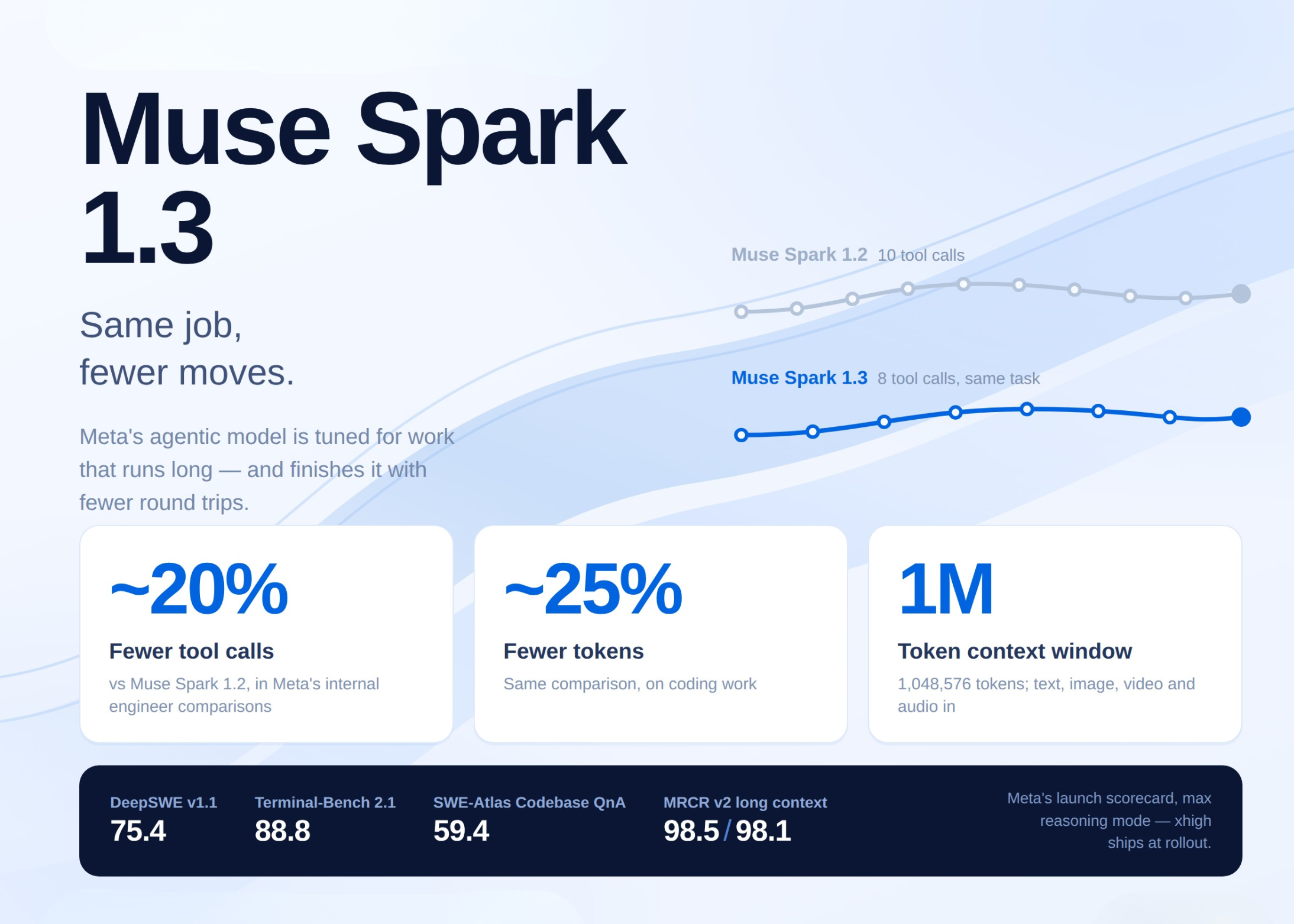
Meta AI Released Muse Spark 1.3: An Agentic Coding Model That...
The release of Muse Spark 1.3 improves efficiency in AI coding tasks, reducing costs associated with tool calls and token usage, which can benefit developers across various applications.
- Meta AI launched Muse Spark 1.3, designed for long-horizon coding tasks, which offers improved collaboration features and reduced verbosity compared to its predecessor.
- The new model achieves approximately 20% fewer tool calls and approximately 25% fewer tokens than Muse Spark 1.2, impacting operational costs.
- Muse Spark 1.3 can be accessed through Muse Code and the Meta Model API; however, it is not available for self-hosting due to closed weights.
Muse Spark is a coding model developed by Meta aimed at enhancing productivity in programming tasks. Previous versions saw incremental updates, with Muse Spark 1.3 being the latest in a series of improvements. Watch for future updates regarding open weights that could expand accessibility for developers.
Read the original ↗
Anthropic Released Claude Commerce Agents: An Apache-2.0 Blueprint for Shopping and...
The release of Claude Commerce Agents by Anthropic provides a significant resource for developers looking to create efficient shopping assistants across various retail and service sectors, fostering innovation.
- Anthropic has released an Apache-2.0 blueprint for Claude Commerce Agents, enabling the development of shopping and merchant agents.
- The blueprint includes four runnable verticals: retail, travel, telecom, and entertainment, along with supporting documentation.
- Claude Commerce Agents run locally on Python 3.11+ and Node 22, and are deployable on major platforms like the Claude API and Google Cloud Vertex AI.
Anthropic is known for its advancements in AI systems, focusing on responsible development and deployment. This release is aimed at easing the development of commerce-related agents and follows a trend of open-sourcing AI tools for wider accessibility.
Read the original ↗
OpenAI Releases GPT-6 Astra: A 1.05M-Context Computer-Use Model Gated Behind a...
The release of GPT-6 Astra could significantly impact the way organizations automate and manage complex computer tasks, especially given its advanced cybersecurity features.
- OpenAI has launched GPT-6 Astra, which features a 1,050,000-token context window and is primarily designed for computer-use tasks.
- Astra is a closed, hosted model that is available only to organizations in OpenAI’s Trusted Access and Daybreak programs.
- The model improves context handling by retaining notes across context windows instead of using previous compaction methods.
- Astra is priced at $10 per million input tokens and $50 per million output tokens, with various billing adjustments for higher token requests.
- It is categorized as OpenAI's first model to reach the Critical cybersecurity threshold, allowing for advanced cybersecurity work.
OpenAI is a leading AI research organization known for developing advanced language models. GPT-6 Astra represents a shift towards a more practical application of AI in computing tasks, building on previous model advancements. Users should monitor how this model's cybersecurity features will influence access and usage policies.
Read the original ↗
OpenAI Releases GPT-6 Astra, Its First Model Rated Critical for Cybersecurity
The introduction of GPT-6 Astra as a cybersecurity-rated AI could significantly enhance digital security measures and the development of defensive software solutions.
- OpenAI released GPT-6 Astra on September 3, 2026, marking its first model rated critical for cybersecurity.
- Astra's capabilities include a 98% score on FrontierMath Tier 4 and 100% on ExploitBench, enabling it to find and exploit software vulnerabilities.
- The model will be rolled out to a limited group of organizations initially, expanding to all ChatGPT Plus, Pro, Business, and Enterprise users within days.
- Astra supports faster task completion and has been reported to perform better than previous models, including discovering new software vulnerabilities.
- OpenAI intends to enable less restrictive safeguards in the near future to facilitate defensive cybersecurity workflows.
OpenAI is a leader in AI development, known for its advanced language models like GPT. Prior models have emphasized alignment and safety; Astra aims to set a new standard in cybersecurity capabilities. Future developments will focus on refining deployment and enhancing model safeguards.
Read the original ↗
GPT-6 Astra Is Here—and OpenAI Thinks It May Kick Off the AGI Era
The launch of GPT-6 Astra signals a potential shift towards artificial general intelligence, which could transform how AI systems interact with computing tasks and boost OpenAI's market position.
- OpenAI announced the launch of GPT-6 Astra, an AI model designed to excel at computer navigation, software writing, and problem-solving.
- The model will be initially available to selected enterprise clients and subscribers of different ChatGPT plans; free users were not mentioned.
- OpenAI executives believe GPT-6 Astra may signify the beginning of the artificial general intelligence era, which implies AI systems could surpass human intelligence.
- The company claims this model is the most capable and safest AI it has produced, capable of performing tasks faster than average humans.
- OpenAI faces challenges in ensuring safety and oversight of advanced models, which may hinder future development and scaling efforts.
OpenAI is a leading AI research organization known for developing advanced models like ChatGPT. The introduction of GPT-6 Astra occurs amid competition from rivals like Anthropic and the company's goals to enhance technology and sales ahead of an IPO.
Read the original ↗
Google's new AI weather model uses live satellite data for higher-resolution forecasts
The introduction of Google's WeatherNext 3 model could significantly enhance weather forecasting capabilities, improving decisions in sectors reliant on precise weather data, such as renewable energy.
- Google DeepMind has launched WeatherNext 3, an AI-powered weather model providing higher-resolution forecasts from live satellite data.
- The model offers hourly forecasts within a 5-kilometer square grid, compared to the previous model's 25-kilometer grid.
- WeatherNext 3 is expected to deliver up to 50 percent more accurate precipitation forecasts, particularly in areas previously known for unreliable predictions.
- This model will enhance weather features across Google products like Search, Maps, and Earth Engine.
WeatherNext 3 is the latest iteration of Google's AI weather models that aim to improve forecasting accuracy using cutting-edge technology. Previous models have relied more on fixed weather prediction data, which can be limited by time delays. The advancements in WeatherNext 3 leverage real-time satellite data to provide detailed and timely weather information, essential for various applications.
Read the original ↗
OneRail uses Nvidia AI for real-time last-mile delivery optimisation
OneRail's new AI platform significantly enhances last-mile delivery efficiency, potentially lowering costs for retailers and distributors while improving service level decisions.
- OneRail launched its AI platform, OmniSTAR, using Nvidia technology to optimize last-mile delivery.
- The system can reduce delivery calculations from 20 minutes to under two minutes, enhancing operational efficiency.
- OmniSTAR evaluates various delivery methods and selects the lowest-cost option that meets service requirements.
- OneRail's platform is already deployed with enterprise customers, including US Foods and an unnamed tire distributor.
OneRail is a technology company specializing in delivery optimization, using machine learning models for effective logistics. The OmniSTAR platform integrates Nvidia's cuOpt technology for fast, adaptable delivery decision-making. The collaboration with Nvidia involved three years of development and aims to redefine last-mile fulfillment operations.
Read the original ↗
AI’s Very Bad Morning: Claude, ChatGPT and Grok Had Outages at the Same Time
The simultaneous outages of major AI services highlight potential vulnerabilities in cloud infrastructure that could disrupt users and businesses relying on these technologies.
- Several major AI services, including OpenAI's ChatGPT and Anthropic's Claude, experienced simultaneous outages on a Thursday morning.
- Outages reportedly began around 9:30 a.m. ET and were attributed to infrastructure issues according to an Anthropic developer.
- As of the article's writing, affected services were reported to be back to normal, according to their status pages.
Cloud computing plays a crucial role in the functionality of many AI services, meaning they can be affected simultaneously by technical issues. Previously, individual service outages were more common, but this incident has raised concerns about shared vulnerabilities among providers. Observers will be looking for any official reports explaining the outages and any patterns in their occurrence.
Read the original ↗
OpenAI’s Astra Is Here: What to Know About GPT-6
The release of GPT-6-Astra highlights significant advancements in AI capabilities, triggering discussions on cybersecurity protocols and the future of autonomous AI systems in various sectors.
- OpenAI has launched GPT-6-Astra, marking a significant advancement in AI technology.
- Astra performs better than previous models, including GPT-5.6 and Sol, particularly in coding and safety.
- The model was trained on more than 100,000 GPUs and involved prior models in the training process.
- OpenAI will stagger Astra's rollout, limiting initial access to cybersecurity experts before expanding availability to subscribers.
- Astra has undergone extensive testing for cybersecurity vulnerabilities following recent breaches in AI training environments.
OpenAI is known for developing powerful AI models, such as the GPT series. The release of GPT-6-Astra follows previous models that sparked debates over AI safety and cybersecurity, prompting OpenAI to implement tighter evaluation processes. Future developments will likely focus on balancing AI advancements with ethical considerations and safety standards.
Read the original ↗
Meta is paying to peek at how you use their latest AI model
Meta's new pricing model incentivizes user data sharing, potentially transforming how AI models are developed and improving their capabilities in real-world applications.
- Meta is offering a 95% discount for users who provide prompts and outputs to its Muse Spark model, designed for coding and other tasks.
- Under the contributor pricing model, 1 million input tokens cost 10 cents, compared to a standard rate of $1.25, and output tokens are discounted from $4.25 to 20 cents per million.
- Meta's attempts to gather training data faced significant internal criticism, leading to a paused initiative earlier this year.
- The contributor model aims to lower barriers for testing and prototyping AI tools that can handle user data.
Meta is a tech company focused on developing AI models, including the Muse Spark model for coding applications. This pricing strategy may help them secure vital user data, as large companies often prefer to keep their data proprietary. Observers are watching how this move will impact the competitive landscape among AI developers.
Read the original ↗
OpenAI launches Astra, its powerful (and controversial) new model
Astra's launch highlights significant advancements in AI capabilities, particularly in cybersecurity, but raises concerns about transparency and safety due to its controversial underlying technology.
- OpenAI launched Astra, claiming it is its most powerful and capable AI model to date.
- Astra will initially be available to users of OpenAI's cybersecurity program, Daybreak, and later through various paid plans and APIs.
- OpenAI's testing indicates Astra excels in cyber-related tasks such as finding bugs and executing terminal commands, outperforming its predecessors.
- The introduction of opaque recurrence in Astra may complicate the auditing of its decision-making processes, raising transparency concerns.
- OpenAI executives suggest that Astra signals an evolution in AI capabilities, sparking debates on its implications for artificial general intelligence (AGI).
OpenAI is a leading AI research organization known for developing advanced machine learning models. Astra builds upon their previous work, aiming to enhance AI performance in coding and cybersecurity. As AI technologies evolve, stakeholders are increasingly scrutinizing their safety and transparency.
Read the original ↗