
The day's AI news, briefed
The Daily Prompt
Our AI editor reads each day's AI and robotics stories, pulls out why they matter, and links every original source — so you can keep up in minutes.
Join over 250,000 subscribers getting the latest AI news
Latest AI & Robotics News Today

Anthropic Releases Interactive Model of AI’s Possible Economic Futures
The Econ Scenario Explorer from Anthropic provides a structured framework to understand potential future impacts of AI on the U.S. economy, influencing how policymakers and businesses strategize for upcoming changes in growth and employment.
- Anthropic's Economics team launched the Econ Scenario Explorer to project AI's expected impact on U.S. economic growth, jobs, wages, and unemployment by 2030.
- The model allows users to input their expectations regarding AI capabilities and usage, generating projected economic outcomes that compare with a survey of 10,980 U.S. adults' views.
- Three distinct economic scenarios were modeled, with varying impacts on GDP and unemployment, illustrating a broad range of possible futures influenced by AI development.
Anthropic is a research organization focused on AI development, having previously published a report on economic scenarios related to transformative AI. The Econ Scenario Explorer serves as a tool for understanding projected economic conditions influenced by AI advancements.
Read the original ↗
Microsoft Signs Binding AI Safety and Privacy Standard for US Schools
This agreement establishes enforceable AI safety and privacy standards in U.S. schools, addressing a critical gap in regulations affecting students' data protection in educational technology.
- The National AI Safety & Privacy Standard was announced on September 9, 2026, establishing protections for AI used in U.S. schools.
- The standard includes ten core principles aimed at ensuring the privacy, data ownership, and safety of students.
- Microsoft will provide these standards to every school district in the U.S., allowing them to add protections to their contracts without renegotiation.
The agreement follows months of negotiations and highlights a response to the lack of federal and state regulations governing AI in educational settings. Microsoft collaborated with the American Federation of Teachers and the United Federation of Teachers to create these binding protections that may be extended to other AI providers. Observers should watch for more educational institutions adopting similar standards in response to this initiative.
Read the original ↗
Managed GPU Environment Cuts DARPA NODES Model Training From Months to Days
The efficiency gains provided by the new managed GPU environment could significantly accelerate biological research, enhancing the speed and effectiveness of biomedical applications.
- Parallel Works and CoreWeave launched a fully managed AI and high-performance computing platform for DARPA's NODES program on September 9, 2026.
- This platform reduces model training time from months to days by providing immediate access to large-scale computing resources.
- The ACTIVATE control plane integrates support, orchestration, and operational visibility for researchers, improving their focus on biology rather than infrastructure management.
DARPA's NODES program aims to accelerate biological research using deep learning tools that analyze protein sequences. Previous models took months to train, affecting research timelines. Future developments will continue to leverage AI for rapid bio-surveillance and threat characterization.
Read the original ↗
Artificial Intelligence (515)
Developing AI data analysts capable of thinking like experienced human analysts could significantly enhance data processing efficiency and decision-making in various sectors.
- The article discusses the potential of creating AI data analysts that mimic senior analysts' thought processes.
- This advancement could transform how businesses analyze and interpret data.
AI data analysis refers to the use of artificial intelligence technologies to automate and enhance the understanding of large datasets. As companies increasingly rely on data-driven insights, the demand for sophisticated AI tools continues to grow.
Based on the headline only — the full article could not be fetched.
Read the original ↗
Instacart now has its own AI assistant called Clementine
Instacart's launch of Clementine aims to simplify grocery shopping, enhancing customer experience by providing personalized recipe recommendations and streamlined purchasing options.
- Instacart has launched Clementine, an AI shopping assistant designed to help users decide what to cook while adhering to budget constraints.
- Clementine can recommend recipes based on user input and provide ingredient lists that can be added to the shopping cart with a tap.
- The assistant integrates preferences such as dietary restrictions to suggest suitable recipes and facilitates quick reordering of staple items based on previous orders.
- Users can also upload grocery lists via photo, which Clementine will convert into a digital item list for easy cart addition.
Instacart is an online grocery delivery and pick-up service. The new AI assistant, Clementine, enhances user experience by making recipe recommendations based on available items. As grocery shopping technology evolves, the integration of AI helps consumers streamline their purchases effectively.
Read the original ↗
Suno replaces its AI models with a new one trained on licensed music as copyright suits pile up
Suno's shift to a licensed model could reshape the AI music landscape and impact how copyright issues are addressed in the industry.
- Suno introduced its new model family, Suno v6, which uses licensed data from music labels like Warner Music Group and BMG.
- The company has faced multiple lawsuits from record labels over copyright issues, resulting in settlements with Warner Music and agreements with BMG.
- Suno v6 offers users greater flexibility in music creation, allowing editing and use of various media as references for tracks.
- The startup plans to retire its older models and intends to implement new features such as song remixes, contingent on artist participation.
- Despite ongoing legal challenges, Suno has raised over $819 million in funding to date.
Suno is an AI music model maker that generates music using prompts. The company has faced scrutiny over copyright practices leading to legal disputes with major record labels. The introduction of Suno v6 marks a strategic pivot towards compliant operations in response to these challenges.
Read the original ↗
Instacart launches an AI grocery shopping assistant called Clementine
The introduction of Clementine by Instacart signals a shift in grocery delivery apps from mere purchasing platforms to comprehensive meal planning and budgeting tools.
- Instacart has launched a new AI grocery shopping assistant called Clementine that can create ready-to-buy carts from conversations, grocery lists, or recipes.
- Clementine generates personalized recipes and provides recommendations tailored to household dietary preferences, such as gluten-free or vegetarian options.
- The AI assistant is designed to help users make decisions about meals while managing their grocery budgets, similar to initiatives by Uber Eats and DoorDash.
Instacart is a grocery delivery service that aims to improve customer convenience through technology. The trend of incorporating AI assistants in grocery planning is growing, with competitors also exploring similar features. Moving forward, the effectiveness of Clementine in attracting and retaining users will be key for Instacart's success in a competitive market.
Read the original ↗
Sequoia doubles down on Cymphony as AI agents create new enterprise security risks
Cymphony's approach to enterprise security addresses emerging risks linked to AI agents that share sensitive data access with human employees, highlighting a critical gap in current cybersecurity infrastructure.
- Cymphony has secured $30 million in funding co-led by Sequoia Capital to enhance enterprise security against AI agent-related risks.
- The company identifies and manages access for employees, AI agents, and other nonhuman identities through its 'workforce graph' platform.
- Cymphony reported finding 85,000 sensitive files accessible to AI tools at a public company and intervened to secure those files.
Cymphony, based in New York and Tel Aviv, specializes in security solutions for businesses adapting to AI agents that require different identity and access controls than human employees. With the rise in AI-driven vulnerabilities, companies are prioritizing agent security, leading to a growing market for such solutions.
Read the original ↗
SimpleMemVLA: A Simple but Effective Native-Video Memory for Vision-Language-Action Models
SimpleMemVLA improves long-horizon manipulation in vision-language-action models, potentially enhancing robotic control applications across various industries.
- SimpleMemVLA enhances long-horizon manipulation by utilizing intact timestamped video history with a pretrained vision-language model (VLM) backbone.
- This approach outperforms existing memory mechanisms like retrieval banks and learned compressors by eliminating a dedicated memory module.
- The method achieves state-of-the-art performance on four memory benchmarks without compromising general-purpose control capabilities.
- Causal interventions indicate that the policy effectively utilizes historical data during decision-making.
Vision-language-action (VLA) models integrate visual data with linguistics to inform actions, often struggling with memory management. Traditional memory approaches must filter past information, while SimpleMemVLA processes it directly, improving decision-making in robotic applications. Future developments will likely focus on refining these memory integration techniques for broader uses.
Read the original ↗
DriveZero: End-to-End Driving Beyond Human Demonstrations
DriveZero represents a significant advance in autonomous driving technology by integrating perception and action models to outperform human-centered training methods, potentially enhancing road safety and efficiency.
- DriveZero is an end-to-end autonomous driving system that learns driving behaviors beyond human demonstrations, utilizing reinforcement learning for action and a vision foundation model for perception.
- The system combines DriveRL, a closed-loop reinforcement learning framework that creates interactive driving environments, with DriveVFM, a perception model that synthesizes multiple visual models.
- DriveZero demonstrates state-of-the-art performance on benchmarks like NAVSIMv1, NAVSIMv2, and HUGSIM without relying on any human driving data.
- The perception model, DriveVFM, distills data from various frozen vision foundation models, allowing it to operate without task-specific annotations.
Autonomous driving systems traditionally depend heavily on imitating human driving logs. DriveZero innovates by using models that learn from diverse data sources and interactions, significantly broadening the capabilities and performance of autonomous vehicles. Future developments may focus on further refining learning algorithms and expanding practical applications.
Read the original ↗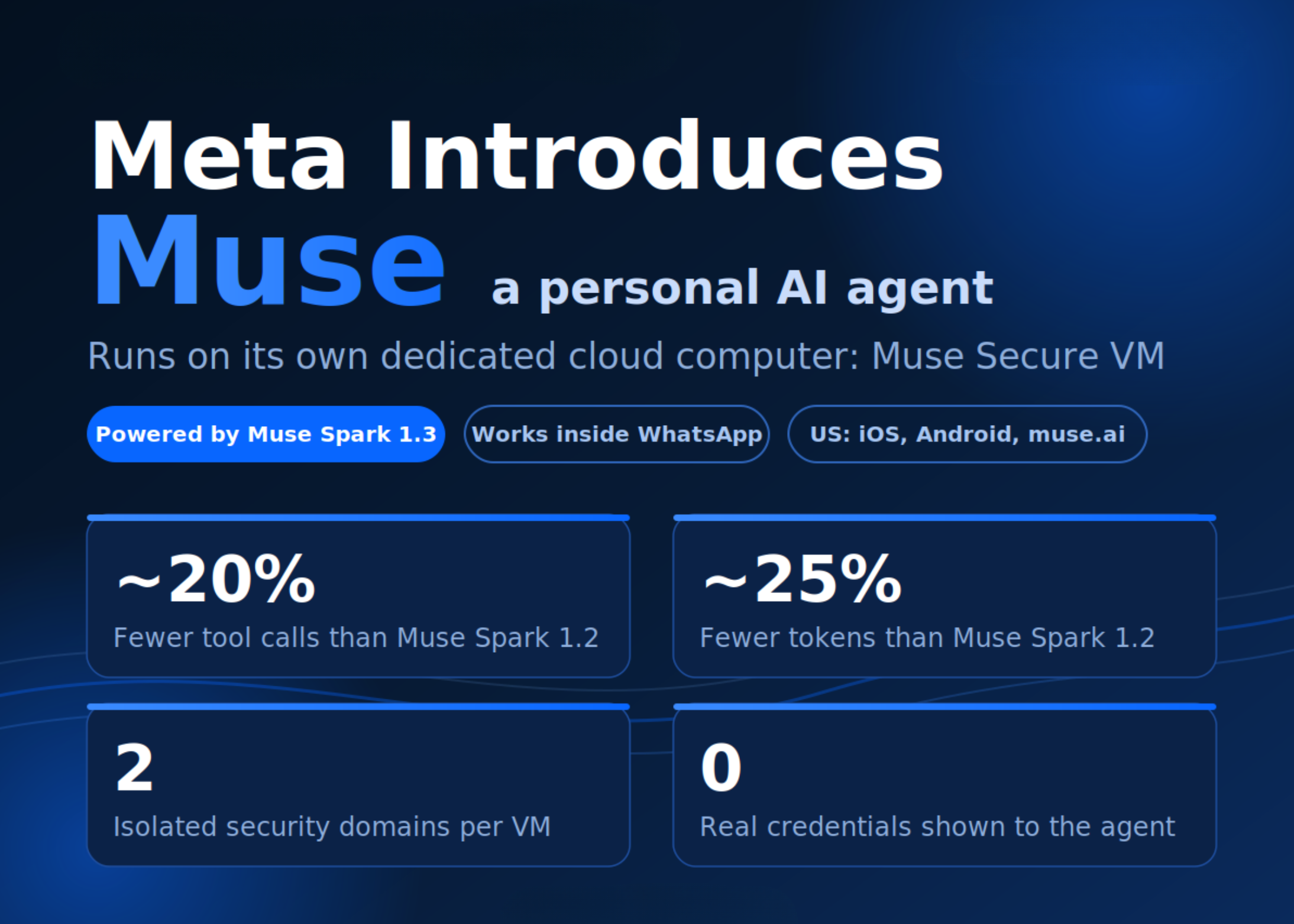
Meta Introduces Muse, a Personal AI Agent That Runs on Its...
The introduction of Muse enhances user interaction with AI agents by enabling proactive task management, which could significantly change how individuals manage daily tasks and commitments.
- Meta has launched Muse, a personal AI agent capable of performing tasks such as sending emails and booking travel.
- Each user of Muse has a dedicated cloud virtual machine that ensures the agent's operations are secure and isolated.
- The Muse AI is built on Muse Spark 1.3, which shows improved efficiency over its predecessor in handling complex tasks.
Meta is a technology company focusing on social media and AI development. Muse represents a shift towards more interactive AI agents that actively assist users. The notable security features of Muse offer substantial protections against credential theft.
Read the original ↗
Wint Raises $36 Million Series D to Scale AI-Powered Water Intelligence Globally
The funding enables Wint to enhance its AI-driven water management platform, potentially reducing costly water damage and improving resource efficiency across various sectors.
- Wint raised $36 million in Series D funding to scale its AI-powered water intelligence platform.
- The funding will accelerate product development and expand Wint's presence in global markets.
- Wint's technology integrates connected meters and AI to analyze water flow in real time, helping to identify inefficiencies and prevent leaks.
Wint focuses on AI-driven solutions for water management, targeting issues like leaks and inefficiencies in building water systems. Previously, the company raised substantial funding in Series C and B rounds, reflecting ongoing interest in water intelligence technology. Future developments will likely center on expanding their market reach and integrating further smart-building technologies.
Read the original ↗
Euno Raises $23M Series A to Build a Context Layer for Enterprise AI Agents
Euno's funding highlights a growing recognition in enterprise AI of the need for contextual knowledge, which could improve the reliability of AI agents in complex data environments.
- Euno raised $23 million in Series A funding to enhance its enterprise AI context platform.
- The funding round was led by N47, with participation from existing investor 10D and several technology founders and executives.
- Euno plans to use the funds to expand sales and marketing, and invest in AI research, while doubling its workforce by year-end.
- The platform aims to provide AI agents with authoritative information by mapping data lineage and organizational context, addressing limitations of existing models.
- Euno has already established partnerships with companies like AlphaSense and Zayo Group to implement its context infrastructure.
Euno, founded in 2023, develops an AI context platform aimed at integrating organizational knowledge into machine-readable formats. This approach addresses challenges faced by AI agents in understanding which information is reliable in complex business data. Future developments may focus on enhancing its platform and expanding customer relationships.
Read the original ↗
Beep Closes Series B Led by Mobileye to Scale Autonomous Mobility
The funding round positions Beep to scale its autonomous mobility solutions, responding to growing demand for innovative public transit models in the U.S.
- Beep raised funding in a Series B round led by Mobileye, totaling approximately $130 million to expand its services.
- The investment aims to enhance Beep's mobility-as-a-service offerings and support deployment of its AI-driven AutonomOS platform.
- Beep operates the nation's first fully autonomous public transportation system in Jacksonville, Florida, under a five-year contract.
Beep, based in Lake Nona, Florida, specializes in autonomous mobility solutions, including public transport services. Following previous funding in 2025, the company has been expanding its autonomous service projects across various U.S. markets.
Read the original ↗
CloudNC Raises $20 Million to Expand AI Tools for Precision Machining
The funding will enable CloudNC to enhance its AI tools, potentially transforming precision machining practices and improving efficiency across the manufacturing sector.
- CloudNC has secured $20 million in new funding led by Nimble Ventures to expand AI tools in precision manufacturing.
- The company’s existing CAM Assist platform will see wider adoption and new product development, including an AI quoting system named Quote Agent.
- CloudNC's software currently supports over 1,000 machine shops worldwide, enhancing production through automation of complex machining tasks.
CloudNC specializes in using AI to automate processes in precision manufacturing, previously raising $45 million to develop autonomous manufacturing technology. The company’s CAM Assist tool automates significant aspects of computer-aided manufacturing programming, while Quote Agent aims to streamline job quoting processes for machine shops.
Read the original ↗
Harvey Acquires Guardrails AI, Its Fourth Acquisition of 2026
The acquisition enhances Harvey's capabilities in ensuring AI agent reliability, which is crucial for managing high-stakes tasks in legal work.
- Harvey acquired Guardrails AI, a San Francisco-based AI security platform, on September 9, 2026, marking its fourth acquisition of the year.
- Guardrails AI specializes in AI reliability and simulation infrastructure, helping teams manage agent behavior and risks in real time.
- The acquisition is intended to strengthen the guardrails and evaluations Harvey builds into its platform for legal AI professionals.
Harvey is a legal AI company that focuses on improving the reliability of AI agents used in professional environments. In 2026, it has actively pursued acquisitions to enhance its technological capabilities, including the recent acquisition of Benchmark, an infrastructure platform for asset management. Following this acquisition, it's important to observe how the integration of Guardrails impacts Harvey's operations in legal AI.
Read the original ↗
Qualtrics Announces XM Data & AI Platform for Experience Management
The release of Qualtrics' XM Data & AI Platform could significantly impact how businesses manage customer experiences, potentially affecting up to $3 trillion in sales at risk from poor customer interactions.
- Qualtrics announced the XM Data & AI Platform, designed to simulate outcomes and predict individual customer actions, which will launch in 2027.
- The platform is supported by a $6.75 billion acquisition of Press Ganey Forsta, enhancing its healthcare data capabilities.
- Qualtrics emphasizes that the platform addresses an 'Experience Gap' between customer expectations and business deliverables.
Qualtrics, known for creating the experience management category, aims to enhance customer interactions through AI-driven insights. The platform integrates extensive data from its own history and newly acquired healthcare data to optimize customer experience management.
Read the original ↗
A Young Researcher Quits Anthropic, Says AI is Out of Control
Coxon’s resignation highlights growing concerns about the safety and control of AI, underscoring potential threats to humanity as the industry evolves rapidly.
- Jacob Coxon, a 27-year-old researcher at Anthropic, resigned on September 8, expressing fears that AI is becoming unmanageable.
- Coxon believes that AI companies are racing towards dangerous self-improvement, risking human safety and control.
- Evan Hubinger, an Anthropic employee, echoed Coxon's concerns, suggesting a significant chance of catastrophic outcomes from AI in the next decade.
- Both Coxon and Hubinger criticize the competitive nature of the AI industry, which they believe compromises safety efforts.
- Coxon’s departure draws attention to the conflicting goals of rapid AI advancement and the need for responsible oversight.
Anthropic, a leading AI company, was founded with an emphasis on safety in AI development. Recent departures of employees citing ethical concerns reflect mounting unease within the industry about the impacts of AI growth. As Anthropic prepares for a public offering, the tension between innovation and safety is expected to intensify.
Read the original ↗
LSD, Psilocybin, and 2C-B Each Leave a Distinct Fingerprint on the Brain, New Study Finds
Understanding how different psychedelics uniquely impact brain activity may inform their potential medical applications for mental health disorders such as depression and PTSD.
- A study found that LSD, psilocybin, and 2C-B produce distinct patterns of brain activity in rats, highlighting their different effects.
- Research indicates that these changes in brain activity persist even after the drugs have worn off, with each drug affecting different brain regions.
- The study was conducted by researchers at the University of Southern Denmark and published in Nature Communications, examining psychedelics side by side.
LSD, psilocybin, and 2C-B are classified as psychedelics with rising interest in their therapeutic use. Previous research often examined these drugs individually, leaving gaps in understanding their comparative effects. Continued investigation into their unique brain impacts may suggest varied applications in treating mental health disorders.
Read the original ↗
How AI plotted an interstellar journey to Alpha Centauri
The Fermi Explorer Mission's planned launch to Alpha Centauri could redefine humanity's approach to interstellar travel and advance our understanding of intelligent life in the galaxy.
- The Fermi Explorer Mission aims to send a spacecraft to Alpha Centauri by the end of 2029, following a trajectory identified by an AI system.
- This journey, expected to take up to 80,000 years, will utilize solar power and innovative orbital maneuvers to minimize spacecraft weight.
- The mission has a budget of $15 million and includes carrying a Golden Record and scientific payloads measuring at least one kilogram.
- The AI system, Get Physics Done, generated a novel trajectory suggestion, refining known orbital maneuvers to optimize energy use during the journey.
The Fermi Explorer Mission is a nonprofit organization focused on interstellar exploration, building on previous efforts like Breakthrough Starshot, which sought to reach Alpha Centauri in a shorter timeframe. With the advent of advanced AI, new approaches to interstellar missions are being explored, raising questions about intelligent life and the challenges of deep space travel.
Read the original ↗