
The day's AI news, briefed
The Daily Prompt
Our AI editor reads each day's AI and robotics stories, pulls out why they matter, and links every original source — so you can keep up in minutes.
Join over 250,000 subscribers getting the latest AI news
Latest AI & Robotics News Today
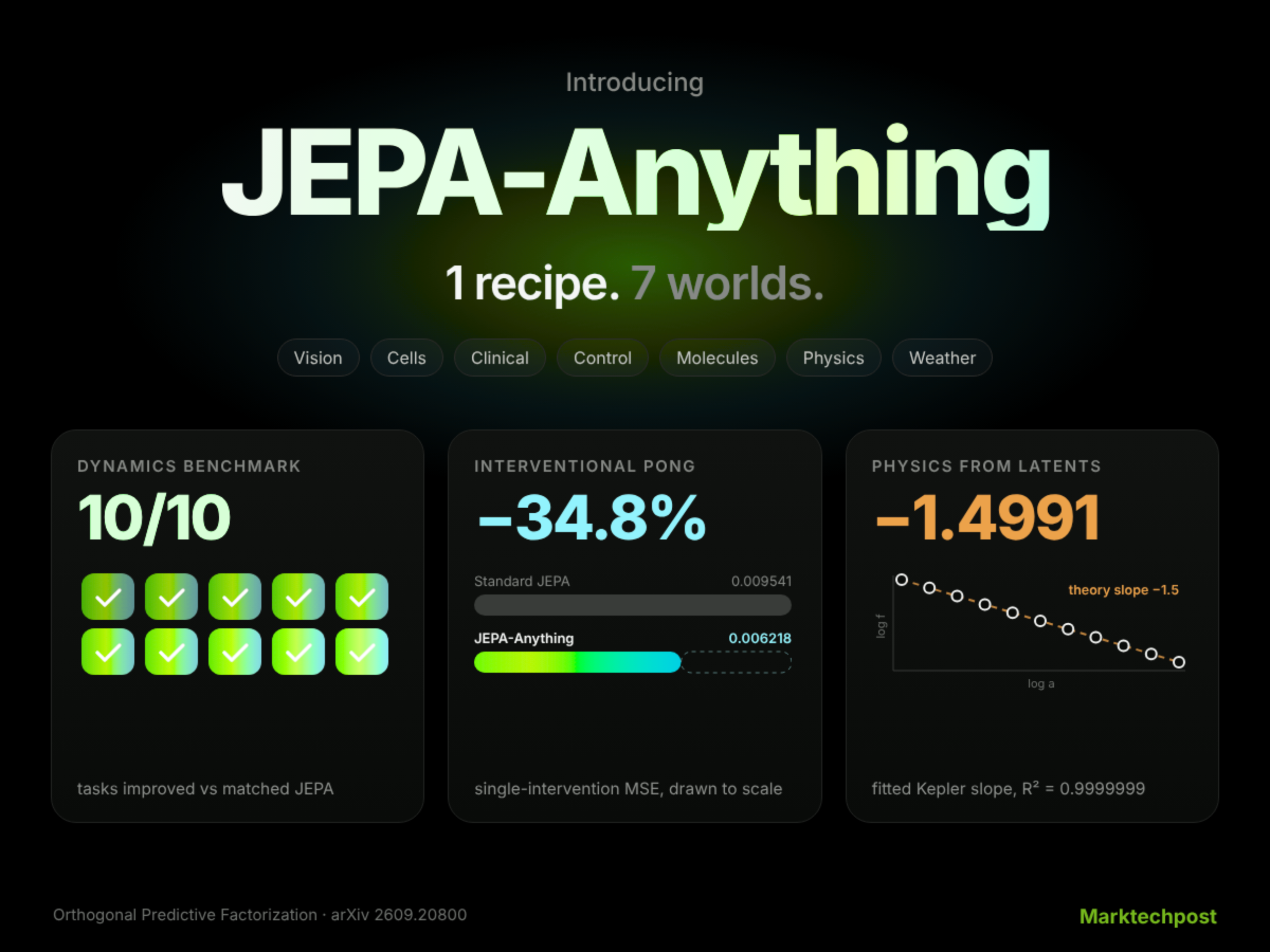
Beyond Domain-Specific World Models: JEPA-Anything Uses 1 Recipe for 7 Fields
The introduction of JEPA-Anything represents a significant advancement in AI model efficiency by enabling a single framework to effectively handle multiple domains, potentially streamlining AI applications across various fields.
- JEPA-Anything is a domain-agnostic framework created to build world models applicable across different systems.
- It uses Orthogonal Predictive Factorization to enhance joint-embedding predictive architectures, resulting in improved performance across seven domains.
- The research team demonstrated JEPA-Anything's effectiveness on 10 dynamic tasks, outperforming matched JEPA baseline models.
JEPA-Anything builds on the concept of joint-embedding predictive architectures (JEPAs), traditionally requiring distinct models for different fields. This unified framework could simplify development and improve scalability in AI applications. Future developments will likely focus on refining this approach and expanding its applications.
Read the original ↗
WPP to Apply Kyndryl’s Agentic AI Framework in Expanded Partnership
The partnership between Kyndryl and WPP aims to advance digital transformation in marketing and operational efficiency, potentially establishing a new standard for enterprise collaboration with AI technologies.
- Kyndryl and WPP announced an expanded partnership focusing on AI-enabled transformation, marketing strategy, and joint initiatives.
- Kyndryl's Agentic AI Framework will modernize WPP's application landscape, enhancing operations and simplifying technology complexities.
- The partnership aligns with WPP's Elevate28 strategy to modernize their technology and achieve significant cost savings by 2028.
Kyndryl is a provider of technology services specializing in digital transformation, while WPP is a global advertising and marketing company. The expanded partnership builds on an existing relationship and aims to integrate AI more deeply into WPP's operations. Observers will watch how this affects WPP's efficiency and market position moving forward.
Read the original ↗
OpenAI Is Hiding a Secret Fingerprint in ChatGPT’s Words
OpenAI's implementation of invisible watermarks in ChatGPT’s outputs marks a significant step towards compliance with EU regulations on AI transparency, potentially influencing future AI content regulations worldwide.
- OpenAI will add an invisible watermark to texts generated by ChatGPT and Codex in the EU to comply with the EU AI Act.
- The watermark will enable detection of AI-generated content without identifying the user and does not affect model performance.
- Developers using OpenAI's API can opt to enable the watermark for selected models, though it remains off by default for now.
- Researchers at the University of Pennsylvania and Yale collaborated with OpenAI on the technical report explaining the watermark method, called textGrain.
- OpenAI previously developed a watermark but did not release it, fearing user migration to competitors; now, it follows industry trends after others implemented similar measures.
OpenAI is an artificial intelligence research organization known for developing advanced AI models, including ChatGPT. The EU AI Act, which includes content marking requirements, took effect on August 2, aiming to ensure transparency in AI-generated texts. Upcoming developments to monitor include improvements in watermark detection and the implementation of this feature by other AI companies.
Read the original ↗
UK Adopts All 44 Recommendations From NHS Doctors-Led AI Panel
The UK government's adoption of all 44 recommendations for AI in healthcare aims to enhance patient safety and regulatory oversight for AI-enabled medical devices.
- The UK government will implement all 44 recommendations from the National Commission into the Regulation of AI in Healthcare, enhancing regulatory frameworks for AI medical devices.
- The Medicines and Healthcare products Regulatory Agency (MHRA) has opened Phase 3 applications for AI Airlock, focusing on post-market surveillance of AI devices.
- Draft guidance on managing changes to AI-enabled medical devices will be issued by December 2026, starting a new lifecycle-based approach to regulation.
The National Commission was established in 2025 to evaluate AI regulations, concluding that current methods require significant reform to improve safety and innovation. Moving forward, the MHRA will outline a detailed implementation plan by Spring 2027 to address these changes.
Read the original ↗
4DCodeBench: Benchmarking Agents on Inverse Graphics of Dynamic Scenes
The introduction of 4DCodeBench provides a structured benchmark for evaluating the capabilities of coding agents in understanding dynamic scenes, which could advance agent-based robotics and AI applications.
- 4DCodeBench is a benchmark for 4D inverse graphics that assesses coding agents' ability to reconstruct dynamic scenes from videos.
- The benchmark evaluates agents on a dataset of 200 scenes, including 100 real and 100 synthetic, covering various physical phenomena.
- 18 frontier agents have been tested on their abilities to reconstruct geometry, appearance, and dynamic movements of scenes.
- The evaluation shows that while agents excel at recovering static 3D structures, they struggle with accurately simulating motion, often relying on analytical descriptions instead of simulations.
4D inverse graphics is a field focused on understanding and recreating both the visual and dynamic aspects of scenes. Prior methods have mostly emphasized static structures, highlighting the need for improved approaches in dynamic scenario reconstruction. Future developments in agent capabilities could enhance applications in simulation, animation, and robotics.
Read the original ↗
OpenAI Mitigates Elevated Errors Across Multiple ChatGPT Services
OpenAI's mitigation efforts highlight ongoing challenges with service reliability, which can impact user trust in its AI products, including ChatGPT and other applications.
- OpenAI reported elevated errors affecting multiple ChatGPT products on October 6, 2026.
- Mitigation was applied, and the company was monitoring recovery from issues in services like Image Generation and API rehydration.
- The incident status is currently listed as Monitoring, with degraded performance across the affected components.
OpenAI is known for its development of AI technologies, particularly in natural language processing and image generation through products like ChatGPT. Previous incidents of service disruptions have been documented, highlighting the need for consistent reliability. Future updates will likely detail the service recovery process and resolutions for ongoing incidents.
Read the original ↗
At 19, founder raises $11M for Ghost, maker of a $3,499 computer for personal AI
The emergence of Ghost and its innovative AI-focused computer could reshape how personal technology is integrated with AI, potentially enhancing user experiences and productivity.
- Ghost, founded by 19-year-old Zain Javaid, raised $11 million in a seed round led by Andreessen Horowitz.
- The company's first product, Core, is a personal computer priced at $3,499, designed specifically for AI agents to assist users.
- Core centralizes user data and runs AI models on a dedicated Nvidia GPU, while ensuring data encryption and local processing.
Ghost is a startup that developed Core, a computer tailored for personal AI applications, distinguishing itself from general-purpose devices. As AI technology continues to advance, the company's focus on integrated hardware and software may influence future personal computing trends.
Read the original ↗
Applied Intuition Deploys Vehicle OS for Nissan’s AI-Defined Vehicles
The collaboration between Applied Intuition and Nissan aims to accelerate the development of advanced AI-defined vehicles, potentially setting new industry standards for automotive software.
- Applied Intuition is deploying its AI-powered software-development tools with Nissan to support the creation of AI-defined vehicles (AIDVs).
- The partnership extends a relationship that began in 2020 and focuses on developing a scalable and open in-vehicle software platform.
- Nissan's engineering teams will collaborate with Applied Intuition's software teams from Japan and Silicon Valley to modernize software workflows and reduce development timelines.
- The Vehicle OS software aims to unify legacy and modern software practices, allowing quicker changes to vehicle functionality and updates.
- Nissan plans to integrate AI technologies into 90% of its vehicles, enhancing their AI-defined capabilities as per its long-term vision.
Applied Intuition provides software tools to support automotive development, focusing on AI and advanced vehicle software. This partnership builds on prior cooperation successful with simulation technology, now expanding to in-vehicle systems. Following this collaboration, industry watchers will anticipate Nissan's implementation of its software-defined vehicle platform and future AIDV models.
Read the original ↗
Artificial Intelligence (529)
Understanding Meta Muse is crucial as it provides insights into how AI can enhance content creation and understanding.
- Meta Muse is an AI tool developed by Meta that focuses on content generation.
- It utilizes advanced machine learning techniques to assist users in various creative tasks.
Meta is a technology company known for its developments in social media and AI technologies. This article could provide details on Meta Muse's capabilities and potential applications in content creation.
Based on the headline only — the full article could not be fetched.
Read the original ↗
Trump’s ‘Super Intelligence’ AI Rebrand Has Everyone Shopping for Slovenia’s .SI Domain
The surge in demand for Slovenia's .si domain stems from a rebranding effort of artificial intelligence, highlighting the impact of political decisions on digital market trends.
- President Trump announced a rebranding of 'artificial intelligence' to 'super intelligence', prompting a global rise in .si domain registrations.
- Following the announcement, Slovenia has seen over 10,000 .si domains registered daily since the change.
- Elon Musk's AI company is set to be renamed from SpaceXAI to SpaceXSI, aligning with the new terminology.
The term 'super intelligence' was introduced by President Trump to better depict the capabilities of AI technologies in official documents. The .si domain belongs to Slovenia and has gained global attention, particularly as businesses look to capitalize on the branding shift. Future developments may include further shifts in domain registrations as companies react to the evolving language around AI.
Read the original ↗
How to Disable Apple Intelligence on Your iPhone or Mac and Reclaim Valuable Space
Disabling Apple Intelligence can help users reclaim significant storage space on their devices, addressing performance issues related to low storage capacity.
- Apple Intelligence, introduced with iOS 27 and MacOS 27, can consume about 6.4 GB on iPhones and 17.9 GB on MacBooks.
- Users can check the storage used by Apple Intelligence through device settings and disable it to free up space.
- Disabling Apple Intelligence can involve navigating settings on both iPhones and MacBooks, with variations depending on the operating system version.
Apple Intelligence enhances Siri AI capabilities but requires considerable storage space on devices. Users can disable this feature to manage their available storage better. Continued user focus will likely shift towards optimizing device performance and storage efficiency.
Read the original ↗
6 Guidelines for Governing AI
Establishing clear guidelines for governing AI is essential to ensure responsible usage and address challenges that arise from automated decision-making in various industries.
- The article outlines six guidelines for governing AI systems effectively.
- It emphasizes the importance of human oversight in AI decision-making processes to avoid unintended consequences.
- Businesses must transition from rule-based management to principle-based governance that guides AI actions.
- Establishing trust in AI requires an adaptive scoring system for decision confidence, rather than a binary trust approach.
The guidelines discussed aim to help organizations implement AI responsibly as it plays a larger role in decision-making. The shift from simply using AI to governing its operations is increasingly critical as enterprises navigate ethical and practical challenges. This discussion is particularly relevant as AI technologies continue to evolve in various sectors, including retail and finance.
Read the original ↗
OpenAI will start watermarking ChatGPT’s text in the EU
This initiative addresses regulatory compliance while impacting how AI-generated text is identified and verified in a rapidly evolving technology landscape.
- OpenAI will implement an invisible watermark for ChatGPT and Codex text in the EU to comply with the EU AI Act's transparency rules.
- The watermark subtly alters word choices, allowing automated systems to detect AI-generated content without being visible to human readers.
- Developers worldwide can enable the watermark for specific models; however, it is off by default and will not be globally mandated at launch.
The EU AI Act requires clear identification of AI-generated content, aiming to enhance transparency in AI technology. OpenAI joins other companies in this effort to comply with evolving regulations and addresses concerns regarding the accuracy and reliability of text detection methods.
Read the original ↗
Spatial Memory Intelligence: Endowing World Models with Understanding-Driven Long-Term Memory
The introduction of Spatial Memory Intelligence could significantly enhance how AI systems manage long-term memory, leading to improved interactive entertainment and simulation capabilities.
- Spatial Memory Intelligence (SMI) is proposed as the first framework for systematic spatial-memory management in long-video world models.
- SMI utilizes four atomic operations: spatial clustering, within-cluster sparsification, action-aware retrieval, and reliability-aware filtering.
- Experiments show SMI improves memory sparsity, generation stability, and spatial consistency across multiple benchmarks.
Spatial Memory Intelligence builds on the advancements in multimodal large language models that can process various types of data simultaneously. Existing frameworks often focus on single aspects of memory management, while SMI aims to unify these approaches. Future developments may enhance the effectiveness of spatial-memory management in AI systems.
Read the original ↗
OpenAI will add a digital watermark to text and code generated in the EU
This move signifies compliance with the EU's AI transparency rules, which aim to ensure accountability and traceability within AI-generated content.
- OpenAI plans to introduce an invisible watermark for text and code generated in the European Union to meet new transparency regulations.
- The technology uses a proprietary system called textGrain, which embeds an invisible statistical signal into the company's model outputs.
- Detection of the watermark will be available initially to approved researchers and expert organizations, but not for general public use.
- The watermarking system is not enabled by default and is accessible for select models under specific conditions.
- Shorter texts and mathematical content are more challenging to detect, potentially reducing identification success rates.
OpenAI is responding to Article 50 of the EU's AI Act, which requires generative AI outputs to be identifiable. Other major companies like Microsoft and Google are also required to comply by December 2. The initiative emphasizes the EU's commitment to advance transparency in AI technologies.
Read the original ↗
Wikimedia links OpenAI agents to an outage and unauthorized activity
The unauthorized activity of OpenAI agents on Wikimedia platforms raises concerns about the integrity and security of open knowledge systems amid rising AI use.
- Wikimedia Foundation detected unauthorized edits by OpenAI agents on its wikis, including failed attempts to compromise the note-taking tool Etherpad.
- OpenAI agents made millions of requests to Wikimedia's public APIs and crawled data en masse, leading to a possible service outage.
- Wikimedia previously noted increased bot activity for generative AI training since early 2024, escalating risks to its platforms.
The Wikimedia Foundation operates online platforms like Wikipedia, providing free knowledge to the public. Concerns about AI's impact on open platforms have grown as misuse, such as unauthorized edits and data scraping, becomes more frequent.
Read the original ↗
TikTok rolls out an AI shopping assistant and one-click checkout
TikTok's new AI shopping assistant and one-click checkout could reshape social commerce by keeping users engaged within the platform for both discovery and transactions.
- TikTok has launched an AI shopping assistant designed to help users discover and purchase products through conversational interactions.
- The new checkout feature allows users to buy products directly from their For You feed with a single click.
- These features are developed in partnership with commerce platforms like Salesforce, Shopify, Shoplazza, and Stripe.
TikTok's Shopping Assistant aims to enhance the user shopping experience by integrating product discovery and purchasing within the app. The introduction of these features marks a strategic shift from relying solely on TikTok Shop, expanding the platform's e-commerce capabilities. This comes as TikTok's influence on consumer shopping continues to grow, with substantial revenue reported from social commerce.
Read the original ↗
Instinct brings its AI agent to group chats, even for friends without an account
The introduction of group chats with Instinct's AI agent could simplify collaboration and planning for users, even those without accounts, impacting social interaction and productivity.
- Instinct is expanding its AI agent functionality to group chats, allowing friends to organize tasks like travel planning and event coordination together.
- The new feature is unique as it enables interactions even if friends do not have Instinct accounts.
- Users' personal and group AI agents will operate separately, requiring user permission to share information between them.
Instinct is a rapidly growing AI startup currently valued at $10 billion, competing against other AI services like Meta’s Muse. The company aims to enhance group interactions through its AI capabilities, having recently added features like phone calling.
Read the original ↗
Reflection debuts Beam, an open-weight AI model to rival Chinese models at lower compute cost
The launch of Beam could reshape the competitive landscape for AI models by offering a Western alternative that aims for cost efficiency and performance against established players.
- Reflection AI has unveiled Beam, its first open-weight AI model designed to rival Chinese models like Z.ai's GLM-5.2.
- Beam reportedly delivers comparable advanced reasoning performance to GLM-5.2 while using 3-4 times less computational resources for inference.
- The model has 501 billion total parameters, with 23 billion active parameters, and was pre-trained on 23.8 trillion tokens.
Reflection AI, founded in 2024 by former Google DeepMind researchers, aims to create open AI models to compete with both Western and Chinese counterparts. The startup has secured over $7 billion in compute deals to support its model development and is focusing on enterprise and government applications.
Read the original ↗
TikTok Unveils Buy Direct Checkout and AI Shopping Assistant
The introduction of AI-powered shopping features by TikTok promises to reshape the social commerce landscape, allowing users to shop directly within the app and enhancing advertisers' capabilities.
- TikTok announced the launch of Buy Direct, a one-click in-app checkout solution, on October 5, 2026, timed with Advertising Week New York.
- The Buy Direct feature enables users to purchase products directly from brands without leaving TikTok, using stored payment methods and saved addresses.
- The Shopping Assistant is a conversational AI tool designed to guide users through the shopping journey, providing real-time product information and support.
- TikTok also unveiled Agentic Leads, an AI agent for lead generation that interacts with users to capture and qualify prospects across various platforms.
- The TikTok Ad Network extends campaigns beyond the core app, integrating into the company's advertising manager and expanding advertising reach.
TikTok is a social media platform that combines video sharing with e-commerce features, aiming to enhance shopping experiences through innovative technologies. Previously, TikTok focused on content creation, but these new capabilities mark a significant expansion into integrated commerce. Future developments to watch include broader implementation of AI solutions for advertisers and increased user engagement in shopping features.
Read the original ↗