
The day's AI news, briefed
The Daily Prompt
Our AI editor reads each day's AI and robotics stories, pulls out why they matter, and links every original source — so you can keep up in minutes.
Join over 250,000 subscribers getting the latest AI news
Latest AI & Robotics News Today

Artificial Intelligence (478)
Access to free educational resources in artificial intelligence can enhance skills for beginners and contribute to a more knowledgeable workforce in the field.
- Five free courses are available for individuals looking to transition from AI beginners to practitioners.
- These resources aim to provide foundational knowledge and practical skills in artificial intelligence.
Artificial intelligence (AI) encompasses computer systems designed to perform tasks that typically require human intelligence. With the rapid advancement of AI technologies, educational opportunities are crucial for skill development. Interest in AI career paths continues to grow, prompting the need for accessible training options.
Based on the headline only — the full article could not be fetched.
Read the original ↗
China’s Low-Priced Z.ai Model Is Exposing Costly Coder Habits
Z.ai's GLM 5.2 could disrupt established coding practices, revealing a trend where software engineers prioritize model power over cost, potentially influencing AI usage and budgeting in programming.
- Z.ai's GLM 5.2, released on June 16, is a large language model designed for coding that costs significantly less than U.S. competitors.
- GLM 5.2's API charges $4.40 per million output tokens, less than one-fifth the price of Anthropic's Opus 4.8 model.
- Despite competitive pricing, many engineers still prefer powerful models, leading to unchecked project costs and reliance on expensive tools.
- GLM 5.2 performs comparably to U.S. models in certain benchmarks but lags in some complex coding tasks, according to testing results.
- The model's open-weights format allows organizations to self-host and mitigate concerns over using AI with foreign infrastructure.
Z.ai is a Beijing-based lab that developed GLM 5.2, a large language model aimed at enhancing coding efficiency. The model contributes to growing competition with U.S. AI firms, which traditionally led in AI advancements. Industry observers will be monitoring how GLM 5.2 affects pricing and development practices in software engineering.
Read the original ↗
AI Cheaply Exploits Bugs Risk Models Ignore, Report Says
The ease and low cost of AI-generated exploits could undermine the security of software systems, prompting a reevaluation of how vulnerabilities are prioritized and managed.
- Quantro Security's autonomous agents turned 2,183 disclosed software vulnerabilities into verified exploits at a median cost of $2.83 and within roughly 11 minutes.
- 73% of the vulnerabilities the AI exploited had a low Exploit Prediction Scoring System score of below 0.25, leading many programs to overlook them for patching.
- 89% of the AI-exploitable flaws did not appear in the U.S. cybersecurity agency's Known Exploited Vulnerabilities catalog, suggesting they may remain unaddressed.
Quantro Security, founded by veterans from well-known cybersecurity firms, provides an AI-driven vulnerability management platform. The company's report highlights the potential for AI to exploit vulnerabilities that traditional risk models deem safe, which may lead to higher risks in enterprise systems. Future developments to watch include the ongoing integration of AI in automated cyber exploitation.
Read the original ↗
Horizon3.ai Joins Anthropic’s Glasswing Vulnerability Hunt
This collaboration could enhance cybersecurity efforts by improving the ability to identify and address software vulnerabilities before they can be exploited by attackers.
- Horizon3.ai has joined Anthropic's Project Glasswing, aimed at enhancing cybersecurity through vulnerability hunting using the AI model Claude Mythos.
- Anthropic's program, launched in April, originally partnered with about 50 organizations, expanding to around 150 since, covering various critical sectors.
- Horizon3.ai's product NodeZero focuses on identifying exploitable vulnerabilities, reflecting the company's view that defenders learn from those who understand offensive tactics.
Anthropic's Project Glasswing is a cybersecurity initiative designed to utilize advanced AI for vulnerability detection. The program allows vetted organizations access to powerful AI tools to improve defense strategies. The focus is on not just discovering vulnerabilities but also on the efficient management and patching of these issues.
Read the original ↗
KPMG Reaches the Top of OpenAI’s Partner Network
KPMG's designation as an OpenAI Elite Partner underscores its significant role in AI deployment and may influence enterprise AI strategy across multiple sectors.
- KPMG has been named an OpenAI Elite Partner, the highest tier in the AI company's partner program.
- The firm developed OpenAI’s internal Supply Chain & Fulfillment Orchestration platform as its 'client-zero' deployment.
- KPMG aims to market its AI-deployment approach to enterprise clients using OpenAI as a reference customer.
- The Elite Partner designation reflects a broader trend in enterprise software towards integrating AI layers instead of replacing existing systems.
OpenAI's partner network, launched in June 2026, includes three tiers: Select, Advanced, and Elite. KPMG's appointment to the Elite tier indicates its expertise in AI practices, following similar designations for firms like Bain.
Read the original ↗
Judge approves Anthropic's record-breaking $1.5 billion settlement for AI copyright lawsuit
This settlement marks a significant legal precedent for copyright issues surrounding the use of authors' work in AI training, potentially influencing future AI development policies.
- A federal judge has approved Anthropic's $1.5 billion settlement in a copyright lawsuit filed by a group of authors.
- The lawsuit alleged that Anthropic used their pirated works to train its Claude language models.
- Authors expecting payouts are to receive approximately $3,000 per affected work, with Anthropic mandated to destroy the pirated books.
- Some authors opted out of the settlement to pursue individual lawsuits due to dissatisfaction with the payout.
Anthropic is an AI company that has developed Claude, a large language model. The lawsuit stemmed from allegations of copyright infringement involving the unauthorized use of authors' texts. Future cases may explore the complexities of fair use in AI training.
Read the original ↗
Bristol Myers Squibb buys Nvidia AI system for drug discovery
The acquisition of Nvidia's DGX SuperPOD will enhance Bristol Myers Squibb's AI capabilities, potentially accelerating drug discovery and development processes in the pharmaceutical industry.
- Bristol Myers Squibb is purchasing a DGX SuperPOD built on Nvidia's Vera Rubin architecture to enhance its drug discovery and development capabilities.
- The new infrastructure will comprise eight DGX Vera Rubin NVL72 systems for training proprietary models across its research programs.
- The company expects this system to reduce time in producing drug candidates for clinical trials by up to 50%.
- Bristol Myers Squibb will integrate this new system with its existing SuperPOD for a unified computing environment accessible globally.
- The acquisition supports improvements in AI applications for target identification and molecule optimization in drug development.
Bristol Myers Squibb is a global biopharmaceutical company focused on discovering, developing, and delivering innovative medicines. Previously, the company utilized an older Nvidia SuperPOD for AI applications in research. The integration of the new system aims to streamline research processes across the organization.
Read the original ↗
Gritt exits stealth with $34 million for robots to build solar plants—then, everything else
Gritt's advancement in robotic solutions for solar panel installation addresses labor shortages in construction while enhancing efficiency and safety, a critical need amid the renewable energy push.
- Gritt has secured $34 million in funding to develop robots for building solar plants.
- The company has deployed two robotic systems that can increase installation rates from 800 to up to 4,000 solar panels daily.
- Gritt aims to assist in the installation of 2.8 gigawatts of solar panels within the next 18 months, partnering with major U.S. power construction firms.
Gritt is a startup founded by roboticists aiming to automate construction tasks, particularly in solar energy. The company has gained funding to support the rise of AI models that enhance robotic capabilities in unstructured environments, and plans to expand its tasks beyond solar panel installation.
Read the original ↗
China Weighs Walling Off Its Best AI and Chip Designs
China's potential export controls on advanced AI and chip designs may impact global technology dynamics, affecting competition and access to these technologies worldwide.
- China's Ministry of Commerce is consulting major AI and chip companies on proposed export controls to keep advanced technologies from reaching Western markets.
- Proposed measures include restrictions on data used for training AI models and on foreign access to Chinese-designed semiconductor technologies.
- The controls aim to prevent foreign companies from acquiring important Chinese startups in the AI sector, following trends in US export regulations.
- The initiative reflects China's strategic shift to protect its technological advancements, mirroring similar actions taken by the US against China.
- Chinese open-weight AI models have become popular for their low cost, and restricting access may reduce competition in the AI landscape.
China has previously allowed its AI models to be openly shared and distributed, impacting global AI projects. With rising tensions in US-China relations, both countries are increasingly treating advanced AI and chip technologies as national assets. Observers should monitor the upcoming revision of China's export-control regulations for formal implementation of these proposed measures.
Read the original ↗
Chinese open-weight models are cheap. Washington is deciding what that costs.
The potential regulation of Chinese open-weight AI models may significantly impact procurement decisions globally, raising concerns about security and access to cutting-edge technology.
- Chinese open-weight models like Moonshot AI's Kimi K3, released on July 16, prompt new policy discussions in Washington regarding their safety and regulation.
- The U.S. government is considering federal procurement rules and export controls that could restrict the use of Chinese models among enterprises.
- Regulatory uncertainty around the use of open-weight models may affect their availability on major cloud platforms, influencing global access and pricing.
Open-weight AI models are those whose underlying code and data are freely available for use and modification. Recent discussions in the U.S. center on regulatory risks surrounding these models amidst increasing competition with Chinese firms like Moonshot AI. Watch for developments in U.S. policy as they will likely influence global enterprise AI strategies.
Read the original ↗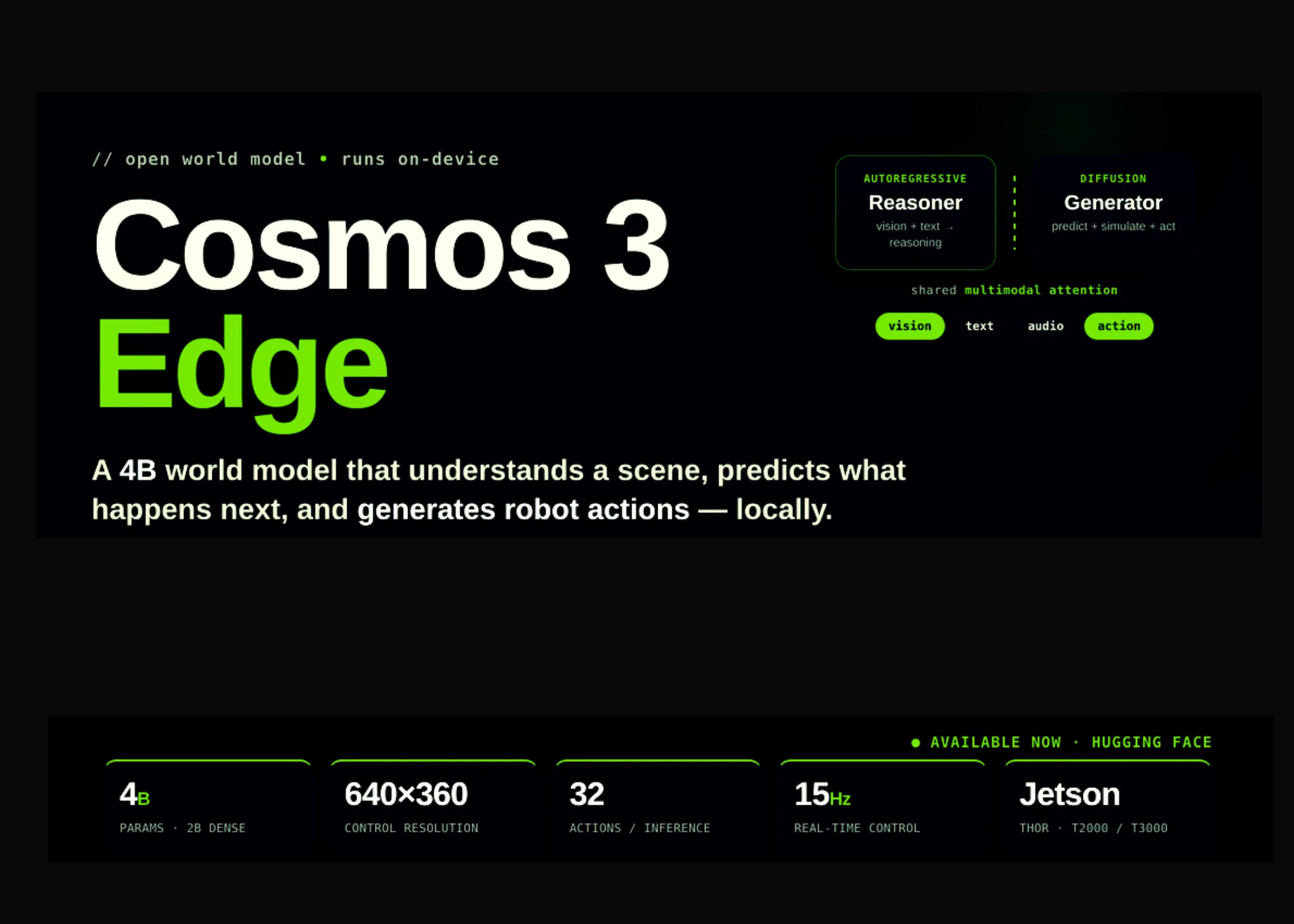
NVIDIA Releases Cosmos 3 Edge: A 4B-Parameter Open World Model That Reasons and Generates Robot Actions On-Device
NVIDIA's Cosmos 3 Edge model enhances robot autonomy and efficiency in environments requiring real-time decision-making, which is crucial for advancing robotics in various industries.
- NVIDIA has launched Cosmos 3 Edge, a 4-billion-parameter open world model designed for on-device operation.
- Cosmos 3 Edge enables robots to understand their surroundings and perform actions by reasoning in real time.
- The model was released on July 20 and aims to deliver data center-level performance while operating on memory-constrained systems.
- Cosmos 3 Edge can generate up to 32 actions per inference and achieve real-time control at a rate of 15 Hz.
- Developers can customize the model for specific tasks using the open Cosmos framework and fine-tune it on NVIDIA hardware.
Cosmos 3 Edge is part of NVIDIA's Cosmos 3 model line, which also includes larger models like Cosmos 3 Nano and Super. It addresses the need for powerful AI in edge devices across various sectors, such as manufacturing and healthcare. Companies are increasingly looking for efficient on-device AI solutions to process data locally and improve operational efficiency.
Read the original ↗
Elite Robots Pitches Its Cobots for Generalist AI’s GEN-1
The collaboration between Elite Robots and Generalist AI highlights the strategic importance of partnerships in the evolving landscape of industrial automation and robotics.
- Elite Robots, a Chinese manufacturer of collaborative robots, announced on July 21, 2026, that it collaborated with the U.S. startup Generalist AI to supply cobot arms for its GEN-1 robotics model.
- Generalist AI’s GEN-1 was introduced in April 2026 and is designed to perform various dexterous tasks, achieving a 99% success rate compared to its previous model.
- Elite's cobots have been deployed across more than 40 countries, with significant clients including Toyota and Volkswagen, and are claimed to have a 100,000-hour mean time between failures.
Elite Robots, founded in 2016 and based in Shanghai, specializes in collaborative robots designed to work alongside humans. Generalist AI, established in 2024 by former Google DeepMind researchers, develops foundation models that aim to enhance robotic capabilities across various hardware platforms. Industry observers will be watching how this partnership shapes the landscape of industrial automation as models like GEN-1 gain traction.
Read the original ↗
TorchUMM: A Unified Multimodal Model Codebase for Evaluation, Analysis, and Post-training
TorchUMM's unified codebase can enhance the evaluation and development of multimodal models, improving their effectiveness in real-world applications across diverse tasks.
- TorchUMM is a new unified codebase for evaluating multimodal models that addresses the challenges of diverse architectures and training paradigms.
- It supports various tasks including multimodal understanding, generation, and editing, using established and novel datasets for comprehensive benchmarking.
- The framework provides standardized protocols that enable fair and reproducible comparisons among different multimodal models.
Unified multimodal models (UMMs) are designed to understand and generate content across different formats, such as text and images. Previously, evaluating these models was complicated due to differing architectures and methodologies. TorchUMM simplifies this process by creating a cohesive evaluation framework, setting a standard for future developments in UMMs.
Read the original ↗
Idemitsu to Fuel a 600 MW Texas AI Data Center Campus
The development of a large-scale data center in Texas with independent energy supply could expedite AI computing capabilities in a market faced with power supply constraints.
- Hedgehog USA has signed a long-term energy supply agreement with Idemitsu for a planned 600 MW data center campus in Navarro County, Texas.
- The project is designed to run on natural gas from onsite generators, bypassing delays from the public electric grid.
- The deal lacks an anchor tenant, interconnection agreement, construction permit, and financial terms, highlighting uncertainties around the project.
- The Texas data center market faces significant demand, with over 438 gigawatts of requests largely from data centers, outpacing grid capabilities and necessitating faster energy solutions.
- Idemitsu aims to establish its presence in the U.S. data center energy market after previously signing a similar deal with Overwatch Capital.
Idemitsu is a major Japanese energy company expanding into the U.S. data center market, focusing on natural gas supply. The Texas data center landscape is dealing with a surge in demand for energy, making speedy energy generation solutions critical. Future developments will hinge on the successful establishment of necessary infrastructure for the planned data center.
Read the original ↗
OpenAI Builds Its First Commercial Team in Israel
OpenAI's establishment of a commercial team in Israel directly targets one of the fastest-growing markets for AI adoption, aiming to convert extensive AI usage into enterprise contracts.
- OpenAI is opening its first commercial team in Israel to engage local enterprise customers.
- The team will focus on business development rather than research, marking a shift in OpenAI's market approach.
- A senior executive from Amazon Web Services in Israel has been hired to oversee operations in Europe, the Middle East, and Africa, primarily focusing on Israel.
OpenAI has previously engaged with the Israeli market remotely. Israel is a leader in generative AI adoption and AI talent concentration. OpenAI's strategy aligns with its global expansion efforts that emphasize sales before engineering.
Read the original ↗
Anthropic to Pay $1.5 Billion in Settlement to Book Authors
This settlement exemplifies the ongoing tensions between copyright laws and AI development, highlighting challenges faced by tech companies in training models on copyrighted material.
- Anthropic will pay $1.5 billion in a settlement to authors and publishers after a copyright lawsuit.
- The lawsuit addressed whether Anthropic violated copyright laws by using books to train its AI models.
- The settlement covers an estimated 500,000 works, with each work valued at $3,000 for authors and publishers.
- A federal judge ruled that while training on copyrighted books may qualify as fair use, Anthropic's method of downloading pirated books was illegal.
Anthropic is an AI company known for developing its AI model, Claude. This lawsuit marks a significant moment in copyright history and raises questions about fair use in AI training. Similar legal challenges are ongoing in the AI sector, particularly against other tech companies like Google and Meta.
Read the original ↗
Anthropic’s landmark $1.5B copyright settlement is approved
The approval of the $1.5 billion settlement impacts the ongoing legal landscape regarding the use of copyrighted materials in training AI models, influencing future cases and industry practices.
- A federal judge approved a $1.5 billion settlement between Anthropic and authors over copyright infringement claims.
- The settlement follows findings that Anthropic illegally downloaded copyrighted books from pirate sites, while also purchasing some legally.
- Although seen as a historic settlement for U.S. copyright law, many authors view it as insufficient since it did not clarify the legality of training AI on copyrighted texts.
Anthropic, an AI research lab, faced legal action over its use of copyrighted books for training AI models. This settlement is significant but does not set a legal precedent, as the core issue of fair use remains unresolved in the broader industry.
Read the original ↗
Nvidia Just Wired Corporate Japan Into the Physical-AI Era
Nvidia's agreements with major Japanese corporations herald a significant shift towards integrating AI in industrial and financial systems, potentially enhancing productivity amidst a shrinking workforce.
- Nvidia secured partnerships with Japan's biggest bank, national research lab, and major manufacturers during a two-day visit to Tokyo.
- The collaborations aim to develop Japan's largest AI factory in finance and bolster robotics through Nvidia's technology.
- The Japanese government launched a 'Physical AI Initiative' to promote the use of AI agents and robotics across various sectors, indicating a national strategy to adopt this technology.
Nvidia is a major player in AI hardware and software solutions, focusing on advancing computing technologies. The company has been expanding its influence in various industries, and this initiative reflects Japan's commitment to evolving its workforce and manufacturing capabilities through automation. Moving forward, the consolidation of AI technologies within Japan's economy will likely influence global trends in industrial AI adoption.
Read the original ↗
Perplexity AI WhatsApp Assistant Features
The removal of Perplexity AI's WhatsApp assistant highlights challenges for AI technologies in adapting to platform policies and maintaining user access to innovative tools.
- Perplexity AI's WhatsApp integration launched in spring 2025, allowing users to receive instant, sourced answers without needing an app or account.
- On January 15, 2026, Meta banned general-purpose AI chatbots, including Perplexity, from WhatsApp, citing system strain and a competitive need for its own AI assistant.
- Perplexity's WhatsApp assistant provided real-time information, fact-checking, voice input, and image generation, but lacked several features that limited its effectiveness compared to its main app.
Perplexity AI is a platform that offers real-time information retrieval. It launched its WhatsApp assistant to enhance user access but faced a shutdown due to a new policy by Meta that restricted various AI services. Observers are now watching how AI tools will innovate outside these limits and what alternatives might emerge for users.
Read the original ↗Google’s Opal AI Builds Apps From Your Words — When It Works
Google's Opal AI has the potential to simplify app creation through natural language processing, making technology more accessible, but users may face challenges due to its experimental nature.
- Opal AI is a no-code tool that allows users to create apps using natural language and comes with a visual editor displaying nodes for the app-building process.
- Users can choose from a gallery of pre-made apps or build their own, but the tool is still an experiment with a learning curve.
- Opal supports various AI models for content generation, but users reported frequent errors and performance issues during app creation.
Opal is part of Google's ongoing experiments in AI technology, designed to democratize app development without requiring coding skills. Previous tools like Gemini have laid the groundwork for such innovations, while the future of Opal depends on user feedback and further refinement of its interface.
Read the original ↗