
The day's AI news, briefed
The Daily Prompt
Our AI editor reads each day's AI and robotics stories, pulls out why they matter, and links every original source — so you can keep up in minutes.
Join over 250,000 subscribers getting the latest AI news
Latest AI & Robotics News Today

NoteGPT Pricing in 2026: Every Plan Explained (With the Credit Math Nobody Shows You)
Understanding NoteGPT's pricing structure is essential for users to maximize their value, especially given the varying credit types affecting usability.
- NoteGPT offers three pricing tiers: Pro at $9.99/month, Unlimited at $29/month, and Max at $99/month, with annual billing discounts available.
- The Unlimited plan, popular with 80% of users, provides 2,800 Premium Credits for advanced features, compared to 100 credits on the Pro plan.
- Basic Quotas cover essential features like summaries and basic AI chat, while Premium Credits are needed for more advanced capabilities like podcast generation and AI chat with advanced models.
NoteGPT is an AI-powered tool designed for summarization, transcription, and various learning aids. The platform utilizes a credit system that impacts feature access. Future developments may include enhancements to pricing transparency and user experience based on ongoing feedback.
Read the original ↗
ChatGPT is now refusing requests to write in famous authors' styles
This change in ChatGPT's capabilities may impact how users interact with the technology, particularly regarding requests that involve imitating specific authors' styles, raising concerns about copyright issues.
- ChatGPT now refuses to copy the writing styles of both living and dead authors, according to reports.
- Previously, the chatbot would comply with requests to imitate deceased authors' styles.
- The refusal is likely a precaution by OpenAI to prevent potential copyright lawsuits.
- ChatGPT continues to offer to write in a manner that reflects authors' qualities without direct imitation.
ChatGPT is an AI language model developed by OpenAI, designed to understand and generate human-like text. The current refusal to imitate authors' styles appears to be a new measure implemented by OpenAI to navigate copyright challenges. Observers should monitor future updates from OpenAI regarding its policies on copyright and creative content generation.
Read the original ↗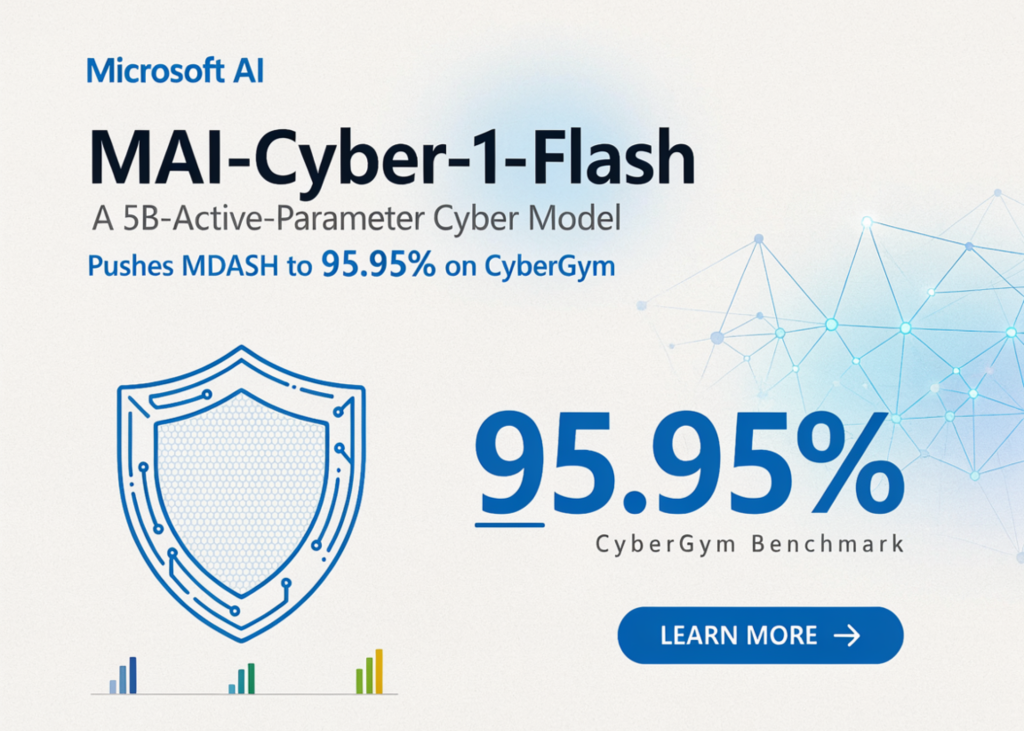
Microsoft AI Releases MAI-Cyber-1-Flash: A 5B-Active-Parameter Cyber Model That Pushes MDASH to 95.95% on CyberGym
The release of MAI-Cyber-1-Flash marks a significant advancement in cybersecurity, improving threat detection capabilities and potentially reducing costs in defense operations.
- Microsoft AI has launched MAI-Cyber-1-Flash, a model designed specifically for cyber defense that operates within MDASH.
- This model features a total of 137 billion parameters, with 5 billion active parameters, and achieves a score of 95.95% on CyberGym.
- MAI-Cyber-1-Flash takes on 90% of MDASH's tasks, leaving the more complex 10% to the GPT-5.4 model, resulting in 50% cost savings.
- The model was developed by Microsoft's Autonomous Code Security team and is a fine-tuned version of MAI-Code-1-Flash, previously used in coding applications.
MAI-Cyber-1-Flash is part of Microsoft's ongoing efforts in AI-driven cybersecurity through the MDASH platform, which also includes multiple AI models for enhanced vulnerability analysis. This launch builds on prior developments, including MDASH's score improvement from 88.45% to 95.95% following this new model's integration.
Read the original ↗
BlackRock Takes Majority Stake in Meta’s El Paso AI Campus
This deal demonstrates a significant shift in the ownership structure of major data centers, impacting the financial strategies of tech companies and the future of AI infrastructure.
- BlackRock has acquired an 80% stake in Meta's gigawatt-scale data center campus in El Paso, Texas, through a joint venture.
- The total development cost of the campus is approximately $14 billion, with Meta contributing land and initial constructions valued at about $2.3 billion.
- BlackRock will invest roughly $4.9 billion in cash as part of the agreement and provide $12.5 billion in debt financing to support its contribution.
- Meta will remain as the tenant and operator of the campus under a lease with an initial term of four years and options to renew for a total of 20 years.
Meta is constructing a large data center to support AI infrastructure, branded as Meta Compute, in El Paso, Texas. Previous partnerships have influenced Meta's investment strategy, and the local utility is expanding its power generation capacity to meet growing demand. Future developments regarding data center regulations and local energy capacity will be critical to monitor.
Read the original ↗
Deploying a 1-Bit Bonsai-27B Model with PrismML llama.cpp and OpenAI-Compatible Local Inference Workflows
This tutorial enables AI practitioners to deploy a highly efficient language model locally, ensuring faster response times and greater control over the inference process without relying on external services.
- The tutorial covers deploying the 1-bit Bonsai-27B language model using PrismML's llama.cpp, which is optimized for specific CUDA operations.
- It details the setup process, including GPU validation, installation of dependencies, and model weight retrieval from Hugging Face.
- The deployment allows for multi-turn conversations, code generation, and various options for performance benchmarking.
The Bonsai-27B model is a language model designed for efficient inference with a highly compressed weight format. This deployment process uses open-source tools like PrismML and llama.cpp to facilitate local execution of the model. Future developments may include further efficiency improvements and feature expansions for local AI models.
Read the original ↗
DataFlex: A Unified Framework for Data-Centric Dynamic Training of Large Language Models
DataFlex offers a significant advance in large language model training by improving the effectiveness and efficiency of data usage, which can enhance model performance and reproducibility in real-world applications.
- DataFlex is a unified framework for dynamic, data-centric training of large language models, supporting sample selection, domain mixture adjustment, and sample reweighting.
- The framework maintains compatibility with standard training workflows and allows for large-scale deployments using DeepSpeed ZeRO-3.
- Dynamic data selection with DataFlex outperforms static full-data training on MMLU for models like Mistral-7B and Llama-3.2-3B.
- DataFlex achieves improvements in MMLU accuracy and corpus-level perplexity with optimized data mixture methods during pretraining on Qwen2.5-1.5B.
- Comprehensive experiments confirm DataFlex enhances reproducibility and provides efficient infrastructure for LLM training.
DataFlex was developed by the PKU DCAI laboratory and LLaMA-Factory team to enhance the training of large language models by optimizing data usage. The framework addresses limitations of existing isolated data selection methods that hinder reproducibility and integration. Looking ahead, its implementation in diverse training scenarios may further influence LLM performance.
Read the original ↗
Anthropic’s Dario Amodei responds: doesn’t oppose open-weight models, but fears Chinese AI
Dario Amodei's comments highlight industry concerns regarding the implications of open-weight AI models and the competitive landscape of artificial intelligence between the U.S. and China.
- Dario Amodei of Anthropic stated that his company does not support bans on open-weight AI models.
- Amodei expressed concern that authoritarian governments, particularly the Chinese Communist Party, may develop more powerful AI systems.
- He emphasized that open-weight models pose risks due to difficulties in monitoring their usage once released.
Anthropic is an AI research company known for developing AI models. Recent discussions have focused on the implications of open-weight models and concerns about competitive advantages in AI technology, particularly with regards to China. The industry is watching calls for global model safety testing more closely.
Read the original ↗
Skill Self-Play: Pushing the Frontier of LLM Capability with Co-Evolving Skills
Skill Self-Play advances the capabilities of language models by addressing the balance between task diversity and verification reliability, enhancing their performance in reasoning and tool-use tasks.
- Skill Self-Play is a framework that co-evolves a task proposer, solver, and dynamic skill controller using reinforcement learning.
- The framework addresses the tension between narrow task execution and broad task generation by leveraging agent skills for diversity.
- Empirical evaluations show that Skill Self-Play improves language models' performance on various reasoning and tool-use benchmarks.
Language models (LLMs) are increasingly trained through self-evolution methods that allow them to learn from interactions instead of manual annotations. Previous approaches struggled with balancing task diversity and reliability in feedback, leading to performance issues. The next steps involve further enhancing the skill library and optimizing the reinforcement learning loop.
Read the original ↗
Claude Shared Chats Accidentally Appeared on Google
The accidental exposure of sensitive conversations via Claude underscores critical privacy vulnerabilities users may face when utilizing public sharing features in AI platforms.
- Users of Anthropic's Claude AI discovered that shared chats appeared in Google search results, including sensitive personal and business information.
- The issue became known after Reddit users noticed that searching Google with 'site:claude.ai/share' revealed these conversations.
- Reports indicated that some indexed pages contained medical reports, internal company documents, and children's personal information.
- Anthropic stated that shared links can only be indexed if users post them publicly on platforms that search engines can crawl.
- By Monday, searches for the shared chats no longer returned results, suggesting the issue was resolved, though details on the resolution remain unclear.
Anthropic's Claude AI features a public sharing option called 'Share Chat' which allows users to create links to their conversations. When such links are made public, they can be indexed by search engines if posted online. This incident highlights the need for careful management of privacy settings by users of AI platforms.
Read the original ↗
Microsoft Says Its New Cybersecurity AI Beats Industry Leaders at Half the Cost
Microsoft's new cybersecurity AI model offers significant cost savings and improved performance, which could change the competitive landscape in AI-driven security solutions.
- Microsoft's MAI-Cyber-1-Flash cybersecurity model, combined with MDASH and GPT-5.4, outscores Anthropic's Claude Mythos 5 by 12 points in security benchmarks.
- The new system is designed for AI-driven defense against cyber threats and enters public preview on August 3.
- Pricing for the service is consumption-based, potentially offering savings of nearly 50% compared to current configurations available on the market.
Microsoft's MAI-Cyber-1-Flash is part of a growing trend in AI cybersecurity aimed at enhancing defenses against emerging threats. Recently, Anthropic’s Claude Mythos 5 faced scrutiny over its security capabilities, impacting its deployment. Observers will monitor how Microsoft’s offering performs as it rolls out to its products.
Read the original ↗
New Firefighting Technologies Could Help Battle Blazes Like Those in France and Spain
The development of new firefighting technologies is crucial as climate change intensifies wildfire threats, impacting public safety and resource management in affected regions like Spain and France.
- Spain faces a national emergency as intense wildfires ravage the community of Madrid and surrounding provinces, with double the average annual area burned this year.
- France is experiencing unprecedented wildfires this season, which have been six times more destructive than normal, leading to widespread evacuations.
- Technological innovations in Spain are being tested to enhance fire prevention and detection, including biodegradable firefighting liquids and AI-supported early-warning systems.
- New systems such as Predifire use AI and drones to identify fire outbreaks early, aiming to reduce response times and improve intervention effectiveness.
- Monitoring projects like SenForFire utilize wireless networks of low-cost sensors to predict fire outbreaks by assessing environmental conditions.
The surge in wildfires in Spain and France highlights the urgent need for advanced firefighting technologies, spurred by climate change-related factors such as extreme heat and dry conditions. Recent initiatives in Spain include developing biodegradable extinguishing agents and AI models designed for early detection and resource allocation during fire emergencies. The impact of these innovations on future wildfire management will be significant as these countries continue to face increasing fire risks.
Read the original ↗
Private Claude Chats Exposed in Google and Bing Search Results
The exposed chats highlight significant privacy concerns regarding user interactions with AI chatbots and the challenges in safeguarding private conversations online.
- Private chats from Anthropic's AI chatbot Claude were unexpectedly indexed by Google and Bing search engines.
- Some conversation topics included personal advice and role play, raising serious privacy issues.
- Anthropic's robots.txt file aimed to prevent search engines from indexing shared chats, but lacked a crucial 'noindex' tag.
- Despite claims of privacy, user-shared chats can potentially remain discoverable if not properly managed by the host.
- Anthropic has previously faced criticism for similar indexing issues affecting user privacy.
Anthropic is a company focused on developing AI and chatbot technologies, including Claude. Past incidents with user privacy have raised concerns, and the recent exposure of shared chats reinforces the need for robust privacy controls. Future responses from Anthropic regarding indexing practices will be crucial to restoring user trust.
Read the original ↗
PSA: Your Claude shared chats and Artifacts may have ended up on Google
The exposure of private chats and sensitive information on Google raises serious concerns about user privacy and data security in AI platforms.
- Numerous Claude chats and Artifacts were found publicly searchable on Google, including sensitive health records and personal information.
- The issue stemmed from Claude's 'share chat' feature, which permits users to create links for others to view conversations.
- Anthropic stated that shared links appear in search results only when posted on publicly accessible platforms, indicating users may have inadvertently shared them.
- Previous incidents have occurred where Claude conversations and other AI chats were indexed by search engines, highlighting ongoing privacy vulnerabilities.
Claude is an AI language model developed by Anthropic that allows users to share conversations and create interactive applications called Artifacts. Recent searches revealed that sensitive data was indexed, prompting scrutiny over privacy practices, as it echoes earlier incidents with similar AI technologies. Observers should watch for any updates on improved privacy measures from Anthropic.
Read the original ↗
Satya Nadella says companies that trust one AI for everything may not survive
Nadella's warning highlights the risks businesses face if they rely too heavily on proprietary AI models, prompting companies to reconsider their AI strategies to ensure long-term viability.
- Microsoft CEO Satya Nadella warns businesses that reliance on a single AI provider could jeopardize their survival.
- Nadella advocates for companies to retain control over their data and model training to avoid 'outsourcing their thinking.'
- He emphasizes the importance of utilizing multiple AI models and keeping AI infrastructure separate from model providers.
Microsoft is a leading company in AI technology and has invested in major AI labs like Anthropic and OpenAI. Previously, businesses have increasingly adopted AI but are now recognizing the need for flexibility and control over their own AI models. The ongoing conversation about model dependence suggests future developments in AI governance and business operations.
Read the original ↗
Microsoft unveils AI security tools it says outperform competing platforms
The introduction of Microsoft’s AI security tools highlights an ongoing evolution in cybersecurity approaches amid rising threats and competition in the market.
- Microsoft has launched new AI tools aimed at automating the identification and reduction of security risks for customers.
- MAI-Cyber-1-Flash, Microsoft's first AI model for security weaknesses, is trained on extensive security data and analyzes software vulnerabilities.
- The new MDASH tool, integrated with MAI-Cyber-1-Flash, reportedly outperforms similar tools, receiving a 96 percent score on a benchmark test.
- Project Perception uses specialized AI agents for vulnerability assessment tasks, offering cost-effective solutions compared to competitors.
- Microsoft claims the new tools can alleviate pressures on security teams facing modern cyber threats.
Microsoft is a leading technology company known for its software, hardware, and cloud solutions. The development of AI-powered security tools comes amid increasing cyberattacks, necessitating advancements in defensive measures. Upcoming evaluations of these tools will be critical as organizations navigate these emerging technologies.
Read the original ↗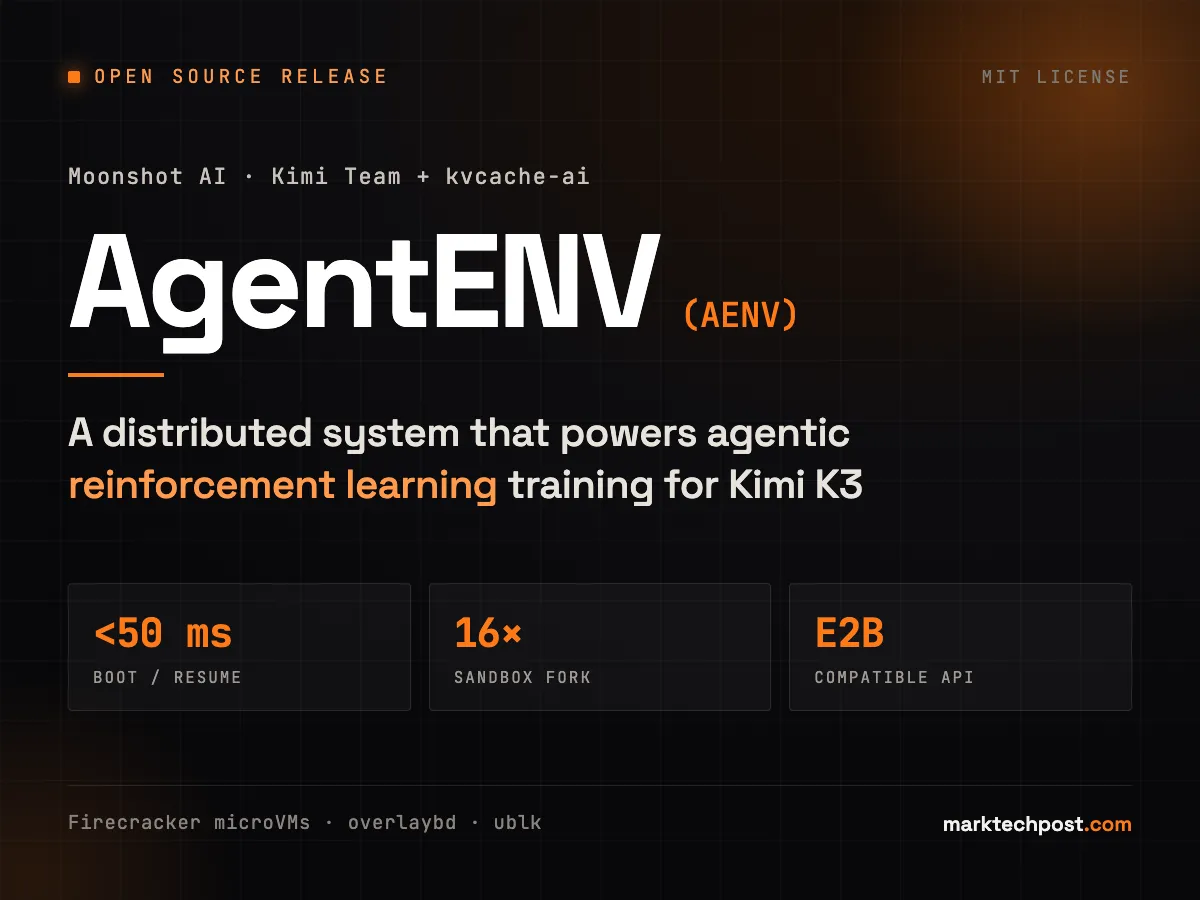
Kimi AI and kvcache-ai Open Sources ‘AgentENV’: A Distributed System that Powers Agentic Reinforcement Learning (RL) Training for Kimi K3
This development could significantly enhance the training efficiency for reinforcement learning, which is crucial for the advancement of AI capabilities in complex environments.
- Moonshot AI's Kimi team and kvcache-ai have open-sourced AgentENV, a distributed platform for running agent environments at scale.
- AgentENV supports agentic reinforcement learning training for Kimi K3, a 2.8-trillion-parameter model, using Firecracker microVMs for better isolation.
- The framework allows for quick boot and pause times of under 50 ms and 100 ms respectively, optimizing the training process further.
AgentENV is designed to bridge gaps in existing virtualization technologies for reinforcement learning by providing isolated environments quickly and efficiently. It uses Firecracker microVMs, which enhance isolation compared to containers and speed up the setup process, essential for complex AI training. Future developments will likely focus on expanding its capabilities for broader AI applications.
Read the original ↗
Verizon touts $1B dark fiber deal for Google data centers as first of many
Verizon’s significant investment in AI infrastructure through partnerships and network updates highlights the growing demand for low-latency data processing needed for advanced AI applications.
- Verizon has announced a deal exceeding $1 billion to link Google data centers via dark fiber routes.
- The company is retrofitting its central offices into small data centers to support AI workloads requiring low latency.
- Verizon's new "AI Connect" initiative aims to expand its offerings in the AI sector, with additional deals expected by year-end.
- The telecom has been transitioning from copper to fiber-optic technology to enhance broadband services and AI capabilities.
Verizon is shifting its strategy to capitalize on the increasing demand for AI services by enhancing its infrastructure. The company recently acquired Frontier Communications, which expanded its fiber network significantly. Moving forward, attention will focus on how these initiatives impact revenue and operational efficiency.
Read the original ↗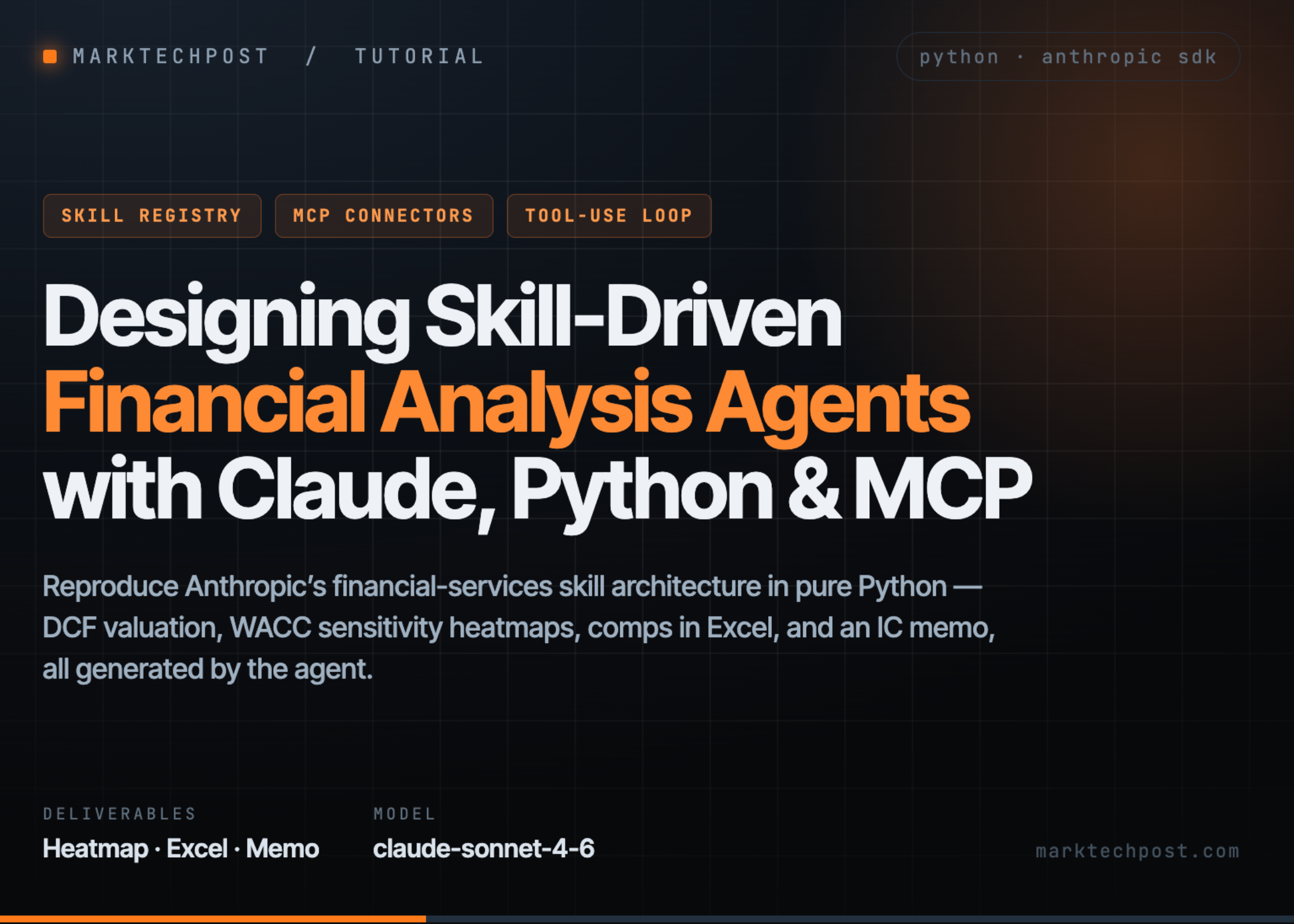
Designing Skill-Driven Financial Analysis Agents with Claude, Python, MCP Connectors, and Automated Deliverables
This tutorial demonstrates how to automate complex financial analysis tasks using AI, showcasing practical applications that can improve efficiency in financial services.
- The tutorial details the construction of skill-driven financial analysis agents using Anthropic’s framework and Python.
- It includes automating processes like discounted cash flow (DCF) analysis, comparable-company analysis, and investment memorandum preparation.
- Users can integrate external financial data through managed-agent cookbooks and MCP (managed-connectivity providers) integrations.
Anthropic is known for developing AI frameworks used in various applications, including finance. The tutorial presents a hands-on approach to leveraging Anthropic's repository for creating real-world financial analysis tools. Future developments may include enhancing these agents with more financial skills and connecting them to various data sources.
Read the original ↗
Why AI-Driven Cognitive Systems Are Redefining Radar and Electronic Warfare
Cognitive AI-driven radar and electronic warfare systems are crucial for effectively countering advanced, unpredictable threats in modern military contexts.
- Cognitive AI/ML architectures allow for adaptive countermeasures against mode-agile threats that traditional radar systems cannot handle.
- Traditional systems struggle with dynamic threats that utilize unexpected frequencies and modulation techniques, making them less effective.
- Challenges include resource demands, latency issues, and testing procedures for developing and validating AI/ML algorithms in real-time environments.
Cognitive radar and electronic warfare (EW) systems leverage artificial intelligence and machine learning to autonomously perceive and respond to diverse threats. As threats evolve from predictable to unpredictable modes, traditional static libraries are proving inadequate. Future developments will likely focus on improving these systems' speed and adaptability in real-world conditions.
Read the original ↗
Threads users can now chat with Meta AI in their DMs
The integration of Meta AI within Threads’ DMs aims to strengthen user engagement and retention within Meta's ecosystem, potentially reducing reliance on competing AI tools.
- Meta has begun rolling out its AI chatbot within the direct messages (DMs) of Threads, allowing for private conversations with the AI assistant.
- Users can share posts, images, links, and videos with Meta AI within their DMs and can ask follow-up questions for deeper engagement.
- This update will be globally available starting Monday, enhancing the AI interaction capabilities in Threads as part of a broader strategy to aggregate user activity.
Meta, the parent company of social media platforms like Facebook, Instagram, and Threads, is enhancing its AI offerings as part of its competitiveness against other AI services, such as OpenAI's ChatGPT. The Meta AI is already accessible on its other platforms, aiming to create a seamless experience for users across its services. Future updates are expected based on user feedback from the ongoing tests in public feeds in select markets.
Read the original ↗