
The day's AI news, briefed
The Daily Prompt
Our AI editor reads each day's AI and robotics stories, pulls out why they matter, and links every original source — so you can keep up in minutes.
Join over 250,000 subscribers getting the latest AI news
Latest AI & Robotics News Today
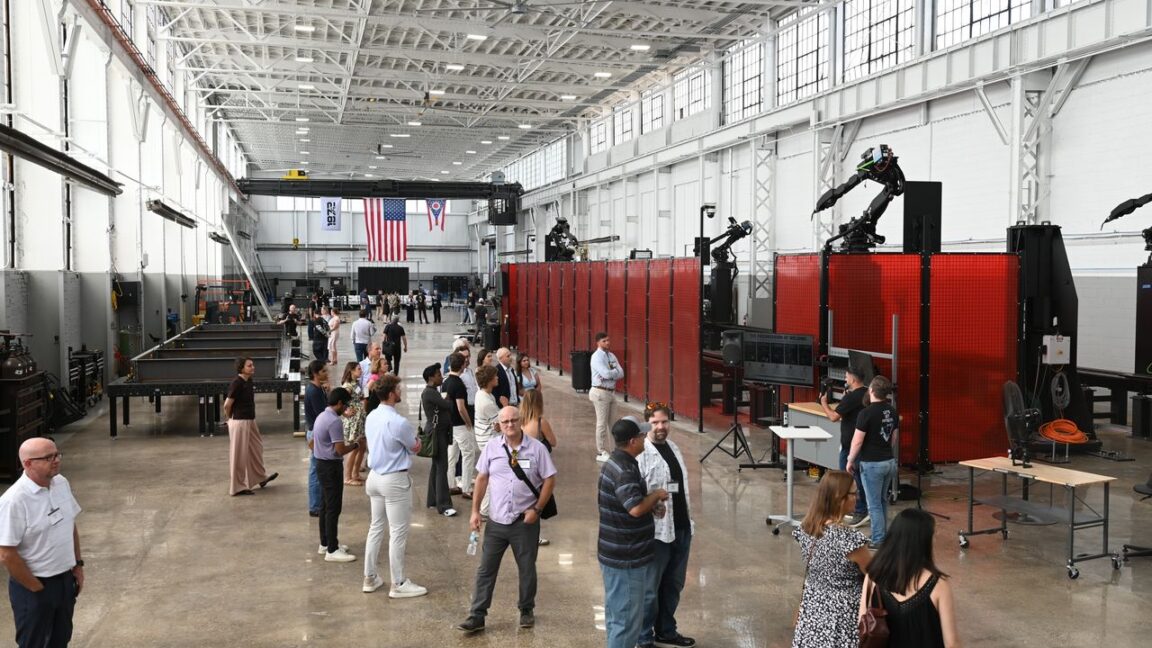
Former SpaceX engineers are building a robotic factory for making steel parts
The establishment of a robotic factory by former SpaceX engineers could significantly enhance the efficiency of manufacturing steel parts amid a growing shortage of skilled labor in the U.S.
- Three former SpaceX engineers have launched a startup called 1872 to create a prototype automated factory for steel parts by 2027.
- The company aims to automate the production of steel skids, essential for modular buildings and AI data centers.
- 1872 has received $15 million in seed funding to develop its automation technology and ensure profitability.
- Automation in steel fabrication aims to address the U.S. skilled labor shortage in industries like shipbuilding and data center construction.
- Robotic arms from Path Robotics will play a key role in welding processes, achieving high efficiency and lower costs compared to manual welding.
1872 is focused on automating the manufacturing of steel components to mitigate the shortage of skilled workers. The startup's founders leverage experience from SpaceX to implement advanced robotic systems. Future developments may expand to include other types of structural components as automation technology matures.
Read the original ↗
Hidden Airtag reveals Amazon is trashing rare books to train AI
This discovery raises ethical concerns about AI training practices that may lead to the destruction of rare books, impacting cultural preservation and narrowing the diversity of available training data.
- Amazon is reportedly destroying rare books after scanning them to train AI, confirmed by tracking an Airtag planted in a book to an Amazon facility in Las Vegas.
- Earlier this year, Amazon faced a shortage of books for scanning, raising concerns about the operational viability of its scanning team, known as VGT3.
- Critics argue that the destruction of these books disregards their historical and intellectual value, as Amazon focuses primarily on unique, low-cost ISBNs for training data.
Amazon is a leading technology company known for e-commerce and AI development. This revelation follows growing suspicions among booksellers about AI firms acquiring rare books. Future developments may include increased scrutiny and calls for ethical practices in AI training and cultural preservation.
Read the original ↗
ByteDance agrees to reel in its AI models to protect Hollywood IPs
The agreement between ByteDance and the MPA aims to safeguard intellectual property rights in the entertainment industry, potentially influencing how AI models are developed and used in creative sectors.
- ByteDance signed a memorandum of understanding with the Motion Picture Association to protect intellectual property.
- The agreement comes after a cease-and-desist letter from the MPA regarding copyright infringement by ByteDance's AI models.
- The memorandum covers all AI models from ByteDance, including those used on TikTok and CapCut.
ByteDance is the parent company of TikTok and has previously faced scrutiny over copyright issues related to its AI models. The MPA represents major Hollywood studios such as Disney and Warner Bros. Current actions may affect future AI developments and usage in the industry.
Read the original ↗
How to tell if your AI platforms’ accounts have been hacked
Understanding how to secure AI platform accounts is crucial as the risk of hacking increases, potentially compromising users' personal information and data security.
- Hackers can target accounts on popular AI platforms like ChatGPT, Claude, and Perplexity.
- Users should utilize unique passwords and enable multi-factor authentication (MFA) to enhance security.
- ChatGPT and Perplexity allow users to check active sessions, while Claude uses a login link instead of a password for account access.
AI platforms such as ChatGPT, Claude, and Perplexity facilitate user interactions with advanced technology, and security breaches on these platforms can severely impact user privacy. Prior recommendations emphasize using strong passwords and MFA to safeguard accounts. Future updates on security practices and potential vulnerabilities are expected as the technology evolves.
Read the original ↗
Groq raises $350M to fuel its pivot from AI chips to neocloud
Groq's fundraising and strategic shift may impact the competitive landscape of AI infrastructure and cloud services, particularly in relation to Nvidia's dominance.
- Groq has raised $350 million, valuing the company at $3.5 billion, down from $6.9 billion last September.
- The funding will support Groq's transition from AI chipmaking to becoming a neocloud provider utilizing Nvidia-powered data centers.
- Groq aims to scale its data center capacity from 54 megawatts to over 200 megawatts by 2027, currently operating 13 centers globally.
- The company is targeting enterprises and developers that require clusters for AI training and inference workloads.
- Despite the shift in strategy, concerns remain about the long-term profitability of neocloud services.
Groq was originally focused on creating AI chips, specifically language processing units (LPUs), to compete with Nvidia. Following the loss of key personnel to Nvidia, Groq pivoted towards offering cloud and data center services powered by Nvidia's technology. Investors are watching how this pivot affects Groq's growth and sustainability in the rapidly evolving AI sector.
Read the original ↗
Amazon, which started off selling books, is destroying rare texts to train AI
The destruction of rare texts by Amazon highlights ethical concerns surrounding data sourcing for AI training, raising questions about cultural preservation and intellectual property.
- Amazon is reportedly buying and cutting up rare books to scan them for training AI models, raising ethical concerns.
- A tracking device placed in a rare book revealed its arrival at an Amazon facility in Las Vegas known as VGT3.
- Rare books are valuable for training AI because they provide unique content not available online, helping avoid risks of 'model collapse' when overusing AI-generated material.
Amazon, originally an online bookstore, is now a leader in cloud computing and AI technologies. The company is increasingly sourcing texts for large language models (LLMs), which require extensive training data. The situation reflects broader tensions between AI development and the preservation of cultural artifacts.
Read the original ↗
#523 AI ethics is nobody's job now. The labs prefer it that way.
The erosion of dedicated ethics teams in leading AI labs raises concerns about accountability and oversight in artificial intelligence development, impacting the technology's ethical deployment.
- Four AI labs have reportedly disbanded their ethics teams, removing the structures designed for oversight.
- Chloé Bakalar, the only dedicated ethicist at OpenAI, left her position without a successor announced.
- Anthropic raised its risk rating regarding its AI systems, coinciding with the disbanding of its safety team.
- The recent trend shows a preference for organizational restructuring over established ethical and safety commitments in AI labs.
The trend of diminishing ethics oversight in AI development reflects a broader concern about accountability in technology. Historically, several prominent AI companies have formed ethics teams to address risks, but recent departures signify a shift in priorities. Observers are now noting a move towards external evaluations instead of in-house ethical frameworks, prompting scrutiny of long-term implications.
Read the original ↗
From AI Copilots to Agent Swarms
The evolving role of AI agents in software development signifies a fundamental shift in how software is created and managed, potentially increasing productivity and efficiency in the industry.
- AMD has achieved a 30 percent increase in productivity through AI in software development within one year.
- AI-generated code now comprises over 20 percent of AMD's production, with targets of reaching 50 percent in the entire codebase by 2027.
- AMD's AI systems assist in various stages of software development, including debugging, testing, and code generation, enhancing developer output.
- By collaborating in swarms, AI agents can independently solve problems and optimize workflows, moving beyond traditional human-defined methods.
- The percentage of issues automatically fixed by AI agents in AMD's Radeon Software eXperience has risen from 6 percent to 75 percent since late 2025.
AMD focuses on integrating AI into the software development lifecycle (SDLC) to improve productivity and quality. The company aims to shift from human-defined processes to collaborative AI swarms capable of independent problem-solving. Future developments will involve continuous learning loops for AI agents to enhance their performance in real-time tasks.
Read the original ↗
Nvidia investing $1.5B in SoftBank data center developer behind OpenAI project
Nvidia's investment in SB Energy strengthens its position in powering OpenAI's infrastructure, highlighting ongoing collaboration in artificial intelligence and technology development.
- Nvidia will invest $1.5 billion in SB Energy, a company affiliated with SoftBank and OpenAI.
- This investment guarantees Nvidia as the sole supplier of compute infrastructure for OpenAI’s Ports-Pike data center near Cincinnati, Ohio.
- SB Energy will also construct a 9.2 gigawatt natural gas power plant on a site that previously enriched uranium.
- The anticipated cost of the power plant project is $33 billion, reflecting rising construction costs for natural gas facilities.
Nvidia is a leading manufacturer of graphics processing units (GPUs) widely used in AI applications. This investment follows SoftBank's previous shareholding in Nvidia, which it sold to fund AI initiatives. Moving forward, the project will contribute significantly to the energy landscape amidst rising natural gas prices.
Read the original ↗
Can We Defend Against AI-Generated Video Attacks on Real-World Crisis Events? A Systematic Evaluation of Detectors, Generators and Social Dissemination
The inability of current AI-generated video detectors to accurately identify misinformation presents significant challenges for public safety and information integrity during crises.
- A new benchmark, RA-Bench, evaluates AI-generated video detection capabilities and highlights failures of current detectors in realistic crisis scenarios.
- The benchmark includes 17,886 videos, featuring 1,830 real videos and 16,056 AI-generated clips across 10 categories of social risk.
- Evaluations show that none of the detector families performed consistently across various video instances, making them unreliable for crisis-related content.
AI-generated videos can create false representations of real-world crises such as wars and disasters, increasing risks of misinformation. Previous benchmarks did not effectively assess AI video detection performance, necessitating improvements in detector robustness. The findings indicate an urgent need for enhanced detection methods to combat realistic AI-generated misinformation effectively.
Read the original ↗
Axiom Math’s AI Verifies the 246 Prime-Gaps Theorem in Lean
This achievement marks a significant advancement in the field of formal verification of mathematical theorems, demonstrating AI's potential to enhance mathematical research and the reliability of complex proofs.
- Axiom Math's AxiomProver has verified the 246 Prime-Gaps Theorem using Lean 4, marking a milestone in gap analysis between prime numbers.
- The theorem shows that infinitely many prime pairs differ by no more than 246, which is the strongest known result to date.
- The formal proof has been developed and published as a public Lean library, PrimeGapsLib, featuring contributions from 41 collaborators.
- This work builds on earlier findings, including contributions from theorists like James Maynard and the Polymath8b collaboration, refining the bound from 600 to 246.
Axiom Math specializes in using AI for formal proofs in mathematics. The Prime-Gaps Theorem deals with the distribution of prime numbers and follows significant results from the last decade, notably Yitang Zhang's initial findings on prime gaps. Future developments may focus on similar proofs and expanding the PrimeGapsLib framework.
Read the original ↗
Monetizing AI: A Modern Framework for How Companies Can Maximize Business Growth
Understanding effective AI monetization strategies is essential for software companies to improve profitability while meeting customer expectations in today's competitive landscape.
- AI has transitioned from a competitive advantage to a basic expectation for software firms, driving significant investments in infrastructure and development.
- Companies are spending 12–23% of revenue on AI, but 71% do not charge for AI-enabled features, indicating monetization challenges.
- Effective AI monetization is critical as firms that address this challenge can gain a competitive edge through improved pricing and customer relationships.
AI refers to technologies that enable machines to mimic human intelligence. Many software companies are now integrating AI to differentiate their offerings but are struggling with effective pricing models. The article outlines a framework for transitioning from cost to revenue generation through strategic pricing and customer value alignment.
Read the original ↗
The Hidden Cost of AI: How “Black Box” Models Are Eroding Trust, Budgets, and the Environment
The inefficiencies of general-purpose AI models impact costs, operational performance, and trust, potentially hindering the technology's broader adoption in critical real-time applications.
- Enterprises face rising costs and reliability issues due to the inefficiencies of general-purpose AI models.
- Many models struggle to interpret nuanced communication, risking vital insights in real-time situations such as customer interactions.
- The complexity of these models often leads to reduced trust and transparency, making them difficult to interpret and understand.
- Organizations are forced to analyze only a subset of interactions in areas like contact centers due to prohibitive continuous operational costs.
The AI industry is increasingly reliant on large, general-purpose models, which are costly and complex. This ongoing shift has raised concerns about the sustainability and efficiency of such models, particularly in real-time environments requiring quick decision-making. Future developments may focus on optimizing AI systems for efficiency rather than sheer scale.
Read the original ↗
A Constitution for the New Enterprise: 15 Rules for AI Governance
Establishing a governance framework for AI is crucial as it helps organizations navigate the evolving landscape of technology while managing risks and ensuring accountability.
- A proposed constitution outlines 15 articles aimed at guiding AI governance within enterprises.
- These articles emphasize accountability, human decision-making over automation, and the importance of capturing and learning from outcomes.
- The document argues that enterprises need a constitution instead of scattered policies to maintain clarity and adaptability during technological changes.
This governance framework comes at a time when many enterprises are piloting AI technologies without standardized oversight. Prior attempts have led to fragmented policies, highlighting the need for a cohesive structure. Future discussions will likely revolve around how organizations can effectively implement these principles and adapt to rapidly changing AI technologies.
Read the original ↗
New “Gamma Wave Entrainment” Glasses Supercharge Your Brain’s Performance
The development of transparent OLED glasses that enhance cognitive function through gamma wave entrainment may offer new, noninvasive therapeutic options for cognitive impairments and Alzheimer’s disease.
- Seoul National University scientists have created transparent OLED glasses that use flickering light stimulation (FLS) to improve brain connectivity.
- These glasses aim to enhance gamma wave entrainment, which helps synchronize brain activity linked to memory and focus improvements.
- Initial trials showed safety and effectiveness, paving the way for further clinical studies on their cognitive benefits.
Gamma wave entrainment is a method for synchronizing brainwaves, contributing to better communication between brain regions. This technology follows previous research into FLS for cognitive enhancement, with transparency in glasses addressing comfort issues for users. Future studies will focus on clinical applications and long-term effects of using these glasses.
Read the original ↗I’m a College Professor. Here’s How AI Has Changed the Way I Teach
AI tools are increasingly being integrated into college classrooms to enhance teaching effectiveness and engage students in a competitive learning environment.
- AI tools have been adopted by some college professors to enhance their teaching methods and materials.
- These tools help in creating visuals and presentations, improving engagement with students who may be distracted by other media.
- Examples of useful AI tools include Midjourney for image creation, Mixio for website generation, and Gamma for presentation development.
AI refers to technology that simulates human intelligence processes such as learning and problem-solving. Many educators are exploring how AI can help them adapt to changing educational environments and compete for student attention. The future may see wider adoption of AI as teaching aids, particularly in visual education.
Read the original ↗
AI Used to Verify Toughest Mathematics Proof Yet
This advancement in AI verification of mathematical proofs could pave the way for ensuring the reliability of AI-generated code, which is increasingly vital for digital infrastructure.
- Axiom Math has verified the proof of the '246 theorem,' marking a significant milestone in AI-assisted mathematical research.
- The 246 theorem asserts that there are infinitely many prime numbers that differ by 246, a key result in number theory.
- Formal verification using AI has implications for the correctness of AI-generated computer code, which is crucial for software reliability and cybersecurity.
- AxiomProver, Axiom Math's AI system, has previously verified several mathematical proofs, contributing to major developments in mathematics this year.
Axiom Math develops AI tools for formal verification, a process where machines confirm the correctness of mathematical proofs. This achievement builds on previous successes and highlights the potential for AI systems to enhance the reliability of computer code used across various sectors.
Read the original ↗
Wispr raises $280M at $2B valuation as it looks beyond dictation
Wispr's substantial funding will enable the company to expand its services and improve its technology, positioning it competitively against emerging dictation tools and notetaking solutions.
- Wispr raised $280 million in Series B funding at a $2 billion valuation, led by Menlo Ventures.
- The new funding will help Wispr expand into new areas, including its newly launched note-taker tool for meetings.
- Wispr has raised a total of $361 million to date, with previous rounds completed less than 10 months ago.
- The company's new model, Canto, aims to significantly improve speech understanding accuracy by reducing error rates from 30% to less than 10%.
- Existing investors participated again, alongside several new investors indicating growing interest in Wispr's technology and potential.
Wispr started as a dictation tool and is now venturing into meeting notetaking solutions. As competition intensifies with new apps emerging, its upcoming technologies like Canto and the notetaker tool are crucial for maintaining its market position.
Read the original ↗
Serve Robotics Brings Sidewalk Robot Delivery to Grubhub, Expands to Three New Cities
This partnership enhances last-mile delivery options through autonomous robots, potentially changing consumer habits and operational efficiency in the food delivery sector.
- Serve Robotics has partnered with Grubhub to offer sidewalk robot delivery, launching initially in Chicago, Los Angeles, and Alexandria, Virginia.
- More than 100 Grubhub merchants in Chicago and nearly 200 in Los Angeles are participating in the robot delivery service.
- Serve plans to expand to Washington, DC and San Jose, California, while introducing a micro-depot in Miami to streamline operations.
- Serve's new product, Beacon, allows restaurants to interact with delivery robots without additional hardware beyond power.
Serve Robotics, spun off from Uber in 2021, specializes in autonomous delivery robots. This expansion into Grubhub's marketplace marks its growth into major urban areas and showcases its strategic plans for increased operational efficiency through micro-depots. Future developments may involve additional partnerships and product offerings to enhance delivery capabilities.
Read the original ↗
NVIDIA Guarantees up to $105B for 8-GW Ohio AI Campus Leased by OpenAI
This deal significantly impacts the future of AI infrastructure by providing financial backing for one of the largest data center campuses dedicated to AI, facilitating OpenAI's growth.
- NVIDIA has guaranteed up to $105 billion in lease obligations for an 8-gigawatt AI data center campus in Pike County, Ohio, leased by OpenAI for 20 years.
- The campus will use NVIDIA's full-stack DSX AI factory platform and is expected to begin operations in phases starting in 2028.
- SB Energy will build and operate the campus, which includes a commitment to develop new power generation and handle site cleanup.
NVIDIA's deal with OpenAI marks a significant shift in AI infrastructure investments, as it now acts as a financial backstop for this major compute buildout. Previously, OpenAI aimed to expand its capacity through a cloud partnership and various infrastructure initiatives. Future developments will include the planned phases of the campus becoming operational and the ongoing reported investments in AI technology.
Read the original ↗