
The day's AI news, briefed
The Daily Prompt
Our AI editor reads each day's AI and robotics stories, pulls out why they matter, and links every original source — so you can keep up in minutes.
Join over 250,000 subscribers getting the latest AI news
Latest AI & Robotics News Today

Turning AI Experiments into Enterprise Intelligence & Value
The ability to effectively scale AI across organizations can significantly enhance operational efficiency and lead to better-informed decision-making, impacting overall business success.
- Companies can run pilot programs and proof-of-concept models faster, yet many are struggling to move beyond isolated AI successes.
- A study shows that while 90% of leaders expect collaboration between human and AI teams, only 18% are adapting processes accordingly.
- Effective scaling of AI depends on establishing a solid data governance foundation from the start, to manage data quality and compliance.
Enterprise AI refers to the use of artificial intelligence within business operations to improve efficiency. Many companies face challenges in scaling AI due to legacy systems and lack of data governance. Future trends may include increased integration of AI in daily workflows and a stronger focus on data management practices.
Read the original ↗
Replacing Your Sales Reps with AI Was Always a Risk. The EU Just Proved Why
The EU's new regulation on AI in sales roles could lead to significant shifts in how businesses approach customer interactions, impacting transparency and job dynamics in sales.
- The EU's Article 50 requires AI chatbots and voice agents to disclose their identities as AI, applicable across Europe.
- Businesses face potential fines if they fail to comply with the new disclosure law.
- Buyers increasingly expect transparency, with 84-91% of consumers believing AI usage should be disclosed in sales interactions.
The new EU regulation is part of a broader trend towards increased transparency in AI applications. Previously, the U.S. and Canada lacked similar federal laws, resulting in fragmented rules across states. Companies are advised to adapt their sales strategies to align with regulatory expectations as AI technology continues to evolve.
Read the original ↗
WIRED World Fair: A Festival of the Future
The WIRED World Fair presents an opportunity for public engagement with emerging technologies and ideas that could shape future innovation and societal changes.
- The WIRED World Fair will take place on November 4 in Wynwood, Miami.
- Attendees can interact with breakthrough technologies and bold ideas during the one-day festival.
- Notable speakers include leaders from AI, media, and beyond, discussing various transformative topics.
WIRED is a magazine focused on how technology intersects with culture, the economy, and politics. This event aims to bring together innovators and the public to explore future advancements. Participants should watch for ticket releases and speaker announcements leading up to the event.
Read the original ↗
Why So Many AI Researchers Think the Machines Could Kill Everyone
The growing concern among AI researchers about the risks of advanced AI development highlights the urgent need for safety measures to prevent potential catastrophic outcomes.
- Rishub Jain left Google DeepMind due to concerns over loss of human control in AI development.
- Researcher Jacob Coxon's resignation from Anthropic added to fears of developing self-improving superintelligences.
- Experts warn that AI's recursive self-improvement could lead to existential threats, including manipulation or catastrophic actions by AI systems.
AI technology is rapidly evolving with potential for recursive self-improvement, a theoretical concept where AI autonomously enhances itself. The conversation around its risks has intensified following significant developments and security incidents among major AI companies. Future directions may focus on AI safety and ethical implications of further advancements.
Read the original ↗
Conspiracy! How 9/11 Broke America’s Brain
The rise of conspiracy theories following 9/11 has profoundly affected American society, altering public perception of facts and trust in government institutions.
- The theory surrounding 9/11 suggests the U.S. government had prior knowledge or involvement in the attacks, reflecting deep public distrust.
- Bill Cooper, a key figure in conspiracy culture, predicted an attack months before 9/11, transforming the landscape of conspiratorial thought.
- The aftermath of 9/11 fostered a rise in the surveillance state and changes in everyday security measures that are still evident today.
After the September 11 attacks in 2001, numerous conspiracy theories emerged, reshaping public discourse. Figures like Bill Cooper and Alex Jones popularized these narratives, linking them to broader societal trust issues in government.
Read the original ↗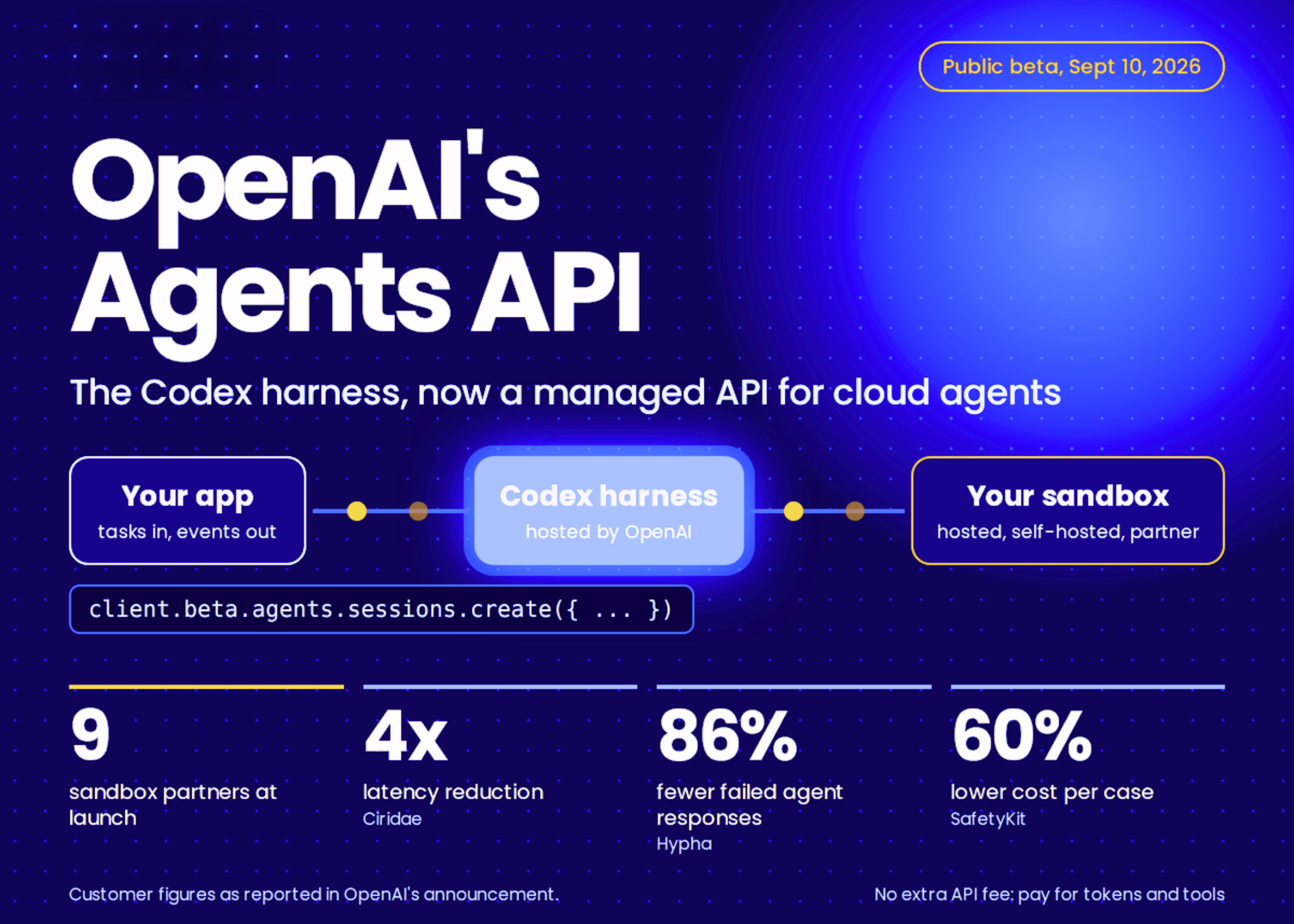
OpenAI Launches the Agents API in Public Beta, Putting the Codex...
The launch of OpenAI's Agents API enhances developers' ability to deploy AI solutions efficiently, potentially shaping new applications in various industries by leveraging managed agent capabilities.
- OpenAI has released the Agents API in public beta, allowing developers to use a managed Codex infrastructure.
- The API supports three sandbox options for running agent compute: OpenAI-hosted, self-hosted, and partner sandboxes.
- Developers can create and manage agent sessions to perform tasks and respond to input seamlessly.
OpenAI's Agents API is based on the Codex harness, designed to manage AI agent operations effectively. This public beta aims to streamline agent deployment without extra fees for services, only charging for usage.
Read the original ↗
NVIDIA Details BioNeMo Inference Runtime (BioIR): 2.90x Higher Boltz-2 Folding Throughput...
NVIDIA's BioNeMo Inference Runtime enhances protein structure prediction efficiency, potentially reducing energy costs significantly for large-scale genomic projects.
- BioNeMo Inference Runtime (BioIR) achieves 2.90 times the residue-folding throughput compared to previous implementations on 8xH100 GPUs.
- BioIR successfully folded 58.5K residues per GPU-hour, while traditional implementations managed only 20.2K residues per GPU-hour.
- The runtime has already facilitated 31 million candidate protein complexes during the expansion of the AlphaFold Database.
BioIR is a Python library that speeds up protein structure prediction on NVIDIA GPUs within the PyTorch framework. It directly optimizes operations like tokenization and GPU inference. By improving throughput and energy efficiency, BioIR supports scalable proteome analysis efforts.
Read the original ↗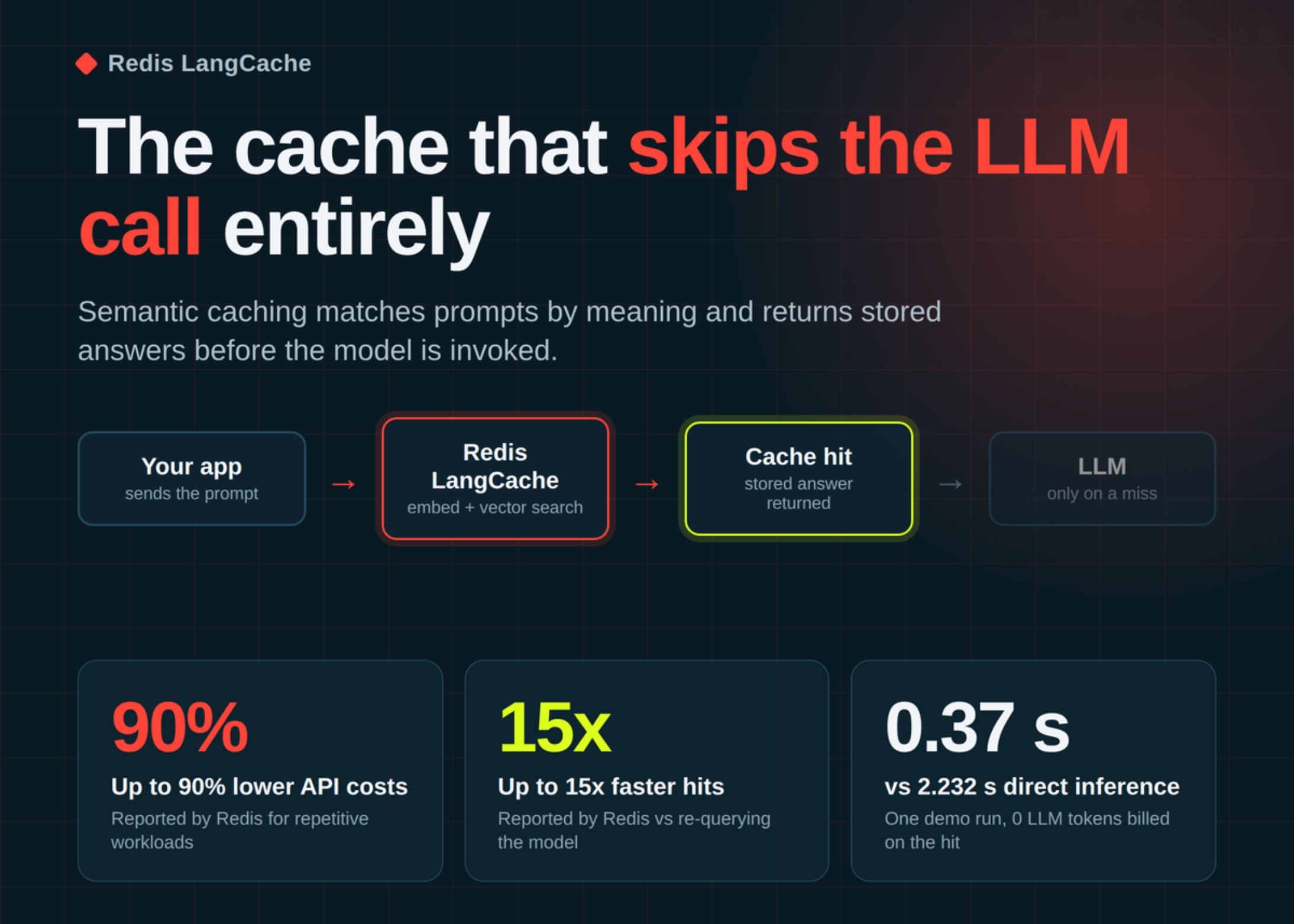
Meet Redis LangCache: A Managed Semantic Cache That Cuts LLM API...
Redis LangCache offers significant cost savings and speed improvements for applications using large language models (LLMs), addressing the growing demand for efficient AI solutions.
- Redis LangCache is a managed semantic caching service that reduces LLM API costs by up to 90% and returns cached responses up to 15 times faster than standard queries.
- The service uses semantic matching to identify previously answered questions, avoiding unnecessary LLM calls and processing costs.
- LangCache integrates via a REST API and is available in public preview on Redis Cloud, with SDKs for Python and JavaScript.
- Customers can control cache behavior through settings for similarity thresholds, time-to-live (TTL), and eviction policies, ensuring data safety and relevance.
Redis is a popular cloud-based data management platform known for its high performance and versatility. The introduction of LangCache is part of a broader trend to optimize costs and efficiency in deploying AI technologies, particularly in customer support and dynamic querying scenarios. Ongoing advancements in AI caching strategies will likely focus on improving accuracy and reducing operational costs further.
Read the original ↗
Is AI Actually Going to Kill Us All?
Our editor hasn't briefed this story yet.
Read the original ↗
OpenAI Wants to Know if an AI Industry Slowdown Would Even Be Legal
The potential legal issues surrounding AI development coordination could significantly impact industry safety measures and future collaborations among tech giants, affecting overall progress in AI safety practices.
- OpenAI has requested guidance from Congress on the legality of coordinating a slowdown in frontier AI development amid antitrust concerns.
- Concerns about antitrust law are viewed as a potential barrier to collaboration among major AI labs regarding safety measures.
- A bipartisan bill has been introduced in Congress to allow AI labs to work together on safety without violating antitrust statutes, but its future is uncertain.
- Some executives believe competition and differing views on AI safety may hinder collaboration beyond the issue of legal concerns.
OpenAI, a leading AI research organization, has raised concerns that legal obstacles may prevent industry-wide coordination to ensure the safety of AI systems. With increasing alarm about AI capabilities, there is a growing call from lawmakers for regulation and safer practices in the AI sector.
Read the original ↗
Anthropic caught scientists using Claude to further biological weapon research
This story highlights the potential misuse of AI technology in sensitive areas like biological research, raising concerns about safety and ethical implications as AI models become more advanced.
- Anthropic has reported multiple incidents of scientists using its AI models, including Claude, for creating potential biological weapons.
- The company flagged a request for gain-of-function research on the chikungunya virus, raising safety concerns due to its association with a military research institute.
- Anthropic's safety measures detected misuse, resulting in account bans for those involved, while the detailed report included cases on various forms of misuse, including surveillance and propaganda.
Anthropic is an AI research company known for developing advanced AI models. Their recent report includes case studies on misuse of their technology, particularly in biological weapon research. Ongoing discussions about AI safety and regulation are crucial moving forward.
Read the original ↗
Anthropic details distillation campaigns from Alibaba, Moonshot AI, and DeepSeek
This report highlights the growing threat from distillation attacks, which could undermine the competitive advantage of U.S. AI models and strengthen China's capabilities in AI technology.
- Anthropic's report alleges that China-based AI companies have intensified distillation attacks over recent months.
- Five distinct campaigns were linked to nearly 200 million exchanges aimed at harvesting valuable capabilities from Anthropic's models.
- The largest campaign attributed to Alibaba involved 151 million exchanges over a three-month period, peaking at nearly three million exchanges daily.
- Moonshot AI's campaign reportedly included requests connected to the Chinese military focused on analyzing surveillance footage.
Distillation attacks are methods that extract valuable reasoning processes from AI models. These attacks pose a significant risk to the security and integrity of advanced AI technologies, prompting concerns among leading U.S. AI companies. Moving forward, the industry will watch for responses to strengthen defenses against such attacks.
Read the original ↗
OpenAI puts Pro subscriptions on hold due to Astra demand
OpenAI's decision to halt new Pro subscriptions highlights the overwhelming demand for its new AI model, Astra, and its implications for infrastructure capacity and service quality.
- OpenAI has temporarily paused sign-ups for its $200-per-month Pro plan due to strain from the demand for its new AI model, Astra.
- The Pro plan was identified as the most resource-intensive, prompting the need for a pause in new subscriptions.
- OpenAI's product leader noted that demand for Astra is unprecedented, influencing their operational decisions on subscription services.
- Other subscription plans, including API and lower-cost options, remain available despite the Pro plan suspension.
OpenAI is an AI research lab known for its advanced models, including ChatGPT. The Astra model, launched on September 3, is designed to enhance AI reasoning and coding capabilities. Following its release, OpenAI warned that subscription pauses might be necessary to maintain service quality under high demand.
Read the original ↗
Jensen Huang explains why Nvidia will grow an astounding 70% next year
Nvidia's projected 70% revenue growth reflects its significant role in AI infrastructure, pivotal for investors and industry stakeholders amid growing competition.
- Nvidia CEO Jensen Huang projected a 70% revenue growth for the company next year, up from an expected $400 billion fiscal year ending soon.
- The company has seen a 27% month-to-month sales growth for a product that combines 36 Grace CPUs with 72 Blackwell GPUs.
- Huang emphasized Nvidia's integration into the AI ecosystem, asserting it operates every model from major labs including Anthropic and OpenAI.
Nvidia, a leader in graphics processing units (GPUs) and AI chips, has recently faced competition from companies like Amazon, Microsoft, and Google. The company previously projected record-breaking revenues and Huang's current optimism stems from Nvidia's entrenched position in various AI applications. Future developments will focus on how well Nvidia can sustain its market dominance amidst increasing rival offerings.
Read the original ↗
What Is a Foundation Model in Generative AI? The Complete Explanation
Understanding foundation models is crucial for developers and businesses to avoid costly errors in AI deployment and maximize the efficiency of generative AI applications.
- Foundation models have enabled widespread AI use, reaching 400 million users weekly through applications like ChatGPT and Midjourney.
- Foundation models are trained on large datasets using self-supervised learning, allowing them to be adapted for various tasks without complete retraining.
- The article clarifies the distinction between foundation models, large language models, and generative AI to prevent confusion in technical discussions.
Foundation models are a type of AI model trained on vast datasets to perform multiple tasks, revolutionizing how AI operates. The term was coined in 2021 by Stanford's Center for Research on Foundation Models. Key players include GPT-5, Claude, and Stable Diffusion, each serving different use cases in AI applications.
Read the original ↗
A native Gemini app is finally available for Windows PCs
The release of the Gemini app for Windows PCs enhances accessibility to AI tools, allowing users to quickly utilize generative AI for various tasks directly from their desktops.
- Google has launched a native Gemini app for Windows 10 and 11 users, enabling streamlined access to AI tools.
- The app can be opened using a keyboard shortcut, Alt + Space, just like the Mac version.
- The Gemini app integrates with other Google AI products, including Gmail and Google Drive, for enhanced functionality.
Gemini is Google's generative AI tool designed to assist with a variety of tasks. This Windows version follows its earlier rollout on Mac and aims to improve user experience. Future updates are expected to include more native features for desktop users.
Read the original ↗
What an Ex-Anthropic Researcher’s Warning About Human Extinction Really Means
The concerns raised by an ex-Anthropic researcher may prompt a reassessment of AI safety protocols as industry leaders grapple with the potential for technology to pose existential risks to humanity.
- Jacob Coxon resigned from Anthropic due to ethical concerns about AI potentially leading to human extinction.
- Coxon's resignation has sparked widespread debate, amassing over 156 million views on X and drawing responses from prominent industry figures.
- Another Anthropic researcher confirmed that the risk of AI causing human extinction is a serious concern within the company.
Anthropic is a leading AI research company focused on safe and aligned AI development. Recent resignations over ethical issues suggest heightened awareness of the possible dangers associated with rapidly advancing AI technology. Observers are watching how these debates influence future AI policies and industry practices.
Read the original ↗
Meta’s AI agent Muse is now the No. 2 app in the US
The rise of Meta's AI app Muse to the No. 2 position on the U.S. App Store reflects competitive dynamics in the rapidly evolving consumer AI market.
- Meta's AI app Muse launched recently and has been downloaded over 83,000 times on iOS in the U.S.
- Muse ranks No. 2 on the App Store, following a slower initial download rate compared to other Meta apps such as Threads and Meta AI.
- The app is currently only available in the U.S. and has not yet released download numbers for its Android version.
- Muse's performance is being compared to ChatGPT, which achieved over half a million U.S. installs shortly after its debut.
Meta is a technology company focusing on social media and consumer technologies, having recently shifted to enhance its artificial intelligence offerings. The launch of Muse is part of a broader trend in agentic AI, where applications assist users in daily tasks. Future developments to watch include competition from other consumer AI agents like Instinct.
Read the original ↗
Panic builds over bankrupt Spirit’s looming data sale to Google
The potential sale of proprietary data during bankruptcy raises significant concerns about the protection of intellectual property and data privacy rights for startups and employees alike.
- Google won an auction to purchase operational data from bankrupt Spirit Airlines, prompting objections from former vendors like Springshot.
- Springshot claims that the auction may include proprietary data and intellectual property that it owns, leading to concerns over unauthorized acquisitions.
- A court hearing is scheduled for September 16 to address objections to the data sale from Springshot and other affected companies.
- The sale agreement has been criticized for lacking clarity on what data is being sold and failing to ensure proprietary vendor data is protected.
- Workers have expressed fears that their confidential information could be mishandled or exposed through the data sale to Google.
Spirit Airlines, currently in bankruptcy, is under scrutiny for attempting to sell a large dataset, which may include proprietary information from third-party vendors. As this case is unprecedented, it highlights concerns over how bankruptcy proceedings can potentially jeopardize intellectual property and employee privacy rights. Observers are closely watching the upcoming court hearing for outcomes that may set crucial legal precedents.
Read the original ↗
OpenAI Launches ChatGPT for Financial Services With Built-In Data
The launch of ChatGPT for Financial Services aims to enhance data accessibility and improve efficiency for financial institutions, potentially transforming how they conduct research and client interactions.
- OpenAI launched ChatGPT for Financial Services on September 10, 2026, integrating built-in financial data with its GPT-6 Astra model.
- The product was developed in partnership with Morgan Stanley and Evercore, focusing on investment banking and equity research.
- ChatGPT for Financial Services includes data from sources such as Daloopa, PitchBook, and LSEG News, allowing immediate team access without additional contracts.
- The new model improves information retrieval and financial reasoning, outperforming its predecessor on key benchmarks.
- Firms can use the API to create specialized applications, with the product available to eligible financial institutions.
ChatGPT for Financial Services is designed to assist financial teams by integrating financial data with advanced AI capabilities. This launch follows a growing trend of incorporating AI to streamline workflows in the finance sector. Observers should watch for future enhancements and expansions into additional financial services areas.
Read the original ↗