
The day's AI news, briefed
The Daily Prompt
Our AI editor reads each day's AI and robotics stories, pulls out why they matter, and links every original source — so you can keep up in minutes.
Join over 250,000 subscribers getting the latest AI news
Latest AI & Robotics News Today

A ChatGPT Co-Inventor Built an AI That Can’t Talk. Developers Are Losing Their Minds Over It.
Jev introduces a cost-effective AI model that efficiently automates decision-making without generating text, potentially reshaping workflows in software development significantly.
- TypeSafe AI launched Jev on September 15, an AI model that cannot generate text but selects from predefined choices and provides confidence scores.
- Jev operates at a substantially lower cost than traditional large language models, costing $0.042 per million input tokens compared to $10 for some competitors.
- Demand for Jev caused TypeSafe's API to crash on launch day, underscoring its popularity and potential impact in the software industry.
- Jev's unique design eliminates hallucination by restricting responses to specified answers, providing users with reliable decision-making capabilities.
- Initial tests show Jev provides faster and more reliable outcomes for tasks like safety classification and monitoring other AI agents.
Jev is a new AI model developed by Diogo Almeida, a co-inventor of ChatGPT, which challenges conventional text-based AI by focusing on rapid decision-making. Unlike traditional large language models that generate prose, Jev selects from fixed options, promising greater speed and cost efficiency. Industry reactions indicate a strong interest in adopting its capabilities for more precise and automated tasks in various applications.
Read the original ↗
Sony Music and UMG say Suno's new models still violates their copyright
The lawsuit highlights ongoing tensions between AI music creators and record labels over copyright issues, which could impact how AI technologies develop in the music industry.
- Sony Music and Universal Music Group are suing AI music generator Suno for copyright infringement regarding its v6 models.
- The lawsuit claims Suno trained its models on unlicensed music, despite having licensing deals with other companies.
- The labels argue that Suno's training method, derived from user interactions, infringes on the copyright of over 60,202 sound recordings.
- Suno faces potential damages of up to $9 billion under U.S. copyright law for these alleged violations.
Suno is an AI music generator that has released various models, claiming to create music based on both licensed content and community interaction. The company previously faced legal challenges from record labels over its practices of scraping online music for training its models. This lawsuit builds on those ongoing disputes as the music and AI industries evolve.
Read the original ↗
AI Firms Knew Chatbots Were an ‘Existential Threat’ to Journalists, Court Docs Show
The acknowledgment by AI firms that chatbots threaten journalism could influence ongoing copyright litigation, impacting how such technologies interact with published content.
- Court documents reveal AI firms were aware that using copyrighted material for training chatbots could be seen as theft.
- A Microsoft executive referred to the issue as potentially the "largest theft of labor in human history."
- The lawsuits against OpenAI and Microsoft include claims from publishers like The New York Times and Ziff Davis regarding copyright infringement.
- Arguments suggest that AI firms' use of published content undermines the business of journalism by attracting audiences away from publishers' websites.
AI technology is built using vast amounts of written material, often leading to controversy over copyright laws and fair use. Recent legal actions by publishers challenge the practices of companies like OpenAI and Microsoft, raising issues that could reshape the landscape of AI development. Monitoring the outcomes of these lawsuits is critical, as they may set precedents for future technology and media relationships.
Read the original ↗
Sweeping EU Child Safety Proposal Would Transform Social Media, Online Gaming and AI Chatbots
If enacted, the EU Kids Act could significantly change how social media, online gaming, and AI chatbots operate, impacting user safety and child accessibility to these platforms.
- The EU Kids Act would impose strict regulations on tech companies, requiring a ban on social media for children under 13 and age verification for online accounts.
- Tech companies must demonstrate their services are designed safely or risk being unable to offer services to minors.
- The proposal accelerates age verification, limits screen time, and prohibits addictive design features and livestream options for minors.
The EU Kids Act aims to enhance child safety online by enforcing rigorous standards for social media, gaming, and AI chatbots. This comes amid rising concerns over children's vulnerability to harmful content and predatory behavior. The act reflects broader international efforts to regulate technologies affecting youth, with many anticipated legislative challenges ahead.
Read the original ↗
Anthropic’s first embedded evaluator is … Accenture?
The collaboration between Anthropic and Accenture aims to enhance AI model safety, reflecting growing concerns about accountability and the integrity of AI systems.
- Anthropic will embed evaluators from Accenture to assess its AI models and practices.
- Accenture plans to invest at least $1 billion in this initiative over the next five years.
- The choice of Accenture for this role surprised analysts and positively impacted its stock price, which rose by 8%.
- Anthropic is discussing the involvement of other safety organizations for future evaluations.
- Accenture's experience in deploying AI for major companies is considered a critical asset for the partnership.
Anthropic, founded with a focus on AI safety and alignment, aims to implement embedded evaluators for more rigorous oversight. Accenture's involvement marks an unusual choice, given its traditional focus and experience in consulting rather than deep learning research. The approach to AI safety evaluation is evolving amid recent concerns over AI model behaviors.
Read the original ↗
AI hallucination of Chinese nuclear components almost led to US military attack
This incident highlights the critical risks associated with using AI-generated intelligence in military operations, raising questions about reliability and safety in national defense strategies.
- The US military almost boarded a Chinese ship based on an inaccurate AI-generated intelligence report claiming it was transporting nuclear arms components.
- The AI tools used mistakenly identified materials, leading analysts to prepare for an interception with air support.
- This episode demonstrates the potential dangers of AI 'hallucinations', where artificial intelligence generates false information when data is insufficient.
AI 'hallucination' refers to instances where AI generates inaccurate or fabricated information. The US military's reliance on AI for intelligence analysis is part of a broader AI acceleration strategy launched by the Department of Defense. This incident underscores the need for careful integration of AI in military operations, amid ongoing discussions about AI safety and accountability.
Read the original ↗
Anthropic Taps Accenture’s Faculty for Embedded AI Model Evaluation
This partnership aims to enhance the evaluation and safety of AI systems, promoting accountability and transparency as the field evolves rapidly.
- Anthropic and Accenture are partnering to evaluate frontier AI with each company investing at least $1 billion over the next five years.
- The partnership will include embedded evaluators conducting assessments directly within Anthropic to improve oversight of AI models.
- Anthropic's CEO proposed embedded evaluators as part of a broader framework to slow AI development and ensure safety and alignment.
- Accenture's expertise in AI deployment across industries will inform its evaluation approach, focusing on model safety and risk management.
Anthropic is an AI company focused on developing safe AI technologies. This partnership with Accenture marks a commitment to independent evaluations, building on previous collaborations aimed at fostering safe AI practices.
Read the original ↗
Here’s How an AI Slowdown Could Actually Be Enforced
Determining effective measures to control AI development is crucial as the technology poses potential dangers and rapid advancements could outpace human understanding.
- AI researchers express concerns about the potential dangers of the technology they are developing, highlighting a need for effective controls.
- Various proposals for slowing AI development include tighter regulations, model evaluations, and even significant measures like tracking GPUs or destroying AI chips.
- Experts suggest that third-party evaluators should be given access to AI models for reliable inspections to prevent unsafe developments.
AI technology has rapidly advanced, prompting calls for oversight to ensure safety. Current discussions focus on the balance between innovation and potential threats posed by AI's capabilities. Future monitoring of AI development and international cooperation are pivotal.
Read the original ↗
Disney hires ex-CEO of AI company it accused of copyright infringement
Disney's hire of Karandeep Anand signals a strategic pivot towards integrating AI technology and addressing past copyright concerns, highlighting a shift in industry dynamics.
- Disney has hired Karandeep Anand as its first chief technology officer after he was previously the CEO of Character.AI.
- Disney had previously accused Character.AI of copyright infringement related to the use of its intellectual property.
- Anand will oversee enterprise technology and data and AI platforms at Disney, bringing some of Character.AI's technical staff with him.
- Disney CEO Josh D'Amaro emphasized the importance of technology in storytelling and creativity as part of the company's strategy.
Disney, a major player in entertainment, has been cautious about the use of generative AI, previously issuing cease and desist letters for copyright infringement. The company appears to be pivoting towards a collaborative approach with AI as a part of its future, particularly focusing on technology to enhance storytelling.
Read the original ↗
A new kind of AI model from a ChatGPT inventor is thrilling developers
The introduction of Jev could significantly reduce costs and increase efficiency in software development, paving the way for broader and more effective use of AI in automation tasks.
- TypeSafe AI released Jev, a new transformer-based model designed specifically for software automation and not for generating human language.
- Developers experienced high demand for Jev, causing temporary service disruptions to its API.
- Jev outputs calibrated decisions instead of text, eliminating the issue of hallucination—when AI generates false or misleading information.
- Early tests showed Jev delivering results five to 18 times faster than previous models while being significantly cheaper.
TypeSafe AI was co-founded by Almeida, a former OpenAI researcher, to address limitations in current AI models that primarily focus on human language. Jev represents a different approach to AI model design, favoring speed and affordability over traditional language processing. Future developments may include additional model versions and applications.
Read the original ↗
FAA tees up $875M AI tool to help manage air traffic congestion
The FAA's introduction of the SMART AI tool could significantly improve air traffic management and address staffing shortages in a critical infrastructure sector.
- The FAA plans to launch its SMART AI tool to assist air traffic controllers in managing congestion in Washington, DC's airspace.
- SMART is part of an $875 million contract awarded to Air Space Intelligence to enhance air traffic management in the US.
- The tool aims to improve operational efficiency by predicting traffic flows and providing alternative route information without altering existing procedures.
- The FAA's initiative occurs during a staffing crisis among air traffic controllers, which has persisted for decades.
The SMART system represents a technological advancement in air traffic management, using AI to predict and optimize traffic flows. This rollout aims to alleviate congestion and improve efficiency, particularly as the FAA faces an ongoing shortage of air traffic controllers. The agency is simultaneously modernizing its infrastructure and addressing challenges posed by its declining workforce.
Read the original ↗
Anthropic Launches Claude Code Projects in Beta: Parallel Cloud Sessions That...
The launch of Claude Code Projects in beta enhances efficiency in software development by enabling parallel cloud sessions, which continue operating even after a user's laptop is closed.
- Anthropic has redesigned Claude Code Projects, transitioning from a folder format to an ongoing conversation where Claude acts as a coordinator.
- The new system allows each task to split into parallel cloud threads, each running independently and reporting back to the main conversation.
- Threads can open pull requests and handle merge conflicts automatically, enhancing collaboration in software development.
- The beta version is currently limited to select Pro and Max users on web and desktop platforms.
- Each project can generate a maximum of 200 new threads per day based on existing plan limits.
Anthropic's Claude is an AI assistant designed for coding projects. The recent updates introduce enhanced capabilities for managing software development through better task delegation and parallel processing. Future developments will likely focus on expanding access and refining the functionality of these threads.
Read the original ↗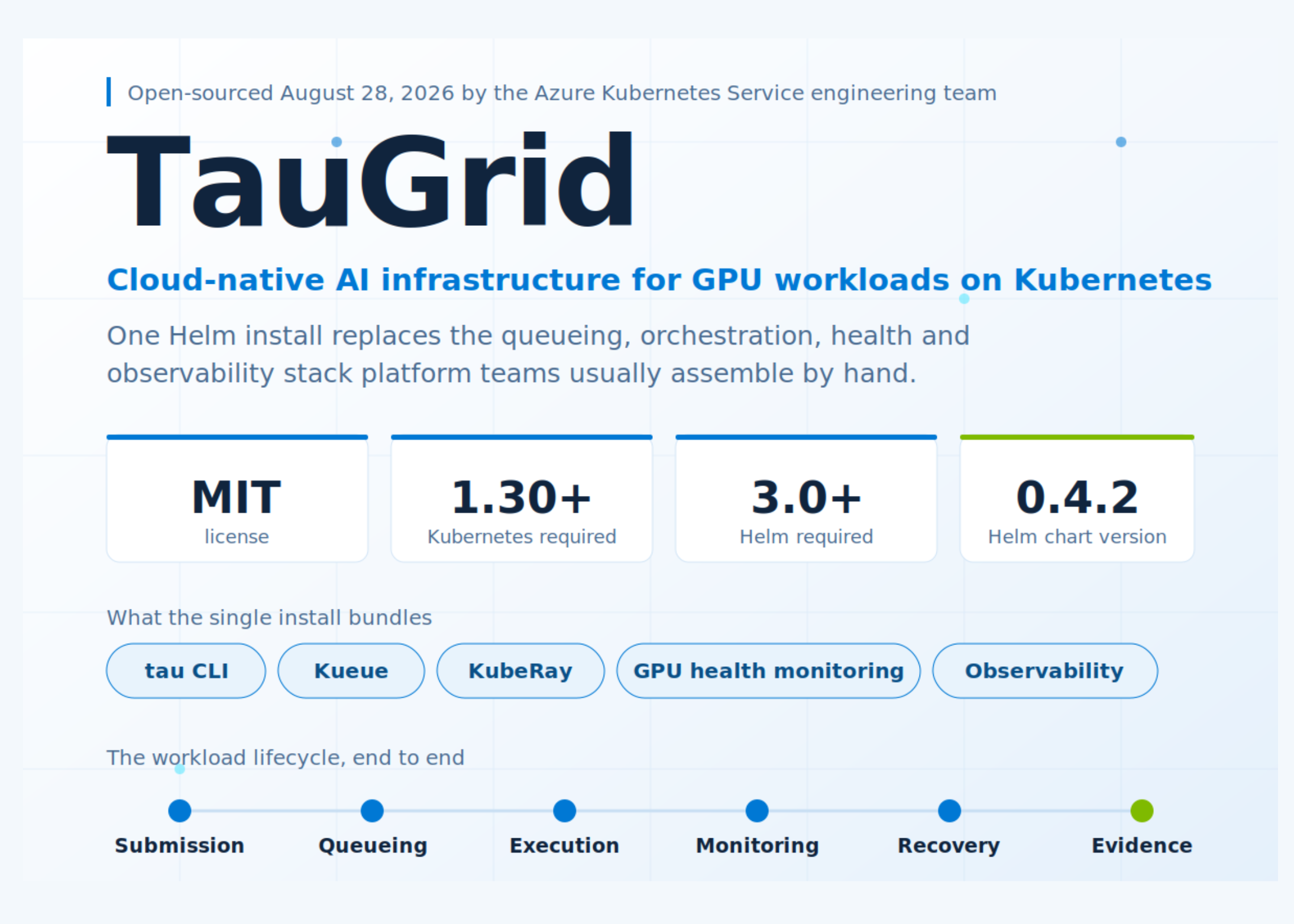
Microsoft Open-Sources TauGrid: A Kubernetes-Native Stack for GPU AI Workloads
The release of TauGrid as open-source allows broader access to a streamlined solution for managing GPU AI workloads on Kubernetes, which can enhance efficiency in AI deployment.
- Microsoft open-sourced TauGrid on August 28, 2026, under the MIT license.
- The tool integrates workload queueing, orchestration, and GPU monitoring through a single Helm install.
- TauGrid requires a Kubernetes 1.30+ cluster with GPU nodes, kubectl, and Helm 3.0 or later for deployment.
- No telemetry is sent to Microsoft by default, ensuring user privacy unless configured otherwise.
- Some integrations, particularly observability through Azure Data Explorer, remain Azure-specific for now.
TauGrid is a Kubernetes-native platform that simplifies the process of running AI workloads by integrating multiple components into one installation. Prior to its release, teams managing AI on Kubernetes faced complexities due to the need for manual integration of various tools. Future updates may expand its compatibility and features for non-Azure environments.
Read the original ↗
Salesforce Agentforce: Bridging the Enterprise AI Gap from ‘Vibe Coding’ to...
Salesforce Agentforce aims to enhance the reliability and efficiency of enterprise AI systems, addressing significant operational challenges that affect business continuity and customer satisfaction.
- Salesforce Agentforce builds an enterprise harness integrated with Salesforce Data Cloud, enabling stable performance and accountability in AI operations.
- The platform includes tools for automatic synthetic stress testing, real-time tuning, and omnichannel interaction capabilities to improve AI deployment.
- Southwest Airlines tested Agentforce, reporting a projected $6 million savings and a 45% autonomous resolution rate for customer inquiries.
Salesforce is a leading cloud-based software company known for its customer relationship management solutions. Agentforce aims to improve the deployment of AI agents in enterprise environments by addressing specialized challenges within AI operational workflows. Stakeholders will watch for its adoption impact and performance improvements across various sectors.
Read the original ↗
Best Open-Source Agent Harnesses for Local LLMs in 2026
Understanding the strengths and weaknesses of various open-source agent harnesses for local large language models (LLMs) can help developers choose the most suitable tools for their needs.
- The article ranks 11 open-source harnesses that support local inference for large language models, including OpenCode, Pi, Goose, and others.
- Key ranking criteria include license approval, documentation of local runtimes, maintenance status, and safety controls.
- Top options like OpenCode and Goose provide significant features related to context management and tool calling for local model setups.
Open-source agent harnesses are tools that manage and enhance local LLM functionality by executing commands and managing data. These harnesses are evolving as developers seek effective and efficient ways to utilize local LLMs for various tasks. This guide provides insights into the best harness options available as of 2026.
Read the original ↗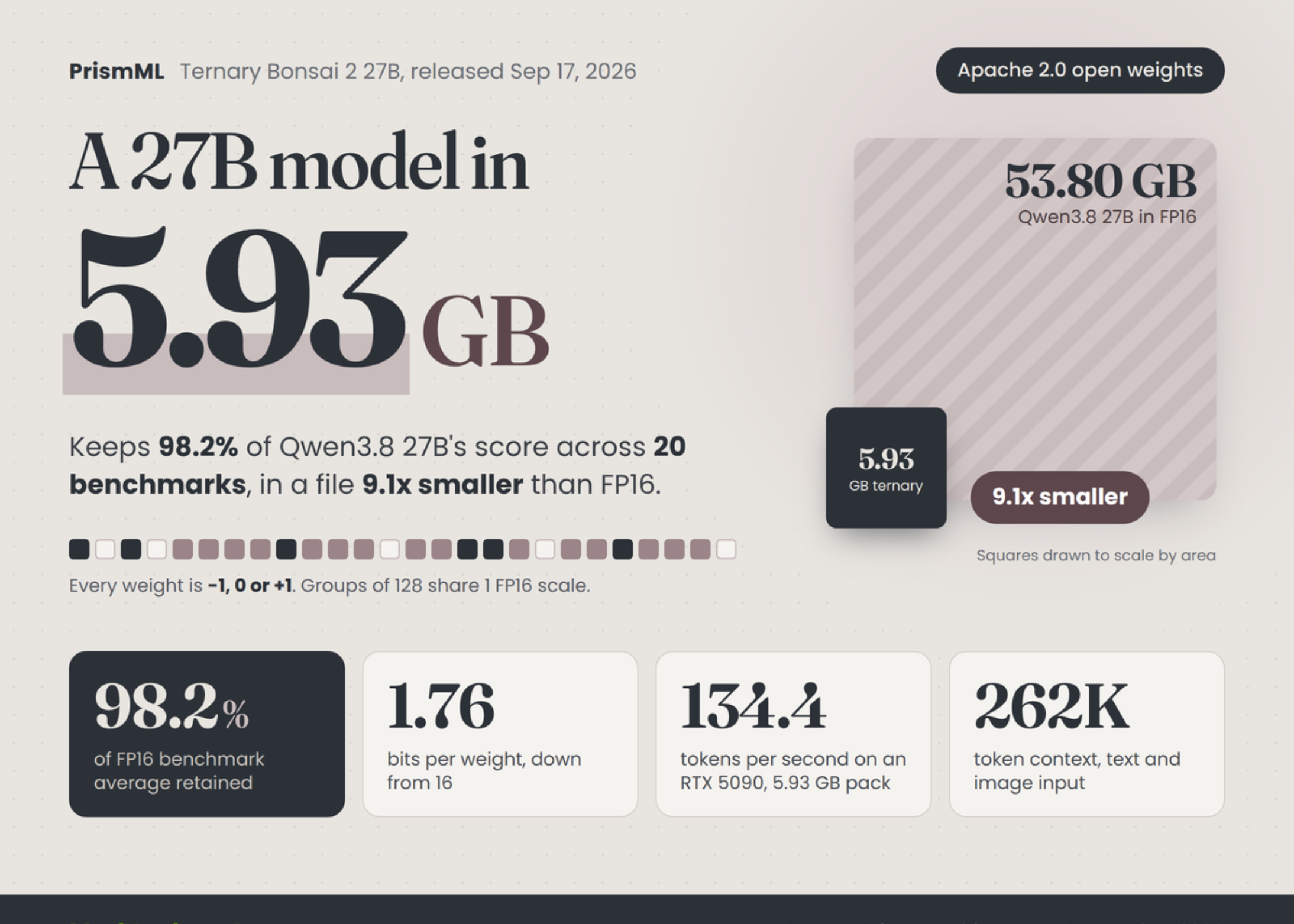
PrismML Releases Ternary Bonsai 2 27B: A 5.9 GB Apache 2.0...
The release of Ternary Bonsai 2 27B illustrates significant advancements in model efficiency and performance retention, crucial for developing more accessible AI applications.
- PrismML has released Ternary Bonsai 2 27B, a compressed version of the Qwen3.8 27B model, reducing its size to 5.93 GB from 53.80 GB.
- The new model retains 98.2% of its parent model's performance across 20 benchmarks, while supporting both text and image inputs with a context length of 262K tokens.
- The model can operate on a laptop or GPU with at least 16 GB of memory, and is available under the Apache 2.0 license.
- Ternary Bonsai 2 27B includes 27.36 billion parameters and utilizes a hybrid attention mechanism, combining linear and full-attention layers.
- PrismML's benchmarks report the model achieves up to 142.5 tokens per second on an RTX 5090.
PrismML specializes in AI and machine learning models, focusing on improving efficiency and performance through innovations like ternary weights, which use three values for parameters instead of the traditional two. Ternary Bonsai 2 27B builds on the earlier Bonsai 27B model, offering enhanced performance in a smaller package. Future developments to watch include further optimizations in model performance and energy efficiency.
Read the original ↗
Spanberger Signs Data Center Accountability Order, Creates AI Task Force
Virginia's new regulations on data centers and the establishment of an AI task force may set a precedent for accountability in technology and energy usage, impacting the state's infrastructure and environment.
- Virginia Governor Abigail Spanberger signed Executive Order 22 on September 18, 2026, aimed at increasing accountability for data centers.
- The order creates a framework with five main pillars covering community engagement, environmental protection, energy affordability, clean energy advancement, and workforce improvement.
- An AI Task Force was established to address workforce displacement, data privacy risks, and cybersecurity threats from AI agents.
- The framework prohibits nondisclosure agreements for data center projects, requires local approval for major developments, and sets new energy and environmental standards.
Virginia's Data Center Accountability Framework introduces extensive regulations for data centers, addressing their environmental impact and energy costs. This order follows previous initiatives by Governor Spanberger to impose an energy consumption tax on data centers and tighten regulations on their operations. Future developments will focus on integrating these policies into permanent law during the 2027 General Assembly session.
Read the original ↗
An Undercover Google Analyst Infiltrated a Notorious Supply-Chain Hacking Gang
This infiltration by Google highlights significant advancements in cybersecurity measures against sophisticated cybercriminal organizations, emphasizing the ongoing battle to secure digital ecosystems.
- TeamPCP, a hacker group, compromised open-source software to execute widespread supply-chain attacks, breaching over a thousand companies.
- Google's undercover analyst infiltrated TeamPCP, allowing real-time monitoring and disruption of the hackers' activities during their rampage.
- Two alleged leaders of TeamPCP were arrested in Australia last month after a collaborative investigation with the FBI.
TeamPCP is known for its extensive hacking spree targeting supply chains, which involve infiltrating software systems to distribute malware. Google’s threat intelligence division has been enhancing its methods to combat such cyber threats, including infiltration tactics. Watching the evolving dynamics of cybercriminal group interactions, such as TeamPCP's partnerships and betrayals, will be crucial moving forward.
Read the original ↗
Manus seeks $4B valuation in new $500M fundraise as it resumes independent ops
Manus's efforts to secure $500 million at a $4 billion valuation highlight ongoing shifts in the AI industry amid rising geopolitical tensions affecting mergers and talent movement.
- Manus is in discussions to raise $500 million at a $4 billion valuation as it resumes independent operations after breaking off a merger with Meta.
- Potential investors include IDG Capital, Boyu Capital, and existing backers such as Tencent and HSG.
- The company plans a restructuring for a potential initial public offering (IPO) in Hong Kong.
- Manus went viral last year with its AI agent demo and has relocated its staff to Singapore.
Manus is a Chinese AI startup that creates AI products and agents, similar to those from companies like OpenAI. It previously attempted a merger with Meta, which was blocked by regulatory concerns. The company is now focusing on its independent operations and plans to go public in Hong Kong.
Read the original ↗
Google’s new ‘CC’ is an AI agent that helps families run their households
The development of Google's AI agent CC demonstrates a shift towards utilizing AI for household management, potentially transforming how families organize their daily lives.
- Google introduced a new version of its AI agent CC, designed specifically to help families manage their households.
- CC can assist with tasks such as managing calendars, making shopping lists, and planning meals based on family members' schedules.
- The agent has its own Google account to collaborate with family members, who can share information selectively with CC.
Google's CC originally functioned as a productivity tool linked to its suite of services, like Gmail and Google Calendar. The shift towards household management reflects user demand for family organization support. Future developments may include broader accessibility and additional features to enhance family coordination.
Read the original ↗